Repair First or Document First After Property Damage? A Decision Framework for UAE Asset Managers
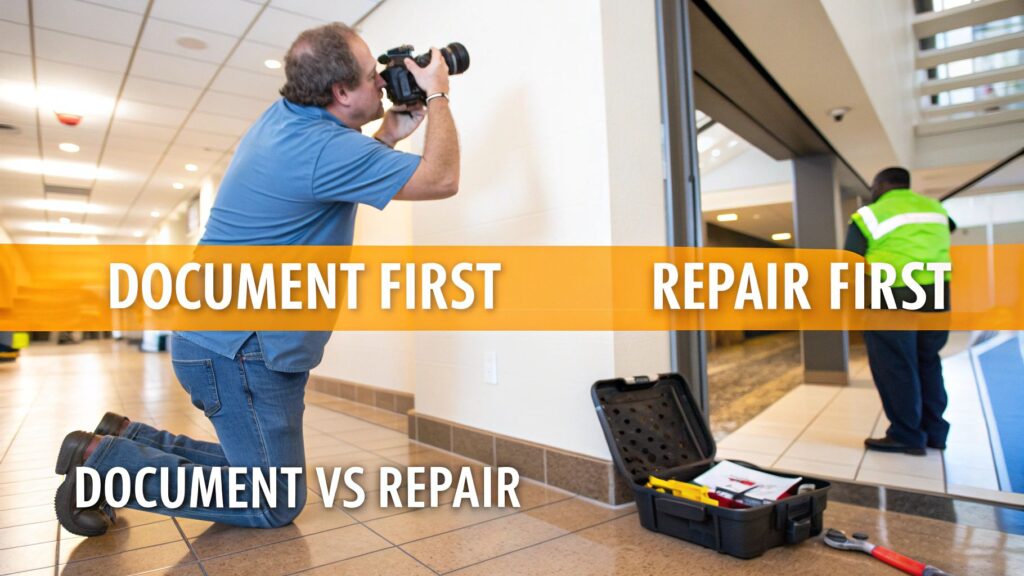
When property damage occurs, UAE facility managers, asset owners, and hospitality engineering leaders face a critical decision point: do we initiate immediate repairs, or do we secure comprehensive documentation first? For any incident that does not pose a direct threat to life or safety, the protocol is unambiguous: document first, then mitigate. Rushing into repairs without a verifiable, time-stamped record of the initial damage is the most common reason for insurance claim disputes and rejections in the UAE's compliance-driven commercial environment. The Critical First 60 Minutes: A Protocol for Asset Protection How your team responds within the first hour of discovering damage dictates the financial outcome for the asset. The natural impulse is to rectify the issue immediately. However, premature repairs can permanently destroy the evidence required by insurers to validate a claim. In the UAE, an absence of proof is often interpreted as an absence of grounds for a claim, potentially leaving your organisation with 100% of the liability. This initial phase is not about permanent fixes. It is about a disciplined, sequential response framework. Ensure Safety: Address immediate life-safety risks. This includes isolating water mains, de-energising electrical circuits, or evacuating the area. Personnel safety is the overriding priority. Document the Scene: Utilise mobile devices to capture detailed, time-stamped photographs and videos of the damage before any clean-up or repair work commences. Mitigate Further Damage: Only after evidence is secured, implement temporary measures to prevent escalation. This may involve deploying tarps over a leaking roof or relocating sensitive equipment from a flooded area. This "document, then mitigate" sequence separates a managed claims process from a financial liability. It establishes the clean, auditable trail that regional insurers and loss adjusters mandate. Financial Impact Analysis: Proceeding with repairs before documentation can result in claim denials of up to 100%. Insurers operate on verifiable evidence. Without a clear "before" state, they can argue the damage was pre-existing or less severe than claimed. Your initial documentation is your primary negotiating asset. The following framework provides decision-making clarity for on-site teams in the crucial first 15 minutes, prioritising actions based on damage type and associated risks. Immediate Action Protocol: A Risk-Based Framework Damage Scenario Immediate Priority (First 15 Mins) Justification (Primary Risk Factor) Indicative Response Time SLA (Industry Benchmark) Major Water Leak/Burst Pipe 1. Isolate water main. 2. Document source & spread. High risk of rapid structural saturation, mold growth (critical in UAE climate), and electrical hazards. < 1 Hour Fire Incident (Post-Extinguishing) 1. Secure the area. 2. Document all untouched areas. High risk of evidence contamination. Soot, smoke, and water damage from suppression are crucial to capture for the claim. < 2 Hours Structural Damage (e.g., impact) 1. Evacuate & restrict access. 2. Document from a safe distance. Extreme safety risk. Immediate danger of progressive collapse or further structural failure. Immediate HVAC Failure (e.g., chiller leak) 1. Isolate power. 2. Document leak source & affected equipment. Risk of electrical faults, costly equipment damage, and significant business interruption (downtime). < 4 Hours Vandalism/Break-in 1. Do not touch anything. 2. Document the entire scene. Critical for both police reports and insurance claims. Scene preservation is paramount for liability assessment. < 2 Hours This table serves as a training tool to standardise your team's response, shifting their mindset from reactive panic to a structured protocol that protects your organisation's financial interests. Understanding the critical difference between a simple damage report and an insurance-ready claim file is foundational. It transforms a chaotic event into a managed process, ensuring a clear path from incident to resolution without incurring preventable financial loss. Why Insurers Mandate Documentation Before Repairs From an insurer's perspective, undertaking permanent repairs before a formal assessment is akin to destroying evidence. Loss adjusters are tasked with verifying the cause, scope, and liability associated with the damage, and this requires an unaltered scene. Without clear, time-stamped proof, it is difficult to distinguish a new incident from pre-existing wear and tear or poor maintenance—common exclusions in many commercial property policies. A well-intentioned but premature repair can be misinterpreted as an attempt to obscure the true nature of the incident, immediately raising red flags. Preserving the Chain of Evidence The damaged area constitutes critical evidence. Your photographic and written records create an unbroken "chain of custody" that validates what happened, where, and when. This documentation is the primary tool for successful claim settlement. The entire claims process is predicated on this initial evidence. It provides the loss adjuster with the necessary data to: Establish Causation: Was the damage from a sudden and unforeseen event (typically covered), or a slow leak resulting from deferred maintenance (often excluded)? Validate Scope of Work: Does the evidence support a full replacement of an asset, or merely a localised repair? Assess Third-Party Liability: Could a contractor, neighbouring tenant, or other third party be responsible for the loss? Insurers operate on verifiable data. Missing documentation creates ambiguity, and in the context of insurance, ambiguity leads to delays, disputes, or claim denials. Lessons from Recent UAE Weather Events The importance of the "document first" protocol was starkly highlighted during major weather events in the UAE. Following the unprecedented rainfall in April 2024, which generated estimated insured losses approaching US$850 million, many asset managers who initiated immediate clean-up and repairs without comprehensive documentation faced claim rejections. Insurers had no verifiable way to link the claimed damage directly to the insurable event. Data from the aftermath showed that properties with immediate, systematic digital documentation systems in place recovered their financial losses up to 40% more efficiently than those relying on manual processes. This event provided a clear lesson: in the UAE's commercial property market, documentation must precede action. Guidance for Procurement Teams: This risk mitigation strategy can be embedded directly into your service contracts. Mandate specific photo-documentation standards and response protocols within your Annual Maintenance Contracts (AMCs). This makes your service provider contractually obligated to preserve evidence before commencing work, shielding your organisation from the financial impact of a denied claim. To facilitate claim approval, it is