Evaluating Facility Management Companies in Dubai: An Operational Framework
Selecting a facility management (FM) company in Dubai is a critical operational and financial decision. It requires a structured, engineering-led evaluation of a provider's capability to manage technical risk, ensure compliance, and preserve asset value within the UAE's demanding climate. This guide provides a technical framework for asset owners, property managers, and procurement teams to move beyond marketing claims and focus on operational performance. The objective is to equip decision-makers with a defensible methodology for evaluating service models, contract structures, and technical competencies. The framework will analyze the trade-offs between integrated versus specialist providers, the impact of contract types on operational expenditure (OPEX), and the role of Service Level Agreements (SLAs) in mitigating asset risk. An Engineering Framework for FM Provider Selection This guide is not a ranking but a technical framework for evaluating FM providers in Dubai. It moves past promotional language to focus on the operational and financial impact of procurement decisions. The goal is to provide a structured, defensible methodology based on quantifiable metrics. This analysis will break down the trade-offs between service delivery models, examine how contract structures affect OPEX, and define how to use Service Level Agreements (SLAs) to protect assets. Core Evaluation Principles The evaluation process is built on three pillars: technical capability, compliance assurance, and operational resilience. The focus is on verifiable performance indicators rather than marketing assertions. Key areas of analysis include: Service Delivery Models: An examination of the structural differences between an Integrated Facility Management (IFM) provider and a multi-specialist contractor model. This decision directly impacts accountability, communication protocols, and risk concentration. Contractual Impact: Analysis of how comprehensive versus labour-only contracts allocate risk and influence OPEX predictability. For a deeper review of maintenance agreements, our guide on MEP contractors in Dubai provides additional context. Technical Competence: Assessment of a provider's ability to manage assets under the unique environmental stresses of the UAE, including high heat loads on HVAC systems, significant dust loading, and specific material degradation patterns. Compliance and Governance: Verification of adherence to regulations stipulated by Dubai Municipality and Civil Defence, which is a critical component of risk management. A common failure in FM procurement is selecting a provider based on the lowest price alone. This approach frequently leads to deferred preventive maintenance, accelerated asset degradation, and higher lifecycle costs. An effective evaluation prioritizes technical competence and robust processes over initial cost. By applying this engineering-based logic, decision-makers can make a more strategic and informed selection that protects the long-term value of the asset. Comparing FM Service Models and Operational Differences Choosing an FM partner in Dubai requires a fundamental decision on the operational model: a single Integrated Facility Management (IFM) provider or multiple specialist contractors. This is a strategic decision that defines risk management, communication flows, and ultimate accountability. The Integrated Facility Management (IFM) Model The IFM model consolidates all facility services—from MEP and HVAC to cleaning and security—under a single contract with one point of contact. This model is frequently adopted for large, complex assets such as commercial towers, mixed-use developments, or large residential communities. The primary advantage is streamlined administration. It simplifies work orders, reporting, and financial management. A critical chiller failure and a simultaneous plumbing leak require only one communication channel for resolution. However, the model's effectiveness depends entirely on the provider's in-house technical depth across all disciplines. Service gaps can emerge if the IFM partner has capability imbalances, such as a strong HVAC team but a weak civil works division. Key operational characteristics of IFM include: Centralised Command: A single management structure oversees all services, theoretically improving coordination. Potential Cost Synergies: Bundling services may offer volume-based pricing, though this depends on negotiation and scope. Standardised Processes: Effective IFM providers use a single Computerised Maintenance Management System (CMMS) for all services, providing consistent performance data. The primary risk is dependency. If an IFM provider underperforms in a critical area, decoupling that single service from the master contract can be operationally complex and disruptive. The Multi-Contractor Specialist Model The multi-contractor model involves procuring separate, specialized companies for distinct functions. An asset owner might engage a dedicated HVAC contractor, a separate firm for fire safety compliance, and another for soft services. This approach is often favored for facilities with highly critical or specialized assets, such as data centers or industrial plants. The key advantage is access to deep, domain-specific expertise. A specialist fire safety contractor possesses a level of regulatory knowledge that a generalist IFM technician may not. This model procures focused technical competence. This approach has distinct operational implications: Increased Administrative Load: The in-house facility management team acts as the central coordinator, managing multiple contracts, vendors, and inter-contractor disputes. Defined Expertise: This model mitigates the risk of a single point of failure. Underperformance by one contractor does not impact the delivery of other critical services. Potential for Scope Gaps: Ambiguity can arise at the interface between contractors. For example, determining responsibility for wall damage from an AC leak—the HVAC contractor or the civil works contractor—can cause rectification delays. The decision represents a trade-off. The IFM model offers administrative simplicity at the potential cost of specialized depth. The specialist model provides technical excellence but requires higher management overhead from the client's team. The optimal choice depends on asset complexity and the internal team's vendor management capacity. A practical decision framework is to assess asset criticality. If 80% of operational risk is concentrated in HVAC and electrical systems, securing top-tier specialists for those functions may be the prudent choice, despite the administrative burden. For a standard residential building with less complex systems, the streamlined nature of an IFM model often provides a more efficient operational solution. How Contract Structures Impact Your Financials and Risk The FM contract structure is the blueprint for operational expenditure (OPEX), risk exposure, and provider motivation. An incorrectly structured agreement can lead to budget overruns and accelerated asset degradation. The contract allocates financial and operational risk between the client and the provider. A low upfront cost may conceal significant downstream liabilities for parts and
Apartment AMC in Dubai: What Tenants & Owners Should Expect (Checklist + Pricing)
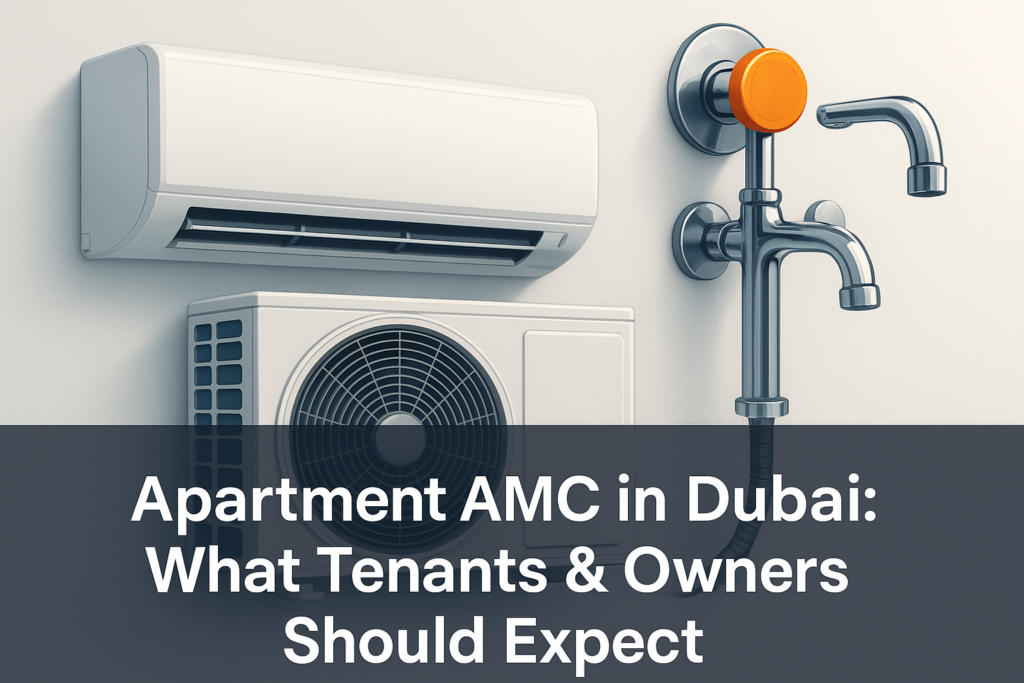
Dubai is a city of dreams, but keeping your home in top shape can be a challenge. The hot climate means your air conditioning works overtime. Plumbing and electrical systems also need regular care. This is where an Apartment Annual Maintenance Contract (AMC) in Dubai becomes incredibly useful. An AMC is like a yearly health check-up for your home. It’s a service agreement with a company to handle routine maintenance and repairs. This guide will help both apartment owners and tenants understand what to expect from an AMC in Dubai. We will cover costs, typical inclusions, and how to choose the best provider. What is an Apartment AMC in Dubai? An Apartment Annual Maintenance Contract (AMC) in Dubai is a service agreement. You pay a set fee each year to a maintenance company. In return, they provide scheduled maintenance and emergency repairs for your apartment’s systems. This typically includes AC, plumbing, and electrical work. Think of it as peace of mind. Instead of finding a technician every time something breaks, your AMC provider is just a call away. It helps you budget for maintenance costs and keeps your home comfortable. This is different from service charges, which cover common building areas like lifts, gyms, and lobbies. An AMC focuses on your specific apartment unit. Dubai-Specific Considerations for Your Apartment Dubai’s unique environment directly impacts your maintenance needs. The extreme heat means your AC system is critical and needs constant care. Regular AC servicing is not just about comfort; it prevents breakdowns and keeps energy bills in check. The Real Estate Regulatory Agency (RERA) sets clear guidelines for landlord and tenant responsibilities. Understanding these rules is crucial when you sign a tenancy or an AMC contract. Different residential communities in Dubai also have varied regulations for external maintenance. Always check your community’s specific guidelines. What’s Typically Covered in Dubai Apartment AMCs When you get an Apartment AMC in Dubai, certain services are usually part of the package. These standard inclusions ensure your home runs smoothly. It is wise to review the specific terms of your contract carefully. Standard Inclusions AC Servicing: This is vital in Dubai. It includes cleaning filters, checking refrigerant gas levels, and inspecting the overall unit. Regular AC maintenance prevents breakdowns and improves efficiency. Many contracts offer 2-4 services per year. Plumbing Maintenance: This covers common issues like leaky faucets, clogged drains, and running toilets. It also includes checks on water heaters and pumps. Technicians will fix minor leaks and ensure proper water flow. Electrical Systems: Expect checks on light fittings, switches, sockets, and distribution boards. This also covers minor wiring repairs and troubleshooting electrical trips. It ensures all your electrical appliances are safely powered. General Repairs: Many AMCs include basic handyman services. This might mean fixing a loose door hinge, minor carpentry, or re-attaching curtain rails. These are small fixes that make a big difference in daily living. Common Exclusions to Watch Out For While AMCs offer extensive coverage, some items are usually excluded. Be aware of these to avoid surprises later. Major replacements like a completely new AC unit or water heater are typically not part of a standard AMC. These often incur separate charges. Cosmetic repairs, such as painting, wallpaper touch-ups, or tiling work, are usually excluded. Damage caused by the tenant, like accidental breakage or misuse of appliances, also falls outside AMC coverage. Structural issues, like cracks in walls or roof leaks, are usually the building management’s responsibility, not your apartment’s AMC provider. Tenant vs. Owner Responsibilities in Apartment Maintenance Understanding who pays for what is crucial in Dubai. RERA guidelines offer clarity on this. Generally, landlords are responsible for major structural repairs and ensuring the property is habitable. This includes big fixes to the AC system or plumbing infrastructure. Tenants, on the other hand, are typically responsible for minor repairs and daily upkeep. This includes things like replacing light bulbs or fixing small issues caused by their usage. An AMC can bridge this gap by offering a clear framework. Sometimes the landlord includes an AMC as part of the rental agreement. Other times, a tenant might choose to get one for their own peace of mind, especially for minor repairs not covered by the landlord. 2025 Pricing Guide for an Apartment AMC in Dubai The cost of an Apartment AMC in Dubai can vary widely. It depends on several factors, including the size of your apartment and the level of service you choose. Here’s an estimated breakdown for 2025. Average AMC Costs by Apartment Size Studio/1-Bedroom Apartment: Expect to pay between AED 3,000 to AED 8,000 per year. These prices reflect basic to comprehensive coverage. 2-Bedroom Apartment: For a larger unit, costs typically range from AED 8,000 to AED 13,000 annually. 3-Bedroom+ Apartment: For bigger homes, an AMC can cost AED 13,000 to AED 20,000 or even more per year. These figures are estimates. The actual price can go up or down based on the apartment’s age, specific systems installed, and the chosen provider. A basic package might cover only emergency call-outs. A premium package could include more frequent preventive checks and even minor spare parts. When an AMC Makes Financial Sense Many wonder if an AMC is worth the cost. Consider the alternative: paying for every repair as it happens. Unexpected breakdowns, especially for AC in peak summer, can be very expensive. An AMC offers cost predictability. It also includes preventive maintenance, which can avoid costly repairs down the line. For busy individuals or property owners who want hassle-free management, an AMC often provides significant value and peace of mind. Choosing the Right Apartment AMC Provider in Dubai Selecting a reliable maintenance partner is key. You want a company that is responsive, professional, and offers good value. Look for providers with strong local experience and a reputation for quality. Our Top Recommendation: SnapFixNow When it comes to dependable and comprehensive apartment maintenance in Dubai, SnapFixNow stands out as a leading choice. They offer a wide range of AMC packages tailored for