Civil Maintenance Services Dubai Commercial Property
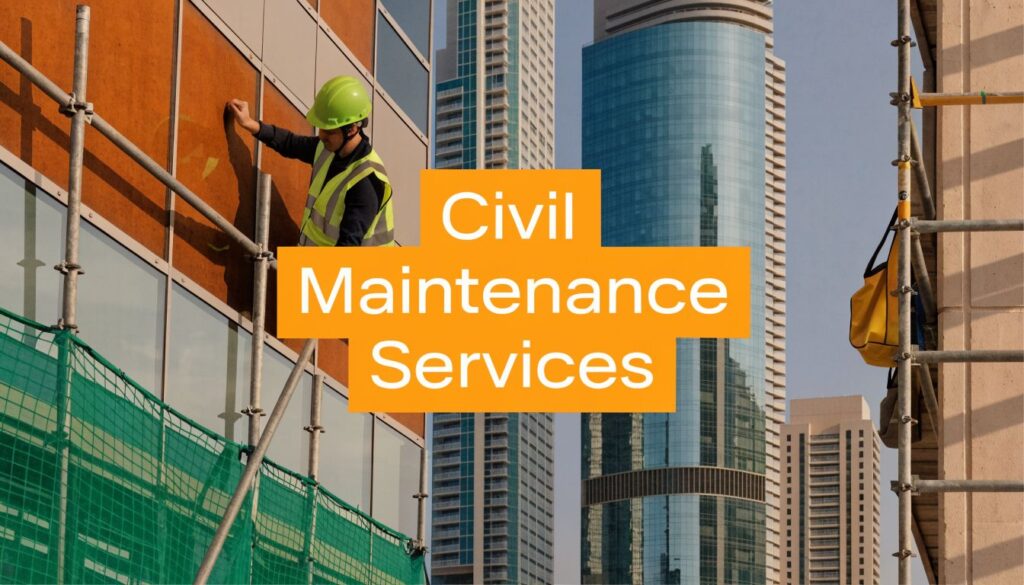
If you manage a commercial building in Dubai, you’re probably dealing with the same pattern repeatedly. A crack appears in a corridor wall, tiles start lifting near a wet area, waterproofing fails after being ignored too long, and the repair request arrives only after tenants complain. By then, the issue is no longer a minor civil defect. It has become an operational, budget, and compliance problem. That’s why civil maintenance services dubai commercial property decisions shouldn’t sit in the same category as ad hoc handyman work. In 2024, Dubai’s commercial property market recorded 9,038 transactions, a 24% year-on-year increase, with transaction values reaching AED 90.1 billion, according to CRC Property’s Dubai commercial market review. More assets, more occupancy pressure, and more refurbishment activity mean more wear on building envelopes, finishes, access areas, and structural elements. For facility managers, procurement teams, and asset owners, civil maintenance is part of lifecycle control. It affects tenant disruption, safety exposure, OPEX stability, and when CAPEX gets forced forward. The practical question isn’t whether defects will appear. It’s whether your contract model identifies and rectifies them early, documents them properly, and allocates risk in a way that protects the asset. Table of Contents Introduction The Critical Role of Civil Maintenance in Dubai's Commercial Sector Defining the Scope of Civil Maintenance Services Structural fabric and concrete repair Finishes waterproofing and external works Contract Models A Comparison of AMC vs Reactive Maintenance How the two models behave in practice Operational comparison matrix Navigating Dubai's Regulatory and Compliance Landscape Why Dubai climate turns minor defects into compliance issues What contract documentation should prove Key Cost Drivers for Civil Maintenance Services in Dubai Where quotations diverge Where cutting cost usually creates future liability Implementation The Role of Digital Platforms in Quality Assurance Why photo based verification changes contract control Minimum digital workflow for Dubai commercial assets A Framework for Selecting a Civil Maintenance Vendor Technical and commercial screening criteria Questions procurement should ask before award Conclusion Structuring for Long-Term Asset Value Frequently Asked Questions (FAQ) Introduction The Critical Role of Civil Maintenance in Dubai's Commercial Sector Dubai’s commercial expansion has changed the maintenance brief. When transaction activity rises this quickly, existing buildings don’t just compete on location or leasing terms. They compete on reliability, presentation, compliance history, and how well the owner controls deterioration. Civil maintenance covers the physical shell and finishes that people see first and damage first. That includes cracks, spalling, tiling failures, waterproofing defects, plaster breakdown, joint deterioration, kerbstone displacement, and similar issues that begin as visible defects but often point to moisture ingress, movement, abrasion, or deferred repair. For a commercial property, the risk isn’t limited to repair cost. A failed podium waterproofing system can affect occupied space below. Loose external paving can become a safety incident. Repeated patch repairs without root-cause diagnosis can hide a larger building envelope problem that keeps returning as rework. Practical rule: Treat civil maintenance as an asset-preservation function. If it only starts when tenants report visible damage, you’re already paying the reactive premium. The better operating model links inspection, defect classification, method statements, response SLAs, and completion records into one maintenance framework. In practice, that framework usually sits alongside broader MEP services in Dubai because envelope defects, water ingress, and internal environmental conditions often interact. Defining the Scope of Civil Maintenance Services Civil maintenance is often specified too loosely in tenders. That creates disputes later. One party assumes structural crack treatment is included. The other assumes only superficial making-good is covered. The result is delayed approvals, variation claims, and unresolved defects. Structural fabric and concrete repair The first category is structural fabric. This includes crack monitoring, crack injection where appropriate, concrete patch repair, spalling rectification, and treatment of corroded reinforcement where the defect has progressed beyond cosmetic repair. In Dubai, the distinction between a surface crack and a durability issue matters. Heat, humidity, and exposure conditions can convert a neglected defect into concrete deterioration that needs access equipment, substrate preparation, repair mortar, and reinstatement of finishes. Labour-only patching usually doesn’t solve that. A useful procurement test is simple. Ask whether the contractor’s scope includes defect investigation, substrate preparation, repair methodology, and post-repair documentation, or only visible patching. Finishes waterproofing and external works The second category is masonry and finishes. That covers plaster repairs, blockwork rectification, partition reinstatement, skimming, painting interfaces, tile replacement, grout renewal, and façade-adjacent surface repairs. Tile and masonry maintenance in Dubai’s high-traffic commercial spaces requires precise specifications because alkaline groundwater and abrasion accelerate failure. Failure rates can reach 15-20% in porcelain tiles within 3-5 years without proper intervention, including the use of S1 flexible adhesives and epoxy grouts to prevent moisture wicking, according to Pioneer-Gulf’s regional technical guidance. The third category is waterproofing. Roofs, planter boxes, basements, wet areas, service yards, and podium slabs all fall into this area. Waterproofing failure is expensive because the visible damage often appears far from the entry point. If the contract only pays for internal making-good and excludes leak tracing, you haven’t transferred much risk at all. The fourth category is external works. Interlock resetting, kerbstone alignment, ramps, boundary walls, access paths, and hardscape repairs often sit outside the headline civil scope even though they create recurring liability in commercial assets. For teams writing service scopes, a useful benchmark is to map civil maintenance under four headings: Structural repairs: Crack treatment, concrete repair, spalling, and load-related defects. Internal finishes: Tiles, plaster, paint interfaces, blockwork, and partition repairs. Waterproofing systems: Wet areas, roofs, basements, joints, and leak rectification. External hardscape: Interlock, kerbs, steps, ramps, boundary walls, and surface reinstatement. Security and maintenance planning often intersect in access routes, perimeter conditions, and service yards. For readers reviewing broader site upkeep controls, Wisenet Security's expert maintenance provides a useful example of how maintenance thinking can support operational reliability outside the core civil scope. Contract Models A Comparison of AMC vs Reactive Maintenance Contract structure determines whether defects are found early or merely processed after failure. That’s the main commercial difference between a