A Technical Guide: How Much Does It Cost to Maintain a Villa in Dubai?
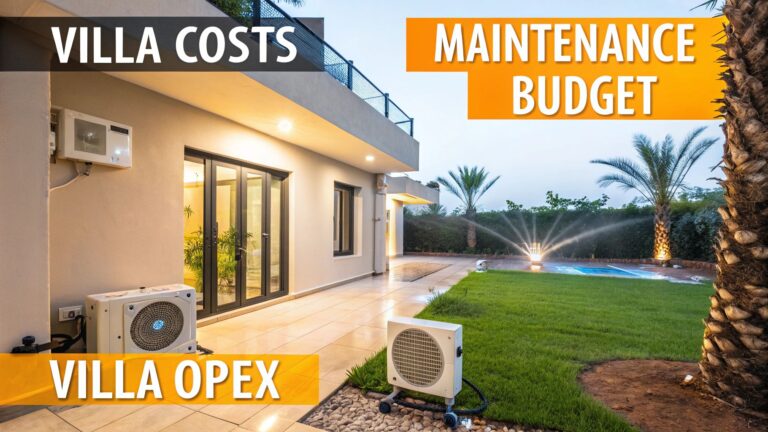
For asset owners and facility managers, the operational expenditure (OPEX) for maintaining a villa in Dubai typically ranges between 1% and 2% of the property's total value annually. This benchmark is a critical input for financial forecasting, lifecycle asset management, and ensuring sustained portfolio value. This guide provides a technical breakdown of these costs, comparing maintenance models and offering a decision framework for optimising OPEX without compromising asset integrity or regulatory compliance. A Practical Breakdown of Villa Maintenance Costs To accurately forecast the cost of maintaining a villa in Dubai, one must analyse the constituent parts of the total OPEX, which includes planned preventive maintenance, reactive rectification works, utilities, and mandatory community fees. Effective budgeting requires a granular understanding of each cost driver. For property and facility managers overseeing a portfolio, financial clarity is a primary operational requirement. The table below provides an estimated annual cost breakdown for a standard 3-5 bedroom villa, serving as a high-level framework for OPEX forecasting. Estimated Annual Maintenance OPEX for a Standard Dubai Villa This table provides a typical cost breakdown for maintaining a standard 3-5 bedroom villa, helping asset owners and facility managers forecast operational expenditures. Service Category Average Annual Cost Range (AED) Key Operational Drivers Annual Maintenance Contracts (AMC) 1,500 – 15,000 Scope of work (labour-only vs comprehensive), asset criticality, SLA response times. Utilities (DEWA) 40,000 – 70,000 HVAC efficiency, irrigation system controls, occupancy patterns, DEWA tariff structure. Landscaping & Pool Maintenance 12,000 – 30,000 Garden size, irrigation automation, plant types, pool size and equipment condition. Specialised Services & Cleaning 5,000 – 20,000 Pest control frequency, facade cleaning, water tank cleaning, deep cleaning schedules. Mandatory Community Service Charges 15,000 – 35,000 Community tier, common area amenities, DLD Service Charge Index, developer policies. This data illustrates that while an AMC is a visible cost, it often represents a smaller fraction of the total financial commitment required for compliant and effective property operation. As the infographic indicates, the maintenance contract is a component of a much larger operational budget required to manage the asset effectively. Industry data confirms this. For a standard three-bedroom villa valued between AED 3-5 million, the total annual maintenance expenditure typically falls between AED 70,000 and AED 100,000. This aligns with the 2% OPEX benchmark. This figure is distributed across key cost centres that every facility manager must plan for. For instance, a basic Annual Maintenance Contract (AMC) may range from AED 1,500 to AED 6,000 annually, often covering emergency call-outs and baseline system checks with limited scope. An ultimate seasonal home maintenance checklist can serve as a useful tool for mapping out the full spectrum of required tasks throughout a calendar year. Decoding Core Hard FM Costs Like HVAC and MEP While soft services contribute to the asset's aesthetic and habitability, it is the 'hard' facilities management (FM) services that constitute the operational core and present the most significant financial variable in the maintenance budget. These are the critical HVAC (Heating, Ventilation, and Air Conditioning) and MEP (Mechanical, Electrical, and Plumbing) systems. Mismanagement of these assets leads to escalated OPEX and premature asset failure. In Dubai, the primary catalyst for accelerated degradation is the climate. The combination of sustained high temperatures, high humidity cycles, and significant airborne dust loading places extreme stress on mechanical and electrical systems. This environment accelerates component wear, reduces operational efficiency, and shortens the asset lifecycle unless mitigated by a structured preventive maintenance plan. HVAC Systems: The Dominant Cost Centre Within any Dubai villa's hard FM budget, the HVAC system is the dominant cost centre, primarily through its impact on electricity consumption. Operating almost continuously for 8-9 months of the year, it is the logical focus for both cost control and operational risk management. A reactive "fix-on-fail" methodology is an operationally unsound and financially punitive approach. An emergency call-out for a critical AC failure during peak summer months incurs premium labour charges, introduces the risk of secondary asset damage, and guarantees significant occupant discomfort. Proactive maintenance is the only logical risk mitigation strategy. Industry practice often shows that the cost of an emergency HVAC compressor replacement can be 5 to 10 times higher than the annual cost of a preventive maintenance plan designed to identify and rectify precursor faults. A robust HVAC maintenance plan is based on several key preventive activities, each with direct cost implications: Quarterly Filter Cleaning/Replacement: Essential for maintaining required airflow and indoor air quality. Obstructed filters increase system load and can elevate energy consumption by 5-15%. Bi-Annual Coil and Condenser Cleaning: Dust and biofilm accumulation on coils acts as an insulator, severely impairing the system's heat exchange efficiency. Annual System Health Check: A comprehensive technical inspection covering refrigerant levels, electrical connections, and thermostat calibration to ensure operational parameters are within design specifications. For a typical villa, a dedicated annual maintenance plan for the HVAC system will generally fall between AED 2,000 and AED 5,000, contingent on the number and type of units. This is not an expense but a strategic investment in OPEX control and asset lifecycle extension. Analysing MEP and Utility Expenditures Beyond HVAC, the remaining MEP systems and associated utility consumption represent a significant and often underestimated financial commitment. A detailed understanding of DEWA's tariff structure is essential for effective cost management. These costs are substantial. Annual utility bills can easily reach AED 20,000-30,000, with specialised electrical or plumbing rectification works adding thousands more. DEWA’s slab tariff structure is the primary driver. For residential consumers, the electricity rate begins at AED 0.23/kWh for the first 2,000 kWh but increases to AED 0.38/kWh above 6,000 kWh (plus a fuel surcharge). This tiered system means operational inefficiency incurs costs at an accelerated rate. A comprehensive maintenance strategy targets key points of failure before they escalate into high-cost emergencies: Plumbing: Regular inspections of water pumps, booster sets, and tanks are vital to prevent costly leaks and catastrophic failures in water pressure. Electrical: An annual inspection of distribution boards (DBs), circuit breakers, and wiring is a fundamental safety and compliance requirement. Utilities:
February 12, 2026