SnapFixNow

Latest News and Updates on Emergency Preparedness

Stay updated with latest emergency preparedness news, tips, and strategies for safety and readiness.
Snapfix Blog Cover
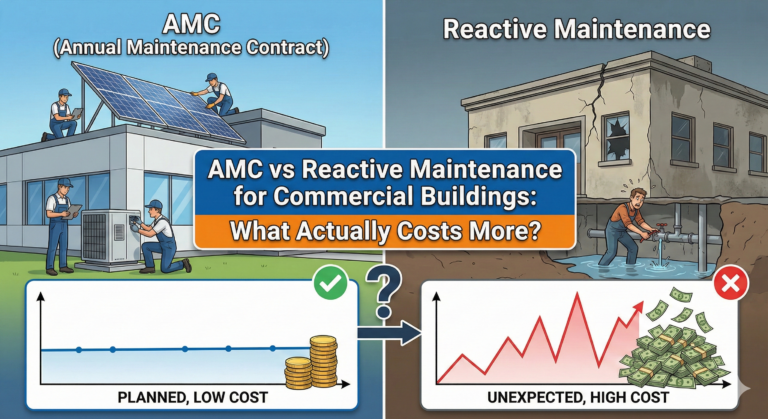
AMC vs Reactive Maintenance for Commercial Buildings: What Actually Costs More?

AMC vs Reactive Maintenance for Commercial Buildings: What Actually Costs More?

Commercial building owners and facility managers are often faced with a recurring decision: whether to operate under an Annual Maintenance Contract (AMC) or rely on reactive, call-out-based maintenance. While reactive maintenance may appear cost-effective in the short term, it often results in higher long-term operational costs, increased downtime, and greater risk exposure. Understanding the practical differences between AMC and reactive maintenance is essential for informed asset management decisions. 1. What Is Reactive Maintenance? Reactive maintenance refers to repairs carried out only after a failure or breakdown occurs. Service providers are engaged on an ad-hoc basis, typically during emergencies or visible equipment failures. While this approach may reduce immediate contractual commitments, it often leads to unpredictable expenses, delayed response times, and unplanned operational disruptions. 2. What Is an Annual Maintenance Contract (AMC)? An AMC is a structured agreement covering planned preventive maintenance, routine inspections, and defined response protocols for building systems. For commercial buildings, AMCs typically include HVAC, electrical, plumbing, civil, and general MEP systems, with scheduled visits and SLA-backed response times. 3. Cost Visibility vs Cost Illusion Reactive maintenance creates a cost illusion: expenses appear lower when no failures occur, but spike sharply during breakdowns. AMC-based maintenance provides predictable operating expenditure (OPEX), allowing better budgeting and financial planning. 4. Impact on Asset Life and Performance Lack of preventive maintenance accelerates wear and tear on critical assets such as HVAC equipment, pumps, electrical panels, and control systems. AMCs emphasize early fault detection, calibration, and servicing, which helps extend asset life and maintain system efficiency. 5. Downtime, Risk, and Business Continuity Reactive maintenance often results in longer downtime due to delayed fault identification, spare procurement, and contractor mobilization. In contrast, AMC arrangements prioritize response, reduce escalation time, and support business continuity, especially in commercial environments. 6. Compliance and Insurance Implications Many insurance policies and regulatory frameworks expect reasonable maintenance practices. Poor maintenance records under reactive models may complicate insurance claims or compliance audits. AMC documentation provides maintenance logs, inspection records, and compliance evidence. 7. When Reactive Maintenance Makes Sense Reactive maintenance may be suitable for non-critical assets, temporary facilities, or low-usage systems. However, relying solely on reactive maintenance for core building systems significantly increases operational and financial risk. Engineering-led facility management companies such as SnapFixNow™ FMC design AMC frameworks that balance preventive care, responsive support, and cost control. This structured approach helps commercial building owners reduce downtime, manage OPEX predictably, and protect long-term asset value. More information on structured AMC services is available at: Final Thought The true cost difference between AMC and reactive maintenance becomes evident over time. For commercial buildings with mission-critical systems, structured AMC arrangements generally deliver better financial control, reliability, and risk management.

January 25, 2026
A Guide on How to Prepare a Successful Property Damage Insurance Claim in Dubai

A Guide on How to Prepare a Successful Property Damage Insurance Claim in Dubai

Filing a successful property damage claim in Dubai is not about luck; it is a structured process demanding precision from the outset. For property managers, facility managers, and asset owners, executing this process correctly protects asset value and ensures business continuity, especially when mitigating the region's unique climate-related risks. The methodology is rooted in three core disciplines: immediate response, meticulous documentation, and professional communication with the insurer. Navigating Property Damage Claims in the UAE When a pipe bursts in a commercial tower or a storm damages a hospitality asset, it triggers a critical business process, not just an operational headache. The objective for facility managers, asset owners, and procurement teams in Dubai is to restore the asset to its pre-loss condition with minimal financial and operational disruption. A fair and timely settlement hinges on a systematic approach that demonstrates due diligence from the moment the incident is discovered. The commercial and regulatory environment in the UAE demands a high standard of preparation. Insurers operate in a competitive market and apply rigorous scrutiny to claims—especially large or complex ones involving commercial, hospitality, or industrial assets. A disorganised or poorly documented submission is a direct pathway to delays, disputes, and potential rejection, which directly impacts cash flow and operational stability. The Financial Stakes of a Well-Prepared Claim The financial impact of property damage extends beyond the immediate repair bill. Business interruption costs can be equally significant, a reality underscored by recent climate events. In the wake of unprecedented heavy rainfall, UAE insurers faced estimated losses between $1.5 billion and $2.5 billion (Dh5.5 billion to Dh9.175 billion), predominantly from property damage claims. Post-event analysis shows that insurers are now rigorously examining policy fine print. Claims are being scrutinised for strict adherence to terms—deductibles, sub-limits, and exclusions, with a particular focus on maintenance logs. This has already led to a quantifiable increase in legal disputes. You can read more about the rise in UAE insurance claims on Khaleej Times. This environment makes a proactive, evidence-based strategy essential. A successful claim is one where the submission is so clear and comprehensive that it pre-emptively answers the loss adjuster's questions, leaving no room for ambiguity. To align with industry trends, it is beneficial to have an understanding of automated claims processing to appreciate how insurers are leveraging technology to evaluate submissions. A successful property damage insurance claim is built on a foundation of irrefutable evidence. Your goal is to present a narrative supported by timestamped data, expert analysis, and clear communication, effectively guiding the loss adjuster to the correct and fair conclusion without any friction. The following sections provide a detailed, step-by-step guide designed for B2B stakeholders. We will cover every critical action, from the immediate incident response through to coordinating post-settlement repairs, enabling you to manage the entire claim lifecycle with confidence. This framework will help you convert a potential crisis into a manageable recovery process. Your Immediate Response and Documentation Protocol The first 72 hours are critical. When property damage occurs, actions taken within this initial window can determine the success of your entire insurance claim. For facility and property managers in Dubai, this is the period to shift from crisis management to a controlled, evidence-gathering operation—rapidly. The priority is not to assign blame or calculate final costs. The mission is preservation: preserving the asset from further deterioration (e.g., mould ingress following water damage) and preserving all evidence required for a fair settlement. This requires a clear, immediate protocol that on-site teams can execute without hesitation. Mobilising Your Immediate Response Team Upon notification of an incident, your priorities are safety and stabilisation. This involves more than a simple call to a maintenance crew; it is a coordinated effort to secure the site and mitigate ongoing damage. Your protocol should initiate several concurrent actions: Secure the Site: Immediately restrict access to the damaged area. This is a non-negotiable safety measure, particularly after a fire, structural failure, or major electrical fault, and it preserves the scene for investigation. Mitigate the Damage: Authorise immediate, essential actions to prevent further loss. This includes engaging specialists for water extraction, deploying industrial dehumidifiers, or boarding up compromised windows. These are not permanent repairs but essential first-aid measures. Issue First Notice of Loss (FNOL): Contact your insurance broker or the insurer’s claims department in writing. This initial notification does not require extensive detail but officially starts the claim timeline. An email with the date, time, location, and a brief incident description is sufficient. This timeline illustrates the claim lifecycle, highlighting the critical importance of the initial response and documentation phases. As shown, the diligence applied at the start directly influences the efficiency of the subsequent stages. The Gold Standard for Evidence Collection Insurers in the UAE expect robust, verifiable proof. Insufficient evidence, such as a few low-resolution photos and a vague description, will not suffice. Your documentation must present a clear, chronological narrative of the damage and your response. Modern facility management platforms like SnapFixNow, which utilize photo-based work orders, are invaluable in creating a timestamped, auditable trail automatically. Your evidence-gathering checklist should include: Comprehensive Photography: Capture hundreds of high-resolution images. Start with wide shots for context and then zoom in on specific damage points. Crucially, photograph the source of the damage—the burst pipe, the faulty electrical panel—before any mitigation work begins. Video Walk-through: A continuous 360-degree video of all affected areas provides an unfiltered view of the scene. Narrate the video as you record, pointing out key details such as the extent of water ingress or specific structural issues. Detailed Action Log: Maintain a written log of every action taken and every communication. Note the person spoken to, the date and time, and the key points discussed. This log becomes a critical reference during discussions with the loss adjuster. An insurer's loss adjuster is trained to identify weaknesses in a claim. A meticulously documented file, containing timestamped photos and detailed logs of mitigation efforts, answers their questions proactively. It demonstrates professional diligence and can significantly accelerate the approval process.

January 25, 2026
Why Business All Risk (BAR) Insurance Claims Get Delayed In The UAE

Why Business All Risk (BAR) Insurance Claims Get Delayed In The UAE

For any property or facility manager in the UAE, a delayed Business All Risk (BAR) insurance claim can be more than just frustrating—it can stall operations and put a serious strain on cash flow. Delays are rarely caused by a single factor. Instead, they typically arise from a combination of documentation gaps, procedural missteps, and the unique operational pressures of the UAE market. This guide provides a structured analysis of the BAR claims process, offering asset owners, procurement teams, and hospitality engineering leaders a clear framework for navigating claim complexities and mitigating potential delays. Decoding Delays in BAR Insurance Claims A Business All Risk policy is designed to be a comprehensive safety net, covering incidents from fire and water damage to critical equipment failure. However, the journey from filing a claim to receiving settlement funds is often complex. This gap is a critical period where business continuity is at risk, particularly for commercial, retail, and hospitality properties where operational uptime is paramount. At its core, the reason most BAR claims get delayed in the UAE boils down to a mismatch between the policyholder's submitted claim and the level of proof an insurer requires for validation. Insurers and their appointed loss adjusters operate on a fundamental principle: verification. Every component of the claim, from the proximate cause of the incident to the valuation of the loss, must be substantiated with clear, objective evidence. Common Sources of Friction When a claim process stagnates, the cause can almost always be traced to one of these three areas: Documentation Deficiencies: This is the most prevalent bottleneck. Incomplete maintenance logs, a non-existent or outdated asset register, or a vague initial incident report immediately raises queries. These must be resolved before the claim can progress. For instance, a claim for a failed HVAC chiller lacking a complete service history could be delayed for weeks while the insurer investigates potential pre-existing faults or maintenance negligence. Procedural Missteps: A BAR policy is a contract with specific conditions precedent to liability. Most policies contain clauses requiring immediate notification (often within a 7-14 day window) or mandating that damaged property be preserved for inspection. Failure to adhere to these procedural steps provides the insurer with legitimate grounds to pause, or even dispute, the claim. Third-Party Dependencies: The claim process frequently involves independent loss adjusters, surveyors, or specialist engineering consultants. Their availability, assessment duration, and report submission timelines are external variables that can extend the overall claim lifecycle. This is particularly evident following a major regional event, such as a storm, which can cause a surge in claims and create a backlog for these professional services. Understanding typical timelines and regulatory expectations is key to managing the process. A proactive approach, including familiarity with how long insurance companies have to settle claims and meticulous preparation of documentation, is fundamental. Mapping The Four Stages Of A BAR Claim To understand why a Business All Risk (BAR) insurance claim is delayed, it's essential to view the process as a multi-stage project, not a single event. A deficiency in one phase creates a domino effect, pushing back the entire timeline. For facility managers, asset owners, and engineering leaders in the UAE, this structured perspective helps demystify the workflow and identify potential failure points. Mastering these stages is the key to avoiding common and costly delays. Stage 1: Incident Reporting And Initial Notification Many claims falter at the outset. The moment a loss occurs—be it a fire, flood, or critical equipment failure—the policy's notification period begins. Policies contractually require prompt formal notification, typically within a 7 to 14-day window. This is not a verbal update but a formal, written notification outlining the date, time, location, and a concise, factual description of the incident. A delayed or vague notification invites deeper scrutiny from the insurer and slows the entire process. A prompt, precise report establishes a professional tone and demonstrates fulfilment of contractual obligations. Stage 2: Site Investigation And Damage Assessment Following notification, the insurer appoints a loss adjuster. This independent expert's role is to conduct a site visit, determine the proximate cause of the loss, and quantify the extent of the damage. This is the critical evidence-gathering phase. The adjuster's work is significantly more efficient when the incident scene is preserved. Disposing of damaged equipment or initiating repairs before the inspection can create significant disputes. For example, if a faulty water pump floods a hospitality property in Dubai and is removed before the adjuster's arrival, proving it as the cause of loss becomes challenging. This leads to extended queries and can potentially reduce the claim value. Full cooperation from the policyholder's technical team is non-negotiable at this stage. Stage 3: Documentation Submission And Substantiation This stage is the primary source of most claim delays. The loss adjuster will issue a formal request for documents required to substantiate the claim. This is a requirement to prove every dirham of loss being claimed. The policyholder must compile a comprehensive evidence file, including: Proof of Ownership: Invoices and asset registers for all damaged property. Maintenance Records: Detailed service logs from a CMMS or equivalent system demonstrating proper equipment upkeep prior to the incident. Financial Records: Profit and loss statements and other financial documents to support any business interruption component of the claim. Repair Quotations: A minimum of two to three competitive quotations for the required repair or replacement work. In the UAE's operational context, a well-maintained Computerised Maintenance Management System (CMMS) is invaluable, providing time-stamped evidence that can satisfy an adjuster's requirements efficiently. A claim without complete documentation is an unsubstantiated request. The burden of proof rests entirely on the policyholder to provide the necessary evidence to validate their loss. Stage 4: Final Adjustment And Settlement After all documentation has been submitted and reviewed, the loss adjuster prepares a final report with a settlement recommendation. This report is then submitted to the insurer for final approval. For complex or high-value claims (e.g., exceeding AED 1 million), this may also require approval from the insurer's reinsurer, adding another

January 24, 2026
Top 10 Affordable MEP Maintenance Service Providers in Dubai for Commercial Buildings (2026 Guide)

Top 10 Affordable MEP Maintenance Service Providers in Dubai for Commercial Buildings (2026 Guide)

How do you ensure your commercial building in Dubai runs smoothly, efficiently, and without breaking the bank?  Dubai’s skyline is filled with impressive commercial buildings, each a hub of activity. Keeping these structures in top shape requires diligent care, especially for their vital Mechanical, Electrical, and Plumbing (MEP) systems. These systems are the unseen backbone of any commercial property.  Without proper maintenance, critical equipment can fail, leading to costly downtime, uncomfortable environments, and potential regulatory issues. Finding a reliable, affordable partner for MEP maintenance is not just a preference; it is a business necessity. This guide offers you a strategic roadmap.  This 2026 guide will help facility managers, building owners, and procurement specialists identify top-tier yet affordable MEP maintenance providers in Dubai for commercial buildings. We focus on value, quality, and compliance to help you make informed decisions. Let’s explore how to safeguard your investment.  Understanding MEP Maintenance: More Than Just AC and Pipes MEP stands for Mechanical, Electrical, and Plumbing. These three engineering disciplines are fundamental to the functionality and safety of any building. In a commercial setting, their complexity and importance are amplified.  Mechanical systems primarily involve heating, ventilation, and air conditioning (HVAC). Given Dubai’s extreme heat, efficient HVAC chiller maintenance is crucial for tenant comfort and energy management. Electrical systems cover power distribution, lighting, and safety measures like fire alarms and emergency power. Plumbing systems manage water supply, drainage, and waste removal, ensuring hygiene and preventing leaks.  Commercial buildings need specialized MEP services due to their larger scale and higher stakes. Complex systems, extensive occupancy, and unique operational demands mean that a failure can have significant financial repercussions. The Dubai context adds further challenges.  The city’s climate, with its heat, humidity, and dust, puts immense strain on MEP systems. Strict local regulations from authorities like DEWA (Dubai Electricity and Water Authority) and DCD (Dubai Civil Defence) also require specific compliance. Choosing the right partner is key to navigating these challenges effectively.  Key Factors for Choosing an MEP Maintenance Provider in Dubai  Selecting an MEP maintenance provider is a critical decision for any commercial property. Focus on these factors to ensure you choose a partner that offers both affordability and exceptional service quality.  Service Scope and Customization  A good provider offers more than just basic repairs. Look for comprehensive Annual Maintenance Contracts (AMCs) that cover all aspects of your MEP systems. Some companies provide tiered packages, allowing you to choose the level of service that best suits your building’s needs and budget. Customization is important for unique properties.  Affordability and Value for Money  Affordability means transparent pricing without hidden costs. Request detailed quotes that break down labor, parts, and call-out fees. Integrated packages, especially those offering services under a specific budget, often provide better value. Preventive maintenance, while an upfront cost, delivers significant return on investment through energy savings and reduced emergency breakdowns.  Certifications and Compliance  Ensure your chosen provider adheres to all local and international standards. This includes certifications from DEWA for electrical and water services, DCD for fire safety, and potentially Trakhees for free zone properties. ISO certifications also demonstrate a commitment to quality and process. These certifications confirm their adherence to Dubai regulations.  Expertise and Experience  A provider’s track record in commercial building MEP is vital. Look for companies with specialized technicians who understand complex systems found in offices, retail spaces, or industrial facilities. Experienced professionals can diagnose issues faster and implement more effective, long-lasting solutions. Their expertise is invaluable.  Emergency Response and Support  MEP emergencies can strike at any time. A reliable provider should offer 24/7 emergency response and rapid call-out services. Ask about their guaranteed response times. Prompt support minimizes downtime and protects your tenants and assets.  Technology Integration  Modern MEP maintenance leverages technology. Providers using Building Management Systems (BMS) or IoT (Internet of Things) for predictive maintenance can proactively identify potential issues. This advanced approach helps prevent failures before they occur, leading to greater efficiency and cost savings. Smart solutions are increasingly important.  Client Testimonials and Case Studies  Reputation matters. Check for client testimonials, case studies, or references from other commercial property owners. This offers proof of their reliability and service quality. Real world feedback can provide valuable insights into a provider’s performance and customer satisfaction. Always ask for references.  Top 10 Affordable MEP Maintenance Service Providers in Dubai for Commercial Buildings (2026) Identifying the top MEP Maintenance Service Providers in Dubai involves evaluating their commitment to commercial clients, their affordability, and their overall service quality. The following list presents illustrative examples of the types of companies that excel in these areas. While specific companies are not named for this exercise, these profiles highlight what to look for when making your selection in 2026, focusing on value, expertise, and commercial property specialization.  1. CommercialCare Solutions  Key Strengths: Known for cost-effective, integrated AMCs tailored for small to medium sized offices. They emphasize transparent pricing and offer entry-level packages under AED 5000/year for essential services. They have a strong local presence. Core Services: HVAC servicing, basic electrical checks, plumbing drainage UAE maintenance, 24/7 call-out for contract holders.  Unique Selling Proposition: Budget-friendly integrated packages designed for start-ups and compact commercial spaces.  Ideal For: Small offices, retail units, boutique commercial properties.  2. PrimeFacility Partners  Key Strengths: Specializes in energy-efficient HVAC solutions for large office complexes and hotels. They provide detailed energy audits as part of their annual maintenance contract MEP offerings, leading to significant utility bill reductions. Their focus is on long-term savings.  Core Services: Advanced HVAC chiller maintenance, electrical panel servicing, smart plumbing solutions, DEWA compliance.  Unique Selling Proposition: Expertise in optimizing large-scale MEP systems for maximum energy efficiency.  Ideal For: Large office buildings, hotels, multi-floor commercial towers. 3. UrbanTech Services  Key Strengths: Offers comprehensive facility AMC packages with a strong focus on predictive maintenance through IoT sensors. This proactive approach minimizes downtime and reduces reactive repair costs. They are tech-forward and reliable. Core Services: Smart building systems integration, automated electrical checks, water leakage detection, building management systems maintenance.  Unique Selling Proposition: Utilizes cutting-edge

January 23, 2026
A Decision-Maker’s Guide to Annual Maintenance Contracts (AMC) in Dubai

A Decision-Maker’s Guide to Annual Maintenance Contracts (AMC) in Dubai

For asset owners and facility managers in Dubai, an Annual Maintenance Contract (AMC) is a strategic tool for shifting from reactive, unpredictable repair costs to a proactive asset protection model. An AMC is a service agreement between a property stakeholder and a facility management company, establishing a fixed annual fee for a predetermined schedule of inspection, servicing, and maintenance of critical systems like HVAC, electrical, and plumbing. This framework converts maintenance from a variable, high-risk expenditure into a planned, manageable operational expense (OPEX). The Dubai climate, with its high heat and humidity, places extreme stress on mechanical and electrical systems. An unscheduled HVAC failure during peak summer months can lead to significant tenant dissatisfaction, business disruption, and reputational damage. A well-structured AMC is fundamentally a risk mitigation instrument. It transforms unpredictable future liabilities into a fixed operational cost, providing the budget certainty required by asset owners, procurement teams, and facility managers. The Core Benefits for Dubai Property Stakeholders A professional AMC provides distinct advantages for different decision-makers involved in property management, aligning their objectives towards long-term asset health and value. Asset Owners: Gain protection for capital investments through extended equipment lifespans, reduced premature replacement costs, and enhanced overall property value. Consistent, documented maintenance is a key indicator of a well-managed asset. Facility Managers: Achieve predictable performance and uptime for critical systems, enabling the consistent achievement of tenant expectations and internal Service Level Agreements (SLAs) without the constant pressure of reactive firefighting. Procurement Teams: Benefit from transparent, fixed-cost contracts that simplify budgeting and eliminate the administrative burden of sourcing multiple quotes for frequent, minor repairs. Hospitality Engineering Leaders: Ensure uninterrupted guest comfort—a critical deliverable in Dubai’s competitive hospitality market. Proactive maintenance prevents system failures that can negatively impact guest experience and lead to reputational damage. Ultimately, a professionally managed AMC preserves and enhances the operational integrity and financial value of a property. By focusing on preventive care, stakeholders can clearly see how an AMC reduces maintenance costs for Dubai properties and protects the bottom line. It provides the foundation for operational excellence, breaking the cycle of costly emergency repairs and moving toward sustained, reliable asset performance. Choosing Your AMC Model: Comprehensive vs. Labour-Only Selecting an Annual Maintenance Contract (AMC) model in Dubai directly impacts budget allocation, risk exposure, and asset performance. The decision hinges on a single question: what level of risk and cost uncertainty is acceptable for the property’s operational and financial strategy? This question differentiates the two primary contract types: comprehensive and labour-only models. A comprehensive AMC is an all-inclusive model. The fixed annual fee covers labour, spare parts, and consumables for both scheduled preventive maintenance and unscheduled emergency repairs. This model provides maximum budget predictability by transferring the risk of component failure and associated costs from the client to the service provider. Conversely, a labour-only AMC (also known as a non-comprehensive contract) has a lower initial fixed fee. This cost covers technician labour for both planned and reactive tasks. However, the client remains responsible for the cost of all spare parts and materials, which introduces budget variability, particularly in the event of a major component failure. Aligning Contract Type With Asset Criticality The appropriate model is determined by the specific asset profile and the operational criticality of its systems. For a luxury hotel, an HVAC failure in a guest room during July presents a significant risk to revenue and reputation, far outweighing the premium of a comprehensive contract. In such high-stakes environments, a comprehensive model is the industry standard. It incentivises the provider to use high-quality parts and perform thorough preventive maintenance to minimise their own future costs, aligning their objectives with the hotel’s need for maximum system uptime. Conversely, for a low-traffic industrial warehouse with non-critical systems, a labour-only contract may be a more financially efficient solution. The operational impact of an AC unit failure in a storage area is minimal, allowing the property manager to absorb the variable cost of parts without jeopardising core business functions. For a deeper analysis of these distinctions, you can explore more about residential and commercial property maintenance contracts in Dubai. This decision tree visualises the two main paths a property owner can take, really highlighting the trade-off between predictable protection and unpredictable repair bills. The key takeaway is that an AMC acts as a financial shield. It turns unknown future expenses into a fixed, manageable operational cost you can plan for. Comparison of AMC Contract Models To facilitate an informed decision, a side-by-side comparison across key evaluation criteria is necessary. The fundamental contract structure is critical; understanding the principles behind Time and Materials vs. Fixed Price contracts is essential, as they form the basis for labour-only and comprehensive models, respectively. The following table outlines the primary trade-offs for decision-makers. Contract Type Scope of Coverage Cost Structure Risk Allocation (Client vs. Provider) Ideal Property Type Comprehensive AMC Labour, spare parts, and consumables for PPM and breakdowns. Fixed annual fee. High budget predictability. Risk of parts failure and cost is transferred to the provider. Hospitality, high-end commercial towers, critical facilities. Labour-Only AMC Labour only. Spare parts and materials are billed separately. Lower fixed annual fee with variable costs for parts. Risk of parts failure and cost is retained by the client. Industrial warehouses, low-occupancy residential, non-critical assets. Ultimately, selecting an AMC model requires a thorough risk assessment. For critical assets where downtime carries severe financial or reputational consequences, the budget certainty offered by a comprehensive contract represents a strategic investment. For less critical assets, a labour-only model can be a cost-effective solution, provided the client has the financial contingency to manage variable repair costs. Decoding AMC Pricing and Hidden Cost Drivers Evaluating the price of an Annual Maintenance Contract (AMC) in Dubai requires an analysis that goes beyond the final proposed figure. Pricing is a direct reflection of the scope, risk, and resources required by a specific asset portfolio. Understanding the key cost drivers enables accurate budgeting and a more effective comparison of proposals. Two primary pricing models are prevalent in

January 23, 2026
A Decision-Maker’s Guide to Facility Management Service in the UAE

A Decision-Maker’s Guide to Facility Management Service in the UAE

Choosing a facility management service in the UAE isn't just another line item on your expense sheet—it's a critical investment in your asset's long-term value and operational resilience. For procurement teams, asset owners, and engineering leaders, the objective is to move beyond simple price comparison and select a partnership that safeguards asset integrity and ensures operational continuity within a uniquely demanding commercial landscape. Why Strategic Facility Management Is Non-Negotiable In the UAE's high-value real estate market, a facility management service functions as the operational backbone of an asset. This service directly impacts tenant retention, regulatory standing, and long-term profitability. Poorly managed facilities invariably lead to escalating operational costs, unplanned downtime, and accelerated asset degradation—risks magnified by the UAE's harsh climate and stringent building performance standards. The goal for decision-makers is to shift from a reactive, cost-centric approach to a strategic, value-driven framework. This involves a clear understanding of how different service models and scopes of work protect the asset's financial and operational performance. Key Focus Areas For Decision-Makers Operational Resilience: This entails ensuring critical systems—HVAC, MEP, and life safety equipment—maintain uptime thresholds, typically benchmarked at 99.5% or higher for essential assets. In a climate where cooling is a mission-critical utility, this is a core operational imperative. Cost Control and Efficiency: Evaluation must extend beyond the initial quote to the total cost of ownership (TCO). This includes quantifying how structured preventive maintenance can reduce utility consumption, a significant factor given DEWA tariffs. For a deeper analysis, see how strategic AMC planning can improve energy efficiency through maintenance. Regulatory Compliance: Navigating the complex requirements from authorities such as Dubai Municipality and Dubai Civil Defence is paramount. Non-compliance can result in financial penalties and operational suspension. A proactive facility management strategy is not about fixing what is broken; it is about engineering an operational environment where asset failure is a managed exception, not a recurring event. This shift protects capital value and enhances occupant experience. Differentiating Hard and Soft FM Services for Budgeting and Risk Allocation To select an appropriate facility management service, it is essential to distinguish between its two primary components. A practical analogy is to view a building as a human body. Hard FM represents the vital systems: the skeleton, circulatory network, and nervous system. Soft FM constitutes the elements that create a productive and pleasant environment: the presentation and daily user experience. Correctly categorising services is fundamental for accurate budgeting, risk allocation, and defining performance expectations. A balanced approach does not just maintain operational functionality; it directly contributes to occupant satisfaction and asset value preservation. Hard FM: The Technical Backbone Hard facility management services encompass the tangible, physical systems integrated into the building's structure. This includes all mechanical, electrical, and plumbing (MEP) infrastructure essential for safe and efficient operation. In the UAE climate, these services are non-discretionary. An underperforming HVAC system, for instance, is not a minor inconvenience but a critical failure with immediate commercial and safety implications. Core Hard FM services include: HVAC Systems: Maintenance of air conditioning, heating, and ventilation to meet both comfort and regulatory standards. Electrical Systems: Management of power distribution, lighting, and critical backup power systems (e.g., generators, UPS). Plumbing & Water Systems: Ensuring reliable potable water supply, drainage, and sanitation infrastructure. Fire Safety & Life Support: Maintenance of alarms, sprinkler systems, and emergency egress systems in compliance with Civil Defence codes. Soft FM: The People-Focused Services Soft facility management services are centred on the human occupants of the building. The objective is to ensure the space is clean, secure, and conducive to its intended use. While less technical, the impact of these services on tenant satisfaction and corporate reputation is significant, particularly in the competitive commercial and hospitality sectors of the UAE. These services shape the daily user experience for employees, visitors, and residents, defining the quality of the built environment. Hard FM ensures a building is functional and compliant. Soft FM makes it an environment where people and businesses can thrive. Maximising a modern UAE property's value requires excellence in both domains. Market data validates this focus on physical infrastructure. Hard services are projected to constitute 60.92% of the UAE facility management market share in 2025, driven by investment in smart MEP systems and predictive maintenance. Concurrently, soft services are expected to see significant growth, reflecting an increasing emphasis on occupant well-being and experience. This data, available in the latest UAE facility management report, is valuable for informing budget allocation between these two critical service categories. Choosing The Right Facility Management Contract Model The selection of a facility management contract is a pivotal decision that directly defines financial risk allocation, budget predictability, and accountability. In the UAE, the choice typically narrows to two primary structures, each with distinct implications for an asset's financial management. Understanding the fundamental trade-offs is key to aligning the service model with an organisation's financial strategy and desired level of operational oversight. The core differentiator is the allocation of responsibility for the cost of spare parts and materials, a factor that shapes the entire risk and cost profile. Comprehensive vs Labour-Only Contracts: A Risk and Cost Comparison A Comprehensive Contract is an all-inclusive model. It consolidates labour, all required spare parts, and consumables into a single, fixed fee. In this structure, the service provider assumes the financial risk of equipment failure. This offers high budget certainty, making it suitable for organisations that require predictable operational expenditures. This risk transfer comes at a premium, reflected in a higher initial contract value. Conversely, a Labour-Only Contract covers only the cost of technician time. The client remains responsible for procuring and funding all spare parts and materials. This model typically has a lower upfront fee but introduces significant budget volatility. A major, unplanned failure—such as a chiller compressor failure during peak summer months—can result in a substantial, unbudgeted capital expense for the client. The core decision is a calculated trade-off: pay a premium for predictable costs and risk transfer (Comprehensive) or accept potential budget volatility in exchange for a lower

January 22, 2026
Carpentry, Landscaping & Villa Maintenance: How a Full-Service AMC Company Helps Dubai Homeowners

Carpentry, Landscaping & Villa Maintenance: How a Full-Service AMC Company Helps Dubai Homeowners

Owning a beautiful villa in Dubai is a dream come true for many. But keeping it in pristine condition can feel like a full-time job. You juggle different contractors for carpentry, find separate teams for landscaping, and then worry about general villa maintenance. It’s a lot to manage, and it takes away from enjoying your home. Imagine having one reliable partner who handles everything. This is where a full-service Annual Maintenance Contract (AMC) company steps in. They simplify your life and protect your valuable investment. Why Integrated Maintenance is Essential for Dubai Villas Dubai’s climate and luxurious properties demand consistent care. High temperatures, humidity, and even sandstorms can affect your home. From wooden fixtures to lush gardens, everything needs attention. But dealing with multiple vendors often leads to wasted time and inconsistent quality. A single point of contact for all your maintenance needs offers immense peace of mind. It ensures that your property is cared for comprehensively. This means everything from a squeaky door to an overgrown garden gets sorted efficiently. Understanding AMC Services for Carpentry, Landscaping & Villa Maintenance An Annual Maintenance Contract (AMC) is a yearly agreement. A professional company takes on the responsibility for your property’s upkeep. For Dubai homeowners, a full-service AMC means carpentry, landscaping, and general villa maintenance are all covered under one plan. This approach saves you time and stress. It also helps in long-term cost savings by preventing small issues from becoming big, expensive problems. Importantly, it ensures your villa meets Dubai’s high standards and regulations. What a Comprehensive Villa AMC Covers A top-tier AMC goes beyond basic fixes. It provides proactive care for every corner of your villa and its surroundings. When considering providers, look for those like SnapFixNow who offer truly integrated services. Preventive Maintenance: Regular checks stop problems before they start. Emergency Support: Help is available when you need it most, often 24/7. Skilled Professionals: Certified technicians handle all tasks. Cost Predictability: A fixed annual fee helps you budget better. Specialised Carpentry Services Under Your AMC Woodwork adds elegance and warmth to any Dubai villa. From custom cabinets to intricate doors, carpentry needs expert care. Dubai’s climate can cause wood to expand, contract, or even warp. Regular maintenance is key to preserving its beauty and function. An AMC with carpentry services ensures your wooden elements last longer. This includes everything from minor repairs to comprehensive care. Experts will check for damage, treat wood, and ensure all fixtures are working smoothly. Furniture and Cabinetry: Repairing, polishing, and maintaining built-in units. Door and Window Frames: Ensuring smooth operation, fixing hinges, and sealing gaps. Decking and Pergolas: Weatherproofing and structural integrity checks for outdoor wood structures. Custom Woodwork: Addressing issues with unique wooden installations. Comprehensive Landscaping Maintenance for Your Villa Your villa’s garden is its outdoor oasis. Maintaining it in Dubai’s climate requires specific expertise. A beautiful landscape enhances your property’s curb appeal and provides a relaxing space. But irrigation systems, plant health, and pest control are constant concerns. An integrated AMC covers all aspects of garden care. This keeps your outdoor spaces vibrant and healthy year-round. It also ensures your landscape design remains as stunning as the day it was created. Garden Design and Upkeep: Seasonal planting, pruning, and weed control. Irrigation Systems: Regular checks and repairs to ensure efficient water use. Tree and Plant Care: Fertilising, pest management, and disease prevention. Hardscaping Maintenance: Cleaning and repairing pathways, patios, and water features. Core Villa Maintenance Components You Can’t Ignore Beyond carpentry and landscaping, a Dubai villa has many critical systems. These need regular attention to ensure comfort and safety. Ignoring these areas can lead to significant problems and costly repairs down the line. A full-service AMC covers these essential elements. Think of it as a health check for your entire home. From your cooling system to your electricity, everything is systematically inspected and maintained. This proactive approach ensures a trouble-free living experience for you and your family. HVAC Systems: Cleaning filters, checking refrigerant levels, and ensuring efficient cooling. Plumbing and Drainage: Inspecting pipes, fixing leaks, and clearing blockages. Electrical Systems: Checking wiring, outlets, and ensuring safety standards are met. Pest Control: Regular treatments to keep your home free from unwanted guests. Swimming Pool Maintenance: Cleaning, chemical balancing, and equipment checks for sparkling pools. Choosing the Right AMC Provider in Dubai Selecting the best AMC company is crucial for your property’s longevity and your peace of mind. Look for companies with a strong track record and transparent services. They should understand Dubai’s unique requirements and offer tailored solutions. Consider their reputation, the range of services, and their responsiveness. A good provider will have clear contract terms and a dedicated customer support team. They should also offer flexible packages to suit different villa sizes and owner needs. When searching for a top-tier provider that offers comprehensive solutions, look for established names. Companies like SnapFixNow are known for their integrated approach, covering carpentry, landscaping, and villa maintenance all under one roof. They represent the kind of reliability and expertise you should seek for your Dubai property. The Value of a Full-Service AMC: Investment Protection For Indian investors in Dubai, a villa is a significant asset. Protecting this investment is paramount. A full-service AMC does exactly that. It ensures your property retains its value and appeals to future buyers or tenants. By preventing structural damage, keeping systems efficient, and maintaining aesthetics, you safeguard your asset. This also means fewer unexpected costs and a higher return on investment in the long run. It’s a smart decision for any discerning homeowner. FAQs What is an Annual Maintenance Contract (AMC) for villas? An AMC is a yearly agreement where a professional company provides regular maintenance services for your villa. This includes routine checks, repairs, and emergency services for various aspects of your property, like carpentry, landscaping, and core villa systems. Why should I choose a full-service AMC instead of hiring separate contractors? A full-service AMC simplifies property management. You deal with one company, saving time and effort. It

January 22, 2026
Evaluating Facility Management Companies UAE: A Decision Framework for B2B Stakeholders

Evaluating Facility Management Companies UAE: A Decision Framework for B2B Stakeholders

Selecting a facility management partner in the UAE is a critical procurement decision that directly impacts asset value, operational expenditure, and tenant satisfaction. For property managers, asset owners, and procurement teams, the primary challenge lies in structuring a scope of work that aligns with both operational realities and financial objectives. This process begins with a clear understanding of the fundamental service categories: Hard FM (technical services) and Soft FM (support services). A precise delineation between the two is the foundation of a robust, cost-effective FM strategy. Decoding The UAE Facility Management Landscape Before evaluating proposals from facility management companies in the UAE, a thorough needs analysis of the property is essential. The region's unique environmental factors—specifically its extreme climate—and the high density of modern, complex buildings dictate which services are mission-critical versus discretionary. The local market reflects this concentration. Dubai and Abu Dhabi represent the epicentres of the UAE's FM sector, with commercial and retail properties accounting for a significant portion of market activity. The industry's projected growth underscores an increasing demand for specialised, engineering-led services to maintain the integrity of new and existing real estate assets. This growth necessitates a sophisticated approach to service procurement, moving beyond simple cost comparisons to a more nuanced evaluation of technical capability and risk management. Hard FM vs Soft FM: A Critical Distinction for Budgeting and Risk A core component of any effective FM strategy is the clear separation and balanced allocation of resources between Hard and Soft FM. This distinction is crucial for accurate budgeting and risk mitigation, preventing critical, legally mandated maintenance from being deprioritised in favour of services that, while important, carry less operational risk. Hard Facility Management (Hard FM): Encompasses the technical and engineering services required to maintain the physical structure and systems of a building. These services are often governed by regulatory compliance and are integral to asset integrity, safety, and operational continuity. Soft Facility Management (Soft FM): Includes services that enhance the occupant experience and operational efficiency of the built environment. While often less regulated, these services are vital for maintaining property value, tenant retention, and brand reputation. A common pitfall in FM procurement is consolidating all services into a single cost centre. By creating distinct budgets for Hard and Soft FM, decision-makers gain granular control, ensuring that mandatory technical maintenance is sufficiently funded and insulated from discretionary spending adjustments. The following matrix provides a framework for categorising services based on property type, a crucial step in defining a relevant scope of work. Hard FM vs Soft FM Service Matrix For UAE Properties This table outlines typical services, helping procurement teams align service scope with asset-specific requirements. Service Category Hard FM Examples (Technical Services) Soft FM Examples (Support Services) Primary Cost Driver Applicable Property Types Building Fabric & MEP HVAC Maintenance, Electrical Systems, Plumbing & Drainage, Building Management System (BMS), Lifts/Escalators General Cleaning, Waste Management, Pest Control, Landscaping Asset Complexity, Age & SFAR All Property Types (High-Rise, Malls, Villas) Safety & Compliance Fire Safety Systems (Alarms, Sprinklers), CCTV Maintenance, Access Control Systems Manned Security Guards, Concierge/Reception Services, Patrols Manpower & Technology Integration Commercial Towers, Residential Communities, Retail Occupant Experience Specialised Equipment Maintenance (e.g., gym, pool pumps) Helpdesk Management, Mailroom Services, Event Support, Car Park Management Staffing Levels & Service Frequency Offices, Hospitality, High-End Residential Specialised Operations Water Tank Cleaning & Testing, Façade/Cradle Systems, Energy Management Audits Indoor Plant Care, Recycling Programmes, Deep Cleaning/Sanitisation Regulatory Standards & Scope Depth Hospitals, Schools, Industrial Facilities, Commercial Climate Impact and Asset-Specific Priorities In the UAE, Hard FM strategy is inextricably linked to climate. The sustained high temperatures and humidity place extreme operational stress on mechanical and electrical systems, elevating certain services to non-negotiable status. HVAC (Heating, Ventilation, and Air Conditioning) is a life-critical system. A robust preventive maintenance programme is not optional; it is a core risk mitigation measure. System failure can render a property uninhabitable within hours, leading to significant business interruption, financial loss, or breaches of tenancy agreements. Consequently, any evaluation of facility management companies in the UAE must rigorously assess their HVAC expertise, technician availability, and contractually guaranteed emergency response times. Similarly, the building envelope—including the façade, roofing, and glazing—requires a proactive maintenance schedule to combat degradation from intense UV radiation and airborne particulates. This prevents water ingress, preserves structural integrity, and maintains thermal efficiency. Mapping the service mix to the asset type is paramount. A commercial tower in DIFC requires sophisticated BMS monitoring and specialised rope access for façade maintenance. In contrast, a villa community in Mirdif may prioritise landscaping, swimming pool maintenance, and security patrols. For a detailed guide on scope definition, review our analysis on understanding facility management services in the UAE. Correctly defining these needs is the first step toward a strategic and financially sound FM partnership. Selecting the Appropriate Contract and Pricing Model The contractual agreement with a facilities management company defines the operational and financial parameters of the partnership. In the UAE market, the choice of contract model directly influences budget predictability, risk allocation, and service quality. Moving beyond a one-size-fits-all approach is critical to aligning expenditure with asset requirements. For example, a luxury hotel on Palm Jumeirah, where guest experience is paramount, cannot tolerate unplanned downtime of critical systems like HVAC or elevators. This operational imperative justifies a Comprehensive Annual Maintenance Contract (AMC), which offers budget certainty and guaranteed response times, effectively outsourcing the operational risk to the service provider. Conversely, a low-traffic warehouse in Jebel Ali storing non-perishable goods would find a comprehensive contract an inefficient use of capital. A more flexible, call-out (ad-hoc) model for non-critical assets combined with a basic preventive maintenance plan for essential systems presents a more commercially viable structure. Comprehensive vs. Labour-Only Contracts: A Risk-Based Analysis Proposals from FM companies in the UAE typically feature two primary contract structures. The selection hinges on the client's risk appetite and the need for budget predictability. A Comprehensive Contract is an all-inclusive model where the provider's fixed fee covers labour, spare parts, and consumables for both planned

January 21, 2026
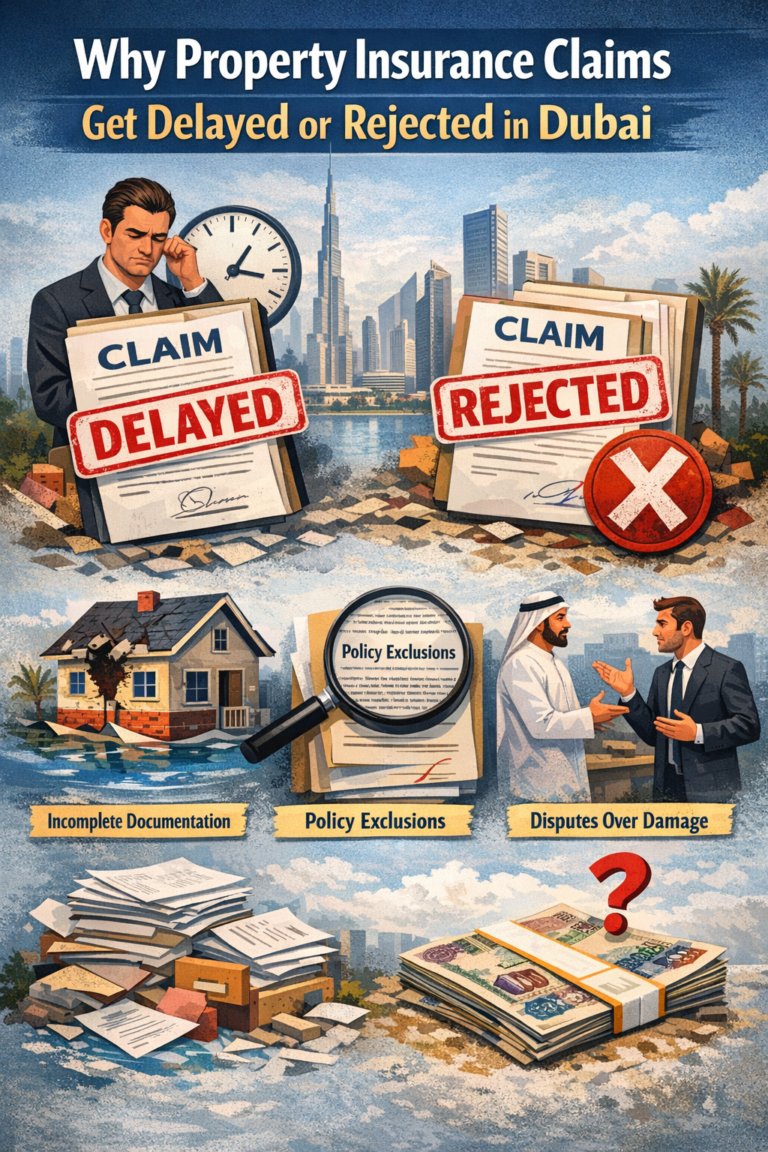
Why Property Insurance Claims Get Delayed or Rejected in Dubai

Why Property Insurance Claims Get Delayed or Rejected in Dubai

Property insurance claims in Dubai are often delayed or partially rejected not because the damage is invalid, but because the claim file lacks the technical and procedural clarity insurers and loss adjusters require. For commercial buildings, offices, retail units, and hospitality assets, insurance claims typically fall under Business All Risk (BAR) or comprehensive property policies. These policies are technical by nature, and insurers assess them based on evidence, causation, policy conditions, and compliance, not intent alone. 1. Incomplete or Poor Documentation One of the most frequent causes of claim delays is insufficient or unstructured documentation. Common issues include photos without timestamps or scale reference, videos that show damage but not the cause, missing records of pre-damage condition, and the absence of a clear incident timeline. Insurers and loss adjusters generally expect documentation that answers three questions clearly: What failed? Why did it fail? What assets were affected as a result? 2. No Clear Identification of Root Cause Insurance coverage is triggered by insured causes of loss, not by damage alone. For example, sudden pipe rupture may be covered, whereas long-term seepage or corrosion may not be. Many claims fail because they focus on visible damage without technically establishing the root cause. Engineering-led assessment is critical at this stage. 3. Misunderstanding the Role of the Loss Adjuster A common misconception is that the loss adjuster acts on behalf of the policyholder. In reality, the loss adjuster is an independent investigator appointed by the insurer. Their role is to assess cause, extent, and policy applicability—not to advocate for either party. Managing this relationship professionally through clear documentation and factual reporting is key. 4. Repairs Undertaken Before Proper Assessment While quick restoration is often necessary, premature permanent repairs can complicate claims. Most policies include a Duty of Mitigation, requiring reasonable steps to prevent further damage. Acceptable mitigation actions include stopping active leaks, isolating power, or securing openings. The key is documenting mitigation actions while deferring permanent rectification until assessment is complete. 5. Contractor Quotes Without a Technical Narrative Contractor repair quotations typically describe what needs to be fixed but do not explain why the damage occurred or link it to an insured event. From an insurer’s perspective, a quote is a cost estimate—not claim justification. 6. Misalignment With Policy Terms and Conditions Insurance policies define covered perils, exclusions, limits, and conditions such as mitigation and notification requirements. Claims are often delayed when the incident description does not align clearly with policy wording. This requires technical interpretation rather than general reporting. How Professional Claim Support Improves Outcomes Specialized facility management companies such as SnapFixNow™ FMC support insurance claims by providing engineering-led documentation, including technical damage assessment, root cause analysis, evidence capture, timeline documentation, and claim-ready reporting aligned with insurer expectations. Dispute Resolution (When Required) In rare cases where claims remain unresolved despite proper documentation, policyholders may explore formal escalation channels. In the UAE, insurance oversight and dispute escalation mechanisms fall under the Central Bank of the UAE, which regulates insurance activities previously overseen by the Insurance Authority. Final Thought Most insurance claim challenges in Dubai arise from process gaps, not lack of coverage. With proper documentation, technical clarity, and structured mitigation, many delays and disputes can be avoided.

January 20, 2026
A Practical Guide to Facility Management in UAE

A Practical Guide to Facility Management in UAE

For property managers, asset owners, and procurement teams in the UAE, facility management is the operational engine that drives asset value, ensures tenant satisfaction, and mitigates risk. The objective is to move beyond reactive repairs and implement a strategic framework for managing the entire lifecycle of a building’s systems and services. Navigating the Facility Management Landscape in the UAE Facility management in Dubai and across the UAE presents a unique set of challenges and opportunities, driven by extreme climate conditions, rapid urban development, and technologically advanced buildings. It is a demanding environment where effective management is not just about maintenance, but about defending high-value assets against harsh conditions while delivering service levels that meet global standards. This guide is structured for B2B decision-makers. It provides clear frameworks for evaluating service models, establishing performance benchmarks, and making informed trade-offs between cost, risk, and service quality. Core Focus Areas for UAE Properties To maintain asset competitiveness and ensure regulatory compliance, decision-makers must focus on several key areas: Hard vs. Soft Services: A critical balance must be struck between maintaining core building infrastructure (MEP, HVAC) and elevating the user experience through services like cleaning and security. The former ensures operational integrity; the latter drives tenant retention. Technology Integration: The use of digital tools like CAFM and IoT is no longer optional. These platforms provide essential operational oversight, automate routine tasks, and enable data-driven maintenance decisions. Understanding ServiceNow's role in UAE enterprise transformation illustrates the depth of this integration. Asset-Specific Strategies: The operational requirements of a commercial tower in DIFC differ significantly from those of a residential community on Palm Jumeirah or an industrial warehouse in JAFZA. A one-size-fits-all approach is both ineffective and financially risky. The primary objective in the UAE market is to transition from a reactive, cost-centric model to a proactive, value-driven one. This requires prioritizing asset longevity, energy efficiency, and operational continuity as key business goals. This guide provides the analytical tools to make informed decisions that protect assets and advance organisational objectives. Hard vs. Soft Facility Management: What's the Difference in the UAE? In facility management, all tasks are categorized as either Hard FM or Soft FM. Understanding this distinction is fundamental for strategic planning, accurate budgeting, and protecting asset value within the UAE's commercial and regulatory environment. These two service categories are not in opposition; they are complementary. Together, they create a property that is safe, compliant, efficient, and a desirable place to occupy. Hard Facility Management (Hard FM) encompasses the technical core of a building—the physical, tangible infrastructure that enables it to function. These are non-negotiable systems; without them, a building cannot operate safely, legally, or efficiently. Conversely, Soft Facility Management (Soft FM) covers the services that shape the human experience within that building. While not physically integrated into the structure, these services are critical for tenant satisfaction, productivity, and maintaining the property's operational flow and aesthetic standards. The Unseen Engine: Why Hard FM is So Critical Hard FM services are intrinsically linked to the physical fabric of a building. In the UAE, where properties feature sophisticated building technologies and a climate that places extreme stress on mechanical systems, these services are paramount for asset longevity and operational continuity. Key components of Hard FM include: MEP Systems: Mechanical, Electrical, and Plumbing systems are the lifeblood of any modern building, covering power distribution, lighting, water supply, and drainage. HVAC Systems: Heating, Ventilation, and Air Conditioning. This is arguably the most critical Hard FM service in the region, directly impacting occupant comfort and accounting for 40-60% of a typical building's energy consumption. Fire Safety and Life Support Systems: These are non-negotiable services mandated by strict UAE Civil Defence codes, including fire alarms, sprinklers, emergency lighting, and smoke control systems. Building Management Systems (BMS): The centralized platform for monitoring and controlling a building's mechanical and electrical equipment, from chillers to lighting schedules. This diagram illustrates how both hard and soft services form the foundation of total facility management, directly impacting asset preservation and value enhancement. The structure is clear: neglecting either the technical or the experiential aspects of management will erode the long-term value of the physical asset. The Visible Difference: How Soft FM Shapes Experience While Hard FM ensures a building operates, Soft FM makes it a desirable place to live, work, or visit. These are the services tenants and visitors experience daily, directly shaping their perception of quality and value. Common Soft FM services include: Security and Manned Guarding Cleaning, Janitorial, and Pest Control Waste Management and Recycling Landscaping and Grounds Maintenance Reception and Concierge Services In a competitive real estate market like Dubai, high standards of Soft FM are not a luxury but a powerful differentiator that can significantly improve tenant retention and property reputation. To better understand the distinct roles and impacts of Hard and Soft FM, the following table provides a clear, side-by-side comparison tailored for UAE assets. Hard Services vs Soft Services: A Comparative Overview for UAE Assets Attribute Hard Facility Management (Hard FM) Soft Facility Management (Soft FM) Scope Tangible assets fixed to the building fabric (MEP, HVAC, BMS, fire safety). People-centric services enhancing the user experience (cleaning, security, landscaping, concierge). Impact Ensures safety, legal compliance, and operational functionality. Prevents catastrophic failures. Drives tenant satisfaction, productivity, property aesthetics, and brand perception. Cost Structure Primarily capital-intensive, with costs tied to asset replacement, predictive maintenance, and specialised technical labour. Primarily operational and labour-intensive, with costs tied to manpower, consumables, and service frequency. Priority Level Critical & Non-Negotiable. Failure poses immediate safety risks and can render a building unusable. Essential for Competitiveness. Poor service directly impacts tenant retention and property reputation. UAE Example (Commercial Tower) Maintaining the chiller plant, BMS, elevators, and facade cleaning systems. Providing lobby security, office cleaning services, and valet parking. UAE Example (Residential Villa) Servicing the AC units, water pump, and electrical distribution board. Managing waste collection, pest control, and swimming pool cleaning. This comparison highlights that while Hard FM is the technical backbone ensuring a property functions, Soft FM is

January 20, 2026
A Decision-Maker’s Guide to an Annual Maintenance Contract in Dubai

A Decision-Maker’s Guide to an Annual Maintenance Contract in Dubai

An Annual Maintenance Contract (AMC) in Dubai functions as a strategic asset management tool. It is a proactive agreement designed to maintain the operational integrity of critical systems—including HVAC, electrical, and plumbing—through scheduled, preventive servicing. This approach shifts an asset's maintenance profile from a reactive, high-cost emergency repair model to a structured, planned care framework. In the demanding climate and operational environment of the UAE, this is a fundamental strategy for asset value preservation. What an Annual Maintenance Contract Delivers in Practice For property managers, asset owners, and procurement leaders in Dubai, an Annual Maintenance Contract (AMC) is a governance instrument. It establishes control over maintenance activities, replacing unpredictable emergency call-outs with a scheduled, data-driven programme designed to optimise asset lifecycle and performance. At its core, an AMC is a service-level agreement between a property owner and a maintenance provider. It defines a clear scope and schedule of preventive tasks, ensuring a building's core systems operate not just functionally, but with optimal efficiency and safety in line with UAE regulations. Core Components of a Standard AMC Scope A typical annual maintenance contract in Dubai is structured around the "hard services" that are foundational to any building's operation. While customisation is standard, these elements form the baseline scope: HVAC Systems: This is the most critical component in the UAE. The scope includes scheduled inspections, filter cleaning/replacement, refrigerant level checks, and full functional diagnostics of all AC units. The objective is to ensure operational continuity and mitigate the risk of system failure during peak temperature periods. MEP Services: This encompasses the Mechanical, Electrical, and Plumbing systems. It involves proactive checks on water pumps, drainage systems, and electrical panels to identify and rectify minor faults before they escalate into significant operational failures. Electrical Systems: This covers inspections of distribution boards, circuit breakers, light fittings, and wiring. The primary goal is to ensure safety, compliance with DEWA standards, and the prevention of unplanned power outages. Plumbing and Water Systems: This includes scheduled inspections for latent leaks, potential blockages in drainage lines, and performance checks of water heaters and pumps. The focus is on preventing water damage and ensuring system reliability. A well-structured AMC provides more than technical servicing; it is a financial control mechanism. It offers budget predictability, supports compliance with local regulatory bodies, and actively preserves the long-term capital value of the property. The Strategic Shift from Reactive to Preventive Maintenance Relying on an ad-hoc, reactive call-out model exposes an asset to significant financial and operational risk. Without a formal AMC, management is locked into a cycle of waiting for system failure, then incurring premium costs for emergency remediation. This approach is not only more expensive over the asset lifecycle but also causes significant disruption to tenants or business operations. A structured AMC fundamentally inverts this model. By implementing a schedule of proactive maintenance, incipient faults are identified and resolved before they can trigger a systemic failure. Decision-makers should reference essential facilities management best practices, which universally advocate for planned maintenance as a core strategy. This approach delivers quantifiable outcomes: improved energy efficiency, enhanced tenant retention, and predictable operational expenditure (OPEX). Maintenance transforms from a variable cost centre into a strategic investment in asset value. Comparing Comprehensive vs Labour-Only AMCs Selecting the appropriate annual maintenance contract model is a critical decision that directly influences budgets, operational risk allocation, and asset performance. The Dubai market primarily offers two contract structures: Comprehensive AMCs and Labour-Only AMCs. Understanding the financial and operational mechanics of each is essential for aligning the maintenance strategy with organisational objectives. This decision path illustrates the strategic choice facing an asset owner when formulating a maintenance and risk mitigation plan. As the diagram indicates, the fundamental choice is between the proactive risk management of an AMC and the reactive, high-risk posture of ad-hoc repairs. The Comprehensive AMC Explained A Comprehensive Annual Maintenance Contract is an all-inclusive model that transfers the maximum level of risk from the asset owner to the service provider. The contract fee covers not only the technician's labour for scheduled preventive maintenance and emergency call-outs but also the cost of any spare parts required for repairs. This structure is designed for complete budget predictability. It functions as a fixed-cost operational policy for a property's critical MEP systems. A higher annual fee is paid in exchange for insulation from the unforeseen and often substantial costs of component failures during the contract term. For facility managers of high-value commercial assets or hospitality leaders, a Comprehensive AMC is often the default choice. The operational imperative for 100% uptime and absolute budget certainty outweighs the higher initial contract cost. A single critical failure can result in revenue loss far exceeding the AMC premium. In Dubai's commercial real estate market, formal maintenance agreements are standard practice. The UAE facility management growth trends project the market to reach USD 23.86 billion by 2026. Hard services, the core of AMCs, already represent 61.64% of this market, driven by the adoption of smart MEP systems and a shift toward predictive maintenance models. The Labour-Only AMC Explained Conversely, a Labour-Only Annual Maintenance Contract covers only the technician's labour for planned visits and breakdown response. The critical distinction is that the cost of all spare parts, consumables, and materials required for repairs is billed separately to the client. This model presents a lower initial contract price, which can be attractive for organisations with constrained operational budgets. However, it introduces significant financial uncertainty. While labour costs are fixed, the total annual maintenance expenditure becomes variable and unpredictable. A major component failure, such as an HVAC compressor or a primary water pump, can trigger a large, unbudgeted invoice, disrupting financial planning. This structure effectively transfers the financial risk of parts failure from the service provider back to the asset owner. A Head-to-Head Comparison of AMC Models An effective decision requires a clear evaluation of the trade-offs between cost, risk transfer, and administrative overhead. The following table provides a direct comparison of the two primary contract types to aid in this

January 19, 2026
Evaluating a Building Maintenance Company in Dubai: A Decision Framework for Asset Managers

Evaluating a Building Maintenance Company in Dubai: A Decision Framework for Asset Managers

Selecting a maintenance partner in Dubai requires a critical decision on the service model that aligns with your asset strategy and budget. This initial choice—between a predictable, all-inclusive contract and a more flexible, pay-as-you-go approach—forms the foundation of your engagement with any building maintenance company in Dubai. It directly shapes your operational expenditure (OPEX), risk allocation, and asset lifecycle management. Choosing the Right Maintenance Model for Your Dubai Property A maintenance model is the financial blueprint for your property's operational health. In Dubai's dynamic real estate market, this decision governs cost control, mitigates the impact of the harsh climate on assets, and influences tenant or occupant satisfaction. The primary models are Comprehensive Annual Maintenance Contracts (AMCs), Non-Comprehensive (or Labour-Only) AMCs, and reactive On-Demand services. Each model is structured for different property types, risk appetites, and management philosophies. Dubai's real estate expansion drives significant demand for structured maintenance. The UAE's facility management market was valued at US$ 11.6 billion in 2024 and is projected to grow at a CAGR of 11.5%. This growth is fuelled by continuous development; for instance, Dubai registered 30,098 real estate sales in Q2 2023 alone, a 35% increase from 22,322 transactions in the same quarter of 2022. Each new asset requires a defined facility management strategy to preserve its value. Matching the Model to Your Asset The risk profile and operational requirements vary significantly by asset type. A Grade-A commercial tower in DIFC with mission-critical MEP (Mechanical, Electrical, Plumbing) systems has a different risk tolerance than a large-scale residential community in a suburban area. The tower's facility manager requires guaranteed uptime and budget certainty, making a comprehensive AMC the logical choice to transfer operational risk. The community manager might favour the cost control of a non-comprehensive model, where routine inspections are covered, but major capital repairs require separate approval and funding. A maintenance contract is more than a service agreement; it is a strategic risk allocation tool. The core decision for an asset manager is determining the optimal balance of financial and operational risk to retain versus transfer to the service provider. This decision tree provides a framework for selecting a maintenance model based on key business drivers like budget predictability, cost flexibility, or response urgency. As the diagram illustrates, if fixed annual costs and minimal budget variance are primary objectives, a comprehensive model is indicated. If greater control over variable expenses and a higher tolerance for risk are acceptable, a non-comprehensive or on-demand solution may be more suitable. Breaking Down the Core Models A detailed understanding of these agreement structures is essential for proper vendor evaluation. Each model has distinct implications for your budget, asset lifecycle planning, and risk management. Comprehensive AMCs: This is an all-inclusive model covering labour, spare parts, and consumables for both planned preventive maintenance (PPM) and emergency reactive call-outs. It offers maximum budget predictability, simplifying financial forecasting. This model is standard for critical infrastructure and premium properties where asset downtime carries significant financial or reputational consequences. Non-Comprehensive AMCs: This is primarily a "labour-only" agreement. It typically covers the cost of technicians for scheduled PPM and emergency responses. However, spare parts, materials, and major repairs are billed separately as incurred. This model offers a lower fixed upfront cost and greater flexibility, but it exposes the budget to fluctuations and requires the owner to carry the risk of major component failure. On-Demand (Pay-Per-Use) Services: This is a purely reactive model. A service provider is engaged only when a fault occurs. It can be suitable for smaller properties with non-critical systems or for organisations with an in-house team managing routine tasks. The significant drawback is the lack of proactive maintenance, which can lead to catastrophic failures and higher long-term costs. The following table provides a side-by-side comparison to aid in selecting the appropriate contract type based on specific property requirements. Comparing Maintenance Contract Models at a Glance Contract Model Scope of Work Cost Structure Best Suited For Risk Allocation (Owner vs. Provider) Comprehensive AMC Covers all labour, spare parts, and consumables for preventive and reactive tasks. Fixed annual fee. Critical infrastructure, premium commercial towers, properties where uptime is paramount. Low risk for owner; most financial and operational risk is transferred to the provider. Non-Comprehensive AMC Covers labour for scheduled preventive work and call-outs. Parts and major repairs are extra. Lower fixed annual fee + variable costs for parts/repairs. Residential communities, mid-range commercial buildings, owners wanting more cost control. Shared risk; owner retains risk for part costs and major failures. On-Demand (Pay-Per-Use) Reactive repairs and services only when requested. No preventive maintenance included. Billed per job (labour + materials). Small properties, non-critical assets, businesses with in-house teams for basic tasks. High risk for owner; all financial and operational risk is retained by the owner. Ultimately, the right choice balances your tolerance for financial risk against your need for operational certainty. When defining the scope, understanding the quality of specific services, such as top-quality commercial door repairs and maintenance services, is crucial. The true value of any contract is defined by how well it preserves the specific assets you rely on. For a more detailed analysis of contract structures, see this guide on understanding annual maintenance contract types for residential versus commercial properties. Understanding Hard and Soft Maintenance Services To effectively evaluate a building maintenance company in Dubai, decision-makers must distinguish between the two pillars of facility management: Hard Services and Soft Services. This distinction is fundamental, as it defines the scope of work, key cost drivers, and the technical competencies required to maintain an asset's operational integrity and value. Hard Services are analogous to a building's vital organs and central nervous system—the critical systems physically integrated into the structure that are essential for its function. Soft Services, conversely, relate to the occupant experience, creating a clean, safe, and productive environment within the building. Defining Hard Maintenance Services Hard Services encompass all maintenance related to the physical fabric and core systems of a building. These tasks require certified, skilled technicians and are strictly governed by

January 18, 2026
Call Now Button