SnapFixNow

HVAC Services Dubai

Expert heating, ventilation, and air conditioning solutions for optimal indoor comfort

The Real HVAC Problems

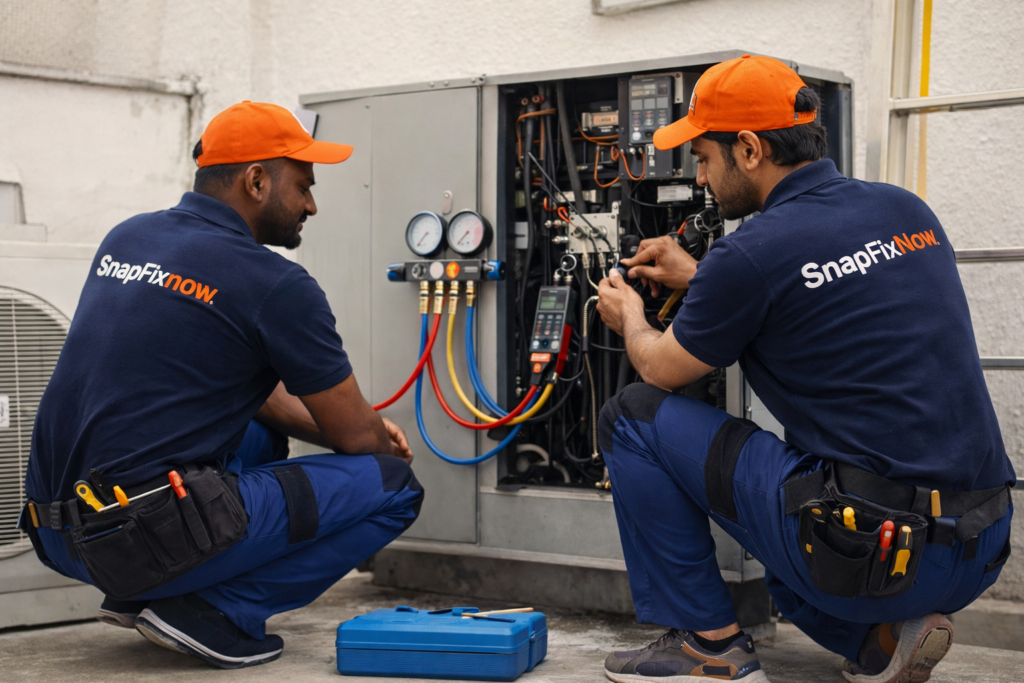
HVAC issues in Dubai rarely start as “major failures”. They start as minor performance drift—then become complaints, high bills, humidity issues, or repeat breakdowns. We focus on preventing that drift and documenting corrective actions clearly.

Comfort Complaints

Hot/cold spots, weak airflow, humidity and 'it's not cooling' escalations.

Common Issues

Our Solutions

Repeat Breakdowns

Same fault returning due to missing root-cause corrections.

Common Issues

Our Solutions

High Energy Bills

Cooling cost increases without obvious reasons.

Common Issues

Our Solutions

What We Fix The Real HVAC Problems

HVAC issues in Dubai rarely start as “major failures”. They start as minor performance drift—then become complaints, high bills, humidity issues, or repeat breakdowns. We focus on preventing that drift and documenting corrective actions clearly.

Comfort complaints

Hot/cold spots, weak airflow, humidity and “it’s not cooling” escalations.

Repeat breakdowns

Same fault returning due to missing root-cause corrections.

High energy bills

Cooling cost increases without obvious reasons.

Enterprise-ready delivery

Our work is designed to be auditable: checklists, readings, photos, and a defect log that procurement and FM teams can approve quickly. If you need “quick fixes” with no documentation, we may recommend a task-based provider instead.

HVAC Systems & Equipment Covered

Clear scope reduces downtime and speeds up approvals, especially under AMCs.

Cooling systems

Major cooling assets and packaged equipment.

Air distribution

Air handling and terminal units.

Supporting infrastructure

Often overlooked—yet causes most repeat issues.

HVAC Services We Provide

Defined services ensure consistent maintenance, faster issue resolution, and AMC-ready compliance.

Preventive Maintenance (PPM)

Planned servicing aligned to occupancy and system load.

Breakdown Repairs & Emergency Response

SLA-based attendance with clear job closure evidence.

Duct Cleaning & IAQ Hygiene

Improve air quality and reduce odor, dust and complaint cycles.

Performance Diagnostics & Optimization

When cooling cost is high, or comfort is unstable.

Our HVAC Process (SLA + Documentation First)

Designed for enterprise clients that require audit-friendly reporting and predictable execution.

Step 1 — Site survey & system health assessment

Asset review, operating conditions, access constraints, baseline readings and risk notes.

Step 2 — Asset-based scope + AMC structure

PPM frequency, response times, exclusions, consumables/spares policy — written for procurement approval.

Step 3 — Execution with checklists, readings & photo evidence

Repeatable servicing standard across units, with defect log and corrective recommendations.

Step 4 — Monthly reporting & improvement loop

Recurring fault elimination, trend observations, and next-cycle action plan.

HVAC AMC Options

Select coverage based on asset criticality, occupancy pressure, and desired SLA priority.

Essential (PPM)

For stable systems needing consistent preventive discipline.

Standard (PPM + Breakdown Labour)

Standard (PPM + Breakdown Labour)

Premium (Enhanced SLA + Detailed Reporting)

For assets where downtime becomes guest/tenant escalation fast.

Transparency note (important for approvals)

Major parts, refrigerant, compressors and OEM components are excluded unless explicitly stated in the proposal. This keeps pricing clean and avoids surprise add-ons mid-year.

Case Studies

Proven results from SLA-driven facility management projects across Dubai

Case Study SnapFix Now

Fountain & Lobby Enhancement

CLIENT / LOCATION
Corporate HQ DIFC
CHALLENGE
Lobby fountain failure impacted visitor experience.
RESULT
39% uptime achieved, positive client feedback
View Case Study
Energy Efficiency Solutions

Energy Optimization Project

CLIENT / LOCATION
Hotel Apartments, Bur Dubai
CHALLENGE
High energy bills from inefficient HVAC operation.
RESULT
Energy savings of 22%, reduced OPEX
View Case Study
Painting on SnapFixNow

Exterior Facade & Painting

CLIENT / LOCATION
Residential Tower, Al Nahda
CHALLENGE
Weather damaged facade reduced property appeal.
RESULT
Increased occupancy rates and reduced vacancy cycle
View Case Study
Parking Barriers

Parking Barriers & Access Control

CLIENT / LOCATION
Business Park, Sharjah Free Zone
CHALLENGE
Barrier failures caused tenant access issues.
RESULT
Reduced downtime by 90%
View Case Study
Luxury Cleaning

Post-Construction Cleaning – Luxury Project

CLIENT / LOCATION
Premium Developer, Downtown Dubai
CHALLENGE
Dust, joint residue, and adhesive marks delayed handovers.
RESULT
400 apartments handed over spotless in 5 weeks
View Case Study
OUR WORK

See The Transformation

Real results from our completed projects across Dubai. Drag the slider to compare before and after.
before-hvac-DxRgjLKM after-hvac-CbtkH8vJ

HVAC System Upgrade

HVAC Installation
before-cleaning-Dk6ROkAv after-cleaning-CgDmYM32

Commercial Deep Cleaning

Cleaning Service
before-renovation-Bk64hXd3 after-renovation-21e1cJ_f

Complete Apartment Renovation

Renovation
Want to see similar results for your property?
WHY CHOOSE US

Why Choose SnapFixNow

We combine process, people and technology to deliver measurable outcomes that exceed expectations and drive continuous improvement for your business success.

24/7 Support

Round-the-clock availability for emergencies. Our dedicated team is always ready to respond to your facility needs, ensuring minimal downtime and maximum peace of mind.

Certified Experts

Highly trained and certified technicians with international standards compliance. Every team member undergoes rigorous training and holds relevant industry certifications.

Guaranteed Results

Quality-assured services with comprehensive warranties. We stand behind our work with performance guarantees and transparent SLA commitments for your complete satisfaction.

Competitive Pricing

Cost-effective solutions without compromising quality. Transparent pricing models, flexible payment options, and exceptional value for your facility management investment.

ISO Certified

ISO 9001:2015 Quality Management

5+ Years

Experience in Dubai

500+ Clients

Satisfied Customers

Licensed & Insured

Fully Certified Technicians

99% Satisfaction

Guarantee on All Services

24/7 Support

Emergency Response Available

500+

PROJECTS COMPLETED

99%

CLIENT SATISFACTION

24/7

HOUR AVAILABILITY

50+

EXPERT TECHNICIANS

[ TESTIMONIALS ]

REAL EXPERIENCES,
REAL SATISFACTION

Ahmed Al Mazrouei

General Manager, InterContinental Hotel

SnapFixNow is great for our hotel's maintenance and cleaning tasks. Using photos for communication is so easy and efficient for our team. I recommend SnapFixNow highly to any hotelier.

★★★★★

Omar Al Ali

Hospitality Business

A fantastic product with great customer service. I've been with SnapFixNow for a few years now over two businesses and I will be continuing this relationship into the future. Highly recommended.

★★★★★

AYESHA KHAN

Facilities Manager, Jumeirah Hotels

SnapFixNow has improved our maintenance team's productivity by approximately 30% and made it easy for non-facilities executive management to monitor our operations. A very efficient tool.

★★★★★

MOHAMMED AL FALASI

Facilities Manager

Easy to use and saves time. Positive experience so far and the software has good potential to support our business needs in multiple ways going forward.

★★★★★

Rohit Sharma

Maintenance Head, Sofitel Dubai Downtown

Excellent for our maintenance department. SnapFixNow makes it simple to assign tasks and follow up on completion across all staff.

★★★★★

FATIMA AL SUWAIDI

Facilities Manager, Dubai British School

A really good facilities tool. All reactive work is logged efficiently and preventive maintenance is completed on schedule. Asset management features are excellent.

★★★★★
SERVICE COVERAGE

We Serve All Dubai

Comprehensive facility management services across 15+ Dubai communities

Downtown Dubai

Premium

Dubai Marina

Residential

Jumeirah Beach Residence

Premium

Business Bay

Commercial

Dubai Mall Area

Commercial

Arabian Ranches

Residential

Dubai Sports City

Residential

Palm Jumeirah

Premium

Emirates Hills

Premium

Dubai Silicon Oasis

Residential

International City

Residential

Deira

Commercial

Bur Dubai

Residential

Al Barsha

Residential

Jumeirah

Premium

Get Your Free Quote

Professional facility management services

    FREQUENTLY ASKED

    Clients Asked Questions & Answers

    Find answers to the most common questions about our facility management services.

    Repeated failures are usually due to underlying issues such as poor preventive maintenance, drainage problems, control faults, or system undersizing. We focus on identifying root causes, not just resetting faults.
    We maintain split ACs, packaged units, VRF systems, chilled water FCUs, and related HVAC components.
    Yes. Preventive maintenance includes inspections, cleaning, performance checks, and condition reporting to reduce breakdowns.
    Drain lines are inspected, flushed, and corrected as part of preventive maintenance to prevent leaks and water damage.
    In many cases, yes. Airflow correction, controls tuning, coil cleaning, and operational adjustments can significantly improve performance.
    Yes. HVAC systems are commonly included under our AMC scope with defined SLAs.

    Read the Latest Insights

    Explore trending topics to maintain and optimize your facilities, your most valuable business investment.

    Industrial Preventive Maintenance Checklist: A Framework for UAE Asset Integrity

    Industrial Preventive Maintenance Checklist: A Framework for UAE Asset Integrity

    An industrial preventive maintenance checklist is a strategic framework for controlling operational expenditure (OPEX), managing risk, and ensuring compliance for industrial asset owners and procurement teams in Dubai and the UAE. It facilitates a shift from reactive, failure-driven rectification to a proactive methodology for protecting asset value, particularly under the demanding conditions of the UAE climate. This structured approach directly impacts asset lifecycle, supports regulatory adherence, and safeguards financial performance. The Strategic Framework for Industrial Asset Integrity For asset owners in Dubai, viewing maintenance through a strategic lens is a critical operational requirement. The objective is to architect a framework that underpins the operational and financial health of an industrial facility by moving away from a reactive, “run-to-failure” model toward a structured, preventive methodology. A well-designed industrial preventive maintenance checklist serves as the operational blueprint for this framework. It provides the structure to systematically manage assets, mitigate risks posed by the UAE's high-stress environment (heat, humidity, dust), and maintain compliance with regulatory bodies like Dubai Municipality and Civil Defence. Comparing Maintenance Models: A Risk-Based Analysis The financial and operational outcomes of different maintenance strategies vary significantly. Understanding these trade-offs clarifies the value of proactive planning. Model Type Operational Approach Financial Implications Risk Profile Reactive (Run-to-Failure) Corrective action is taken only after an asset fails. Minimises planned OPEX but leads to high, unpredictable costs for emergency rectification, including premium labour rates and secondary system damage. High. Exposes the facility to unscheduled downtime, volatile expenditure, and potential safety incidents. Preventive (Structured Planning) Scheduled inspections and servicing are used to identify and rectify potential issues before they cause system failure. Requires planned OPEX but controls overall costs by reducing emergency spending and extending asset life. Low. Establishes operational predictability, budget stability, and protects long-term asset value. From an engineering consultant's perspective, a reactive model exposes an asset portfolio to uncontrolled risk and volatile OPEX. In contrast, a preventive model establishes control, predictability, and long-term asset value protection. Industry practice often shows that every AED 1 spent on preventive planning can save between AED 3 to AED 5 in future emergency rectification costs and associated downtime losses. This strategic shift transforms maintenance from a purely cost-driven function into one that directly supports an organization’s financial objectives. The core of this transformation lies in the data and discipline that a formal checklist provides, creating a clear, auditable trail of due diligence and performance. Checklist Design for UAE Operational Realities A generic, one-size-fits-all checklist is inadequate for managing industrial assets in the UAE. The region’s environmental stressors—intense ambient heat, high humidity cycles, and significant dust loading—are unforgiving. A checklist that ignores these realities is not merely ineffective; it is a liability. A properly engineered industrial preventive maintenance checklist is a core governance document that creates a verifiable audit trail, drives technician accountability, and generates the data required to enforce Service Level Agreements (SLAs). For it to be effective in an environment like Dubai, it must be designed with precision. System And Asset Identification The primary function of a checklist is to eliminate ambiguity regarding what is being serviced. This section must provide a unique, granular identity for each piece of equipment. Vague descriptions like "HVAC Unit – Roof" generate poor data and make it impossible to track an asset’s history. A professional checklist specifies: Unique Asset ID: A distinct code (e.g., AHU-03-L4-ZN2) that corresponds to the central asset register. Asset Location: Precise physical placement (e.g., Level 4, Zone 2, East Wing). Asset Type & Model: A clear description (e.g., Chilled Water Air Handling Unit, Carrier 39CC). This level of detail is essential for ensuring maintenance history is tied to the correct asset, which is critical for tracking repeat failures, calculating Mean Time Between Failures (MTBF), and making informed financial decisions about asset replacement versus ongoing OPEX. Specific Task Descriptions With Quantified Metrics Task descriptions must be direct, actionable, and measurable. Subjective instructions like "Check condenser coils" are ineffective. A technically sound checklist provides clear, data-driven pass/fail criteria. Consider the difference for an HVAC unit exposed to high dust loads: Weak Task: "Clean condenser coils." Strong Task: "Measure pressure differential across condenser coils. If delta-P exceeds 1.5 inches of water column, perform coil cleaning using a low-pressure water jet. Record pre- and post-cleaning pressure readings." This approach replaces subjective judgment with engineering discipline. It establishes a clear operational standard and generates objective data that proves the task was completed to specification—a vital component for enforcing SLAs with third-party maintenance contractors. Defined Frequencies And Triggers Maintenance schedules in the UAE must be dynamic to adapt to seasonal demands and operational intensity. The checklist must specify task frequencies based on a clear risk assessment. Typical categorizations include: Daily/Weekly: For critical, high-use assets where a minor fault can escalate rapidly (e.g., visual checks for pump seal leaks, listening for abnormal motor vibrations). Monthly: For routine servicing. High dust loading in the UAE often necessitates monthly filter changes, whereas a 3-month cycle might be acceptable in a less harsh climate. Quarterly/Annually: For in-depth inspections, component testing, and calibrations (e.g., thermal imaging of electrical panels, full load testing of backup generators). An effective industrial preventive maintenance checklist also includes conditional triggers. For example: "Inspect rooftop AHU filters weekly, but replace immediately if a sandstorm event is officially reported." This dynamic scheduling is essential for preventing failures driven by predictable local conditions. Required Tools And Personal Protective Equipment (PPE) Listing the exact tools and PPE for each task serves two critical functions. First, it ensures technician preparedness, reducing non-productive time. Second, it reinforces safety compliance, a key focus for site managers and a point of scrutiny during audits by authorities like Dubai Municipality. A well-defined checklist item would include: Tools: Digital multimeter, thermal imaging camera, pressure gauge set, torque wrench. PPE: Arc-flash resistant gloves (for electrical work), safety harness (for work at height), N95-rated dust mask, safety glasses. This section standardizes the work method and reduces the risk of incidents. It also provides procurement teams with clearer forecasts for tooling and consumable

    March 19, 2026
    An Executive Guide to Evaluating Maintenance Companies in Dubai

    An Executive Guide to Evaluating Maintenance Companies in Dubai

    Executive Summary: For property managers, facility heads, and asset owners in Dubai, selecting a maintenance partner is a critical procurement decision impacting operational expenditure (OPEX), asset lifecycle, and regulatory compliance. This guide provides a technical framework for evaluating maintenance companies not on price, but on operational capability, risk mitigation, and contractual integrity. It deconstructs service models (Reactive, Preventive, Comprehensive), analyzes Service Level Agreement (SLA) components, and offers a structured methodology for vetting a provider's true engineering depth, moving beyond marketing claims to focus on quantifiable performance metrics. A Framework for Selecting Dubai Maintenance Partners Procuring maintenance services in Dubai requires a disciplined, engineering-led approach. The objective is not to identify the lowest-cost provider, but to secure a partner capable of actively mitigating operational risk, ensuring compliance, and protecting the lifecycle value of building assets. This framework provides the analytical tools to dissect service models, interpret contractual obligations, and align a maintenance strategy with a facility's specific operational and financial objectives. The decision carries significant weight. The UAE facility management sector is projected to grow at a CAGR of 12.12% through 2031. Dubai constitutes a significant 50.90% of this market, with hard services—the technical core of maintenance like MEP—commanding a dominant 60.92% share. This trend is driven by stringent compliance requirements and a market shift towards performance-based contracts. These figures confirm that technical hard services are the primary value driver in Dubai's maintenance industry. Consequently, a provider's engineering proficiency and operational structure should be the principal factors in any evaluation. Core Decision Criteria A sound procurement process is founded on clear, quantifiable criteria. Anchor your evaluation to these operational pillars: Service Model Alignment: Does the proposed contract model—Reactive, Preventive, or Comprehensive—align with the asset's risk profile and the need for OPEX predictability? Technical Depth: What is the ratio of in-house certified technicians to subcontractors? A higher in-house ratio generally correlates with superior quality control, faster rectification times, and clearer accountability. SLA and KPI Structure: The Service Level Agreement must contain specific, measurable, and relevant Key Performance Indicators (KPIs), including defined response and resolution times for critical system failures. Regulatory Compliance: The provider must demonstrate, not just claim, adherence to standards set by Dubai Municipality, Dubai Civil Defence (DCD), and other relevant authorities. This guide will systematically break down each of these elements. For additional context, explore our overview of facility management in the UAE. Unpacking Maintenance Contracts and Their Hidden Risks Selecting between maintenance companies in Dubai involves dissecting the contract models they offer. Each contract structure represents a different allocation of cost, risk, and operational control. This choice is fundamental to managing operational expenditure (OPEX) and preserving asset lifecycle. The contract is a financial instrument that defines risk and responsibility. Understanding the fundamentals of what is a service contract is the first line of defense against unfavorable terms that can impact future operations and budgets. Scenario-Based Comparison: Contract Models Contract Model Description Best Suited For Key Financial Risk Reactive / Call-Out "Pay-as-you-go" model where services are rendered and billed only when a fault occurs. Non-critical assets, low-traffic facilities, properties with minimal complex systems. Unpredictable OPEX. The asset owner absorbs 100% of the financial impact from all failures, including catastrophic ones. Preventive AMC A fixed annual fee covers planned preventive maintenance (PPM) visits and labour for emergency call-outs. Spare parts are excluded. Business-critical systems (HVAC, pumps) where uptime is important but some budget variance is acceptable. Variable spare parts cost. Owner has budget certainty on labour but remains exposed to high costs for major component failures. Comprehensive AMC An all-inclusive fixed annual fee covering PPM, emergency labour, and all spare parts and consumables. High-value, critical infrastructure (chillers, elevators, generators) where budget certainty and maximum uptime are non-negotiable. Higher initial cost. The provider prices in the risk, but the owner gains complete OPEX predictability. The Reactive or Call-Out Model The reactive model appears to be the lowest-cost option as it eliminates fixed fees. However, it introduces complete budget unpredictability. A single major failure, such as a breakdown of an Air Handling Unit (AHU), can result in a significant, unplanned capital expense. This model offers zero budget certainty and shifts the entire financial risk of equipment failure to the asset owner. Operational Reality: The reactive model prioritizes short-term cost avoidance over long-term risk management. This approach typically results in longer asset downtime, as there are no guaranteed response times and the procurement of specialized parts only begins post-diagnosis. The Preventive Annual Maintenance Contract (AMC) A Preventive AMC shifts the strategy from reactive firefighting to proactive asset management. A fixed annual fee covers a pre-agreed schedule of preventive maintenance for specified assets. This is the industry standard for systems critical to business continuity. In Dubai's climate, a Preventive AMC for HVAC systems is an operational necessity. High dust loading, humidity cycles, and heat stress accelerate wear. Scheduled maintenance, such as quarterly coil cleaning and filter replacement, directly mitigates these environmental factors. A typical Preventive AMC includes: Scheduled Service Visits: A defined number of visits per year (e.g., quarterly for HVAC). Labour for Call-Outs: Technician time for emergency rectification is typically included. Exclusion of Parts: This is a critical detail. The cost of all spare parts and consumables is not covered and is borne by the client. This model provides predictable labour costs but exposes the client to potentially high costs for major component replacements. To understand the specifics, our guide explains what an Annual Maintenance Contract really covers in Dubai. The Comprehensive Annual Maintenance Contract (AMC) The Comprehensive AMC represents the highest level of service, offering the most complete risk transfer from the client to the maintenance provider. This model bundles preventive maintenance, emergency labour, and all spare parts and consumables into a single, fixed annual fee. While the initial cost is higher—typically 25% to 40% more than a Preventive AMC—it provides absolute budget certainty. It transforms unpredictable capital-intensive repairs into a fixed operational expense. Maintenance companies price these contracts based on a detailed risk assessment of an asset's age, condition, and service

    March 18, 2026
    A Technical Guide to Selecting UAE Facility Management Companies

    A Technical Guide to Selecting UAE Facility Management Companies

    This guide provides a technical framework for evaluating UAE facility management companies, designed for property managers, asset owners, procurement teams, and engineering leaders. The focus is on analysing operational value, lifecycle cost implications, and compliance within the UAE’s specific regulatory and climatic landscape. Executive Summary for Asset Managers & Procurement Leads Selecting a facility management (FM) provider in the UAE is a decision that extends beyond comparing monthly fees. For asset managers and procurement teams, the primary objective is to mitigate operational risk while controlling long-term operational expenditure (OPEX). This requires a shift from a cost-centric viewpoint to a value-driven, risk-based evaluation. This guide provides the technical reasoning to distinguish between service delivery models and understand their direct impact on asset performance and financial predictability. It is structured to reduce procurement ambiguity by focusing on tangible operational outcomes rather than marketing claims. This analysis does not rank providers; it offers a methodology for independent evaluation. Comparing FM Contract Structures: A Risk & Cost Analysis The selection of an FM service model is a critical decision that directly influences operational risk, cost predictability, and long-term asset performance. For asset owners and procurement teams, the decision centres on the allocation of financial and operational risk between the owner and the FM provider. The three primary contract structures prevalent in the UAE market are the Comprehensive Annual Maintenance Contract (AMC), the Non-Comprehensive AMC, and Reactive (Ad-Hoc) services. Each model presents a distinct risk-reward profile, impacting operational budgets (OPEX) and the lifecycle value of the property. Comprehensive vs. Non-Comprehensive AMCs A Comprehensive AMC is an all-inclusive model where the FM provider assumes full responsibility for labour, all scheduled preventive maintenance, and the cost of all required spare parts and consumables. This model delivers the highest degree of budget certainty. The fixed annual fee, calculated based on asset condition and age, effectively caps the owner's financial exposure to unexpected breakdowns. Conversely, a Non-Comprehensive AMC (often termed a "labour-only" contract) covers the provision of technicians for scheduled maintenance and emergency call-outs. The critical distinction is that the asset owner bears the full cost of all spare parts, materials, and any major repair works. While the initial contract fee is lower, this model introduces significant budget volatility. A single major component failure, such as a chiller compressor seizure, can result in an unplanned expenditure that negates any initial contract savings. From an operational risk standpoint, a Comprehensive AMC aligns the FM provider's incentives with the asset owner's. The provider is financially motivated to perform high-quality preventive maintenance to minimise costly breakdowns, as they bear the full cost of rectification. This model inherently promotes proactive asset care. The Role of Reactive or Ad-Hoc Services Reactive services operate on a purely pay-as-you-go basis. A service provider is engaged for a one-off repair or emergency when a failure occurs, with no pre-existing contract. This model offers maximum flexibility but carries the highest potential cost and operational risk. Reliance on this model implies a complete absence of preventive maintenance, no guaranteed response times under a Service Level Agreement (SLA), and exposure to market-rate pricing for labour and parts at the point of crisis. For any significant commercial or residential asset, this "run-to-failure" approach is a high-risk strategy that almost guarantees accelerated asset degradation and a higher total cost of ownership over the asset's lifecycle. Scenario Analysis: Critical HVAC Failure in a Dubai Summer To illustrate the operational implications, consider a critical HVAC failure in a commercial tower during peak summer conditions in Dubai. A primary chilled water pump has failed, threatening cooling continuity across multiple floors. Under a Comprehensive AMC: The FM provider’s 24/7 helpdesk receives the system alarm. An on-site or rapid response team is dispatched immediately as per the SLA (e.g., within 30-60 minutes for critical failures). They diagnose the fault, and the provider sources the replacement pump and motor from its own inventory or pre-approved suppliers. The entire cost of labour and parts is covered by the contract. The asset owner's role is focused on tenant communication, not procurement or cost approval. Under a Non-Comprehensive AMC: The initial response for labour is the same. However, upon diagnosis, the FM provider issues a quotation for the replacement part and associated labour to the asset owner for approval. This introduces a procurement delay. For high-value components, this may require multiple quotes or senior management sign-off, extending asset downtime. Under a Reactive Service Model: The facility manager must initiate an emergency procurement process to find a qualified and available MEP contractors in Dubai. Rates must be negotiated under duress, followed by diagnosis and quotation approval, all while tenant operations are disrupted. Response times are unknown, and costs are likely to be inflated due to the emergency nature of the call-out. This scenario demonstrates how the contract structure is a primary determinant of operational resilience. The premium for a comprehensive contract functions as an insurance policy against business disruption and unpredictable OPEX. Decision Matrix: FM Contract Models This table outlines the key operational and financial differences to aid in strategic decision-making. Parameter Comprehensive AMC Non-Comprehensive (Labor-Only) AMC Reactive / Ad-Hoc Services OPEX Predictability High. Fixed annual cost covers labour, parts, and consumables. Low to Medium. Fixed cost for labour, but variable and uncapped costs for parts. Very Low. Entirely unpredictable, driven by frequency and severity of failures. Risk Transfer High. Majority of operational and financial risk transferred to the FM provider. Medium. Owner retains financial risk for all parts and major repairs. None. Owner retains 100% of financial, operational, and downtime risk. Incentive Alignment Strong. Provider is incentivised to prevent failures to control their own costs. Weak. Provider is paid for labour regardless; no financial incentive to reduce part failures. None. Service provider profits from failures. Response Time (SLA) Guaranteed. Defined within the contract for different priority levels. Guaranteed. Labour response is typically defined by an SLA. Not Guaranteed. Dependent on provider availability and negotiation. Administrative Burden Low. Minimal involvement in procurement of parts or approval of repair costs. High. Requires

    March 17, 2026
    A Technical Guide to AC Chiller Maintenance in Dubai for Asset and Facility Managers

    A Technical Guide to AC Chiller Maintenance in Dubai for Asset and Facility Managers

    Executive Summary For facility managers, asset owners, and procurement leaders in Dubai, chiller system performance is a primary driver of operational expenditure (OPEX) and asset lifecycle value. This guide provides a technical framework for evaluating chiller maintenance strategies, focusing on risk mitigation, financial accountability, and operational efficiency. It contrasts preventive versus reactive maintenance models, analyzes comprehensive versus non-comprehensive Annual Maintenance Contracts (AMCs), and establishes Key Performance Indicators (KPIs) for measuring service delivery. The objective is to equip decision-makers with the operational reasoning and quantified guidance necessary to optimize chiller performance, control costs, and extend asset life in the demanding UAE climate. A Strategic Overview of Chiller Maintenance From a risk management perspective, a building’s chiller system is a critical asset that directly dictates a significant portion of its OPEX. The decision between reactive rectification and structured preventive maintenance is not merely operational but a strategic choice with direct financial implications. An effective maintenance strategy is fundamental to asset performance and financial stability. The Dubai Climate and OPEX Impact In Dubai, where ambient temperatures frequently exceed 40°C, AC chillers operate under continuous high thermal stress. This sustained high-load condition results in substantial energy consumption, placing significant pressure on operational budgets. Proactive maintenance is a core risk mitigation strategy in this environment. Industry data indicates that a structured preventive maintenance program can extend a chiller’s operational lifespan by up to 40%. A planned approach to chiller maintenance delivers several quantifiable benefits: Asset Lifecycle Extension: Prevents premature wear on high-value components like compressors, deferring significant capital expenditure for replacement. Energy Efficiency & OPEX Control: A properly maintained chiller operates closer to its design efficiency (kW/ton), directly reducing electricity consumption and associated utility costs. Regulatory Compliance: Ensures the system functions in accordance with standards set by authorities like Dubai Municipality, mitigating risks of penalties and ensuring safe operation. Operational Resilience: Systematically reduces the probability of unplanned downtime, which can cause significant business disruption, revenue loss in hospitality settings, and reputational damage. Strategic Planning for Maintenance Operations Implementing a strategic maintenance model begins with selecting the appropriate system for the building’s load profile and operational requirements. Our guide comparing different chiller systems provides a technical comparison of available technologies. To execute this strategy, many organisations leverage tools like HVAC business management software to streamline workflows, manage service schedules, and ensure effective delivery against Service Level Agreements (SLAs). Ultimately, a data-driven approach reframes chiller maintenance from a reactive cost center to a critical function for improving financial performance and operational stability in the UAE market. The Financial Case for Proactive Maintenance For any asset owner or facility manager in Dubai, the management of high-value equipment like AC chillers involves a choice between two philosophies: reactive (run-to-failure) or proactive (planned preventive maintenance). While a reactive model may appear to reduce upfront costs, it introduces significant financial and operational risk, particularly in a high-demand climate. The true cost of a reactive strategy materializes as unpredictable and often substantial financial impacts. These include not just the cost of rectification but also premium charges for emergency call-outs, which are typically 25-50% higher than standard rates, and inflated costs for urgent parts procurement. More significantly, it leads to severe operational disruption, including tenant dissatisfaction, revenue loss, and reputational damage from system failure during peak summer months. Quantifying the Cost of Inaction Beyond the immediate repair invoice, a reactive failure can initiate a chain reaction of escalating costs. For example, a single compressor failure can release contaminants into the entire refrigerant circuit, transforming a component replacement into a complex, system-wide decontamination and rectification project. This exponentially increases both the cost and the duration of the downtime. This is how OPEX becomes uncontrollable. The run-to-failure model exchanges predictable, budgetable expenditure for high-impact financial events that are impossible to forecast. In contrast, a Planned Preventive Maintenance (PPM) schedule converts chiller upkeep from a volatile liability into a predictable, manageable line item. Industry data consistently shows that a well-executed PPM program can reduce a chiller’s energy consumption by 15-20%. For a commercial tower or large hotel in Dubai, that translates directly into substantial annual savings on utility bills and a more stable OPEX. The Hidden Performance Gap Even before a complete failure, a chiller's performance can degrade silently, resulting in significant energy waste. Research data from Qey indicates that up to 80% of chillers in Dubai and Abu Dhabi may be operating at sub-optimal efficiency levels due to undetected faults. Utilizing advanced performance diagnostics, this research demonstrates that low-cost corrective actions—typically identified during a PPM visit—can yield over 20% in energy savings and recover lost cooling capacity. This is not about major capital expenditure; it is about reclaiming system performance that is already paid for. The data is available in the ClimaCheck analysis research. Proactive AC chiller maintenance is a cornerstone of effective asset management in Dubai. It shifts the operational focus from "How quickly can we fix it?" to "How do we optimize its performance and reliability?" By investing in a structured PPM program, decision-makers not only lower the risk of catastrophic failure but also enhance energy efficiency, meet Service Level Agreement (SLA) commitments, and preserve the long-term value of critical assets. Decoding Annual Maintenance Contracts For procurement teams, property managers, and engineering leaders in Dubai, the selection of an Annual Maintenance Contract (AMC) for a chiller system is a critical financial and operational decision. This choice directly determines OPEX, risk exposure, and the lifecycle of a multi-million-dirham asset. The primary decision is between a Comprehensive AMC and a Non-Comprehensive (Labour-Only) AMC. A surface-level cost comparison often favors the labour-only option. However, a technical analysis reveals a significant divergence in risk allocation, budget predictability, and the service provider's performance incentives. This diagram illustrates the AMC lifecycle, showing how the initial contract structure directly influences service quality and the asset’s exposure to failure. As illustrated, a more robust contract structure incentivizes diligent preventive servicing, which in turn reduces the probability of a high-cost failure event. Comprehensive vs. Non-Comprehensive AMCs: A Risk-Based Comparison A Non-Comprehensive

    March 16, 2026

    Ready to Create Your Success Story?

    Join our growing list of satisfied clients across Dubai. Let’s discuss how we can help you achieve similar results.
    Call Now Button