In Dubai, your property isn't just a building; it's a serious financial asset. And like any high-value asset, it needs constant, intelligent care. Bringing in a professional property maintenance company in Dubai isn’t just another line item on your expense sheet—it's a strategic move to protect what you’ve built and boost its value for years to come.
Why Smart Property Maintenance Is Your Best Investment
Think of your building like a high-performance car. You wouldn't dream of skipping oil changes or ignoring the check-engine light and still expect it to run perfectly. It’s the same logic here. Professional maintenance is your property's comprehensive health plan, focusing on proactive care rather than chaotic, last-minute repairs.
This is about ditching the old "break-fix" mentality. It’s the difference between calling an emergency plumber for a burst pipe at 2 AM versus having a routine inspection that spotted and replaced a corroded pipe months before it ever failed. One is a predictable, manageable cost; the other is an expensive nightmare that causes damage, downtime, and unhappy tenants.
Protecting Your Asset's Value
Dubai’s property market is on fire, with total sales soaring past AED 541.5 billion from over 200,780 transactions. In a market this hot, letting your investment slide isn't an option. Well-maintained properties don't just look better—they perform better, holding onto as much as 15-20% more value over time. You can see how maintenance impacts valuation in this detailed property market report.
Proactive upkeep is your best defence against depreciation. It’s about tackling the small stuff—a leaky faucet, a flickering light, an inefficient AC unit—before they snowball into major structural headaches. This keeps your property competitive, desirable, and ready for its next tenant or buyer.
Ensuring Compliance and Tenant Satisfaction
Beyond just the numbers, consistent maintenance ensures your property meets Dubai's strict health, safety, and building codes. A professional property maintenance company handles all of this for you, from checking fire safety systems to making sure your electrical and plumbing are up to standard.
This commitment to quality has a direct payoff: tenant satisfaction. Happy tenants are the lifeblood of any rental property, and their happiness often comes down to the simple things—a well-functioning, safe, and clean environment.
A responsive and effective maintenance programme is one of the top drivers of tenant satisfaction. It transforms a property from a simple space into a reliable and comfortable home or workplace, reducing turnover and vacancy rates.
Ultimately, choosing the right maintenance partner is a critical business decision. It's about minimising downtime, controlling your operational expenditure (OPEX), and getting the best possible return on your investment. A smart strategy, like an Annual Maintenance Contract (AMC), can seriously cut your long-term costs. For a deeper look, check out our guide on how an AMC reduces maintenance costs for properties in Dubai. This guide will give you the confidence to make the right choice.
Getting to Grips with Your Maintenance Options
Beyond just looking at a list of services, it’s crucial to understand the real-world value each one brings to your property. A top-tier property maintenance company in Dubai isn’t just a glorified handyman service; it's a partner dedicated to protecting the health, safety, and financial performance of your asset. Each service is a piece of a much larger puzzle, all designed to keep your investment in prime condition.
Think of your property as a high-performance machine. The AC is the engine that keeps it running comfortably, the plumbing is the circulatory system, and the electrical grid is the nervous system. If one part starts to fail, the entire machine suffers. Let's break down what these core services really mean for you.
HVAC Services: The Engine of Comfort and Efficiency
In Dubai's climate, the Heating, Ventilation, and Air Conditioning (HVAC) system isn't a luxury—it's the very lungs of your building. Its performance has a direct impact on tenant comfort and, more importantly, your bottom line. An AC unit that’s left to fend for itself can lose 5% of its efficiency every single year, which you'll see reflected in steadily climbing DEWA bills.
Proper HVAC maintenance is more than just a quick filter change. It’s a deep dive into the system’s health:
- Duct Cleaning: This isn't just about dust. It’s about stopping allergens and contaminants from circulating through the air, which directly improves indoor air quality and cuts down on health complaints from occupants.
- Coil and Condenser Checks: Keeping these components clean and clear is the key to peak performance. A well-maintained unit can slash its energy consumption by up to 15%.
- Refrigerant Level Inspection: The right refrigerant level prevents unnecessary strain on the system and helps you avoid a catastrophic compressor failure—one of the most expensive repairs you can face.
Being proactive with your HVAC isn’t just about comfort; it's a smart financial move. It stops small issues from turning into a full-blown system meltdown in the middle of August, saving you from outrageous emergency call-out fees and keeping your tenants happy.
MEP Maintenance: The Unseen Backbone of Your Building
Mechanical, Electrical, and Plumbing (MEP) systems are the critical infrastructure that keeps your property alive. They work silently behind the walls, but they are absolutely essential for safety and daily function. Neglecting them simply isn't an option, as a failure here can be disastrous.
Electrical Services
Your electrical system is the property’s central nervous system. Those flickering lights or breakers that trip all the time? They aren't just minor quirks. They are loud warning signs of overloaded circuits or faulty wiring—both of which are serious fire hazards. A qualified maintenance team performs the vital safety checks that stop these risks from turning into reality.
Plumbing Services
From a tiny, persistent drip to a sudden pipe burst, water damage can be incredibly destructive. Consistent plumbing maintenance involves hunting for hidden leaks, clearing drains before they become stubborn blockages, and inspecting water heaters and pumps. Remember, a small, unnoticed leak can waste thousands of litres of water while quietly fostering mould growth and structural rot.
MEP maintenance is, at its core, all about managing risk. It’s the scheduled, preventive work that ensures your property stays safe, compliant, and fully operational, protecting you from liability and shocking, high-cost emergencies.
Civil, Landscaping, and Specialised Cleaning
While MEP and HVAC are the functional heart of the building, these other services are what preserve your property's value and curb appeal. They maintain the building's aesthetic and structural integrity—the very first things tenants, clients, or visitors will notice.
Civil Works
This catch-all category covers everything from patching up masonry and a fresh coat of paint to fixing cracked walls or tiles. Getting these civil works done on time prevents small cosmetic issues from snowballing into major structural headaches, keeping the property looking sharp and preventing decay.
Landscaping and Cleaning
A tidy landscape and spotless common areas create a powerful first impression. In a city like Dubai, where presentation is everything, this is non-negotiable. Specialised deep cleaning services also play a key role in complying with Dubai Municipality's strict health and hygiene rules, keeping the environment safe for everyone.
Ultimately, every service offered by a property maintenance company is connected. A well-serviced HVAC system puts less strain on the electrical grid. Prompt plumbing repairs prevent water damage that would later require expensive civil work. Grasping this synergy helps you see a maintenance proposal not as a list of costs, but as a strategic investment in your property's long-term health and profitability.
Choosing Between an AMC and On-Demand Services
When you own or manage a property in Dubai, one of your biggest decisions is how you'll handle upkeep. It really boils down to two main paths: locking in a long-term partnership with an Annual Maintenance Contract (AMC) or staying flexible with pay-as-you-go, on-demand services.
Think of it like taking care of your car. An AMC is like having a comprehensive service package. You pay a set fee for regular oil changes, tyre rotations, and tune-ups. This proactive approach is all about preventing a major breakdown on Sheikh Zayed Road during rush hour. It's about reliability and peace of mind.
On the other hand, ad-hoc services are like only calling a tow truck when your car has already broken down. You pay only when there's an emergency, but that emergency call-out is always more expensive, stressful, and you have no idea when help will arrive. It's a purely reactive approach, dealing with problems after they've already caused chaos.
The Proactive Approach of an Annual Maintenance Contract
An AMC is a formal agreement you sign with a maintenance provider for a fixed term, usually a year. The whole idea is built around a schedule of planned preventive maintenance (PPM) visits to keep your critical systems—HVAC, plumbing, electrical—in top shape. That proactive mindset is where the real value lies.
For example, regular AC servicing under an AMC isn't just about stopping a breakdown in the middle of a scorching July. It also means the unit runs more efficiently all year long, which can seriously trim your DEWA bills. In fact, a well-maintained AC unit can slash its energy use by up to 15%. With an AMC, you're not just buying repairs; you're investing in dependability and a predictable budget.
An Annual Maintenance Contract flips property upkeep from a reactive, unpredictable expense into a planned operational investment. It’s a strategic move to preserve your asset's value, making sure small issues get caught and fixed before they spiral into costly, disruptive emergencies.
AMCs also come with a Service Level Agreement (SLA) that guarantees response times. So when that pipe does burst, you’re at the top of the list, not stuck waiting behind dozens of other calls. Getting the right agreement is crucial, and it’s worth exploring the differences between residential vs commercial AMCs in Dubai to see what fits your property.
This flowchart can help you decide which service makes sense for your immediate needs.
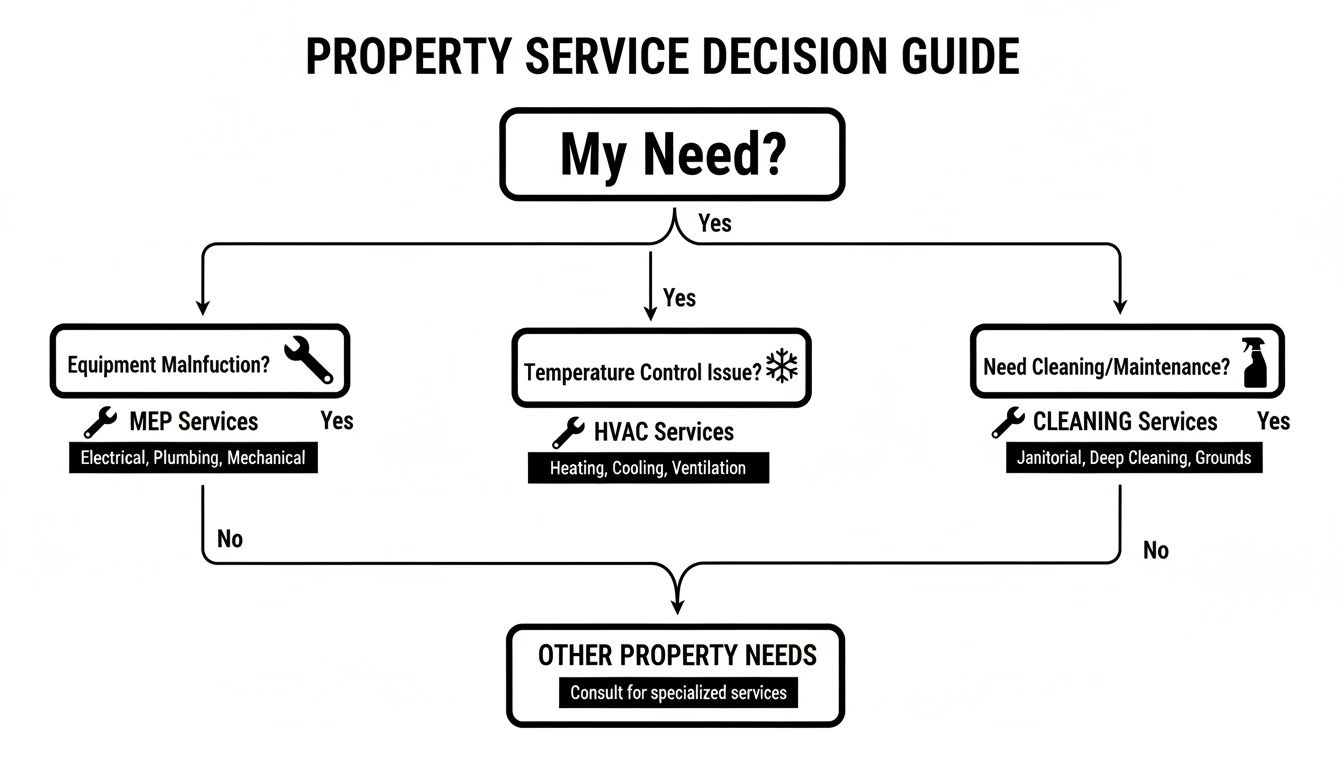
As you can see, different needs, from your core mechanical systems to general cleaning, point toward very different maintenance strategies.
The Flexibility of Ad-Hoc On-Demand Services
On-demand services are simple: you pay per job. This can work well for smaller properties with few critical systems or for hands-on owners who handle most small tasks themselves and only call in the pros for bigger, more complex problems.
The main draw is that you aren't locked into a long-term financial commitment. Got a single leaky tap or a flickering light? Just call a handyman, get it fixed, and pay for that one service. No recurring fees, which sounds great if your budget is tight or unpredictable.
But this model comes with some serious risks. You get no guarantee on response times, and finding a qualified technician during a busy period can feel impossible. The costs are a wild card, too. What looks like a simple electrical fix could uncover a much bigger problem, leading to a bill that takes your breath away. Relying on ad-hoc help often traps you in a cycle of putting out fires instead of building a long-term strategy for your property's health.
To make the comparison clearer, let's break it down side-by-side.
AMC vs Ad-Hoc Services Head-to-Head
| Feature | Annual Maintenance Contract (AMC) | Ad-Hoc (On-Demand) Services |
|---|---|---|
| Cost Structure | Predictable, fixed annual or monthly fee. | Unpredictable, pay-per-job. Emergency rates are higher. |
| Maintenance Focus | Proactive & Preventive. Scheduled checks to prevent failures. | Reactive. Service is only provided after a breakdown occurs. |
| Budgeting | Easy. Costs are known upfront, simplifying financial planning. | Difficult. Impossible to forecast repair costs. |
| Response Time | Guaranteed. Priority service defined in an SLA. | Not Guaranteed. Based on availability; can be very slow. |
| Asset Lifespan | Extended. Regular care keeps equipment running longer. | Shortened. "Run-to-failure" approach causes more wear and tear. |
| Ideal For | Commercial, mixed-use, and premium residential properties. | Small properties with minimal critical systems or one-off tasks. |
Ultimately, your choice hangs on your property’s needs and how much risk you're willing to take. An AMC brings stability, preventive care, and cost control, making it the smart choice for most commercial properties and larger homes. Ad-hoc services offer flexibility but at the cost of uncertainty, better suited for minor, non-critical tasks.
Getting the Contract Right: What to Look For
Think of your maintenance contract as the blueprint for a successful partnership. It’s not just a piece of paper; it’s the rulebook that will shield your property from confusion and unexpected costs. When you review a proposal from a property maintenance company in Dubai, you're formalising a relationship, and a well-crafted agreement is your best tool for making sure it's a good one.
This document should define every part of your engagement, from how quickly a technician will show up for a burst pipe to which spare parts are covered under warranty. Without this level of detail, you're relying on vague promises. A strong contract, on the other hand, gives you the power to hold your provider accountable.
Decoding the Service Level Agreement
The heart and soul of any good maintenance contract is the Service Level Agreement (SLA). This isn't just corporate jargon; it's the section that turns fuzzy commitments like "prompt service" into hard, measurable promises that protect your operations.
A solid SLA needs to spell out:
- Response Times: How quickly will a technician be dispatched and arrive at your property after you report a problem? This must be broken down by urgency—for example, within 1 hour for an emergency like a major leak, 4 hours for an urgent issue like a total AC failure, and maybe 24 hours for a routine fix.
- Resolution Times: A quick response doesn't mean much if the actual repair drags on for days. The contract needs to set clear targets for how long it should take to fully resolve the issue from start to finish.
- Operating Hours: The agreement has to clearly state the hours of coverage. If you’re managing a critical asset, 24/7 emergency support is an absolute must-have.
A vague SLA is one of the biggest red flags you can find. If a contract is missing specific, time-based commitments for both response and resolution, you have no real guarantee of service when you need it most. Insist on seeing clear, measurable targets before you even think about signing.
Verifying Warranties and Certifications
Beyond the SLA, your contract needs to provide solid assurances about the quality of the work and the company's credentials. Don't gloss over these details—they're an essential layer of protection for your investment.
Warranties on Parts and Labour
Any reputable company will stand by its work. Your contract must have an explicit warranty period for both the technician's labour and any spare parts they install. A standard warranty gives you peace of mind that if a fix fails too soon, you won’t be paying twice for the same problem.
Essential Certifications
Certifications are more than just logos on a website; they're proof of a company’s commitment to quality. For any maintenance provider, the ISO 9001:2015 certification is a big one. This international standard confirms the company has a proper Quality Management System in place, meaning their processes for everything from training to service delivery are documented and followed. Working with an ISO-certified firm is a great way to reduce your risk and ensure a higher standard of care.
Spotting the Contractual Red Flags
A good contract should be transparent and straightforward. As you read through it, keep your eyes peeled for common red flags that could signal trouble down the road. A little caution now can save you from major headaches later.
Here are some common warning signs to watch out for:
- Vague Scope of Work: The contract should list exactly which assets and services are covered. Ambiguous language like "general MEP support" is a recipe for arguments over what is and isn't included.
- Hidden Costs: Dig into the pricing section. Look for sneaky clauses about extra call-out fees, charges for "consumables," or premium rates for after-hours work that weren't discussed upfront.
- Automatic Renewal Clauses: Be careful with contracts that lock you into another full term without your explicit permission. You should always have a clear and fair process for deciding whether to renew or terminate.
- Lack of Reporting: The agreement should require regular service reports that detail the work done, inspection findings, and recommendations. Without this paper trail, you have no real way to track performance or the return on your investment.
How Technology Is Transforming Property Maintenance
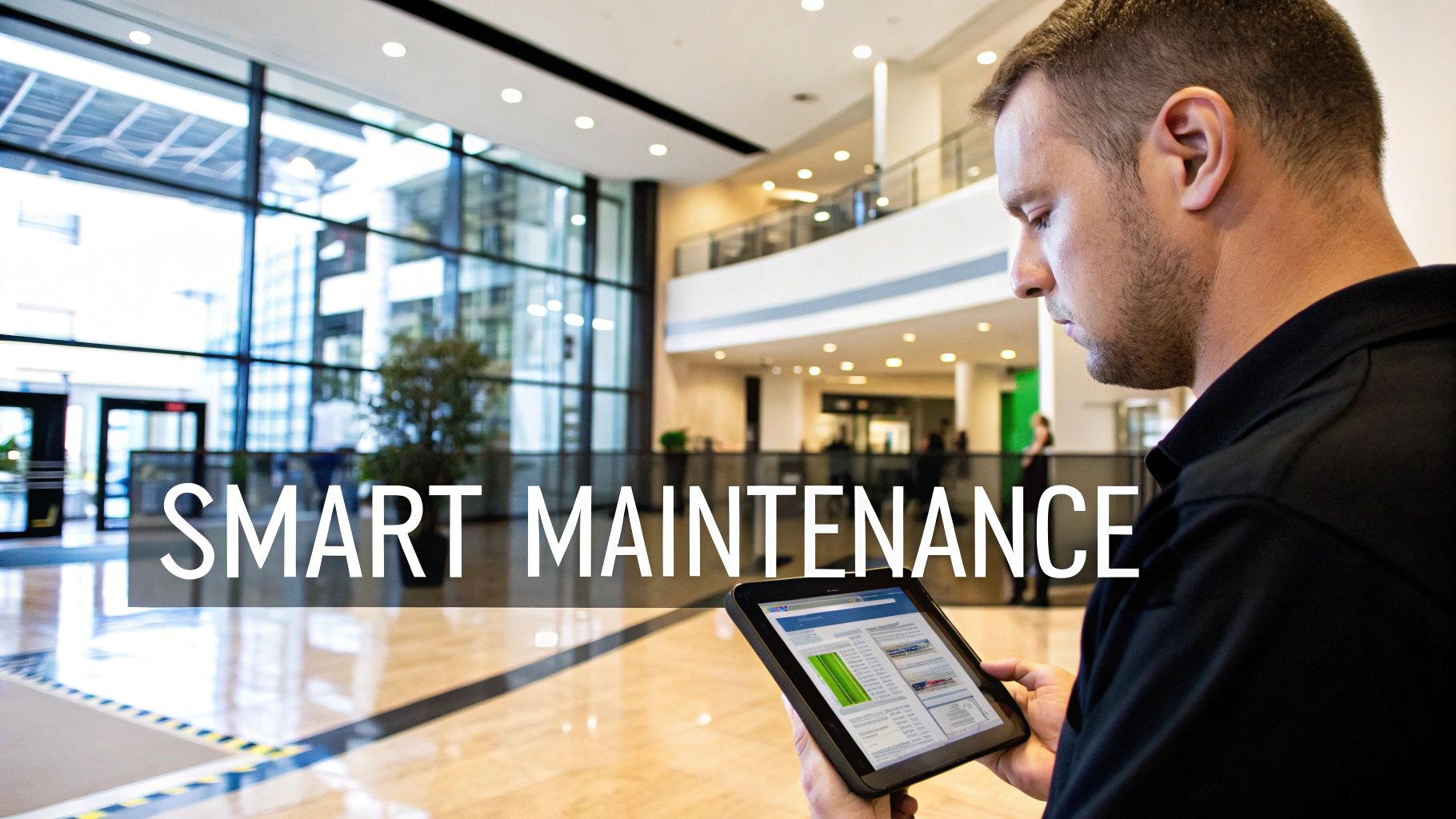
The days of frantic phone calls, misplaced paper work orders, and wondering where your technician is are quickly fading. The best property maintenance companies in Dubai no longer just fix problems—they use technology to stop them from happening in the first place. This shift delivers a service that's faster, more transparent, and far more efficient.
This isn't about adding flashy gadgets for the sake of it. It’s a fundamental change in how maintenance is managed. Think of it like navigating with an old paper map versus using a real-time GPS app. Both might get you there, but one gives you instant traffic updates, the clearest route, and an exact arrival time, killing all the guesswork.
Modern maintenance technology offers that same level of control over your property's health. It turns a chaotic, reactive process into a structured, proactive operation.
From Phone Calls to Photo-Based Work Orders
One of the most powerful changes is the move away from vague verbal requests. Instead of a tenant calling to say, "The AC is making a weird noise," they can now use a mobile platform to submit a ticket with a photo or even a short video of the problem.
This simple change has a massive impact. For a property maintenance company in Dubai, this means:
- Faster Diagnosis: Technicians can literally see the problem before they arrive, letting them bring the right tools and parts for a first-time fix.
- Clear Documentation: Every request, message, and resolution is logged digitally. This creates a permanent, searchable record for compliance and accountability.
- Reduced Miscommunication: A picture is worth a thousand words. Visual proof cuts out the back-and-forth and gets everyone on the same page, fast.
This digital trail also provides invaluable data. By tracking repair types and frequency, you can spot assets nearing the end of their life and budget for replacements ahead of time, avoiding the high cost and hassle of an unexpected failure. Our guide on technology-enabled maintenance solutions explores how these data-driven insights can sharpen your operations.
Real-Time Tracking and Digital Reporting
Another game-changer is the ability to see what’s happening in real-time. Modern platforms let facility managers track a technician's location, monitor the status of a work order, and get instant notifications when a job is done. This transparency builds trust and gives you a clear, live view of your maintenance operations.
Technology brings accountability and efficiency to every step of the maintenance process. It provides the data needed to move from a "break-fix" model to a predictive strategy, significantly reducing asset downtime and operational costs.
The benefits go far beyond convenience. Building management firms in Dubai are projected to boost their operational efficiency by 30-50% by adopting mobile apps and AI. Leading providers use photo-based work order systems and ISO-certified processes to tackle common issues like HVAC failures—which make up 35% of emergency calls—and achieve energy savings of up to 20% with preventive care.
Ultimately, a tech-forward maintenance provider isn't just offering a service; they are offering a smarter, more efficient way to protect your investment. By embracing these tools, they cut down on manual effort, improve tenant satisfaction, and give you the data needed to make informed decisions that optimise spending and prove a clear return on investment.
Making the Right Choice for Your Property
Choosing a partner to look after your asset is one of the most important decisions you'll make. Getting the right property maintenance company in Dubai isn't just about hiring someone to fix things when they break. Think of it as a strategic move that directly protects your investment, gets a handle on your operational costs, and ultimately, safeguards your profitability. This single decision ripples through every part of your property’s health, from keeping tenants happy to preserving its long-term market value.
The journey to finding that ideal partner involves a few critical checkpoints. It all starts with a crystal-clear understanding of what your property actually needs. You have to assess everything from the mission-critical HVAC and MEP systems to the civil works and cleaning required to keep the place looking its best. A great provider can offer a complete solution, but you first have to know what you’re asking for.
Putting Your Strategy Together
Once you have a solid picture of your requirements, the next step is picking the right service model. As we’ve seen, an Annual Maintenance Contract (AMC) is the clear winner for most commercial and high-value residential properties, offering predictable budgets and proactive care. It flips the script on maintenance, turning it from a reactive, costly scramble into a planned, strategic investment in your asset’s longevity.
On the other hand, ad-hoc services give you flexibility but come with the baggage of unpredictable costs and uncertain response times. They’re best kept for non-critical, one-off jobs.
Your final decision should feel like a partnership, not just a transaction. The goal is to find a proactive, professional, and tech-savvy provider who acts as a true custodian for your investment in Dubai's competitive real estate market.
Vetting Your Potential Partner
With your service model locked in, the focus shifts to due diligence. A detailed contract is your shield, so don't skim it. Scrutinise the Service Level Agreement (SLA) for specific, measurable response and resolution times. You need to know exactly what to expect when something goes wrong. Verify the warranties for both parts and labour, and always confirm essential certifications like ISO 9001:2015, which is a strong signal of a company's commitment to quality.
Finally, prioritise providers who have embraced modern technology. Tools like photo-based work order platforms and real-time technician tracking aren't just flashy extras anymore; they are essential for transparency, efficiency, and accountability. A tech-enabled company can slash asset downtime by as much as 75%, simplify communication, and give you the hard data needed to make smarter financial decisions. Follow these steps, and you’ll be perfectly equipped to select a partner who will genuinely safeguard and enhance your property.
Got Questions About Property Maintenance? We’ve Got Answers.
When you're looking after a valuable property in Dubai, it’s natural to have questions. Getting the right maintenance partner is a big decision, and you need to be sure you're making the right call. To help you get there, we’ve put together some straight-talking answers to the questions we hear most often.
Think of this as your final checklist to clear up any lingering doubts about costs, quality, and what to expect from a service agreement. Let’s get you the clarity you need.
What's the Real Cost for an Annual Maintenance Contract in Dubai?
There’s no single price tag for an Annual Maintenance Contract (AMC), as the cost really depends on your property’s size, its age, and exactly which services you need covered. But to give you a ballpark idea for residential spots:
- Studio or 1-Bedroom Apartment: You’re likely looking at a range between AED 3,000 to AED 8,000 for the year.
- Larger Apartments (2-Bedrooms and up): These typically fall somewhere between AED 8,000 and AED 13,000 annually.
For villas, commercial towers, or buildings with a mix of retail and residential, the pricing is completely customised. The quote will hinge on how complex your equipment is, the response times you need guaranteed in your SLA, and if any specialised systems need looking after. A word of advice: never accept a one-line quote. Always ask for a detailed breakdown so you know exactly what you’re paying for.
How Big of a Deal Are Certifications Like ISO 9001?
Honestly? They’re a huge deal. A certification like ISO 9001:2015 is more than just a fancy logo for a company’s website—it’s your proof that they take quality seriously. It shows they have solid, audited processes for everything they do, from how they train their technicians to the way they manage your service requests.
For a facility manager, going with an ISO-certified provider is a smart move. It means you're teaming up with an organisation that’s committed to delivering the same high standard of service, every single time. It’s a simple way to lower your risk and protect the value of your asset.
What Should I Actually Look for in a Service Level Agreement (SLA)?
A good Service Level Agreement (SLA) is all about specifics. Vague promises like "fast service" are red flags. You want firm, measurable commitments that leave no room for interpretation.
Make sure your SLA clearly spells out:
- Response Times: How long will it take for a technician to be at your door? This should be broken down by urgency (e.g., within 1 hour for an emergency, 4 hours for urgent issues).
- Resolution Targets: It's not just about showing up. How long will they take to actually fix the problem?
- Coverage Hours: Are they available 24/7 for emergencies? The SLA should state this explicitly.
- Escalation Path: What’s the plan if they miss a target? A clear process shows they hold themselves accountable.
Can One Company Really Handle All the Maintenance for a Mixed-Use Building?
Yes, and frankly, it’s the most efficient way to do it. A top-tier property maintenance company in Dubai is built to handle the varied demands of mixed-use properties, which might have retail on the ground floor, offices above, and residential apartments on top.
Choosing one integrated provider means you have a single point of contact for everything. They can manage the building-wide HVAC and MEP systems, look after the landscaping in common areas, and handle deep cleaning for the retail units. This approach just makes life easier—it streamlines your contracts, simplifies communication, and ensures you get a consistent level of quality across the entire property.
Ready to partner with a tech-enabled, ISO-certified team that guarantees uptime and protects your investment? SnapFixNow delivers comprehensive AMC programmes and 24/7 support across Dubai. Learn more and request your customised quote at https://www.SnapFixNow.com.