You’ve just taken over a building in Dubai. The handover pack is incomplete, half the warranties are buried in email threads, the chillers look operational but undocumented, and occupants already assume maintenance is “live”. That’s the point where first facilities management stops being an abstract function and becomes an operational risk problem.
For a new asset owner or facility manager, day one isn’t about buying software or issuing a generic service contract. It’s about establishing control. In the UAE, facilities management has been a formal discipline since the late 1970s and early 1980s, when Dubai’s growth created the first structured FM practices in the region, as outlined in this history of facilities management in the UAE. That history matters because the same lesson still applies. Buildings don’t stay stable on their own. They need an operating framework.
Table of Contents
- Executive Summary Your First 90 Days in Facilities Management
- Phase 1 The Initial Site Survey and Risk Assessment
- Phase 2 Asset Inventory, Tagging, and Lifecycle Planning
- Phase 3 Structuring Maintenance Calendars and Contracts
- Phase 4 Defining Contractor and Warranty Management Workflows
- Phase 5 Establishing KPIs and Photo-Based Reporting Frameworks
- Frequently Asked Questions for New FM Implementations
- Q: What should a new owner set up first after handover?
- Q: How much preventive maintenance is enough in a first facilities management setup?
- Q: Should I choose labour-only or comprehensive maintenance for a Dubai property?
- Q: What are the most useful first KPIs for a new FM team?
- Q: How do I stop warranty issues from turning into unnecessary spend?
Executive Summary Your First 90 Days in Facilities Management
The first 90 days determine whether your building will run on evidence or assumption. Most early FM failures don’t come from one major technical fault. They come from missing baselines, unclear scope, undocumented assets, and slow decisions at the point where defects, compliance, and occupancy pressure meet.
In Dubai, that risk is amplified by climate and usage conditions. HVAC systems operate under sustained heat stress. Dust loading affects filters, coils, and fresh air systems. Humidity cycles expose weaknesses in insulation, drainage, seals, and controls. If the building has already been occupied or poorly maintained, hidden deterioration may be sitting behind a clean reception area and a working BMS screen.
The practical objective is simple. Convert the asset from a handed-over building into a controlled operating environment. That means you need a technical survey, a usable asset register, a maintenance calendar, contractor workflows, and measurable service reporting. Without those five elements, your FM setup is reactive even if the contract says “preventive”.
What must be stable by day 90
By the end of the first three months, a new FM operation should have:
- A current risk register: Not a generic snag list, but a ranked record of safety, compliance, operational, and lifecycle risks.
- A critical asset inventory: HVAC, MEP, fire life safety, pumps, electrical distribution, water systems, and access-critical equipment should all be identified and traceable.
- A live planned maintenance schedule: The schedule must reflect actual site conditions, not only OEM theory.
- Clear service boundaries: In-house team, specialist subcontractor, OEM, and warranty responsibility should be defined before the first major failure.
- Working KPIs: Response time, first-time fix rate, and planned maintenance completion should already be visible to management.
Practical rule: If you can’t identify the asset, locate its documents, confirm its status, and assign service responsibility, you don’t control it.
What usually goes wrong early
New owners and new FM teams often make the same mistakes. They mobilise an AMC before validating asset condition. They accept old registers without field verification. They treat compliance as a paper exercise. They also underestimate how quickly unresolved minor faults become occupant complaints, emergency call-outs, and unplanned spend.
A disciplined start is more valuable than a fast start. That’s especially true in first facilities management, where every weak assumption gets baked into the operating model.
Phase 1 The Initial Site Survey and Risk Assessment
The first site survey is not a courtesy walk-through. It is the technical basis for every FM decision that follows. If you rush it, your maintenance plan will inherit bad data, your contractor will price uncertainty into the contract, and your first quarter will be spent reacting to faults that should have been visible on day one.

A proper survey starts with documents, but it cannot end there. Review as-built drawings, O&M manuals, statutory certificates, testing and commissioning records, and prior maintenance logs if they exist. Then verify all of it physically. In Dubai, field conditions often diverge from drawing sets because of tenant fit-out changes, retrofit works, undocumented replacements, or partial repairs.
For commercial and mixed-use buildings, this inspection checklist for commercial building inspections by property managers is a useful reference point because it reflects the kinds of defects that create immediate operational friction.
What the first survey must capture
The survey needs to test both condition and maintainability.
Focus on these categories:
- HVAC and ventilation: Check air handling condition, filter loading, coil cleanliness, drain performance, insulation integrity, control response, unusual noise, and evidence of condensate leakage. In UAE conditions, heat load and dust stress expose neglected systems quickly.
- Electrical infrastructure: Inspect main panels, DBs, labelling quality, thermal stress signs, cable management, earthing visibility, and access safety.
- Water and drainage systems: Review pumps, valves, pipe supports, water hammer signs, leaks, insulation, tank condition, and drainage blockages.
- Fire life safety systems: Confirm panel status, detector condition, extinguisher visibility, pump room accessibility, and coordination records for life safety systems.
- Building fabric: Look for roof ponding, façade seal deterioration, door closer failure, moisture staining, cracked civil finishes, and corrosion in exposed service zones.
Don’t accept “working” as a condition rating. A pump can be running and still be a risk if the base is loose, the valve train is undocumented, or the motor is outside its service history.
How to prioritise findings
Your output should be a risk register, not a photo dump. Each issue should be classified by operational impact.
A practical triage structure works well:
Immediate safety or compliance risk
Anything affecting life safety, electrical exposure, water ingress near power, blocked access, or critical statutory obligations.Business continuity risk
Faults likely to stop cooling, power distribution, water supply, drainage, lift support systems, or key tenant operations.Short-cycle deterioration risk
Items that won’t fail today but will worsen quickly under Dubai operating conditions, such as damaged insulation, blocked condensate lines, and dirty condenser sections.Lifecycle and appearance items
Lower-priority defects that still need logging because they influence future CAPEX and occupant perception.
This phase often determines the quality of all later MEP services in Dubai planning. If the survey is weak, the maintenance model will be weak in the same places.
Phase 2 Asset Inventory, Tagging, and Lifecycle Planning
Most buildings have equipment. Fewer have a reliable asset register. That difference matters because maintenance only becomes controllable when every critical component has an identity, location, service history, and ownership status.

The register should start with critical plant, not with decorative or low-risk items. In a Dubai building, that usually means chillers, package units, FAHUs, pumps, electrical panels, water heaters, fire pumps, pressurisation equipment, BMS interfaces, extraction systems, and major plumbing assets. If the asset can disrupt occupancy, safety, or major OPEX when it fails, it belongs in the first-wave register.
A preventive plan without an accurate register is only a calendar. It doesn’t tell you what is being maintained, whether the asset is still under warranty, or whether the service history belongs to the same unit now sitting on site.
Build the asset register before you build the maintenance plan
A practical starting point is to create a field-verified digital list and assign a unique identifier to every critical asset. QR codes work well because technicians can scan the tag and access photos, manuals, task history, and warranty notes on site. That reduces ambiguity and shortens rectification time when multiple similar units are installed across the same property.
For maintenance teams building their first structured PM environment, this explanation of PPM meaning in maintenance is useful because it ties planned work back to individual asset records rather than generic checklist routines.
What each asset record should contain
Each record should be lean enough to maintain and detailed enough to support decision-making.
Include:
- Identification data: Asset ID, description, make, model, serial number, and exact physical location.
- Operational status: Live, isolated, standby, defective, decommissioned, or tenant-controlled.
- Technical data: Capacity, voltage, duty point, filter size, belt type, refrigerant type, or other relevant specifications.
- Commercial status: Warranty dates, service provider, spare part constraints, and handover defects if unresolved.
- Evidence set: Clear site photos, nameplate image, panel labelling, and surrounding access conditions.
A strong asset register also improves lifecycle planning. You can spot equipment clusters installed at the same time, identify unsupported brands, and separate assets that justify replacement planning from those that still warrant preventive investment.
A building with undocumented assets usually spends more on call-outs because every fault starts with rediscovery.
You don’t need a perfect digital twin on day one. You need a trustworthy operating list that technicians can use, managers can audit, and procurement can rely on when evaluating HVAC maintenance contracts and broader replacement exposure.
Phase 3 Structuring Maintenance Calendars and Contracts
Maintenance planning has two jobs. It protects the asset, and it protects the budget. If the calendar fails, the contract becomes a dispute document instead of a service document.
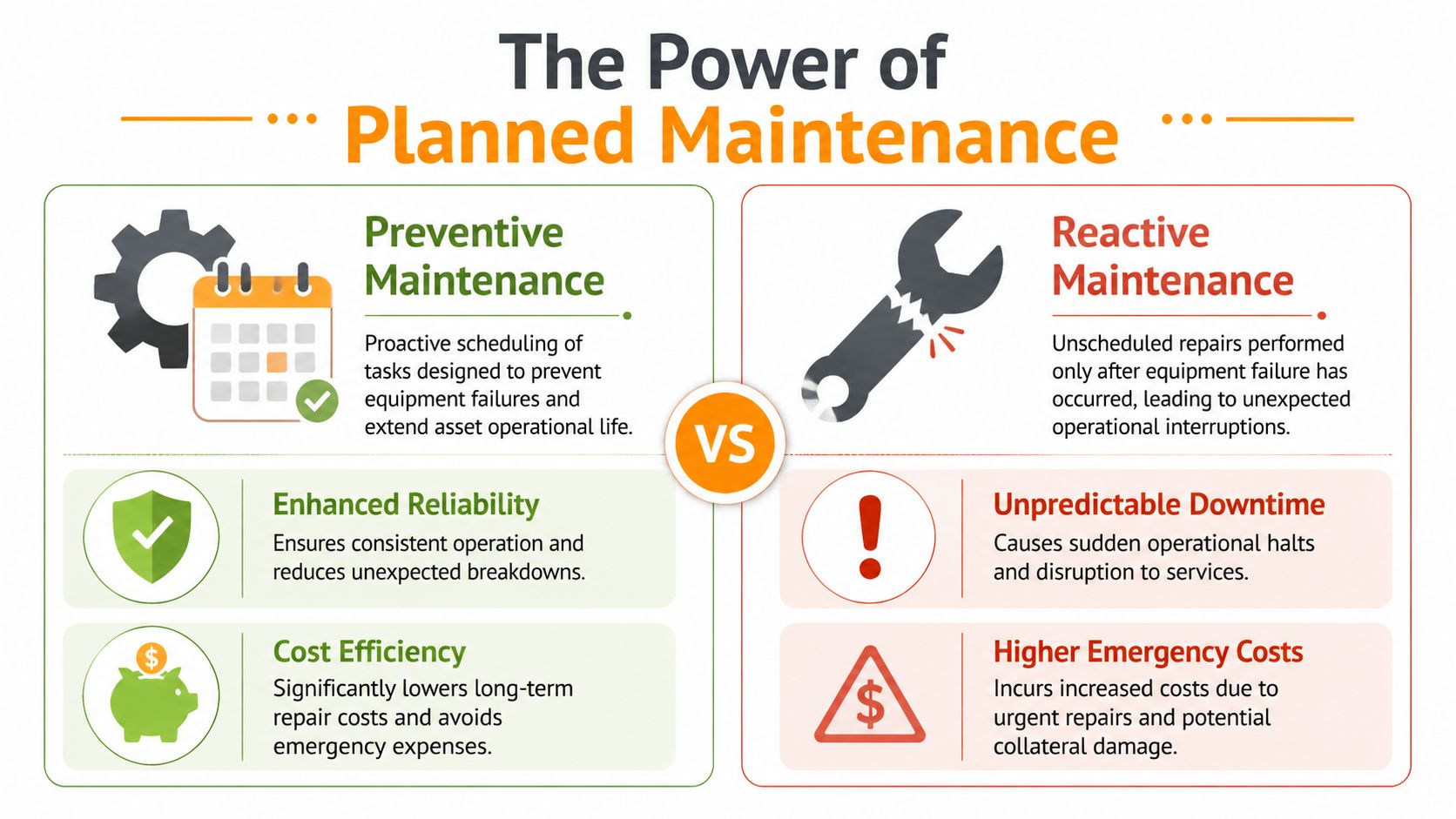
The financial logic for planned maintenance is well established. Reactive maintenance costs 3 to 6 times more than preventive maintenance, and organisations should maintain a preventive maintenance ratio of 50% or higher for efficient operations, according to this benchmark on facility management maintenance metrics. In the same benchmark, deferred work order backlog should not exceed 4 to 6 weeks and should contain only non-critical items. Once backlog stretches beyond that, you’re usually looking at under-resourcing, budget mismatch, or weak planning discipline.
In Dubai, this isn’t theoretical. HVAC neglect becomes expensive quickly because high ambient conditions punish dirty coils, restricted airflow, poor drainage, and unstable controls. The issue isn’t only breakdown frequency. It’s also energy drift, occupant discomfort, and repeated temporary repairs that consume technician hours without fixing root cause.
Preventive planning is the financial baseline
Your maintenance calendar should be asset-led and season-aware. Start from critical equipment, apply OEM requirements, then adjust for actual UAE operating conditions and occupancy intensity. A fresh air unit serving a heavily used retail area should not inherit the same inspection rhythm as lightly loaded back-of-house equipment.
Use these rules:
- Set criticality first: Cooling, power, life safety, water transfer, and business continuity assets must anchor the calendar.
- Separate statutory from routine tasks: Compliance activities need their own control path and evidentiary records.
- Build for access constraints: Rooftop units, tenanted areas, and night-only service windows need realistic labour planning.
- Add rectification logic: PM finds defects. Your process must state who approves corrective work, how it’s priced, and how quickly it must be closed.
A major regulatory turning point came in 2007, when Dubai Law No. 26 mandated professional FM for multi-unit buildings, as noted in the history of IFMA and related FM milestones. For owners today, the practical lesson is straightforward. Professional FM is not just about manpower on site. It is about a managed system of maintenance, documentation, compliance, and accountability.
Comparison of AMC models for UAE commercial buildings
Contract structure changes risk allocation. The cheapest annual figure is often the least stable operating model.
| Parameter | Labour-Only AMC | Comprehensive AMC |
|---|---|---|
| Upfront budget visibility | Lower initial contract value, but variable repair exposure | Higher initial contract value, stronger budget predictability |
| Spare parts and consumables | Usually excluded and approved case by case | Usually bundled or partially bundled by scope |
| Best fit | Newer assets, low failure history, stronger owner oversight | Older assets, critical environments, limited internal FM capacity |
| Cash flow pattern | Irregular. Small monthly fee with intermittent corrective spikes | More stable. Higher fixed cost with fewer approval interruptions |
| Procurement workload | Higher. More quotations, approvals, and dispute points | Lower for routine corrective events within contract scope |
| Risk of delayed rectification | Higher if each defect needs separate commercial approval | Lower where inclusions and SLA triggers are clearly defined |
| Warranty coordination | Often owner-managed unless written into scope | Easier to integrate if the contract includes administration support |
For many properties, the right answer isn’t ideological. It depends on asset age, warranty position, occupancy sensitivity, and how much technical oversight the owner can maintain internally. In practice, a structured approach to Annual Maintenance Contracts (AMC) is often the cleanest way to establish service consistency from the first operating cycle.
Phase 4 Defining Contractor and Warranty Management Workflows
Even a well-staffed FM function depends on third parties. Specialist fire systems contractors, lift vendors, BMS integrators, OEM technicians, fit-out contractors, and emergency repair teams will all interact with your building at some point. If those interfaces are unmanaged, delays and disputes become routine.
The fix is procedural. Establish a contractor management workflow before the building reaches steady-state occupancy. That workflow should define how contractors are inducted, what documents they must submit, who approves site access, which jobs require permit-to-work controls, how completion is verified, and who closes the record. A useful reference for mapping these stages is this contract management workflow roadmap, which aligns well with FM environments that need clear approvals and audit trails.
Control the interface between FM and third parties
Every contractor workflow should answer five practical questions:
- Who owns the scope: Is the contractor responding under warranty, under AMC, under ad hoc purchase order, or as an OEM specialist?
- Who authorises entry: Security, FM, tenant representative, and permit issuer should not be left to informal WhatsApp chains.
- What safety controls apply: Electrical isolation, hot works, confined access, roof access, and after-hours work all need predefined controls.
- What evidence proves completion: Photos, test results, sign-off sheets, commissioning values, and restored housekeeping condition.
- What happens if the repair fails again: Escalation path, revisit responsibility, defect liability, and commercial treatment.
If scope, access, and evidence are unclear, the contractor will still attend. The problem is that nobody will agree later on what was supposed to happen.
Warranty management must sit inside the work order process
Warranty management is often neglected because it feels administrative. In practice, it is cost control. Before issuing any chargeable rectification order, the FM team should check whether the asset, component, or recent work is still covered by OEM, installer, fit-out, or defects liability terms.
A workable process is simple:
- Log every warranty at asset level.
- Attach coverage notes and expiry records to the work order system.
- Force a warranty check before commercial approval of corrective works.
- Record whether the issue was closed under warranty, rejected, or transferred to owner cost.
- Keep a named escalation contact for every supplier.
This approach reduces duplicate spending and shortens accountability arguments. It also helps procurement teams evaluate whether an apparently lower-cost maintenance model is indeed shifting too much rectification risk back to the owner.
Phase 5 Establishing KPIs and Photo-Based Reporting Frameworks
Facilities management is expensive enough that reporting cannot be cosmetic. Facility management typically accounts for 5 to 10% of a company’s total operating costs, and tracking response time, first-time fix rate, and energy cost per facility location is a core part of operational control, according to this overview of facility management cost and KPI practice.
That matters because many FM teams report effort instead of outcomes. They show visit counts, technician attendance, and generic monthly summaries. Owners don’t need more activity data. They need evidence that service response, asset reliability, and defect closure are improving in ways that protect OPEX and occupancy.
Start with operational KPIs that change decisions
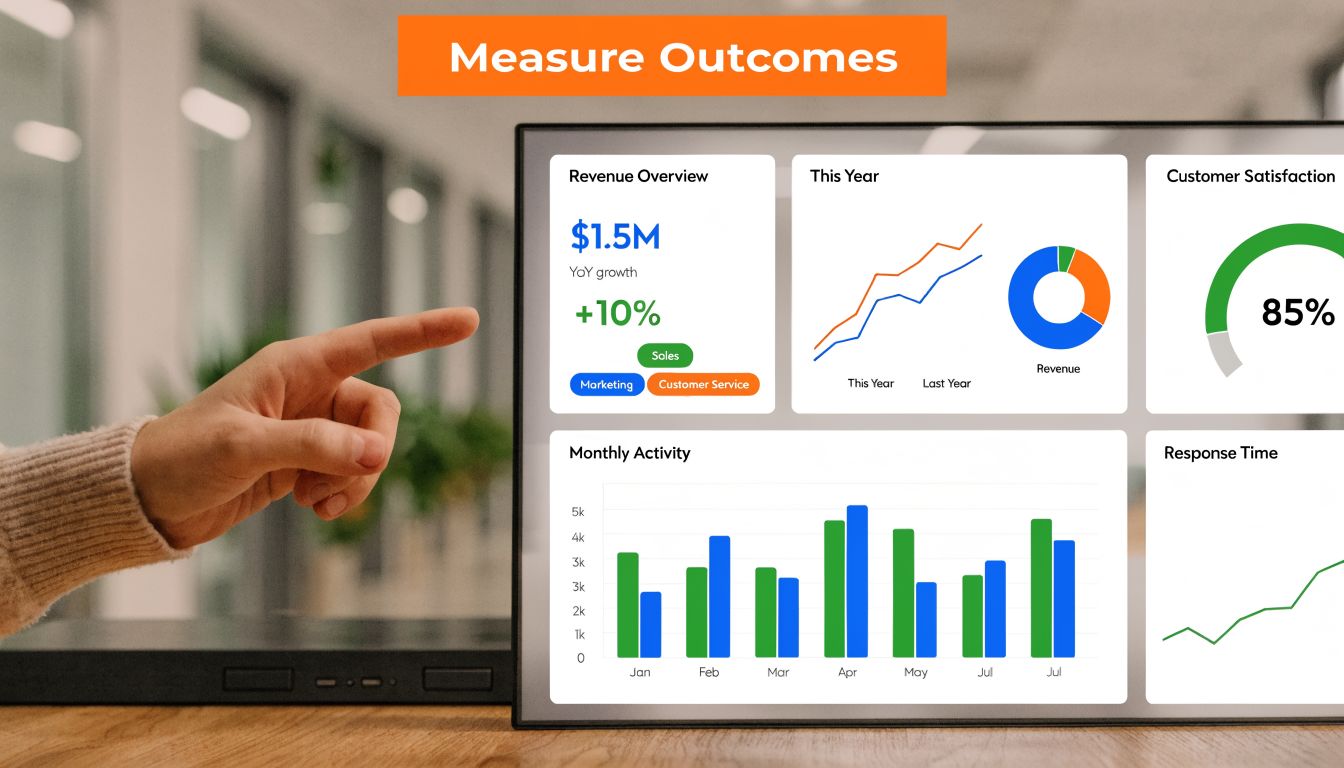
A new FM implementation should start with a small KPI set that management can effectively use.
Recommended baseline KPIs:
- Response time: Measure how quickly the team attends after a fault is logged, then separate emergency, urgent, and routine categories.
- First-time fix rate: This shows whether technicians arrive prepared, whether diagnostics are accurate, and whether spare parts planning is realistic.
- PM completion rate: This is your planning discipline metric. If planned work slips repeatedly, future reactive load is already building.
- Open corrective backlog: Track aged defects, especially repeat issues and unresolved critical assets.
- Energy cost by location: This is useful once metering quality is acceptable and major systems are stable.
A KPI only works if ownership is clear. Someone must review exceptions, ask why performance moved, and approve corrective action. Otherwise, the dashboard becomes decoration.
Why photo-based reporting changes contractor control
Photo-based reporting is not just a convenience feature. It changes the quality of evidence. For every meaningful work order, the technician should upload a before image, in-progress image where relevant, and an after image showing completion condition. That matters in Dubai buildings where access windows are short, defects can recur under load, and owners may not physically inspect every closure.
Photo records help in several ways:
- Quality verification: You can confirm whether filters were replaced, panels relabelled, insulation reinstated, or leaks rectified.
- Dispute resolution: Before-and-after records reduce ambiguity when tenants or contractors challenge closure quality.
- Trend analysis: Repeated staining, recurring trips, and recurring drain issues become visible over time.
- Handover continuity: Staff changes don’t erase site knowledge when the evidence sits in the work order history.
Good FM reporting answers three questions immediately. What failed, what was done, and what evidence proves the closure is acceptable?
In Dubai implementation terms, theory becomes operational. A building with strong reporting can govern outsourced technicians, justify rectification budgets, and identify where MEP services in Dubai need deeper intervention rather than repeated minor repairs.
Frequently Asked Questions for New FM Implementations
Q: What should a new owner set up first after handover?
A: Start with control documents and field validation. You need a site risk register, a verified critical asset list, a live defect log, and clear responsibility for statutory systems. If you start with a broad contract before understanding actual asset condition, you’ll lock uncertainty into the operating model.
Q: How much preventive maintenance is enough in a first facilities management setup?
A: Preventive work should dominate the maintenance mix. According to the benchmark referenced earlier, reactive maintenance costs 3 to 6 times more than preventive maintenance, and a preventive maintenance ratio of 50% or higher is the efficiency threshold in industry practice. If your building is still generating mostly reactive jobs after mobilisation, either the inherited condition is poor, the PM scope is too thin, or the staffing plan doesn’t match the asset base.
Q: Should I choose labour-only or comprehensive maintenance for a Dubai property?
A: Choose based on risk transfer, not headline price. Labour-only works better when assets are relatively new, warranties are active, and the owner can approve parts and specialist works quickly. Full-service structures usually fit older buildings, hospitality environments, and assets where delayed rectification carries a direct operational penalty.
Q: What are the most useful first KPIs for a new FM team?
A: Start with response time, first-time fix rate, PM completion, and corrective backlog. These show whether your team is controlling faults or perpetuating them. Once those are stable, add energy and asset-specific reliability views.
Q: How do I stop warranty issues from turning into unnecessary spend?
A: Put warranty review inside the work order approval path. Every fault on covered equipment should trigger a warranty check before external spend is approved. That one rule prevents many duplicate repair costs and clarifies whether the responsible party is the installer, OEM, specialist contractor, or owner-side FM team.
If you’re putting a first FM framework in place, the practical next step is to convert these principles into a working maintenance structure with verified assets, defined SLAs, and evidence-led reporting. In Dubai, that usually means aligning site surveys, Annual Maintenance Contracts (AMC), and specialist hard services under one controlled operating model. Teams that need implementation support often start with a structured review through SnapFixNow.
Meta description: First facilities management in Dubai explained as a practical day-one playbook for asset owners, FM teams, and property managers in the UAE.