HVAC Dubai decisions usually land on the board table only after something has already gone wrong. A tenant complaint escalates. A hotel floor loses comfort during peak occupancy. A DEWA bill jumps without a clear operational explanation. Procurement receives three maintenance quotes that appear similar on price but are not similar on scope, risk, or lifecycle impact.
That’s the context for hvac dubai. In this market, cooling isn’t a convenience line item. It sits directly inside business continuity, compliance exposure, tenant retention, and asset value protection. Dubai’s climate, dust loading, humidity cycles, and regulatory expectations make HVAC strategy a financial decision as much as an engineering one.
Table of Contents
- Executive Summary and Introduction
- The Operational Context for HVAC in Dubai
- Core HVAC Services A Technical Breakdown
- Comparing Maintenance Models AMC vs Reactive
- Decoding HVAC Costs and Budgeting in Dubai
- SLA and Vendor Selection A Procurement Checklist
- Technology for OPEX Reduction and Downtime Mitigation
- Energy Efficiency and Asset Lifecycle Planning
- Sample HVAC Preventive Maintenance Schedule for Dubai Assets
- Frequently Asked Questions about HVAC in Dubai
Executive Summary and Introduction
Dubai asset owners don’t need another generic overview of air conditioning. They need a framework for deciding how to control OPEX, defer avoidable CAPEX, and reduce operational risk without under-maintaining critical systems.
The market itself signals why this matters. The UAE HVAC market, with Dubai as its largest hub, is projected to reach USD 3.31 billion in 2025 and grow to USD 5 billion by 2032, driven by major investment in towers, airports, tourism assets, and sustainability regulation under the Energy Strategy 2050 and Green Building Regulations, according to UAE HVAC market analysis. More demand means more systems, more service vendors, and more room for poor procurement decisions.
For boards and senior operators, the wrong HVAC strategy usually shows up in four places:
- Unstable OPEX from emergency call-outs and repeat failures
- Hidden CAPEX acceleration when neglected assets reach replacement early
- Compliance risk where maintenance records and system condition don’t support inspections
- Occupant impact through comfort complaints, IAQ concerns, and downtime
Board-level rule: Cheap maintenance isn’t the contract with the lowest fee. It’s the model that produces the lowest total operational cost over the asset’s service life.
A sound HVAC decision in Dubai depends on matching service scope, contract structure, SLA design, technology, and retrofit planning to the building’s risk profile. Office towers, hotels, retail centres, and mixed-use communities don’t carry the same failure cost. They shouldn’t be maintained under the same logic either.
The Operational Context for HVAC in Dubai

At 3:00 p.m. in August, a comfort complaint in Dubai is rarely just a comfort complaint. In a hotel, it becomes reputational risk. In an office tower, it turns into tenant escalation and possible fit-out claims. In a retail asset, it hits dwell time and revenue the same day. HVAC in Dubai operates as a business continuity system, and boards should budget and govern it that way.
The local operating conditions are hard on plant. High ambient temperature, sustained humidity, airborne dust, and long annual run hours push equipment far outside the assumptions many owners still use when they buy low-cost maintenance. The result is familiar. Higher static pressure from dirty filters, reduced heat transfer across fouled coils, unstable humidity control, nuisance trips, and compressor stress during peak demand windows.
That has direct financial consequences. Poor HVAC discipline does not stay inside the maintenance budget. It shows up as excess energy use, more frequent reactive attendance, premature component replacement, shorter asset life, and avoidable tenant churn. For asset owners focused on NOI, this is an OPEX control issue first and a technical issue second.
Dubai also changes the risk profile of deferred work. A missed coil cleaning cycle or weak controls calibration in a mild climate may only reduce efficiency. In Dubai, the same lapse can push a system into visible failure during occupied hours. That is why maintenance intervals, spare parts policy, and response SLAs need to be set against seasonal load and occupancy criticality, not copied from a generic annual contract template.
Three pressures deserve board attention.
Thermal stress on continuously operating equipment
HVAC systems in Dubai carry long operating hours and narrow tolerance for underperformance. Weak commissioning, poor air balancing, or neglected condensers and evaporators usually translate into higher kWh consumption before they show up as breakdowns.Dust loading and faster fouling rates
Filters, coils, strainers, and condensate systems degrade faster in this market. If service scope does not account for local fouling rates, airflow drops, indoor air quality declines, and fan and compressor energy rises.Auditability and compliance exposure
Owners need maintenance records that stand up to internal audit, ESG reporting, insurer scrutiny, and municipal expectations. A contractor that cannot document readings, corrective actions, and repeat-failure history creates governance risk, not just engineering risk.
Communication discipline matters too. During service interruptions, facilities teams still need a documented trail for tenant notices, technician dispatch, and access coordination. Teams that handle this manually often tighten response workflows by text-enabling your business landline, especially across larger portfolios where speed and traceability affect SLA performance.
The operating context in Dubai is clear. HVAC decisions should be made on failure consequence, energy exposure, and asset preservation value. Owners who treat cooling as a commodity service usually end up paying for it twice. First through unstable OPEX, then through earlier CAPEX.
Core HVAC Services A Technical Breakdown
Procurement often receives proposals for “HVAC service” that appear broad enough on paper but differ materially in execution. The first control is to separate service categories properly.
Installation and retrofitting
This scope covers new system installation, equipment replacement, controls upgrades, testing, balancing, and handover coordination. In practice, the primary concern isn’t only whether the unit works. It’s whether the installed system aligns with load conditions, control logic, ventilation requirements, and maintainability.
Retrofitting is usually justified when an older system creates persistent inefficiency, repeated rectification cost, or control limitations that preventive maintenance alone won’t solve. In larger assets, this work should sit within wider MEP services in Dubai because electrical loading, drainage, BMS integration, and fire-life-safety interfaces often determine whether the retrofit performs.
Preventive maintenance
Preventive maintenance is the discipline that keeps HVAC assets serviceable before failure occurs. It typically includes filter management, coil cleaning, refrigerant checks, belt inspection, electrical tightening, sensor verification, drain line cleaning, control calibration, and operating parameter review.
The intended outcome is straightforward:
- Maintain efficiency
- Reduce breakdown frequency
- Preserve component life
- Protect comfort and IAQ
- Create predictable service history
Preventive maintenance doesn’t eliminate corrective work. It reduces the volume, severity, and urgency of it.
Corrective and reactive maintenance
Corrective maintenance addresses identified defects. Reactive maintenance responds after a fault has already disrupted operation. The two are related, but they aren’t the same.
Corrective work might include replacing failed capacitors, actuators, fan motors, valves, sensors, compressors, or damaged controls. Reactive service is what happens when those faults are only addressed after comfort loss or system shutdown.
Practical distinction: Preventive work protects performance. Corrective work restores performance. Reactive work happens after the business has already absorbed disruption.
Boards should insist that vendors define which activities sit inside base scope, which are quoted separately, and which trigger emergency call-out rates. Without that distinction, quote comparison becomes unreliable.
Comparing Maintenance Models AMC vs Reactive
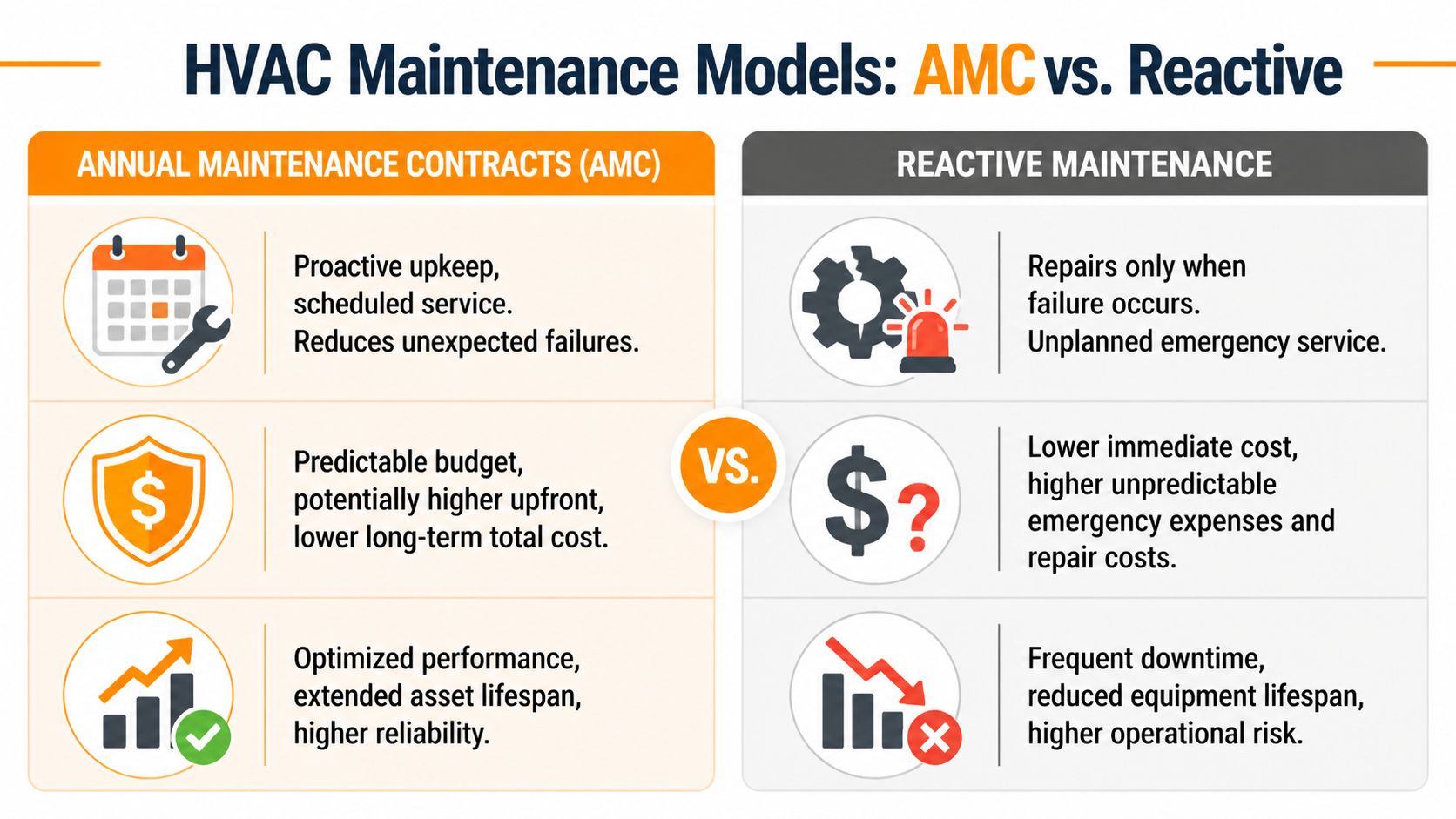
Most portfolio-level HVAC overspend starts with the wrong contract model, not the wrong technician. The key comparison isn’t vendor A versus vendor B. It’s structured maintenance versus run-to-failure.
How the cost logic actually differs
A reactive model looks cheaper because the committed fee is low or absent. That appeals to finance teams when assets appear stable. The problem is that HVAC failures in Dubai rarely arrive as isolated events. One neglected cleaning cycle leads to airflow problems, then comfort complaints, then compressor strain, then emergency attendance, then replacement discussion.
An Annual Maintenance Contracts (AMC) model changes that sequence. It creates a scheduled intervention structure, formal SLAs, reporting discipline, and a service history that allows earlier fault identification.
There are two common AMC structures:
Labour-only AMC
Suitable where owners want planned attendance and budgeting discipline, but are willing to retain parts risk separately.Thorough AMC
Better where uptime matters more than lowest annual fee, particularly in hospitality, healthcare-adjacent, retail, and tenant-sensitive commercial assets.
For teams weighing these models, this breakdown of AMC vs reactive maintenance for commercial buildings is useful because it mirrors the operational decision most building owners are making.
A practical comparison matrix
| Model | Budget profile | Uptime risk | Asset lifecycle impact | Admin burden | Best fit |
|---|---|---|---|---|---|
| Reactive only | Variable and hard to forecast | High | Tends to shorten life through delayed intervention | High during failures | Non-critical or short-hold assets |
| Labour-only AMC | More predictable than reactive | Moderate | Better than reactive if PM scope is disciplined | Moderate | Assets needing structure without full risk transfer |
| Comprehensive AMC | Most predictable | Lower | Usually strongest for lifecycle protection | Lower after mobilisation | Critical operations and owner-held portfolios |
The usual mistake is judging only annual fee levels. A better decision sequence is:
Identify operational criticality
A hotel guestroom floor, retail anchor zone, or executive office stack carries a different consequence of failure than a low-occupancy ancillary area.Review asset age and failure pattern
Older equipment can still sit under AMC, but contract exclusions and parts assumptions need tighter scrutiny.Set response and rectification expectations
If the building requires short response windows, price will move accordingly. That’s normal.Match scope to ownership strategy
Long-term holders usually benefit from planned maintenance discipline. Short-term holders sometimes underinvest, then pay through accelerated deterioration or difficult handovers.
Reactive maintenance can be justified for isolated low-criticality assets. It is weak governance for systems that support occupied, revenue-generating, or compliance-sensitive spaces.
The contract choice should be treated as a risk allocation decision. If the owner retains too much uncertainty under a low-fee reactive model, the apparent saving often disappears into emergency labour, disruption cost, energy waste, and premature plant deterioration.
Decoding HVAC Costs and Budgeting in Dubai
Budgeting for HVAC in Dubai isn’t about finding an average market rate and applying it across the estate. Cost depends on the building, the equipment, the SLA, and the owner’s appetite for risk transfer.
The commercial segment in Dubai, covering offices, retail, and hospitality, dominates HVAC end-user demand and is projected to grow at a 5.2% CAGR through 2033, according to UAE HVAC systems market analysis. That growth matters because it keeps pressure on service capacity and makes disciplined budgeting more important for continuity.
What really drives HVAC cost
Four variables usually explain most of the difference between one quote and another.
System type and complexity
Chillers, VRF systems, DX splits, package units, FCUs, and ventilation systems don’t require the same labour mix or diagnostic depth.Asset condition
An older system with deferred maintenance usually attracts more corrective work, more consumables, and more exclusions.Site profile
Hotels, retail centres, towers, and mixed-use assets have different access restrictions, occupancy patterns, and downtime tolerances.SLA structure
Faster response, longer coverage windows, tighter rectification expectations, and more reporting all increase cost because the vendor must reserve capacity.
A budgeting method that holds up under scrutiny
A stronger OPEX budget usually starts with three cost buckets rather than one blended line.
| Budget bucket | What it covers | Why it matters |
|---|---|---|
| Planned maintenance | Scheduled servicing, inspections, cleaning, reporting | Gives baseline predictability |
| Corrective reserve | Expected wear-and-tear repairs and small rectification | Avoids repeated budget approvals for routine faults |
| Capital watchlist | Units approaching end-of-life or repeated major repair | Prevents surprise replacement pressure |
For procurement and FM leaders, the operational logic is the same as broader risk management. This short guide on how proactive systems improve safety and efficiency in operations is useful because it explains why planned intervention consistently outperforms crisis response.
Budget reviews should also ask practical questions:
- Does the price include consumables and filter policy?
- Are after-hours call-outs bundled or extra?
- Is coil cleaning routine or quoted separately?
- Who pays for access equipment and specialist testing?
- Are exclusions broad enough to undermine the fixed fee?
Cheap quotes usually hide risk in exclusions, labour caps, delayed response terms, or underspecified preventive schedules. That’s where OPEX volatility starts.
SLA and Vendor Selection A Procurement Checklist

The right HVAC vendor isn’t the one with the shortest proposal. It’s the one whose operating model matches the building’s technical risk and reporting requirements. Procurement should test that before price negotiation, not after mobilisation.
Vendor questions that matter
Ask questions that expose delivery capability, not brochure language.
Technical depth
What certifications and practical competencies does the team hold for the actual systems on site?Delivery model
How much of the work is handled by in-house technicians versus subcontractors?Relevant building experience
A vendor that understands hospitality call prioritisation may not be the right fit for an industrial or community portfolio, and vice versa.Process maturity
Is the vendor operating under defined quality procedures such as ISO 9001-based workflows?Reporting discipline
Can the vendor produce asset histories, attendance logs, work completion records, and clear recommendations rather than generic service sheets?
Ask for a sample preventive maintenance report, a sample emergency call report, and a sample exclusion list. Those three documents usually reveal more than the price page.
SLA clauses that reduce disputes
The most expensive contracts are often the vague ones. A usable SLA should define outcomes, not just attendance promises.
| SLA area | What to check | Risk if weak |
|---|---|---|
| Response time | Clock start point, coverage hours, emergency definition | Arguments during urgent failures |
| Rectification time | What counts as temporary fix versus permanent repair | Repeat visits and unresolved faults |
| PM completion KPI | Visit frequency, completion evidence, missed-visit treatment | Preventive scope gets diluted |
| Exclusions | Parts, consumables, access, specialist testing, controls | Fixed fee becomes misleading |
| Escalation path | Named contacts and decision route | Delayed approvals and confusion |
For HVAC maintenance contracts, procurement should also test whether the vendor can support mobilisation properly. That includes asset tagging, PPM calendar creation, baseline condition assessment, and critical spares identification.
One practical reference point is whether the vendor uses documented work-order closure supported by photos, timestamps, and technician notes. That won’t replace engineering judgement, but it does reduce avoidable disputes over whether work was completed to scope.
Technology for OPEX Reduction and Downtime Mitigation

Why visibility changes maintenance outcomes
In Dubai’s dusty environment, clogged filters can reduce HVAC airflow by 40-60% within months, escalating energy use by up to 25%, and photo-tracked AMCs with differential pressure monitoring can prevent the root cause of over 70% of common service calls, according to this UAE HVAC maintenance guide. That’s one of the clearest examples of how maintenance technology affects both OPEX and uptime.
The point isn’t that software cleans filters. The point is that better visibility changes technician behaviour and management decisions. If filter condition, pressure readings, work photos, and timestamps are recorded consistently, the FM team can verify that maintenance frequency matches site reality rather than vendor assumptions.
Where technology fits in real operations
A practical technology layer usually adds value in five places:
Work verification
Time-stamped photos of cleaned coils, replaced filters, or repaired components reduce completion disputes.Asset history
Repeat faults become visible. That helps distinguish one-off issues from developing failure patterns.SLA tracking
Response and closure times can be audited against the contract rather than judged anecdotally.Condition-based action
Pressure trends, temperature anomalies, and repeated alarms support intervention before failure.Budget justification
Boards are more likely to approve corrective work or retrofit spend when the evidence trail is clear.
For example, some Dubai operators use structured digital workflows under their technology-enabled maintenance and predictive monitoring approach to connect service records, inspections, and recurring fault analysis. SnapFixNow is one such option in the local market, using photo-based work-order reporting and real-time tracking as part of its documented FM operations.
A maintenance report that only says “serviced unit” has almost no management value. A report with readings, photos, defect notes, and trend history can support procurement, audit, and CAPEX planning.
Technology doesn’t replace competent technicians. It makes competent technicians easier to manage and weak delivery harder to hide.
Energy Efficiency and Asset Lifecycle Planning
A common Dubai boardroom mistake is approving another round of compressor, fan motor, and control repairs because the invoice looks smaller than replacement. Twelve months later, the asset has absorbed repeated callouts, higher DEWA bills, tenant complaints, and another emergency shutdown. The cheaper decision on paper often costs more across the year.
Energy efficiency has to be assessed as a portfolio control issue. It affects OPEX, the timing of CAPEX, tenant retention, and the probability of service disruption during peak load periods. In Dubai, where cooling demand runs hard for much of the year, inefficient plant does not drift unnoticed in the background. It shows up in utility spend, shortened equipment life, and unstable indoor conditions.
When to keep repairing and when to retrofit
Continued maintenance is financially sound when the unit is stable, spare parts are still obtainable, controls can be serviced, and the asset delivers acceptable performance for its use case. That decision should be based on total operating behaviour, not the cost of the latest work order.
A retrofit review is justified when recurring faults start consuming maintenance budget without restoring reliability. The warning signs are familiar to any FM team managing older stock:
- Breakdowns repeat across the same components or zones
- Technicians rely on frequent manual adjustment to hold setpoints
- Legacy controls limit scheduling, zoning, or fault visibility
- Energy consumption stays high without a clear occupancy or process explanation
- Major parts are replaced, but the system still returns to reactive mode
At that stage, the right comparison is not repair versus replacement in isolation. The board should compare continued corrective spend against four outcomes: lower energy use, fewer tenant-impacting failures, deferred damage to connected equipment, and a longer period before full plant replacement becomes unavoidable.
Why system efficiency changes the asset plan
Variable-capacity systems matter in Dubai because most commercial assets do not operate at peak load all day. Offices, hotels, schools, and mixed-use properties shift by zone and hour. Equipment that can modulate output handles that profile better than older fixed-speed arrangements, particularly where partial-load operation dominates the year.
VRF is one example, but the wider point is asset matching. Zoned control and inverter-driven performance can reduce wasted cooling and limit the stop-start cycling that drives wear. The commercial case gets stronger where occupancy patterns are uneven, fit-outs change often, or tenants expect closer control of comfort conditions.
For boards reviewing older systems, the practical question is simple. Is the current plant still preserving asset value, or is it consuming OPEX to delay a capital decision?
| Condition | Likely action |
|---|---|
| Stable asset, acceptable energy profile, low defect frequency | Maintain and monitor |
| Ageing asset with rising corrective burden | Run a targeted retrofit review |
| Persistent inefficiency plus recurring failures | Build a replacement business case |
| Major tenant repositioning or refurbishment planned | Align HVAC upgrade with CAPEX works |
Lifecycle planning also depends on maintenance discipline. Coil fouling, filter loading, poor drainage, and neglected controls reduce efficiency long before a major failure occurs. A disciplined Dubai HVAC maintenance schedule and seasonal cost planning approach helps asset owners distinguish between systems that need better upkeep and systems that have reached the point where retrofit capital is justified.
For teams formalising replacement triggers and inspection criteria, Products for Automation's reliability guide is a useful reference point for structuring preventive tasks against longer-term asset decisions.
Energy efficiency in Dubai is not a sustainability side topic. It is a direct control on service continuity, operating margin, and how long an HVAC asset remains worth repairing.
Sample HVAC Preventive Maintenance Schedule for Dubai Assets
Preventive schedules in Dubai need shorter intervals for filters, coils, drains, and visual condition checks because dust loading and humidity don’t wait for annual service windows. A useful baseline is to compare your current provider’s schedule against a practical asset-based routine, then refine by system type and occupancy.
| Frequency | Typical task | Operational reason |
|---|---|---|
| Monthly | Inspect and clean or replace filters | Dust loading affects airflow quickly |
| Monthly | Check thermostat and control response | Catches comfort drift early |
| Quarterly | Inspect drain lines and trays | Reduces blockage and hygiene issues |
| Quarterly | Check refrigerant condition and signs of leakage | Supports efficient cooling performance |
| Quarterly | Inspect belts, electrical terminations, and fan operation | Reduces sudden mechanical faults |
| Semi-annually | Deep clean evaporator and condenser coils | Restores heat-transfer efficiency |
| Semi-annually | Review motor condition and vibration indicators | Helps detect wear before failure |
| Annually | Inspect ductwork, insulation, and major electrical components | Supports full-system integrity review |
| Annually | Reassess asset condition and replacement watchlist | Links maintenance to CAPEX planning |
Facilities teams building this into formal PPMs often use external templates as a starting point. Products for Automation's reliability guide is a useful cross-industry example for structuring recurring maintenance logic. For Dubai-specific planning, this guide to HVAC maintenance scheduling for seasonal requirements and cost planning is directly relevant to local operating conditions.
Frequently Asked Questions about HVAC in Dubai
Q: What’s the biggest mistake asset owners make with HVAC in Dubai?
A: Treating HVAC as a reactive trade package instead of a managed asset class. In Dubai, heat, dust, and occupancy pressure make delayed maintenance expensive very quickly.
Q: Is a labour-only AMC enough for a commercial building?
A: It can be, if the asset is in reasonable condition and the owner is prepared to manage parts risk separately. For uptime-sensitive buildings, full scope often creates better budget control.
Q: How should procurement compare two HVAC maintenance proposals?
A: Compare service frequency, exclusions, response terms, reporting format, coverage hours, and rectification responsibilities before looking at annual fee. If those elements differ, the proposals are not directly comparable.
Q: When should an owner consider HVAC retrofit instead of continued repair?
A: Usually when failures repeat, energy performance is poor, controls are unreliable, and major component replacement no longer improves stability. That’s when a lifecycle review becomes more credible than continued patch repairs.
Q: How important is documentation in HVAC contracts?
A: Very important. Service logs, photos, readings, and closure records protect the owner during disputes, inspections, and budget approvals. They also make it easier to justify CAPEX at the right time.
If you’re reviewing HVAC strategy across a portfolio, the practical next step is usually a structured condition review tied to service scope, SLA design, and lifecycle planning. For teams that want that work managed through an integrated FM framework, SnapFixNow is one Dubai-based option for AMC, HVAC, and broader building maintenance delivery.
Meta description: HVAC Dubai guide for asset owners covering OPEX, compliance, AMC vs reactive maintenance, SLAs, lifecycle planning, and budgeting in UAE conditions.