An Annual Maintenance Contract (AMC) in Dubai functions as a strategic asset management tool. It is a proactive agreement designed to maintain the operational integrity of critical systems—including HVAC, electrical, and plumbing—through scheduled, preventive servicing. This approach shifts an asset's maintenance profile from a reactive, high-cost emergency repair model to a structured, planned care framework. In the demanding climate and operational environment of the UAE, this is a fundamental strategy for asset value preservation.
What an Annual Maintenance Contract Delivers in Practice
For property managers, asset owners, and procurement leaders in Dubai, an Annual Maintenance Contract (AMC) is a governance instrument. It establishes control over maintenance activities, replacing unpredictable emergency call-outs with a scheduled, data-driven programme designed to optimise asset lifecycle and performance.
At its core, an AMC is a service-level agreement between a property owner and a maintenance provider. It defines a clear scope and schedule of preventive tasks, ensuring a building's core systems operate not just functionally, but with optimal efficiency and safety in line with UAE regulations.
Core Components of a Standard AMC Scope
A typical annual maintenance contract in Dubai is structured around the "hard services" that are foundational to any building's operation. While customisation is standard, these elements form the baseline scope:
- HVAC Systems: This is the most critical component in the UAE. The scope includes scheduled inspections, filter cleaning/replacement, refrigerant level checks, and full functional diagnostics of all AC units. The objective is to ensure operational continuity and mitigate the risk of system failure during peak temperature periods.
- MEP Services: This encompasses the Mechanical, Electrical, and Plumbing systems. It involves proactive checks on water pumps, drainage systems, and electrical panels to identify and rectify minor faults before they escalate into significant operational failures.
- Electrical Systems: This covers inspections of distribution boards, circuit breakers, light fittings, and wiring. The primary goal is to ensure safety, compliance with DEWA standards, and the prevention of unplanned power outages.
- Plumbing and Water Systems: This includes scheduled inspections for latent leaks, potential blockages in drainage lines, and performance checks of water heaters and pumps. The focus is on preventing water damage and ensuring system reliability.
A well-structured AMC provides more than technical servicing; it is a financial control mechanism. It offers budget predictability, supports compliance with local regulatory bodies, and actively preserves the long-term capital value of the property.
The Strategic Shift from Reactive to Preventive Maintenance
Relying on an ad-hoc, reactive call-out model exposes an asset to significant financial and operational risk. Without a formal AMC, management is locked into a cycle of waiting for system failure, then incurring premium costs for emergency remediation. This approach is not only more expensive over the asset lifecycle but also causes significant disruption to tenants or business operations.
A structured AMC fundamentally inverts this model.
By implementing a schedule of proactive maintenance, incipient faults are identified and resolved before they can trigger a systemic failure. Decision-makers should reference essential facilities management best practices, which universally advocate for planned maintenance as a core strategy. This approach delivers quantifiable outcomes: improved energy efficiency, enhanced tenant retention, and predictable operational expenditure (OPEX). Maintenance transforms from a variable cost centre into a strategic investment in asset value.
Comparing Comprehensive vs Labour-Only AMCs
Selecting the appropriate annual maintenance contract model is a critical decision that directly influences budgets, operational risk allocation, and asset performance. The Dubai market primarily offers two contract structures: Comprehensive AMCs and Labour-Only AMCs. Understanding the financial and operational mechanics of each is essential for aligning the maintenance strategy with organisational objectives.
This decision path illustrates the strategic choice facing an asset owner when formulating a maintenance and risk mitigation plan.
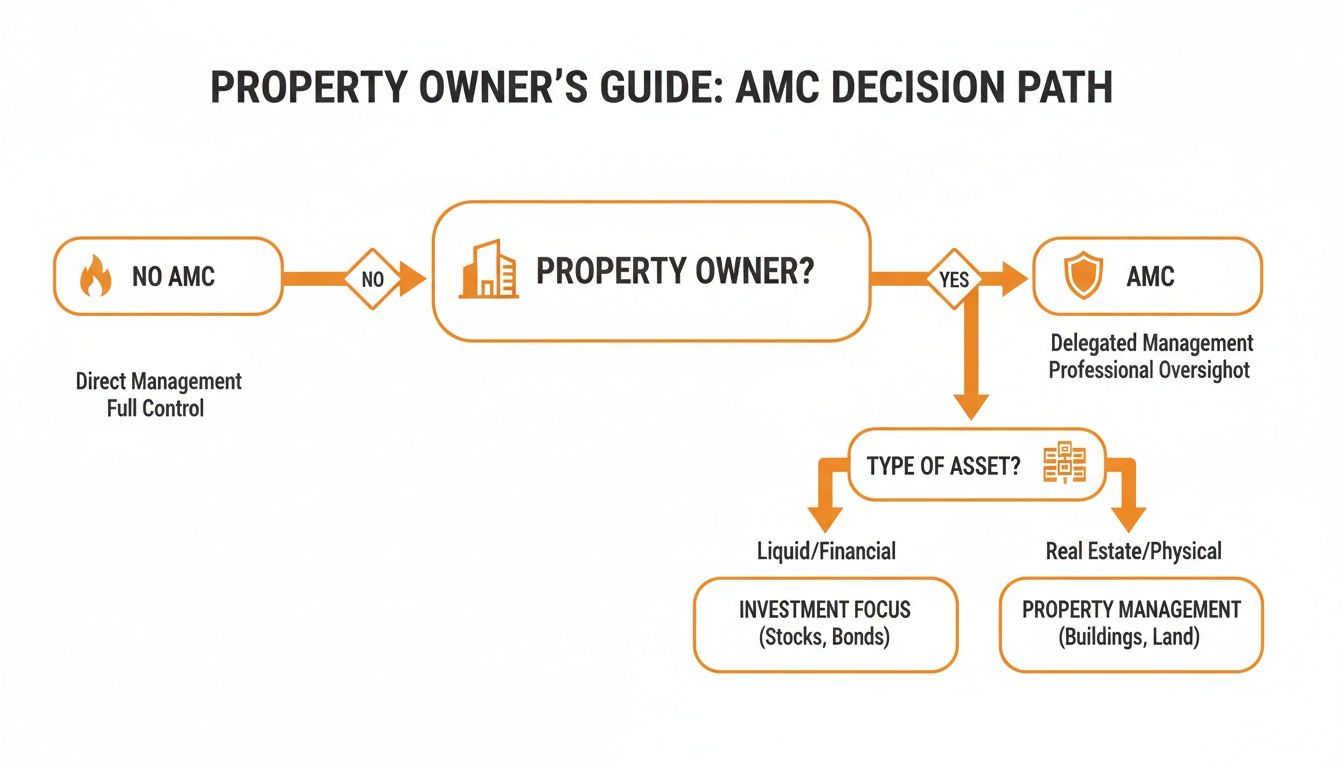
As the diagram indicates, the fundamental choice is between the proactive risk management of an AMC and the reactive, high-risk posture of ad-hoc repairs.
The Comprehensive AMC Explained
A Comprehensive Annual Maintenance Contract is an all-inclusive model that transfers the maximum level of risk from the asset owner to the service provider. The contract fee covers not only the technician's labour for scheduled preventive maintenance and emergency call-outs but also the cost of any spare parts required for repairs. This structure is designed for complete budget predictability.
It functions as a fixed-cost operational policy for a property's critical MEP systems. A higher annual fee is paid in exchange for insulation from the unforeseen and often substantial costs of component failures during the contract term.
For facility managers of high-value commercial assets or hospitality leaders, a Comprehensive AMC is often the default choice. The operational imperative for 100% uptime and absolute budget certainty outweighs the higher initial contract cost. A single critical failure can result in revenue loss far exceeding the AMC premium.
In Dubai's commercial real estate market, formal maintenance agreements are standard practice. The UAE facility management growth trends project the market to reach USD 23.86 billion by 2026. Hard services, the core of AMCs, already represent 61.64% of this market, driven by the adoption of smart MEP systems and a shift toward predictive maintenance models.
The Labour-Only AMC Explained
Conversely, a Labour-Only Annual Maintenance Contract covers only the technician's labour for planned visits and breakdown response. The critical distinction is that the cost of all spare parts, consumables, and materials required for repairs is billed separately to the client.
This model presents a lower initial contract price, which can be attractive for organisations with constrained operational budgets. However, it introduces significant financial uncertainty. While labour costs are fixed, the total annual maintenance expenditure becomes variable and unpredictable.
A major component failure, such as an HVAC compressor or a primary water pump, can trigger a large, unbudgeted invoice, disrupting financial planning. This structure effectively transfers the financial risk of parts failure from the service provider back to the asset owner.
A Head-to-Head Comparison of AMC Models
An effective decision requires a clear evaluation of the trade-offs between cost, risk transfer, and administrative overhead. The following table provides a direct comparison of the two primary contract types to aid in this analysis.
AMC Model Comparison: Comprehensive vs Labour-Only
This matrix offers a direct analysis of the two main AMC structures, enabling decision-makers to align the contract type with their asset profile, budget strategy, and risk tolerance.
| Feature | Comprehensive AMC | Labour-Only AMC |
|---|---|---|
| Cost Structure | Higher fixed annual fee | Lower fixed annual fee |
| Spare Parts | Included in the contract scope | Billed separately as an additional cost |
| Budget Certainty | High. Provides a predictable annual OPEX. | Low. Subject to cost variability from parts failures. |
| Risk Allocation | Financial risk of parts failure is transferred to the provider. | Financial risk of parts failure is retained by the client. |
| Administrative Load | Minimal. A single contract covers most eventualities. | Higher. Requires review and approval for each part purchase. |
| Best Suited For | Critical systems, aging assets, high-value properties, and organisations requiring strict OPEX predictability. | Newer properties with assets under manufacturer's warranty, non-critical systems, and clients with in-house parts procurement capabilities. |
Ultimately, the selection is not merely a cost comparison but an exercise in aligning the contract's risk profile with the organisation's broader financial and operational strategy.
Which Model Is Right for Your Dubai Property?
The optimal choice is determined by the specific asset profile and the organisation's appetite for financial risk.
- For a new Grade-A commercial tower in DIFC: A Labour-Only AMC may be strategically sound for the initial years. Major equipment is typically covered by manufacturer and contractor warranties, making a comprehensive contract redundant for parts coverage.
- For an established 5-star hotel on Sheikh Zayed Road: A Comprehensive AMC is an operational necessity. The risk of failure in guest-facing systems (e.g., HVAC, hot water) is intolerable. Immediate resolution is required without delays for purchase order approvals for parts.
- For an industrial warehouse in Jebel Ali: The decision is nuanced. If the facility uses standard machinery with readily available parts, a Labour-Only contract could be cost-effective. However, for facilities with specialised, long-lead-time equipment, a Comprehensive contract that mandates the provider to stock critical spares is the prudent choice to ensure production continuity.
The decision on an annual maintenance contract model in Dubai necessitates a rigorous analysis of asset age, system criticality, and the organisation's overarching risk management strategy.
Decoding the Key Drivers of AMC Pricing
Understanding why quotes for an annual maintenance contract in Dubai vary significantly is the first step toward making a well-informed procurement decision. The price is not arbitrary; it is a calculated assessment of risk and resource allocation by the service provider.
Grasping these variables allows decision-makers to evaluate proposals based on value and risk mitigation rather than the bottom-line figure alone.

Pricing is fundamentally driven by three core factors: the scope of services, the complexity of the assets being maintained, and the level of risk transferred to the provider.
Property Size and Age
The physical characteristics of the property form the baseline for any AMC price calculation. Larger properties require more man-hours, personnel, and resources, which directly scales the cost.
- Gross Floor Area (GFA): A large commercial tower or villa community has a significantly higher asset count and area to cover than a small office, making GFA a primary cost multiplier.
- Asset Age and Condition: An older building with aging MEP systems presents a higher statistical probability of failure. A provider will price this increased risk of breakdown calls into a comprehensive contract. Conversely, a new building under a defect liability period (DLP) may command a more favourable rate on a labour-only contract.
System Complexity and Specialisation
The technical sophistication of the equipment under the maintenance scope is a major cost determinant, as it dictates the required skill level of the technicians.
Standard MEP systems (HVAC, basic electrical, plumbing) constitute the baseline. Costs escalate when specialised assets are included:
- Building Management Systems (BMS): Require technicians with expertise in software and automated controls.
- Elevators and Escalators: Legally require maintenance by certified, specialist third-party contractors.
- Fire Safety and Suppression Systems: Governed by strict Dubai Civil Defence regulations, demanding certified technicians for all service and inspection activities.
- Chillers and District Cooling Connections: Large, complex assets requiring advanced engineering knowledge for effective maintenance.
The inclusion of these systems increases management overhead and necessitates a higher calibre of technical team, which is reflected in the contract price.
As an indicative benchmark, a comprehensive AMC often falls within the range of 1% to 3% of the property's total MEP asset value per annum. This is a general guideline; the final figure will be adjusted based on specific risk factors and agreed-upon service levels.
Service Levels and Response Times
The final primary cost driver is the Service Level Agreement (SLA). The required speed of response for emergency situations directly impacts the provider's staffing model and, consequently, the cost.
A contract stipulating a 30-minute response time for critical failures on a 24/7 basis requires the provider to maintain a dedicated, round-the-clock rapid response team. This carries a significantly higher operational cost compared to a contract guaranteeing a four-hour response during standard business hours.
This table illustrates how different service levels influence pricing.
| SLA Component | Standard Tier (Lower Cost) | Premium Tier (Higher Cost) |
|---|---|---|
| Emergency Response Time | 2-4 hours | 30-60 minutes |
| Service Window | 8 AM – 6 PM, Sun-Fri | 24/7/365 including public holidays |
| Preventive Maintenance | Quarterly visits | Monthly or bi-monthly visits |
| Reporting | Basic monthly summary | Real-time digital dashboard with photo evidence |
A higher price for an annual maintenance contract in Dubai should correlate directly with lower risk exposure for the client, coverage of more complex assets, and more stringent service guarantees. Understanding these cost drivers empowers procurement teams to critically analyse proposals and ensure the quoted price aligns with the required level of asset protection.
Defining Your Service Level Agreement and KPIs
An annual maintenance contract's effectiveness is dictated by the strength of its Service Level Agreement (SLA). The SLA is the technical core of the agreement, transforming broad service promises into a set of specific, measurable, and enforceable performance standards. For any property or facility manager in Dubai, a meticulously defined SLA is the primary tool for managing performance and mitigating operational risk.
Without a robust SLA, payment is for effort rather than for outcomes. A detailed agreement establishes unambiguous performance expectations, from emergency response times to preventive maintenance schedules. This clarity is vital for operational continuity and budget governance.
Core Components of a High-Performing SLA
An effective SLA for an annual maintenance contract in Dubai must be specific, quantifiable, and tailored to the property's operational requirements. It must move beyond generic commitments to define precise service parameters.
Key mandatory elements include:
- Response Times: Defines the maximum time from a service request being logged to a technician arriving on-site. This must be tiered according to the urgency and impact of the issue.
- Resolution Times: Specifies the maximum time allowed to complete the repair and restore service. Like response times, this must be categorised by priority level.
- Preventive Maintenance Schedule Adherence: The SLA must mandate that all Planned Preventive Maintenance (PPM) is completed within the agreed-upon frequency (e.g., monthly, quarterly) with a compliance target, typically 95% or higher.
- Uptime Guarantees: For business-critical assets such as data centre cooling, chillers, or primary power systems, the SLA can specify a minimum operational uptime, such as 99.5% availability, with penalties for non-compliance.
These metrics form the basis for performance measurement and are critical for demonstrating regulatory compliance. For further details on how AMCs help meet local standards, review this guide on meeting Dubai Municipality requirements through AMCs.
Setting Realistic Response and Resolution Times
In Dubai's commercial environment, asset downtime translates directly to revenue loss and tenant dissatisfaction. The SLA must reflect this with a clear prioritisation matrix for all service requests, eliminating ambiguity.
The following is a typical prioritisation framework used in commercial and hospitality AMCs:
| Priority Level | Description and Examples | Typical Response Time | Target Resolution Time |
|---|---|---|---|
| P1 – Critical | A total failure of a critical system affecting safety, security, or core business operations (e.g., HVAC failure in summer, complete power loss, major water leak). | 30 – 60 minutes | 4 hours |
| P2 – High | A significant disruption that impacts operations but does not cause a complete shutdown (e.g., AC failure in a single office, elevator malfunction, blocked drainage). | 2 – 4 hours | 8 hours |
| P3 – Medium | A non-critical fault causing inconvenience but not disrupting core operations (e.g., flickering lights, minor plumbing leak, faulty door lock). | Within 24 hours | 48 hours |
| P4 – Low | A routine request or minor cosmetic issue (e.g., replacing a lightbulb, adjusting a thermostat, touch-up painting). | Within 48 hours | 72 hours |
This structure ensures that technical resources are allocated efficiently, with the most critical issues receiving immediate attention.
Key Performance Indicators to Track Success
Beyond response times, Key Performance Indicators (KPIs) provide a broader perspective on the AMC's overall effectiveness and value delivery. These are the metrics that should be reviewed in monthly or quarterly performance meetings to identify trends and drive continuous improvement.
An SLA confirms if a provider is meeting contractual obligations. KPIs reveal if the contract is delivering tangible value to the asset. The two work in concert to provide a complete performance overview.
Essential KPIs for an annual maintenance contract include:
- First-Time Fix Rate (FTFR): Measures the percentage of issues resolved completely on the technician's first visit. A high FTFR, typically above 85%, indicates skilled technicians, accurate diagnostics, and effective spare parts management.
- PPM Schedule Attainment: Tracks the percentage of planned maintenance tasks completed within the scheduled period. A consistent rate above 95% demonstrates a proactive and well-managed maintenance regime.
- Mean Time Between Failures (MTBF): For critical assets, this KPI measures the average operational time between breakdowns. An increasing MTBF is a clear indicator that preventive maintenance is effective in improving asset reliability and extending its lifecycle.
- Asset Uptime: The percentage of time a critical asset is operational. For essential infrastructure like data centre cooling or power systems, the target should be exceptionally high, often exceeding 99.9%.
By defining these metrics within the SLA from the outset, a transparent, data-driven framework is established for managing the provider relationship and ensuring the property remains safe, compliant, and operationally excellent.
Tailoring Your AMC for Different Property Types
A generic, one-size-fits-all Annual Maintenance Contract (AMC) is ineffective in a market as diverse as Dubai. The operational priorities of a luxury hotel are fundamentally different from those of an industrial facility. Failure to tailor the AMC scope to the specific property type results in inefficient spend and inadequate risk mitigation for the asset.
An effective annual maintenance contract in Dubai is purpose-built. It must align with the property's core mission, whether that is maximising guest satisfaction, ensuring tenant business continuity, or maintaining uninterrupted production. This sector-specific approach ensures maintenance expenditure is directed toward areas of highest impact.
Commercial Towers and Corporate Offices
For high-rise commercial towers, the primary objectives are business continuity for tenants and energy efficiency. The AMC must be structured to prevent disruptions and maintain a professional, productive environment. Unplanned downtime directly impacts tenant productivity and the building's reputation.
The contract scope should focus on:
- HVAC Performance: Consistent and reliable cooling is non-negotiable. The SLA must mandate aggressive response times for HVAC failures, especially in critical zones like server rooms, where a response time of under 30 minutes is a common requirement.
- BMS and Lifts: Building Management Systems (BMS) and vertical transportation are critical. The contract must include specialist support, with a focus on optimisation to reduce energy consumption, which can account for up to 60% of a building's operational costs.
- Common Area Integrity: All common area MEP systems must be maintained to a high standard to preserve the premium tenant experience.
Residential Communities and Towers
In residential assets, the focus shifts to tenant comfort, safety, and the condition of common area amenities. Success is measured by resident satisfaction and the speed of in-unit issue resolution. Poor maintenance response is a leading cause of tenant turnover.
A robust residential AMC must prioritise:
- 24/7 Emergency Support: Critical failures like major leaks or AC breakdowns require immediate attention, regardless of the time. The SLA must guarantee rapid response around the clock.
- Common Area Amenities: Maintenance of pools, gyms, and landscaped areas must be scheduled to minimise resident disruption while ensuring safety and high standards of presentation.
- Clear Communication Protocols: Residents require a simple, transparent process for logging service requests and tracking their status, often via a dedicated tenant portal or mobile app.
For a deeper analysis of the distinctions, it is useful to review a detailed comparison of residential vs commercial property requirements in Dubai.
Hospitality Hotels and Resorts
In the hospitality sector, the AMC is an integral component of delivering a seamless guest experience. Any maintenance failure can directly impact guest satisfaction, leading to negative online reviews and subsequent revenue loss. The contract must enforce a zero-tolerance approach to failures in guest-facing areas.
In hospitality, preventive maintenance is a brand protection strategy. A single negative review resulting from a faulty shower or noisy AC unit can have a disproportionately large impact on reputation.
Key requirements for a hotel AMC include:
- Guest Room PPM: A rigorous schedule for preventive checks of all in-room MEP systems (AC, plumbing, electrical), timed during low-occupancy periods to avoid guest disruption.
- Back-of-House Systems: Guaranteed reliability of critical operational infrastructure, including kitchens, laundries, and central MEP plant rooms.
- Aesthetic Maintenance: The scope must include rapid response for minor cosmetic repairs (e.g., chipped tiles, flickering lights) that could detract from the guest's perception of quality.
Retail Malls and Industrial Facilities
These sectors have distinct, mission-critical demands. For a retail mall, the priorities are public safety and operational aesthetics. The AMC must ensure all systems are safe for high volumes of public traffic and that the environment remains clean, inviting, and fully functional during all trading hours.
For an industrial facility, the objective shifts entirely to production uptime and specialised equipment care. The AMC is focused on the reliability of manufacturing machinery, process cooling systems, and heavy-duty electrical infrastructure. A breakdown can halt production, resulting in significant financial losses. The contract must therefore provide access to technicians with specialised industrial skills and ensure the availability of critical spare parts.
How to Evaluate and Select an AMC Provider
Selecting the right maintenance partner for an annual maintenance contract in Dubai is a critical procurement decision. The process should extend beyond price comparison to a thorough due diligence of the provider's technical capabilities, operational processes, and safety record.
A structured evaluation framework, such as a scoring matrix, allows for an objective, side-by-side comparison of potential partners. This data-driven approach ensures the final decision is defensible, transparent, and aligned with the asset's long-term operational needs.
Technical and Operational Due Diligence
A provider's value is determined by the quality of its technical team and the robustness of its operational systems.
First, verify technical qualifications. Request evidence of certifications for technicians working on specialised systems (e.g., HVAC, fire alarm panels, high-voltage equipment) to ensure they meet Dubai Municipality and Civil Defence standards. Enquire about their internal training and continuous professional development (CPD) programmes.
Next, analyse their delivery model. A provider with a high percentage of in-house technical staff (e.g., >80%) typically offers better quality control and accountability than one heavily reliant on subcontracting. Ask for a clear breakdown of which services, if any, are subcontracted and what their vetting and performance management process is for third-party vendors.
Analysing Health, Safety, and Technology
A provider's commitment to safety and adoption of modern technology are key differentiators of professional competence in the UAE market.
- HSE Compliance: Request to see their Health, Safety, and Environment (HSE) policy, incident frequency rate logs, and any relevant certifications (e.g., ISO 45001). A strong safety record is a leading indicator of a well-managed organisation.
- Technology Stack: Determine if they operate on a modern Computer-Aided Facility Management (CAFM) system or rely on manual, paper-based processes. A CAFM platform enables real-time reporting, photographic evidence from job sites, and client-facing dashboards, providing a level of transparency and data that is impossible to achieve with manual systems.
- Reference Checks: Go beyond the provider's curated client list. Request references from properties of similar size, complexity, and sector to your own. A provider excelling in small office maintenance may lack the systems and expertise required for a large residential tower or industrial facility.
Applying effective vendor management strategies is crucial for building a successful, long-term partnership. Businesses with well-chosen annual maintenance contracts in Dubai experience extended asset lifecycles and lower total cost of ownership. As property service charges increase, the budget predictability of an AMC becomes a more attractive alternative to the financial volatility of ad-hoc repairs. For further context, you can also explore this guide on affordable annual maintenance contract providers in Dubai for small businesses.
Got Questions About AMCs in Dubai? We've Got Answers.
When evaluating an annual maintenance contract, several key questions consistently arise for property owners and facility managers. Clear, data-backed answers are essential for informed decision-making.
What's the Real Cost of an Annual Maintenance Contract in Dubai?
While pricing varies, a common budgetary benchmark for a comprehensive AMC is between 1% and 3% of the property's total MEP asset value per annum. A small commercial office might see a contract priced in the thousands of dirhams, whereas a large commercial tower will have a significantly higher valuation.
The final quoted price is a function of several key variables:
- The property's size and age; older assets typically require a higher service frequency.
- The complexity of the MEP systems; sophisticated, high-tech systems require more specialised maintenance.
- The stringency of the Service Level Agreement (SLA); shorter response times carry a cost premium.
Are Things Like Fire Safety Systems or Elevators Included in a Standard AMC?
Typically, no. A standard AMC is scoped to cover the core MEP services: HVAC, general electrical, and plumbing. Highly specialised, life-safety systems require maintenance by certified specialists and are almost always covered under separate, dedicated contracts.
Systems such as fire safety, elevators, escalators, and complex Building Management Systems (BMS) are regulated asset classes. They mandate maintenance by OEM-certified or legally accredited specialists. A competent primary AMC provider can, however, manage these third-party specialist contracts on your behalf, providing a single point of contact and simplifying vendor management.
How Do I Actually Know if My AMC is Worth the Money?
Measuring the return on investment (ROI) of an AMC requires looking beyond avoided repair costs. The true value is demonstrated through broader operational and financial metrics.
Key indicators of positive ROI include:
- Reduced Energy Consumption: Optimised and well-maintained systems operate more efficiently, lowering utility costs.
- Extended Asset Lifespan: Proactive maintenance deferrals major capital expenditure on equipment replacement.
- Increased Asset Uptime: For commercial and industrial properties, operational continuity directly protects revenue streams.
- Improved Tenant Retention: High levels of service and fewer disruptions contribute directly to tenant satisfaction and reduce churn.
Tracking these KPIs provides a comprehensive view of the financial and operational value delivered by a well-structured maintenance programme.
At SnapFixNow, we build our Annual Maintenance Contracts on a foundation of transparency and clear SLAs. Our goal is to protect your assets and make your operational budget work smarter. With certified in-house technicians and a real-time reporting platform, we make sure your Dubai property gets the expert care it deserves. Learn more about our flexible AMC solutions.