For property managers, asset owners, and procurement teams in the UAE, facility management is the operational engine that drives asset value, ensures tenant satisfaction, and mitigates risk. The objective is to move beyond reactive repairs and implement a strategic framework for managing the entire lifecycle of a building’s systems and services.
Navigating the Facility Management Landscape in the UAE
Facility management in Dubai and across the UAE presents a unique set of challenges and opportunities, driven by extreme climate conditions, rapid urban development, and technologically advanced buildings. It is a demanding environment where effective management is not just about maintenance, but about defending high-value assets against harsh conditions while delivering service levels that meet global standards.
This guide is structured for B2B decision-makers. It provides clear frameworks for evaluating service models, establishing performance benchmarks, and making informed trade-offs between cost, risk, and service quality.
Core Focus Areas for UAE Properties
To maintain asset competitiveness and ensure regulatory compliance, decision-makers must focus on several key areas:
- Hard vs. Soft Services: A critical balance must be struck between maintaining core building infrastructure (MEP, HVAC) and elevating the user experience through services like cleaning and security. The former ensures operational integrity; the latter drives tenant retention.
- Technology Integration: The use of digital tools like CAFM and IoT is no longer optional. These platforms provide essential operational oversight, automate routine tasks, and enable data-driven maintenance decisions. Understanding ServiceNow's role in UAE enterprise transformation illustrates the depth of this integration.
- Asset-Specific Strategies: The operational requirements of a commercial tower in DIFC differ significantly from those of a residential community on Palm Jumeirah or an industrial warehouse in JAFZA. A one-size-fits-all approach is both ineffective and financially risky.
The primary objective in the UAE market is to transition from a reactive, cost-centric model to a proactive, value-driven one. This requires prioritizing asset longevity, energy efficiency, and operational continuity as key business goals.
This guide provides the analytical tools to make informed decisions that protect assets and advance organisational objectives.
Hard vs. Soft Facility Management: What's the Difference in the UAE?
In facility management, all tasks are categorized as either Hard FM or Soft FM. Understanding this distinction is fundamental for strategic planning, accurate budgeting, and protecting asset value within the UAE's commercial and regulatory environment.
These two service categories are not in opposition; they are complementary. Together, they create a property that is safe, compliant, efficient, and a desirable place to occupy.
Hard Facility Management (Hard FM) encompasses the technical core of a building—the physical, tangible infrastructure that enables it to function. These are non-negotiable systems; without them, a building cannot operate safely, legally, or efficiently.
Conversely, Soft Facility Management (Soft FM) covers the services that shape the human experience within that building. While not physically integrated into the structure, these services are critical for tenant satisfaction, productivity, and maintaining the property's operational flow and aesthetic standards.
The Unseen Engine: Why Hard FM is So Critical
Hard FM services are intrinsically linked to the physical fabric of a building. In the UAE, where properties feature sophisticated building technologies and a climate that places extreme stress on mechanical systems, these services are paramount for asset longevity and operational continuity.
Key components of Hard FM include:
- MEP Systems: Mechanical, Electrical, and Plumbing systems are the lifeblood of any modern building, covering power distribution, lighting, water supply, and drainage.
- HVAC Systems: Heating, Ventilation, and Air Conditioning. This is arguably the most critical Hard FM service in the region, directly impacting occupant comfort and accounting for 40-60% of a typical building's energy consumption.
- Fire Safety and Life Support Systems: These are non-negotiable services mandated by strict UAE Civil Defence codes, including fire alarms, sprinklers, emergency lighting, and smoke control systems.
- Building Management Systems (BMS): The centralized platform for monitoring and controlling a building's mechanical and electrical equipment, from chillers to lighting schedules.
This diagram illustrates how both hard and soft services form the foundation of total facility management, directly impacting asset preservation and value enhancement.
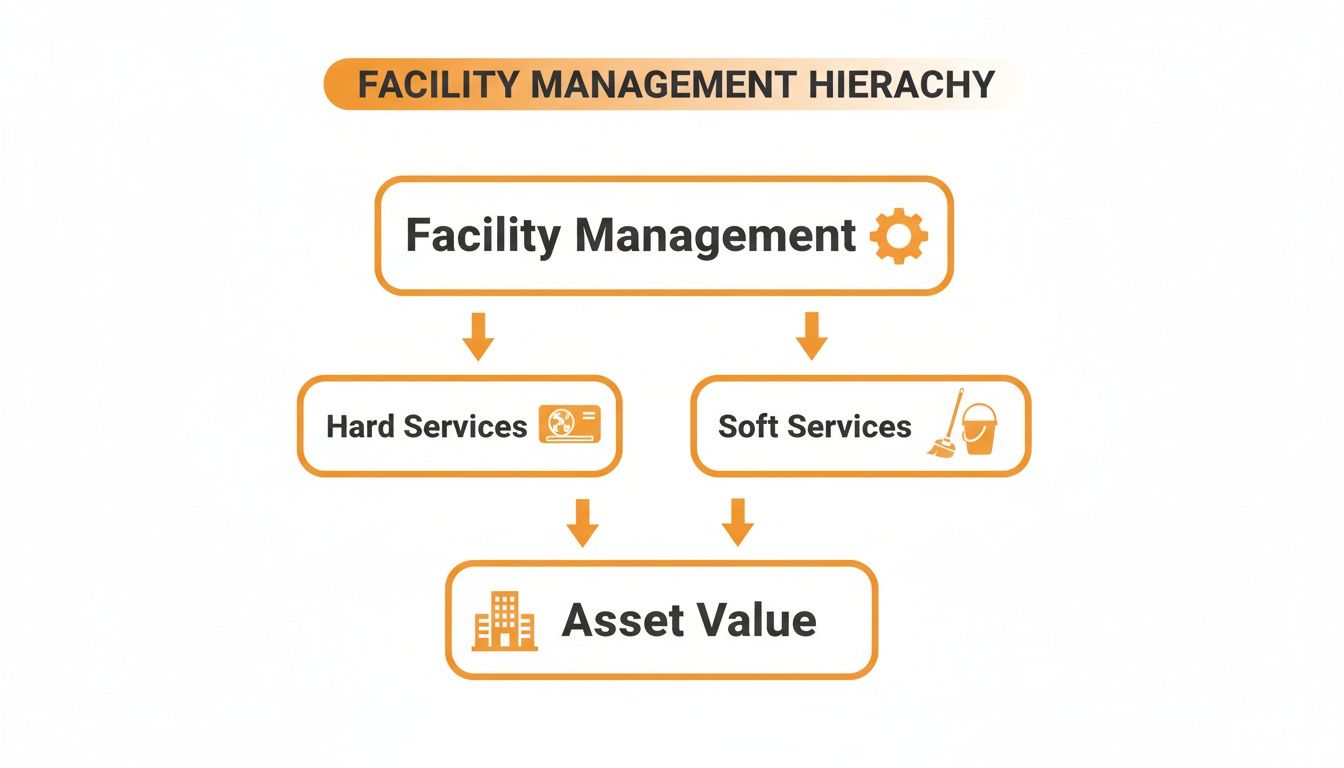
The structure is clear: neglecting either the technical or the experiential aspects of management will erode the long-term value of the physical asset.
The Visible Difference: How Soft FM Shapes Experience
While Hard FM ensures a building operates, Soft FM makes it a desirable place to live, work, or visit. These are the services tenants and visitors experience daily, directly shaping their perception of quality and value.
Common Soft FM services include:
- Security and Manned Guarding
- Cleaning, Janitorial, and Pest Control
- Waste Management and Recycling
- Landscaping and Grounds Maintenance
- Reception and Concierge Services
In a competitive real estate market like Dubai, high standards of Soft FM are not a luxury but a powerful differentiator that can significantly improve tenant retention and property reputation.
To better understand the distinct roles and impacts of Hard and Soft FM, the following table provides a clear, side-by-side comparison tailored for UAE assets.
Hard Services vs Soft Services: A Comparative Overview for UAE Assets
| Attribute | Hard Facility Management (Hard FM) | Soft Facility Management (Soft FM) |
|---|---|---|
| Scope | Tangible assets fixed to the building fabric (MEP, HVAC, BMS, fire safety). | People-centric services enhancing the user experience (cleaning, security, landscaping, concierge). |
| Impact | Ensures safety, legal compliance, and operational functionality. Prevents catastrophic failures. | Drives tenant satisfaction, productivity, property aesthetics, and brand perception. |
| Cost Structure | Primarily capital-intensive, with costs tied to asset replacement, predictive maintenance, and specialised technical labour. | Primarily operational and labour-intensive, with costs tied to manpower, consumables, and service frequency. |
| Priority Level | Critical & Non-Negotiable. Failure poses immediate safety risks and can render a building unusable. | Essential for Competitiveness. Poor service directly impacts tenant retention and property reputation. |
| UAE Example (Commercial Tower) | Maintaining the chiller plant, BMS, elevators, and facade cleaning systems. | Providing lobby security, office cleaning services, and valet parking. |
| UAE Example (Residential Villa) | Servicing the AC units, water pump, and electrical distribution board. | Managing waste collection, pest control, and swimming pool cleaning. |
This comparison highlights that while Hard FM is the technical backbone ensuring a property functions, Soft FM is the heart that makes it a desirable place to be. Both are essential for maximising the value and performance of any UAE asset.
Why Hard FM Takes the Bigger Slice of the Pie in the UAE
The emphasis on technologically advanced, smart infrastructure means Hard FM naturally dominates the local market. Analysis shows that in the UAE's facility management sector, hard services command a significant market share, projected to hit 60.92% by 2025.
This dominance is driven by massive investment in asset-heavy properties, complex MEP systems, and the predictive maintenance technology required to operate these modern structures efficiently. You can dig deeper into the numbers in this Mordor Intelligence analysis of the UAE facility management market.
Decision Framework: When allocating budgets, this ratio should be a key consideration. A common misstep is underfunding Hard FM to finance more visible Soft FM services. While an immaculate lobby is important, neglecting the technical backbone invariably leads to higher long-term costs, significant compliance risks, and eventual operational failure.
Ultimately, a successful facility management in UAE strategy does not prioritize one over the other; it integrates them seamlessly. It recognizes that a failing air conditioning unit (Hard FM) can render an office unusable just as effectively as poor security (Soft FM) can make it unsafe. Balancing investment between the two is key to maximizing asset performance and value.
Choosing Your FM Contract Model
Selecting the right contract for facility management in the UAE is a critical decision that directly impacts budget stability, operational efficiency, and the long-term health of a property. The choice typically lies between a proactive Annual Maintenance Contract (AMC) and a reactive, ad-hoc service model. Understanding the financial and operational trade-offs is crucial for making a sound investment.
An AMC functions as a strategic risk-mitigation tool. For a fixed annual fee, it provides scheduled preventive maintenance and guaranteed response times for corrective issues. The primary objective is to minimize downtime and insulate the asset owner from the unpredictable and often high costs of emergency repairs, thereby establishing a stable, predictable operational expense (OPEX).
Conversely, an ad-hoc or "pay-as-you-go" model is purely reactive. Services are requested—and billed—only when a problem arises. While this may appear less costly due to the absence of a fixed fee, it frequently results in higher overall costs and greater operational risk over the asset's lifecycle.
Comparing Proactive vs Reactive Models
The fundamental difference lies in philosophy: prevention versus cure. An AMC is predicated on the principle that consistent, planned maintenance is significantly cheaper and less disruptive than rectifying a catastrophic failure. An ad-hoc model, by definition, activates only after a failure has occurred, which can lead to extended downtime and more expensive repairs—particularly for critical systems like HVAC during the UAE's summer months.
To accurately assess the implications, one must consider the total cost of ownership (TCO). The initial price of a single ad-hoc service call is lower than an annual contract fee, but TCO encompasses hidden costs that an AMC is designed to prevent:
- Downtime Costs: Lost revenue in a retail environment or reduced productivity in an office due to system failure.
- Asset Depreciation: Equipment that lacks regular servicing has a shorter operational life, leading to premature capital replacement. An HVAC chiller's lifespan can be reduced by 20-30% without proper preventive maintenance.
- Emergency Premiums: Urgent, out-of-hours repair work invariably incurs premium labour charges.
A well-structured AMC effectively transfers the risk of unexpected breakdowns from the asset owner to the service provider. This incentivizes the provider to perform high-quality preventive maintenance to avoid incurring their own costs on emergency call-outs.
Key Factors Guiding Your Contract Choice
The optimal contract model is not a one-size-fits-all solution; it depends on the specific asset and organisational objectives. A careful evaluation of several factors is necessary to ensure the contract aligns with operational and financial realities. For a deeper look, our guide on how to choose the right facility management company in UAE for long-term reliability offers more detailed selection criteria.
The table below provides a decision-making framework for selecting the appropriate model.
| Decision Factor | Favours Annual Maintenance Contract (AMC) | Favours Ad-Hoc / Reactive Model |
|---|---|---|
| Asset Age & Condition | Older assets with a higher probability of failure; new assets under warranty requiring mandatory servicing. | Brand new, simple assets with low usage and few critical components. |
| Property Type | 24/7 operations like hotels, hospitals, data centres, and Grade A commercial towers where uptime is paramount. | Low-traffic warehouses, storage units, or properties with non-critical systems. |
| Uptime Requirement | High. Any downtime directly impacts revenue, tenant satisfaction, or safety (e.g., retail, hospitality). | Low to moderate. Occasional outages are acceptable and do not have a major financial impact. |
| Budgeting Approach | Preference for predictable, fixed annual costs for financial planning and OPEX control. | Tolerance for variable, unpredictable costs and budget flexibility for large, unforeseen repair bills. |
| Risk Tolerance | Low. The primary objective is to mitigate operational disruptions and unforeseen expenses. | High. Willingness to accept the risk of system failure in exchange for lower fixed overheads. |
Ultimately, this decision transcends a simple comparison of upfront costs. It is a strategic assessment of an asset's purpose, its operational demands, and the organisation's risk appetite. For most high-value commercial, residential, and hospitality properties in the UAE, the predictability and risk mitigation offered by a comprehensive AMC make it the more prudent long-term choice.
Setting Performance Benchmarks with KPIs and SLAs
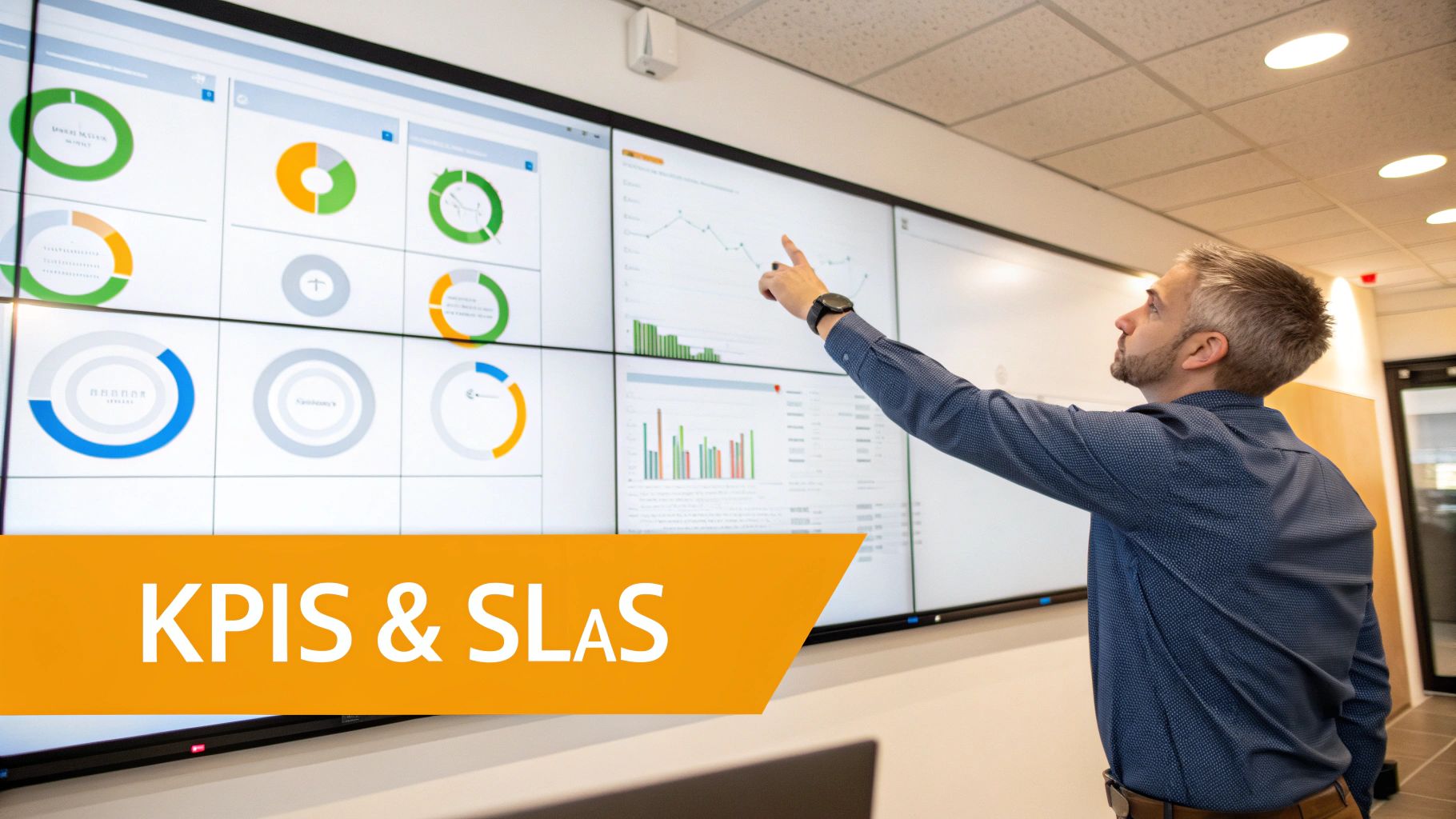
A facility management contract's value is determined by its ability to deliver measurable, quantifiable results. Vague service commitments are insufficient when critical systems fail. To ensure accountability and drive performance, property owners in the UAE must translate expectations into tangible outcomes using Key Performance Indicators (KPIs) and Service Level Agreements (SLAs).
These instruments transform a contract from a static document into a dynamic performance management framework. KPIs measure the effectiveness of the FM provider in achieving high-level objectives. SLAs define specific, time-bound commitments for individual services. Together, they provide an unambiguous definition of success.
Defining Critical KPIs for UAE Properties
Effective performance management focuses on a select few KPIs that provide a clear view of operational health. For the unique demands of facility management in UAE, certain indicators are more significant due to the climate and the high value of assets.
-
PPM Completion Rate: This is a primary indicator of a provider's proactivity. It measures the percentage of scheduled Planned Preventive Maintenance tasks completed on time. A rate of 98-100% demonstrates a commitment to preventing failures.
-
First-Time Fix Rate (FTFR): This measures the percentage of corrective maintenance tasks resolved on the initial visit. A high FTFR, with a target of >85%, indicates strong technical competency and logistical planning, minimizing disruption.
-
Asset Uptime: For critical systems such as chillers, elevators, and building management systems, this KPI is paramount. It tracks the percentage of time the asset is operational. For a commercial tower in Dubai, chiller uptime should exceed 99.5%, particularly during summer months.
-
Energy Consumption vs Benchmark: This KPI quantifies the effectiveness of utility management. It compares a building's energy consumption against historical data or industry benchmarks (e.g., kWh per square foot), providing clear evidence of HVAC optimization.
Structuring SLAs for the Local Context
SLAs give KPIs their enforcement mechanism. They establish clear targets for response and resolution times, often linked to financial penalties for non-compliance. In the UAE, these targets must be realistic, accounting for logistical challenges like traffic and the impact of extreme heat on equipment.
An effective SLA does not merely list timeframes; it categorizes issues by priority. A burst pipe in a server room represents a different level of urgency than a flickering light in a corridor. This prioritization is the core of a functional and equitable agreement.
A common error is to set overly aggressive SLAs that are operationally unachievable, leading to disputes. Conversely, SLAs that are too lenient expose the property to unnecessary risk. The objective is to establish a balanced, property-specific benchmark.
The table below provides a baseline for drafting SLAs for commercial or high-end residential properties in the UAE.
Standard SLA Benchmarks for Critical FM Services in the UAE
| Service Priority | Typical Response Time Target | Typical Resolution Time Target | Example Scenario |
|---|---|---|---|
| Emergency (P1) | 15-30 minutes | 2-4 hours | Complete power failure, major water leak, fire alarm activation, or passenger stuck in an elevator. |
| Urgent (P2) | 1-2 hours | Within 24 hours | Single AC unit failure in a tenanted office, blocked drainage, or a non-critical access control fault. |
| Routine (P3) | 24 hours | 3-5 working days | Replacing light fixtures, minor paint touch-ups, or adjusting a door that is difficult to close. |
Ultimately, these metrics are designed to foster alignment, not to be punitive. By clearly defining KPIs and SLAs from the outset, the property owner and the FM provider establish a shared understanding of performance expectations. This transforms the relationship from a simple client-vendor transaction into a partnership focused on protecting and enhancing the long-term value of the asset.
Understanding FM Cost Drivers and Pricing Models
Budgeting for facility management in the UAE requires a deep understanding of the factors that drive contract pricing. A quote's value cannot be judged on its price alone; decision-makers must analyze the underlying cost components and risk allocation.
The primary factors influencing FM costs are directly related to the physical asset and its operational context. These elements determine the required levels of labour, materials, and risk assumed by the service provider.
Primary Cost Influencers in the UAE
- Asset Age and Condition: Older buildings and equipment require more intensive maintenance. A ten-year-old chiller plant necessitates a more frequent and costly maintenance schedule than a new unit under warranty due to a higher probability of failure.
- Property Size and Complexity: While Gross Floor Area (GFA) is a baseline metric, complexity is an equally important cost driver. A high-tech commercial tower with an integrated Building Management System (BMS) and advanced life safety systems has a higher maintenance cost per square metre than a simple warehouse.
- Technical Specialisation: Standard MEP maintenance forms the core of most contracts, but specialized systems command a premium. Contracts covering data centres, industrial process cooling, or commercial kitchen equipment require certified technicians with specific expertise.
- Service Level Requirements: The stringency of the SLA directly impacts cost. A contract guaranteeing 24/7 support with a 30-minute emergency response time is significantly more expensive than an agreement covering standard business hours. Higher levels of risk transfer to the provider correspond to higher contract prices.
Deconstructing Common Pricing Models
Once cost drivers are understood, the next step is to evaluate how they are structured within a pricing model. Each model allocates financial risk differently between the asset owner and the service provider.
The choice of pricing model is a strategic decision about risk allocation. A fixed-fee model transfers most of the risk for unforeseen repairs to the service provider, while a cost-plus model means the asset owner absorbs that risk.
Three contract structures are prevalent in the UAE market. The table below provides a comparative analysis.
| Contract Model | Description | Risk Profile for Asset Owner | Best Suited For |
|---|---|---|---|
| Comprehensive Fixed-Fee | A single, all-inclusive annual fee covering scheduled maintenance, labour, and all spare parts for any repairs. | Low Risk. Provides complete budget certainty. The provider is incentivized to perform high-quality preventive work to minimize their own repair costs. | High-value assets where uptime is critical and predictable OPEX is required (e.g., hotels, Grade A offices). |
| Labour-Only (Non-Comprehensive) | A fixed fee covering only technician time for both preventive and corrective work. All spare parts are billed separately. | Medium Risk. The upfront cost is lower, but the owner is exposed to unpredictable expenses from major component failures. | Newer properties under warranty or for assets where the owner prefers to control spare parts procurement. |
| Cost-Plus / Ad-Hoc | No fixed fee. The owner pays the actual cost of labour and materials for each job, plus an agreed-upon management fee or margin. | High Risk. Offers maximum flexibility but provides zero budget predictability. Can lead to higher long-term costs due to its reactive nature. | Small, non-critical facilities or for managing specific, one-off projects rather than ongoing maintenance. |
Effective management of procurement is essential for cost control. Exploring different procurement cost reduction strategies can yield significant savings, particularly under Labour-Only or Cost-Plus models.
For a more detailed breakdown of these agreements, our guide on annual maintenance contract packages in Dubai explains how to structure them effectively. Aligning the cost model with the property's operational needs and the organisation's risk tolerance is key to a successful FM partnership.
Integrating Technology and Ensuring Regulatory Compliance
Modern facility management in the UAE requires a dual competency in technology integration and regulatory adherence. Service providers must leverage digital tools for operational efficiency while navigating a complex framework of local laws and standards. For asset owners, evaluating a provider's capability in both domains is critical for mitigating risk and maximizing asset performance.
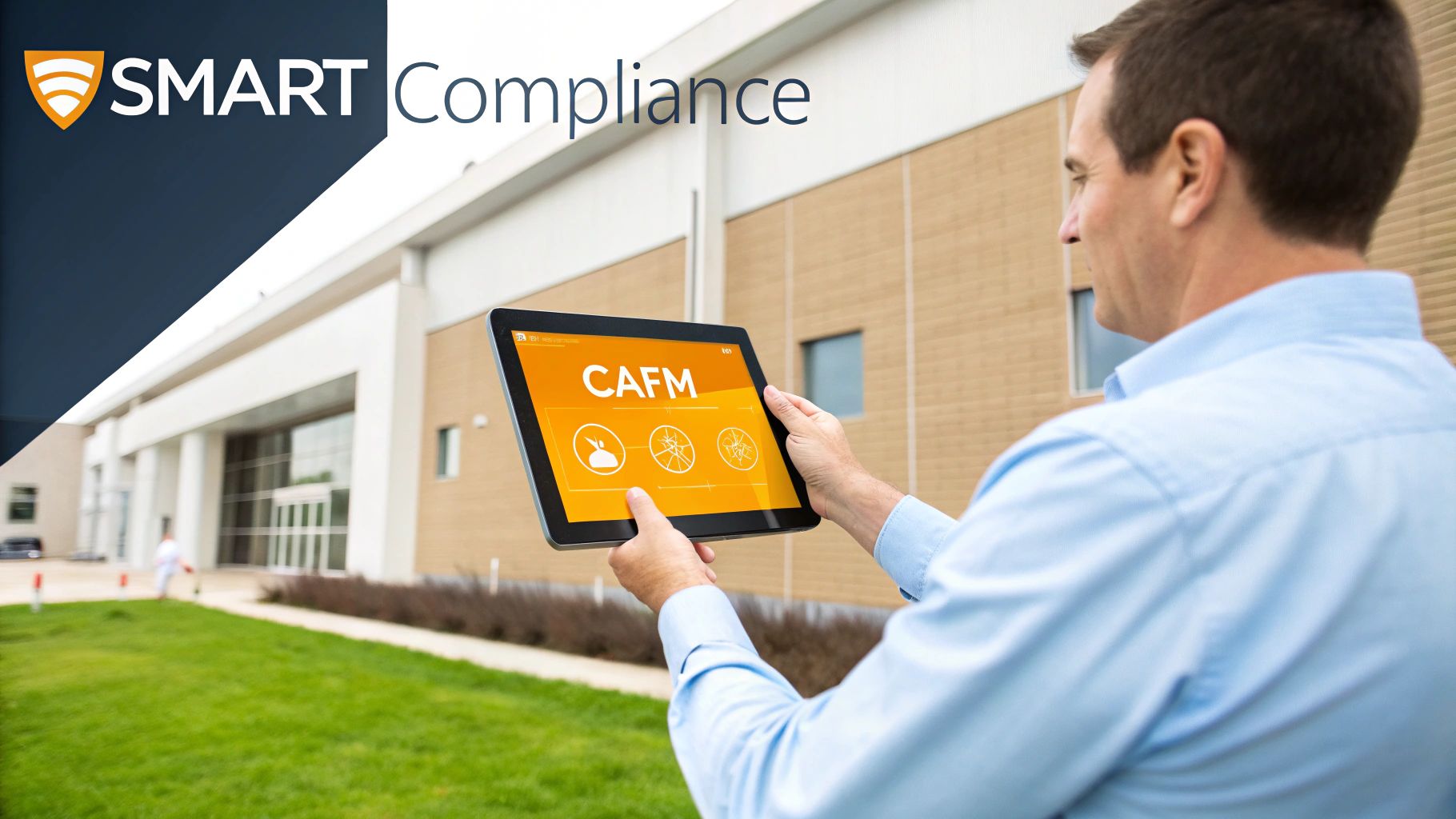
The operational backbone of modern FM is the Computer-Aided Facility Management (CAFM) system. This platform serves as the central hub for all FM activities, digitizing work orders, tracking asset performance, and generating data for informed decision-making. It replaces manual, paper-based processes with transparent, real-time workflows, providing property managers with unprecedented oversight.
The Role of Technology in Modern FM
Beyond core CAFM software, technology is enabling a shift from reactive to predictive maintenance. The deployment of Internet of Things (IoT) sensors on critical equipment, such as HVAC systems and water pumps, is central to this evolution.
These sensors stream live performance data to the CAFM system, triggering alerts when operational parameters deviate from established norms. This allows technicians to address potential issues before they escalate into catastrophic failures. To get a deeper understanding, check out our guide on technology-enabled maintenance and IoT monitoring solutions.
By analyzing data trends from IoT sensors, providers can move from time-based to condition-based maintenance. For instance, instead of servicing a pump every three months, it is serviced when its vibration signature indicates impending wear. This approach optimizes labour and extends asset lifespan.
Navigating the UAE's Compliance Landscape
While technology enhances efficiency, it must operate within the UAE's non-negotiable regulatory framework. Compliance is a fundamental requirement for legal operation and risk management. A provider's commitment to these standards must be a key evaluation criterion.
Key pillars of compliance include:
- ISO Certifications: These international standards demonstrate a provider's commitment to quality and safety. ISO 9001:2015 (Quality Management) is a baseline requirement, while ISO 45001 (Occupational Health & Safety) is equally critical.
- Local Authority Regulations: Adherence to rules set by bodies like Dubai Municipality and Trakhees is mandatory, covering waste management, environmental standards, and building modifications.
- Civil Defence Approval: All fire safety and life support systems must be maintained in strict accordance with UAE Civil Defence regulations. This involves regular inspections by certified technicians and meticulous record-keeping.
- Manufacturer Warranty Adherence: For new equipment, failure to follow the manufacturer's specified maintenance schedule can void the warranty. A competent FM provider must track and adhere to these requirements to protect the owner's investment.
An effective FM partner seamlessly integrates technology and compliance. They use technology not only for efficiency but also to create a robust, auditable trail, demonstrating that all actions taken protect the asset, its occupants, and the owner's legal standing.
Your Top Facility Management Questions Answered
We receive frequent inquiries from property managers, asset owners, and procurement teams across Dubai and the UAE. Here are practical, data-driven answers to the most common questions regarding the local facility management landscape.
What Does an Annual Maintenance Contract in Dubai Typically Cost?
There is no standard price for an AMC; costs are determined by the contract scope, property type, and asset condition. A basic labour-only contract for a small apartment may cost a few thousand dirhams annually.
For a comprehensive AMC on a large commercial building—covering all MEP and HVAC systems, including parts—the indicative cost range is typically 1% to 3% of the property's original construction value per year.
Key cost drivers include the provision of 24/7 support, the inclusion of all spare parts and consumables (a comprehensive model), and the complexity of the systems, such as industrial chillers or an integrated Building Management System (BMS).
How Do I Decide Between a Large FM Provider and a Smaller Specialist?
This decision should be driven by portfolio needs rather than provider size. Large, integrated FM companies excel at bundling hard and soft services into a single contract, offering streamlined management for large, mixed-use developments.
Conversely, smaller, specialized firms often provide deeper technical expertise in specific domains, such as high-voltage electrical systems, specialized industrial equipment, or the maintenance of heritage properties.
The evaluation should focus on the provider's demonstrated technical depth in critical asset areas, their geographic response capability, and their documented ability to meet specific SLA requirements. These factors are more reliable performance indicators than company size alone.
What are the Most Critical Clauses to Have in an FM Service Contract?
Beyond scope and price, several clauses are non-negotiable for protecting the asset and ensuring provider accountability. These clauses mitigate risk and establish clear operational expectations.
Ensure your contract includes:
- Clearly Defined SLAs: Specify response and resolution times for different priority levels, with clear financial penalties for non-compliance.
- PPM Schedules: The contract must include a detailed, asset-level schedule of all planned preventive maintenance activities as a formal appendix.
- Liability and Insurance: Verify the provider holds adequate public liability and workmen's compensation insurance, and clearly define liability for damages.
- Emergency Protocols: Outline the exact procedure for emergency response, including contact protocols and guaranteed timelines.
- Spare Parts Management: Define the process for sourcing, approving, and billing for spare parts and consumables.
- Termination Clauses: Include clear terms for contract termination due to non-performance or other specified conditions.
- Regulatory Compliance: The contract must explicitly state that all work will adhere to relevant UAE regulations, including codes from the local municipality and Civil Defence.
For professional, engineering-led facility management and flexible Annual Maintenance Contracts designed for Dubai's demanding commercial and residential properties, trust SnapFixNow. Our ISO-certified processes and technology-driven approach ensure your assets are protected, compliant, and performing at their peak. Learn more about our comprehensive services at https://www.SnapFixNow.com.