Commercial building owners and facility managers are often faced with a recurring decision: whether to operate under an Annual Maintenance Contract (AMC) or rely on reactive, call-out-based maintenance.
While reactive maintenance may appear cost-effective in the short term, it often results in higher long-term operational costs, increased downtime, and greater risk exposure. Understanding the practical differences between AMC and reactive maintenance is essential for informed asset management decisions.
1. What Is Reactive Maintenance?
Reactive maintenance refers to repairs carried out only after a failure or breakdown occurs. Service providers are engaged on an ad-hoc basis, typically during emergencies or visible equipment failures.
While this approach may reduce immediate contractual commitments, it often leads to unpredictable expenses, delayed response times, and unplanned operational disruptions.
2. What Is an Annual Maintenance Contract (AMC)?
An AMC is a structured agreement covering planned preventive maintenance, routine inspections, and defined response protocols for building systems.
For commercial buildings, AMCs typically include HVAC, electrical, plumbing, civil, and general MEP systems, with scheduled visits and SLA-backed response times.
3. Cost Visibility vs Cost Illusion
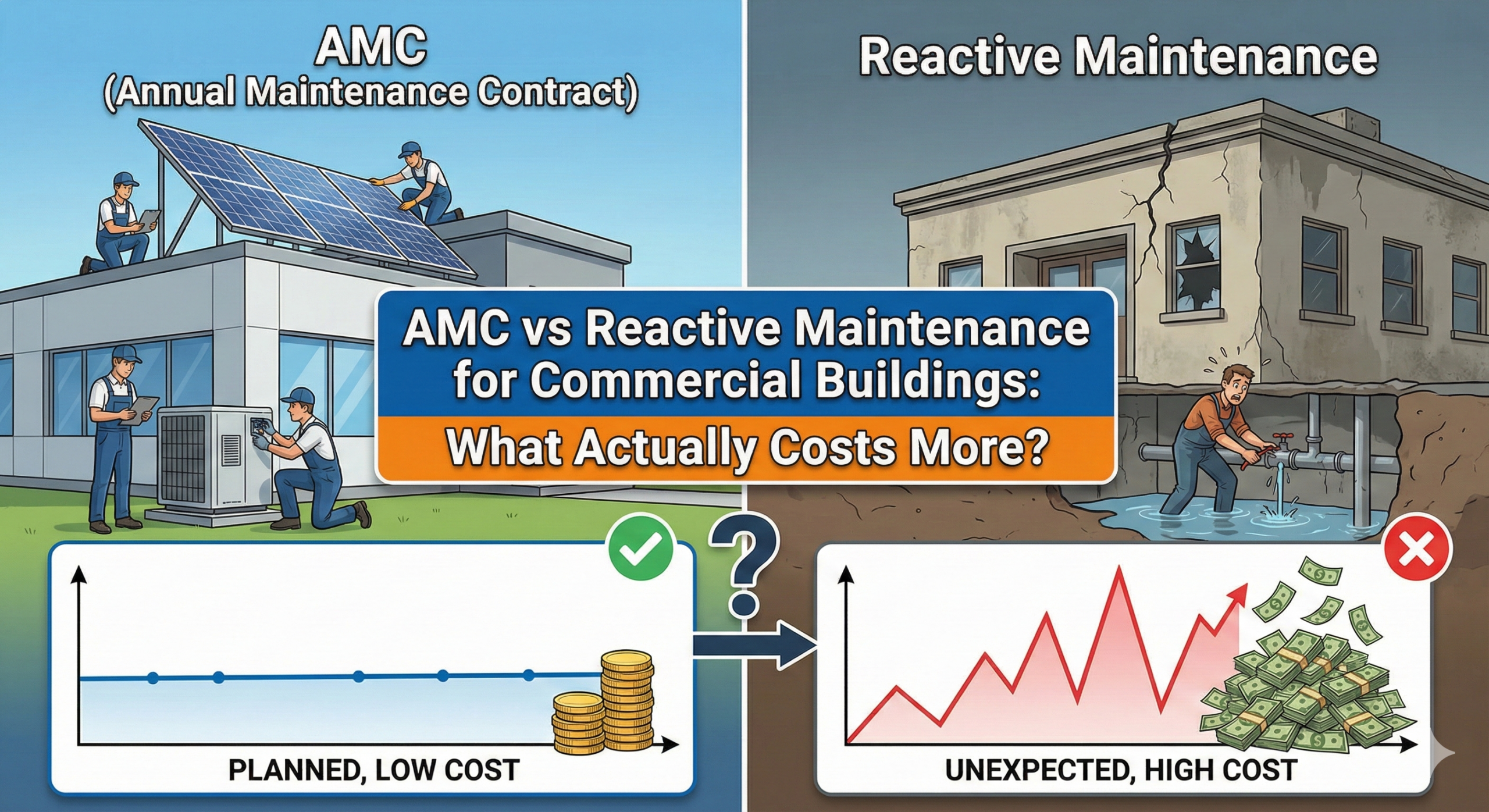
Reactive maintenance creates a cost illusion: expenses appear lower when no failures occur, but spike sharply during breakdowns.
AMC-based maintenance provides predictable operating expenditure (OPEX), allowing better budgeting and financial planning.
4. Impact on Asset Life and Performance
Lack of preventive maintenance accelerates wear and tear on critical assets such as HVAC equipment, pumps, electrical panels, and control systems.
AMCs emphasize early fault detection, calibration, and servicing, which helps extend asset life and maintain system efficiency.
5. Downtime, Risk, and Business Continuity
Reactive maintenance often results in longer downtime due to delayed fault identification, spare procurement, and contractor mobilization.
In contrast, AMC arrangements prioritize response, reduce escalation time, and support business continuity, especially in commercial environments.
6. Compliance and Insurance Implications
Many insurance policies and regulatory frameworks expect reasonable maintenance practices.
Poor maintenance records under reactive models may complicate insurance claims or compliance audits.
AMC documentation provides maintenance logs, inspection records, and compliance evidence.
7. When Reactive Maintenance Makes Sense
Reactive maintenance may be suitable for non-critical assets, temporary facilities, or low-usage systems.
However, relying solely on reactive maintenance for core building systems significantly increases operational and financial risk.
Engineering-led facility management companies such as SnapFixNow™ FMC design AMC frameworks that balance preventive care, responsive support, and cost control.
This structured approach helps commercial building owners reduce downtime, manage OPEX predictably, and protect long-term asset value.
More information on structured AMC services is available at:
Final Thought
The true cost difference between AMC and reactive maintenance becomes evident over time.
For commercial buildings with mission-critical systems, structured AMC arrangements generally deliver better financial control, reliability, and risk management.