For asset owners and facility managers in Dubai, an Annual Maintenance Contract (AMC) is a strategic tool for shifting from reactive, unpredictable repair costs to a proactive asset protection model. An AMC is a service agreement between a property stakeholder and a facility management company, establishing a fixed annual fee for a predetermined schedule of inspection, servicing, and maintenance of critical systems like HVAC, electrical, and plumbing. This framework converts maintenance from a variable, high-risk expenditure into a planned, manageable operational expense (OPEX).
The Dubai climate, with its high heat and humidity, places extreme stress on mechanical and electrical systems. An unscheduled HVAC failure during peak summer months can lead to significant tenant dissatisfaction, business disruption, and reputational damage.
A well-structured AMC is fundamentally a risk mitigation instrument. It transforms unpredictable future liabilities into a fixed operational cost, providing the budget certainty required by asset owners, procurement teams, and facility managers.
The Core Benefits for Dubai Property Stakeholders
A professional AMC provides distinct advantages for different decision-makers involved in property management, aligning their objectives towards long-term asset health and value.
- Asset Owners: Gain protection for capital investments through extended equipment lifespans, reduced premature replacement costs, and enhanced overall property value. Consistent, documented maintenance is a key indicator of a well-managed asset.
- Facility Managers: Achieve predictable performance and uptime for critical systems, enabling the consistent achievement of tenant expectations and internal Service Level Agreements (SLAs) without the constant pressure of reactive firefighting.
- Procurement Teams: Benefit from transparent, fixed-cost contracts that simplify budgeting and eliminate the administrative burden of sourcing multiple quotes for frequent, minor repairs.
- Hospitality Engineering Leaders: Ensure uninterrupted guest comfort—a critical deliverable in Dubai’s competitive hospitality market. Proactive maintenance prevents system failures that can negatively impact guest experience and lead to reputational damage.
Ultimately, a professionally managed AMC preserves and enhances the operational integrity and financial value of a property. By focusing on preventive care, stakeholders can clearly see how an AMC reduces maintenance costs for Dubai properties and protects the bottom line. It provides the foundation for operational excellence, breaking the cycle of costly emergency repairs and moving toward sustained, reliable asset performance.
Choosing Your AMC Model: Comprehensive vs. Labour-Only
Selecting an Annual Maintenance Contract (AMC) model in Dubai directly impacts budget allocation, risk exposure, and asset performance. The decision hinges on a single question: what level of risk and cost uncertainty is acceptable for the property’s operational and financial strategy? This question differentiates the two primary contract types: comprehensive and labour-only models.
A comprehensive AMC is an all-inclusive model. The fixed annual fee covers labour, spare parts, and consumables for both scheduled preventive maintenance and unscheduled emergency repairs. This model provides maximum budget predictability by transferring the risk of component failure and associated costs from the client to the service provider.
Conversely, a labour-only AMC (also known as a non-comprehensive contract) has a lower initial fixed fee. This cost covers technician labour for both planned and reactive tasks. However, the client remains responsible for the cost of all spare parts and materials, which introduces budget variability, particularly in the event of a major component failure.
Aligning Contract Type With Asset Criticality
The appropriate model is determined by the specific asset profile and the operational criticality of its systems. For a luxury hotel, an HVAC failure in a guest room during July presents a significant risk to revenue and reputation, far outweighing the premium of a comprehensive contract.
In such high-stakes environments, a comprehensive model is the industry standard. It incentivises the provider to use high-quality parts and perform thorough preventive maintenance to minimise their own future costs, aligning their objectives with the hotel’s need for maximum system uptime.
Conversely, for a low-traffic industrial warehouse with non-critical systems, a labour-only contract may be a more financially efficient solution. The operational impact of an AC unit failure in a storage area is minimal, allowing the property manager to absorb the variable cost of parts without jeopardising core business functions. For a deeper analysis of these distinctions, you can explore more about residential and commercial property maintenance contracts in Dubai.
This decision tree visualises the two main paths a property owner can take, really highlighting the trade-off between predictable protection and unpredictable repair bills.
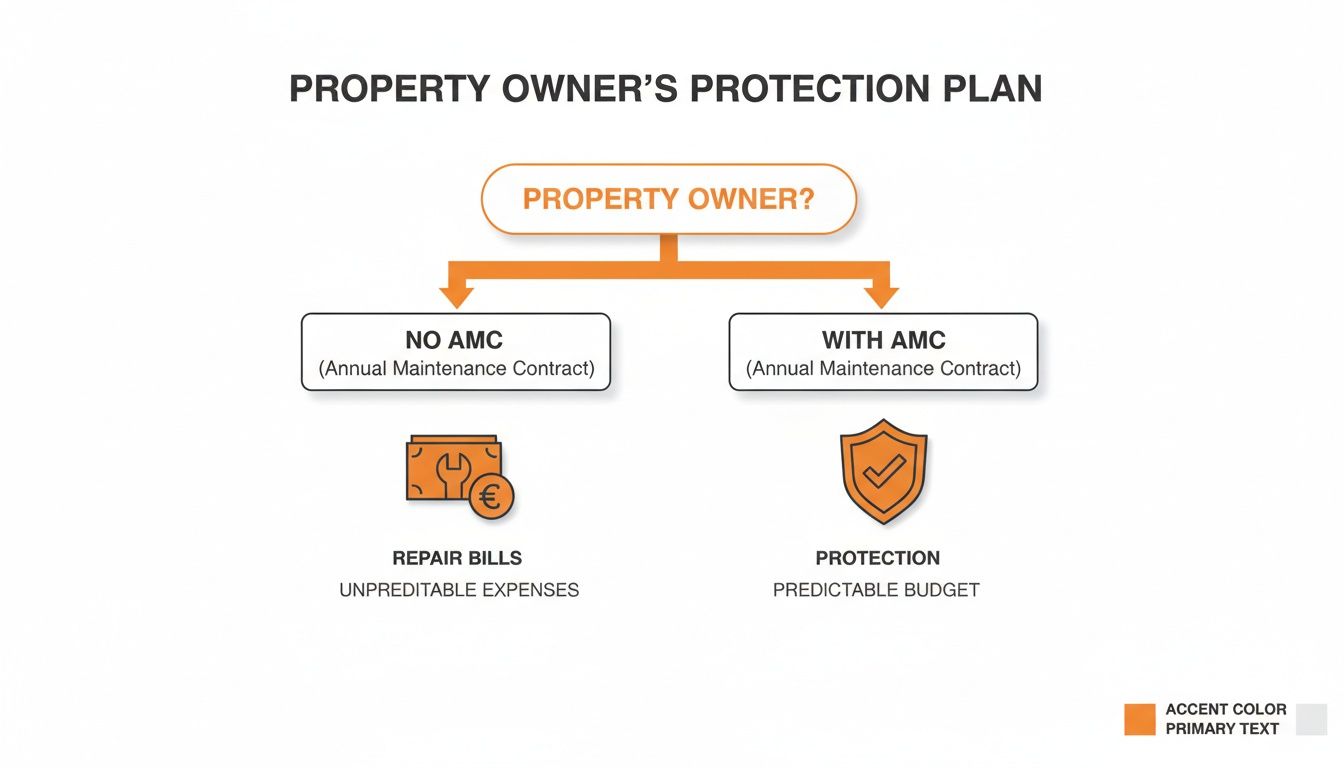
The key takeaway is that an AMC acts as a financial shield. It turns unknown future expenses into a fixed, manageable operational cost you can plan for.
Comparison of AMC Contract Models
To facilitate an informed decision, a side-by-side comparison across key evaluation criteria is necessary. The fundamental contract structure is critical; understanding the principles behind Time and Materials vs. Fixed Price contracts is essential, as they form the basis for labour-only and comprehensive models, respectively.
The following table outlines the primary trade-offs for decision-makers.
| Contract Type | Scope of Coverage | Cost Structure | Risk Allocation (Client vs. Provider) | Ideal Property Type |
|---|---|---|---|---|
| Comprehensive AMC | Labour, spare parts, and consumables for PPM and breakdowns. | Fixed annual fee. High budget predictability. | Risk of parts failure and cost is transferred to the provider. | Hospitality, high-end commercial towers, critical facilities. |
| Labour-Only AMC | Labour only. Spare parts and materials are billed separately. | Lower fixed annual fee with variable costs for parts. | Risk of parts failure and cost is retained by the client. | Industrial warehouses, low-occupancy residential, non-critical assets. |
Ultimately, selecting an AMC model requires a thorough risk assessment. For critical assets where downtime carries severe financial or reputational consequences, the budget certainty offered by a comprehensive contract represents a strategic investment. For less critical assets, a labour-only model can be a cost-effective solution, provided the client has the financial contingency to manage variable repair costs.
Decoding AMC Pricing and Hidden Cost Drivers
Evaluating the price of an Annual Maintenance Contract (AMC) in Dubai requires an analysis that goes beyond the final proposed figure. Pricing is a direct reflection of the scope, risk, and resources required by a specific asset portfolio. Understanding the key cost drivers enables accurate budgeting and a more effective comparison of proposals.
Two primary pricing models are prevalent in Dubai: per-square-foot and per-asset. The per-square-foot model is common for general maintenance in large, uniform spaces such as office floors or retail areas. However, for properties with diverse and complex equipment, a per-asset model is more precise. Under this model, each major system—such as a chiller, generator, or elevator—is priced individually based on its specific maintenance requirements. This granular approach ensures costs are directly aligned with the specialised attention each piece of equipment demands.
Key Factors That Influence AMC Costs
The cost of an amc dubai contract is influenced by several critical variables. Even with an identical scope of work, two properties will likely receive different pricing based on their unique risk profiles.
- Asset Age and Condition: This is a primary cost driver. Older equipment requires more intensive preventive maintenance and has a higher probability of failure. An AMC for a 15-year-old building with original MEP systems will be priced significantly higher than for a new tower because the provider assumes greater risk and anticipates higher consumption of spare parts.
- System Complexity: Maintaining a residential building with standard split AC units is operationally different from managing a commercial tower with a centralised Building Management System (BMS), integrated fire safety systems, and multiple elevators. The need for specialised technicians and advanced diagnostic tools for complex systems increases the cost.
- Property Type and Usage: The operational profile of a property dictates its maintenance intensity. A 24/7 hospitality asset has zero tolerance for downtime, necessitating on-site technicians and immediate response times. A standard 9-to-5 commercial office provides more flexible windows for maintenance activities, reducing the associated cost.
A frequent query is, “Why is the quote for my smaller property higher?” This often occurs when the “small” property is a high-criticality facility like a data centre or a restaurant. These sites contain mission-critical assets where any failure incurs a substantial business cost, justifying a more intensive—and therefore more expensive—maintenance regimen.
Benchmarking Costs for Different Property Types
While each property is unique, indicative cost ranges provide a baseline for budgeting and evaluation. These figures are influenced by the contract scope (comprehensive vs. labour-only) and the required service levels.
In the hospitality sector, for instance, Dubai’s restaurant maintenance market operates within established pricing parameters. Market data indicates that restaurant AMCs in Dubai typically range from AED 20-30 per square foot annually. This scope generally includes critical HVAC, plumbing, and electrical systems, along with emergency call-out provisions. For a mid-sized restaurant of 2,000 square feet, this translates to an annual investment of AED 40,000-60,000, a figure consistent with industry standards given the operational demands.
Uncovering Hidden and Overlooked Cost Drivers
Beyond primary factors, several less obvious elements can impact the total cost of an AMC. Identifying these helps ensure a comprehensive evaluation.
Potential Hidden Costs to Scrutinise:
- Exclusion of Specialised Systems: Verify if the standard MEP contract covers specialised equipment like fire alarm systems, elevators, or access control. These often require separate, third-party contracts that must be budgeted for in addition to the primary AMC.
- Undefined Consumables and Spare Parts: In labour-only contracts, the definition of “consumables” can be ambiguous. Clarify which items (e.g., filters, belts) are included versus what is classified as a chargeable spare part.
- Emergency Call-Out Limits: Some lower-cost plans may cap the number of included emergency call-outs. Exceeding this limit can trigger high per-incident charges that negate initial savings.
- After-Hours and Public Holiday Surcharges: The contract must explicitly state whether work performed outside standard business hours incurs additional fees, a critical clause for any 24/7 operation.
By deconstructing a proposal and interrogating these variables, decision-makers can shift from price comparison to value assessment, securing an amc dubai provider with a transparent, predictable, and fair cost structure aligned with the property’s needs.
Setting SLAs That Actually Drive Performance
An Annual Maintenance Contract is an agreement of performance, reliability, and uptime. The Service Level Agreement (SLA) is the mechanism that codifies this promise into a measurable and enforceable framework. Without a robust SLA, an AMC is merely a list of services without accountability. For managers of an amc dubai contract, a well-defined SLA is the primary tool for performance management.
SLAs function as the performance scorecard for a maintenance provider. They define clear success metrics, from emergency response times to the completion rate of planned tasks. Crucially, they connect maintenance activities to tangible business outcomes, such as tenant satisfaction, uninterrupted operations, and guest comfort. A well-crafted SLA eliminates ambiguity, establishes a mutual understanding of service standards, and helps prevent disputes.
Defining Core KPIs for Maintenance Contracts
An effective SLA is built on Key Performance Indicators (KPIs) that are directly relevant to the facility’s operational goals. These metrics must measure the impact of maintenance on asset performance and business continuity.
For any amc dubai agreement, the following KPIs are essential:
- Response Time: The duration from the reporting of an issue to the arrival of a technician on-site. This should be tiered based on the priority level of the incident.
- Resolution Time: The total time from the initial report to the final closure of the work order, indicating the problem has been fully resolved.
- First-Time Fix Rate (FTFR): The percentage of issues resolved on the first visit without the need for a follow-up. A high FTFR (benchmark: >90%) indicates skilled technicians and efficient logistics.
- Planned Preventive Maintenance (PPM) Completion Rate: The percentage of scheduled PPM tasks completed on time. A target of >98% is the standard for a well-managed program.
- Asset Uptime: The percentage of time a critical asset (e.g., chiller, generator, elevator) is fully operational. This is a non-negotiable KPI for hospitality, commercial towers, and critical facilities.
These KPIs form the pillars of the SLA, providing the quantitative data needed for effective provider oversight and ROI assessment.
Quantifiable Benchmarks for the Dubai Market
In Dubai’s demanding commercial environment, vague service promises are insufficient. SLAs must be specific, quantifiable, and aligned with local market expectations, leaving no room for interpretation.
The table below provides indicative benchmarks commonly used in local contracts.
Indicative SLA Benchmarks for Dubai AMCs
| Priority Level | Description | Typical Response Time Target | Typical Resolution Time Target |
|---|---|---|---|
| P1 – Emergency | A critical failure causing immediate safety risks, major business disruption, or property damage (e.g., total power loss, major flood). | 30-60 minutes | 2-4 hours (for temporary stabilisation) |
| P2 – Urgent | A significant issue impacting operations or comfort but not an emergency (e.g., AC failure in one office, faulty door access). | 2-4 hours | Within 24 hours |
| P3 – Routine | Non-critical corrective work that can be scheduled without major impact (e.g., a flickering light, a minor dripping tap). | Within 24 hours | Within 48-72 hours |
These benchmarks serve as a realistic foundation for negotiating SLA terms.
A critical consideration: An SLA without a penalty clause is a guideline, not an agreement. The contract should include provisions for service credits or financial penalties for consistent failure to meet P1 or P2 response times. This provides a strong financial incentive for the provider to meet their obligations.
Ultimately, an SLA is not a punitive tool but a driver of performance. By establishing clear, measurable, and realistic targets, you ensure your amc dubai partner is actively protecting your assets, ensuring operational stability, and contributing directly to your property’s success. This data-driven approach guarantees the delivery of contracted service levels.
Your Framework for Evaluating AMC Proposals
Selecting the right partner for an amc dubai contract requires a systematic evaluation that extends beyond price. A low initial quote can conceal future operational deficiencies, risk exposure, and compliance failures. A structured framework is essential to compare proposals on a like-for-like basis and identify the provider offering the best long-term value and operational reliability.
This approach prioritises a holistic assessment of a provider’s technical capabilities, procedural maturity, and technological alignment with the property’s specific needs over a simple cost comparison.
Technical and Operational Due Diligence
The foundation of any effective AMC is the provider’s technical expertise and operational discipline. Before reviewing pricing, scrutinise their credentials and internal processes. A professional operator will provide this documentation as a standard part of their proposal.
Your initial diligence checklist should include:
- Company Licensing and Insurance: Verify a valid trade license for technical services in Dubai. Confirm adequate Public Liability and Workmen’s Compensation insurance to protect your asset from liability in case of an incident.
- Technical Certifications: Look for internationally recognised standards like ISO 9001 (Quality Management), ISO 45001 (Occupational Health & Safety), and ISO 14001 (Environmental Management). These certifications indicate a structured, process-driven organisation.
- Technician Competency: Request anonymised summaries of technician qualifications and experience levels. A high ratio of experienced, certified technicians to junior staff assigned to your property is a key indicator of service quality.
A key differentiator in the Dubai market is a provider’s Health, Safety, and Environment (HSE) framework. A mature provider will demonstrate a comprehensive HSE policy, evidence of regular toolbox talks, and detailed risk assessments for all major tasks. This is not a formality but a critical element in mitigating liability for the asset owner.
Assessing the Provider’s Technological Stack
In modern facilities management, technology is a primary indicator of operational sophistication. The tools a provider uses for work order management and reporting offer direct insight into their efficiency and transparency.
Key questions for evaluation:
- Work Order Management: Do they use a digital CAFM (Computer-Aided Facility Management) system? Photo-based platforms for logging, tracking, and closing work orders provide an auditable, visual record of all completed work.
- Reporting Capabilities: Can they provide real-time dashboards and customised monthly reports? The system should automatically track KPIs like first-time fix rates, asset uptime, and SLA adherence.
- Asset Management: How is the asset register created and maintained? A professional provider will conduct a thorough asset survey and tagging exercise upon mobilisation, forming the basis of the entire PPM schedule. A detailed overview of this process is available in this guide to the annual maintenance contract in Dubai.
Scrutinising Sample Documents
Proposals contain promises; sample documents provide evidence of actual work quality. Requesting these is one of the most effective ways to gauge a provider’s thoroughness.
Checklist for document evaluation:
- Sample Planned Preventive Maintenance (PPM) Schedule: Does the schedule align with manufacturer recommendations or industry best practices (e.g., SFG20)? Is it specific to your asset types or a generic template? A detailed PPM checklist for a chiller, for instance, should specify tasks for daily, weekly, monthly, and quarterly intervals.
- Sample Asset Register: A quality register includes asset location, make, model, serial number, and installation date. This level of detail is fundamental for effective lifecycle management.
- Sample Monthly Report: A valuable report provides analysis, not just a list of completed jobs. It should identify recurring faults and offer data-backed recommendations for operational improvements and strategic capital planning.
While evaluating external partners, it is also beneficial to review internal processes. For example, choosing an effective approval management system can streamline internal workflows for reviewing work orders and proposals. This internal efficiency complements a strong external partnership. By applying this multi-faceted evaluation framework, decision-makers can select a true operational partner, not just a low-cost vendor.
Managing Your AMC for Long-Term Success
Executing an Annual Maintenance Contract marks the beginning of a critical operational partnership. Effective contract management from day one is what ensures the realisation of value and the long-term protection of assets. How you manage your amc dubai provider dictates the success of the agreement.
The first 90 days, known as the mobilisation phase, are foundational. This period is less about immediate repairs and more about establishing robust processes, clear communication protocols, and an operational rhythm that will sustain the partnership throughout the contract term.

The Critical First 90 Days
A successful mobilisation follows a structured plan with clear, verifiable milestones. During this initial period, the provider’s primary focus should be seamless integration with your operations and a comprehensive familiarisation with the property.
Key activities to be completed within the first three months:
- Asset Tagging and Condition Survey: All equipment under the AMC scope must be physically inspected, assigned a unique ID tag, and its current condition documented. This survey establishes the baseline for all future performance measurement.
- Handover of Technical Documents: A complete transfer of relevant documentation is critical, including as-built drawings, historical maintenance logs, and active warranties.
- Establishment of Communication Channels: Define clear escalation paths for routine requests versus emergencies. This includes onboarding and training on the provider’s work order management system.
- Finalisation of the PPM Schedule: By the end of this phase, the provider should deliver a detailed, year-long Planned Preventive Maintenance schedule for final approval.
Driving Continuous Value Through Ongoing Management
Post-mobilisation, the focus shifts to performance governance. A passive management approach, where contact is only made when a failure occurs, undermines the strategic value of an AMC. Proactive engagement is essential to evolve the service agreement into a strategic asset management partnership.
An AMC should be a dynamic agreement. Regular performance reviews are crucial to ensure the service evolves with the property’s changing needs, addresses recurring issues systemically, and identifies opportunities for operational improvement or cost optimisation.
A structured governance routine is required to maintain a high-performing partnership:
- Conduct Quarterly Business Reviews (QBRs): In these formal meetings, the provider should present data-driven reports on KPI performance, PPM completion rates, and analysis of significant corrective actions, all measured against the contractual SLAs.
- Leverage Technology for Transparency: Utilise the provider’s reporting platform for ongoing oversight. Real-time dashboards provide insights into work order status and asset health between formal reviews. Photo-based evidence of completed work adds a crucial layer of verification and trust.
- Plan for Renewal Proactively: Initiate contract renewal discussions 90-120 days prior to expiration. This provides sufficient time to review performance, renegotiate terms, and adjust the scope without the pressure of an impending deadline.
By actively managing the relationship from its inception, you ensure your amc dubai contract delivers continuous, measurable value that extends beyond simple repairs and contributes to strategic asset management.
Got Questions About AMCs in Dubai? We’ve Got Answers.
When evaluating an Annual Maintenance Contract (AMC) in Dubai, several key questions consistently arise for facility managers, asset owners, and procurement teams. Obtaining clear, practical answers is essential for making an informed decision that protects both the asset and the budget.
What’s the Real Difference Between a Comprehensive and a Non-Comprehensive AMC?
A comprehensive AMC is an all-inclusive model. The fixed fee covers technician labour, all required spare parts, and consumables. This structure provides complete budget certainty, transferring the financial risk of component failure to the service provider.
A non-comprehensive AMC, or “labour-only” contract, has a lower fixed fee that covers technician labour only. The client is invoiced separately for any spare parts used. While the initial cost is lower, this model exposes the client to unpredictable expenses if a major or high-cost component fails.
How Often Should We Really Be Servicing Our AC in Dubai?
In Dubai’s climate, HVAC systems are mission-critical assets operating under constant load. The maintenance frequency must reflect this intensity.
A standard Planned Preventive Maintenance (PPM) schedule for a commercial building should include monthly filter cleaning and basic operational checks. This should be supplemented by quarterly and bi-annual deep servicing of core components like coils, fans, and drainage systems. The exact frequency must be detailed in the AMC, referencing manufacturer guidelines and the system’s age and condition.
Can an AMC Actually Help Lower Our DEWA Bills?
Yes, a well-executed AMC is a highly effective tool for improving energy efficiency. When HVAC systems are properly maintained—with clean filters and coils, and optimal refrigerant levels—they operate closer to their design efficiency and consume less energy.
This can result in a 5% to 15% reduction in HVAC-related energy consumption. A proactive service provider will not only perform maintenance but also use performance data to identify and recommend energy-saving opportunities or retrofits, contributing to lower operational costs and improved building sustainability.
What Happens If a Repair Isn’t Covered by My AMC?
This is determined by the contract’s scope of work and exclusions clause. In a comprehensive AMC, most common repairs are included.
For work deemed “out-of-scope” under any contract type, the process for managing it should be clearly defined. The AMC must specify the procedure for providing a separate quotation, including agreed-upon labour rates and any markup on materials. This transparency is crucial for avoiding disputes and unexpected costs.
Ensure your property achieves optimal performance and budget predictability with a strategic maintenance partner. SnapFixNow provides ISO-certified, SLA-driven Annual Maintenance Contracts across Dubai, using photo-based reporting to guarantee transparency and protect your asset value. Learn more about our comprehensive facility management services at https://www.SnapFixNow.com.