For any property or facility manager in the UAE, a delayed Business All Risk (BAR) insurance claim can be more than just frustrating—it can stall operations and put a serious strain on cash flow. Delays are rarely caused by a single factor. Instead, they typically arise from a combination of documentation gaps, procedural missteps, and the unique operational pressures of the UAE market.
This guide provides a structured analysis of the BAR claims process, offering asset owners, procurement teams, and hospitality engineering leaders a clear framework for navigating claim complexities and mitigating potential delays.
Decoding Delays in BAR Insurance Claims
A Business All Risk policy is designed to be a comprehensive safety net, covering incidents from fire and water damage to critical equipment failure. However, the journey from filing a claim to receiving settlement funds is often complex. This gap is a critical period where business continuity is at risk, particularly for commercial, retail, and hospitality properties where operational uptime is paramount.
At its core, the reason most BAR claims get delayed in the UAE boils down to a mismatch between the policyholder's submitted claim and the level of proof an insurer requires for validation. Insurers and their appointed loss adjusters operate on a fundamental principle: verification. Every component of the claim, from the proximate cause of the incident to the valuation of the loss, must be substantiated with clear, objective evidence.
Common Sources of Friction
When a claim process stagnates, the cause can almost always be traced to one of these three areas:
- Documentation Deficiencies: This is the most prevalent bottleneck. Incomplete maintenance logs, a non-existent or outdated asset register, or a vague initial incident report immediately raises queries. These must be resolved before the claim can progress. For instance, a claim for a failed HVAC chiller lacking a complete service history could be delayed for weeks while the insurer investigates potential pre-existing faults or maintenance negligence.
- Procedural Missteps: A BAR policy is a contract with specific conditions precedent to liability. Most policies contain clauses requiring immediate notification (often within a 7-14 day window) or mandating that damaged property be preserved for inspection. Failure to adhere to these procedural steps provides the insurer with legitimate grounds to pause, or even dispute, the claim.
- Third-Party Dependencies: The claim process frequently involves independent loss adjusters, surveyors, or specialist engineering consultants. Their availability, assessment duration, and report submission timelines are external variables that can extend the overall claim lifecycle. This is particularly evident following a major regional event, such as a storm, which can cause a surge in claims and create a backlog for these professional services.
Understanding typical timelines and regulatory expectations is key to managing the process. A proactive approach, including familiarity with how long insurance companies have to settle claims and meticulous preparation of documentation, is fundamental.
Mapping The Four Stages Of A BAR Claim
To understand why a Business All Risk (BAR) insurance claim is delayed, it's essential to view the process as a multi-stage project, not a single event. A deficiency in one phase creates a domino effect, pushing back the entire timeline.
For facility managers, asset owners, and engineering leaders in the UAE, this structured perspective helps demystify the workflow and identify potential failure points. Mastering these stages is the key to avoiding common and costly delays.
Stage 1: Incident Reporting And Initial Notification
Many claims falter at the outset. The moment a loss occurs—be it a fire, flood, or critical equipment failure—the policy's notification period begins. Policies contractually require prompt formal notification, typically within a 7 to 14-day window.
This is not a verbal update but a formal, written notification outlining the date, time, location, and a concise, factual description of the incident. A delayed or vague notification invites deeper scrutiny from the insurer and slows the entire process. A prompt, precise report establishes a professional tone and demonstrates fulfilment of contractual obligations.
Stage 2: Site Investigation And Damage Assessment
Following notification, the insurer appoints a loss adjuster. This independent expert's role is to conduct a site visit, determine the proximate cause of the loss, and quantify the extent of the damage. This is the critical evidence-gathering phase.
The adjuster's work is significantly more efficient when the incident scene is preserved. Disposing of damaged equipment or initiating repairs before the inspection can create significant disputes. For example, if a faulty water pump floods a hospitality property in Dubai and is removed before the adjuster's arrival, proving it as the cause of loss becomes challenging. This leads to extended queries and can potentially reduce the claim value. Full cooperation from the policyholder's technical team is non-negotiable at this stage.
Stage 3: Documentation Submission And Substantiation
This stage is the primary source of most claim delays. The loss adjuster will issue a formal request for documents required to substantiate the claim. This is a requirement to prove every dirham of loss being claimed.
The policyholder must compile a comprehensive evidence file, including:
- Proof of Ownership: Invoices and asset registers for all damaged property.
- Maintenance Records: Detailed service logs from a CMMS or equivalent system demonstrating proper equipment upkeep prior to the incident.
- Financial Records: Profit and loss statements and other financial documents to support any business interruption component of the claim.
- Repair Quotations: A minimum of two to three competitive quotations for the required repair or replacement work.
In the UAE's operational context, a well-maintained Computerised Maintenance Management System (CMMS) is invaluable, providing time-stamped evidence that can satisfy an adjuster's requirements efficiently.
A claim without complete documentation is an unsubstantiated request. The burden of proof rests entirely on the policyholder to provide the necessary evidence to validate their loss.
Stage 4: Final Adjustment And Settlement
After all documentation has been submitted and reviewed, the loss adjuster prepares a final report with a settlement recommendation. This report is then submitted to the insurer for final approval. For complex or high-value claims (e.g., exceeding AED 1 million), this may also require approval from the insurer's reinsurer, adding another layer of review and a potential delay.
Delays at this final stage often occur if there is a significant discrepancy between the adjuster's valuation and the amount claimed, initiating a negotiation phase. Once an agreement is reached, a formal settlement offer is issued. Upon acceptance, payment processing can take an additional 15 to 30 days, depending on the insurer's internal financial procedures.
This visual breaks down the most common friction points that stretch out these stages, from gaps in the initial paperwork to dependencies on third parties.
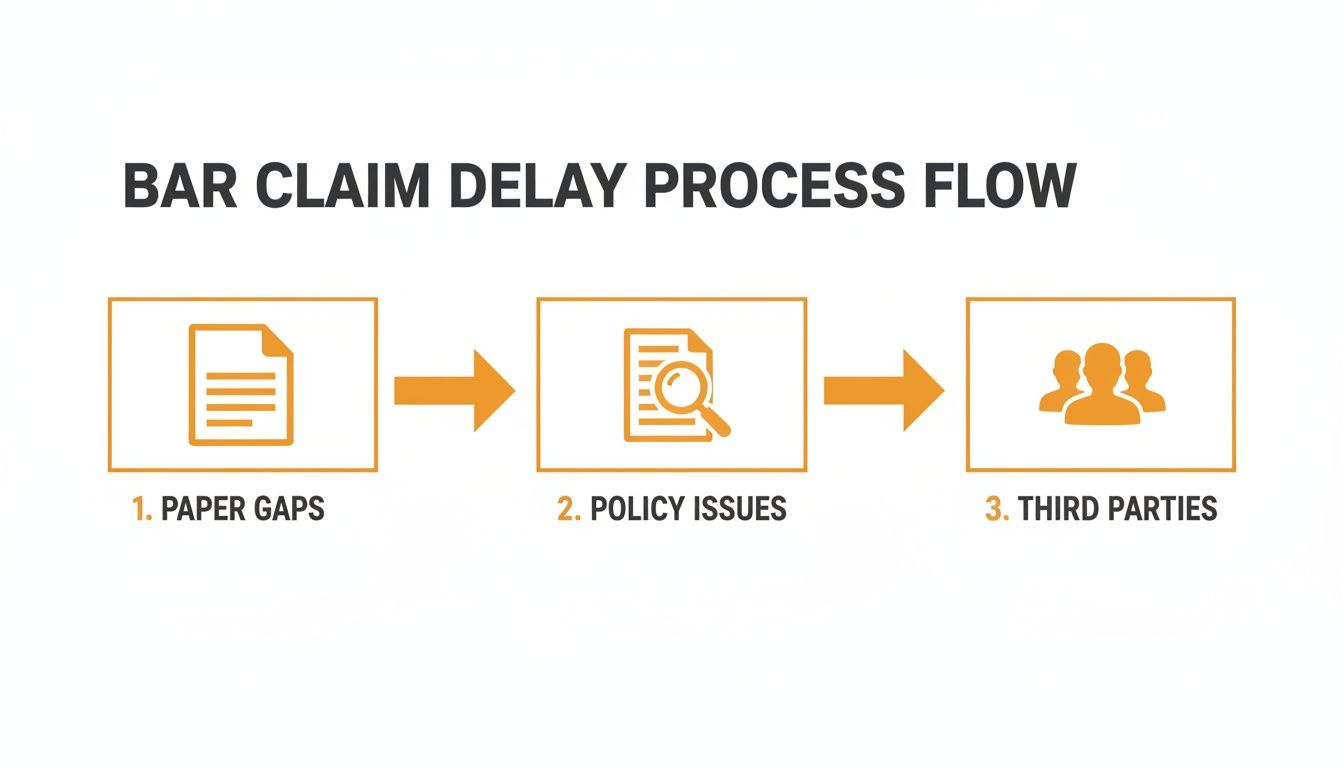
As illustrated, issues with documentation, policy interpretation, and coordination with external experts are the primary reasons why Business All Risk insurance claims get delayed in the UAE.
To further clarify, the following table outlines the division of responsibilities at each stage.
BAR Claim Lifecycle Responsibilities Insured vs Insurer
| Claim Stage | Policyholder (Insured) Responsibility | Insurer / Adjuster Responsibility |
|---|---|---|
| Stage 1: Notification | Provide prompt, written notification of the loss with all initial details. Mitigate further damage. | Acknowledge the claim notification. Appoint a loss adjuster. |
| Stage 2: Investigation | Preserve the scene. Provide site access. Answer technical questions about the incident and assets. | Conduct a thorough site visit. Investigate the cause and extent of damage. Request initial documentation. |
| Stage 3: Documentation | Gather and submit all requested documents (invoices, maintenance logs, quotes, financial records). | Review submitted documents for completeness and accuracy. Ask clarifying questions. Issue further requests if needed. |
| Stage 4: Settlement | Review the adjuster's proposed settlement. Negotiate if necessary. Formally accept the final offer. | Prepare a final adjustment report. Obtain internal/reinsurer approval. Issue a formal settlement offer and process payment. |
Understanding this division of labour helps set realistic expectations and highlights how critical proactive involvement is. A delay on the policyholder's side directly impacts the insurer's ability to move the claim forward.
Top 5 Bottlenecks That Delay Claim Payouts
While understanding the claim stages is important, identifying common breakdown points provides facility managers and asset owners with a strategic advantage. In the UAE's commercial environment, a delayed insurance payout translates directly into operational downtime, cash flow constraints, and stalled projects.
These delays are almost always predictable, stemming from friction points where the policyholder's actions (or inaction) conflict with the insurer's need for verification. Here are the five most common bottlenecks that impede Business All Risk (BAR) claims in the UAE.
1. Vague Or Delayed Initial Notifications
The moment an incident occurs, the policy's notification clause is triggered. Most BAR policies demand written notice within 7 to 14 days. Submitting this initial report late, or with imprecise details, is the first and most easily avoidable error.
Insurers view a late notification as a red flag, raising questions about the reason for the delay and whether the damage worsened in the interim. A vague report such as "water damage in basement" is equally problematic, as it prevents the insurer from taking meaningful action until a loss adjuster can conduct an initial survey. This can add 1-2 weeks to the timeline before the investigation formally begins.
2. Insufficient Proof Of Loss Documentation
This is the single greatest cause of claim delays. Following the initial report, the loss adjuster will request extensive documentation to substantiate the claim. Many organisations falter here, particularly in proving the pre-loss condition of their assets.
An insurer must be satisfied that an asset was adequately maintained before it failed. A claim for a critical MEP system failure in a Dubai commercial tower, for instance, will be immediately queried if maintenance logs, asset registers, or service histories cannot be produced. Without this proof, the adjuster may argue the failure was due to wear and tear or poor upkeep—both of which are common policy exclusions. This deficiency initiates a lengthy back-and-forth that can easily delay a claim by 30-60 days or more.
A claim is essentially a financial argument supported by evidence. Without robust, organised proof like asset registers and maintenance logs, the policyholder’s argument is significantly weakened, leading directly to scrutiny and delays.
3. Conflicts Over Policy Interpretation And Exclusions
Business All Risk policies are complex contracts containing specific definitions, conditions, and, crucially, exclusions. A major bottleneck arises when the policyholder's understanding of coverage does not align with the insurer's interpretation of the policy wording.
For example, a policy may cover storm damage but specifically exclude damage from "gradual water ingress." Following a heavy UAE rainstorm, a claim for water damage might be submitted, but the loss adjuster could argue the proximate cause was a pre-existing, slow leak rather than the storm itself. This type of dispute over "proximate cause" can trigger months of negotiation, often requiring input from legal or specialist engineering consultants to resolve.
4. Dependencies On Third-Party Experts
The claims process is not a simple dialogue between the policyholder and the insurer. It relies heavily on a network of independent professionals, including loss adjusters, forensic engineers, and quantity surveyors. Each expert involved adds a step—and a potential delay—to the timeline.
In the immediate aftermath of an incident, securing a qualified loss adjuster can be challenging, particularly after a widespread event affecting multiple properties. Their site visit, detailed analysis, and report writing all take time. If the damage involves specialised industrial machinery, a specialist engineer must be engaged, adding another assessment layer. This dependency means a significant portion of the claim timeline—often 4-8 weeks—is outside the direct control of both the policyholder and the insurer.
5. System-Wide Strain After Major Events
Catastrophic events, such as the unprecedented storms and floods in the UAE, place the entire insurance ecosystem under immense strain. When thousands of properties are damaged simultaneously, insurers are inundated with claims, creating a system-wide backlog that affects all policyholders.
In the UAE, the aftermath of recent record-breaking floods led to insurer losses estimated at up to AED 2.5 billion and a massive influx of claims. The system faced significant pressure, with gross paid claims across all insurance types jumping 18.3% year-on-year to AED 11 billion in a single quarter. For facility managers, this resulted in extended waiting periods for approvals on everything from water-damaged electrical systems to major plumbing failures.
How Global Reinsurance Markets Can Stall Your Local Claim
When a significant Business All Risk (BAR) insurance claim is filed in the UAE, the final decision-making authority often resides not with the local office but in the global reinsurance market. Understanding this dynamic is crucial to comprehending why major claims can experience prolonged delays.
Reinsurance is effectively insurance for insurance companies. Local UAE insurers lack the capacity to carry 100% of the risk for large-scale assets like commercial towers, industrial plants, or major hospitality developments. They transfer a portion of this risk to global reinsurers.
Consequently, when a large claim is submitted—typically with a value exceeding a threshold of AED 2-5 million—it requires approval not only from the local provider but also from one or more reinsurers. The claim file is reviewed by teams in international hubs like London, Zurich, or Singapore, adding a complex layer of international scrutiny to the process.
The Squeeze of a "Hard" Reinsurance Market
The global reinsurance market operates in cycles, alternating between "soft" and "hard" conditions. A soft market is characterised by high capacity, lower premiums, and flexible terms. In contrast, a hard market—often triggered by major global catastrophes—is defined by reduced capacity, higher costs, and stricter underwriting and claims criteria.
The current market is firmly in a hard cycle, which has tangible impacts on claims in the UAE:
- Intense Scrutiny: With profitability under pressure, reinsurers are dissecting large claims with forensic detail. They scrutinise every document, from the initial incident report to the final repair quotation, seeking any basis to challenge or reduce the payout.
- Extended Decision-Making: The approval chain becomes longer and more complex. It requires sequential approvals from the local claims team, local management, and then one or more global reinsurers. Each step is a potential bottleneck, adding weeks or even months to the timeline as queries are exchanged across different jurisdictions.
This explains why a major fire at a commercial property undergoes a far more rigorous claims process than a smaller incident. The decision is not just a local one; it is a global financial calculation.
UAE Market Pressures and the Reinsurance Effect
This reliance on reinsurance becomes a major chokepoint when the local market is already strained. The UAE's property and casualty market, valued at USD 16.83 billion, is expanding rapidly, with corporate segments growing at an 11.24% CAGR.
Following recent major flood events, global reinsurers increased renewal costs for local insurers. This financial pressure is passed down through the system, contributing to slower BAR claim payouts for high-risk commercial and industrial assets. When gross claims soared to AED 11 billion in a single quarter and profitability fell to a return on assets of just 0.8%, it triggered more cautious and detailed claim reviews across the board. Further data is available on the UAE's property and casualty insurance market at Mordor Intelligence.
When a local market like the UAE is impacted by a wave of large claims, the shockwaves are felt by reinsurers globally. Their reaction is to tighten financial controls and increase scrutiny, a ripple effect that lands directly on the facility manager awaiting a settlement.
For facility and asset managers, the key takeaway is that for any substantial loss, the audience for their claim extends beyond the local insurer to a network of global financial institutions.
This reality elevates documentation from a procedural task to a strategic necessity. The most effective way to navigate this multi-layered approval chain is to provide comprehensive, unambiguous, and undeniable evidence from day one.
A Proactive Framework To Accelerate Your Claim
To move from understanding delays to actively preventing them, a proactive framework is essential. For facility and asset managers in the UAE, waiting for an incident to occur before preparing a claim is a strategy that guarantees disruption and financial strain. An effective approach starts with knowing how to go about effectively filing an insurance claim, which means mastering pre-loss preparation and meticulous record-keeping.
This structured methodology transforms claim preparation from a reactive, high-stress task into a core component of strategic asset management. The framework is built on three pillars designed to address the specific vulnerabilities that cause BAR claims to stall.
Pillar 1: Pre-Loss Readiness
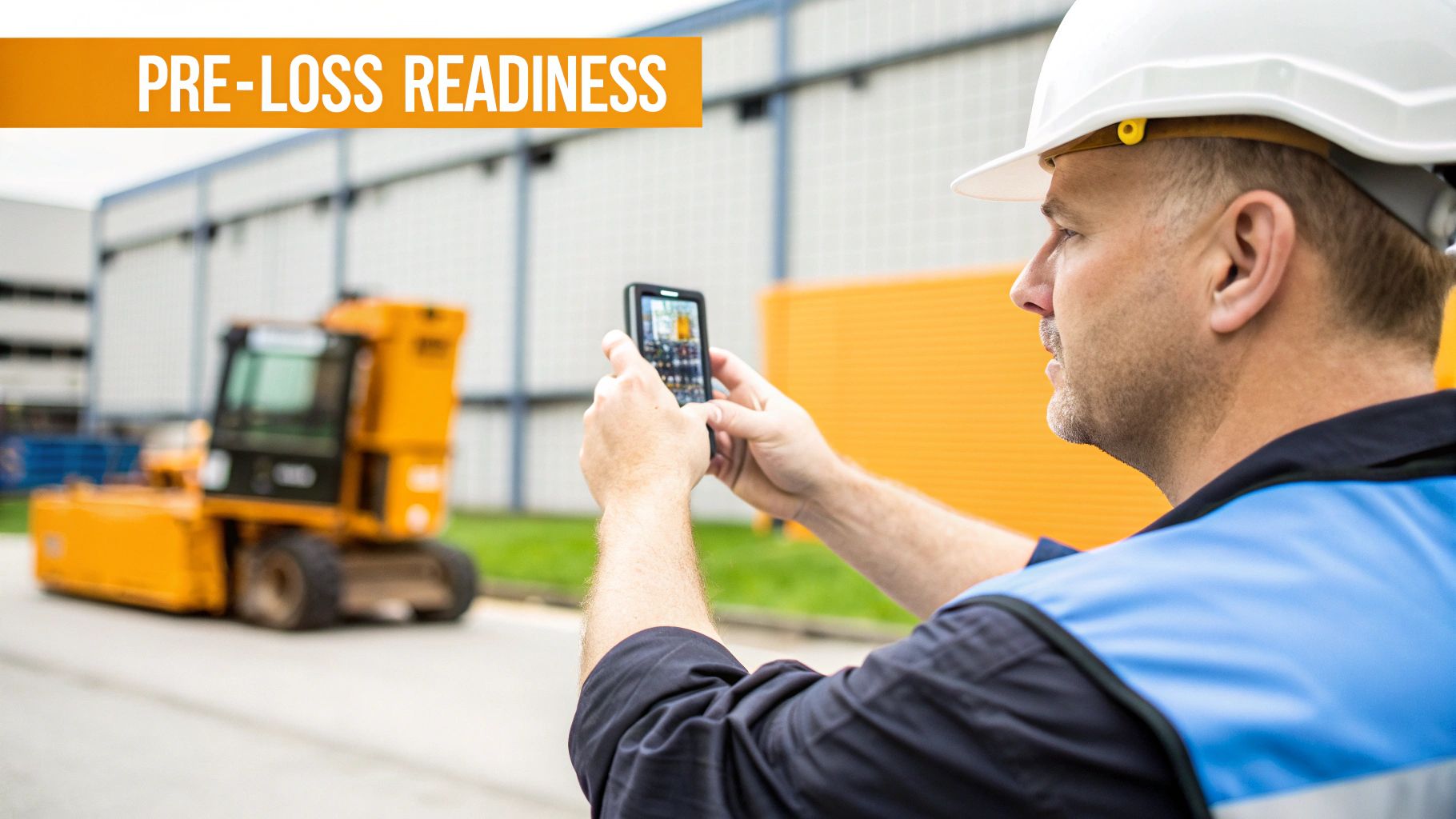
The most effective way to accelerate a future claim is to prepare for it before it occurs. Pre-loss readiness involves creating an undeniable, time-stamped record of an asset's condition, maintenance history, and value. This removes ambiguity for loss adjusters and preempts potential disputes.
Key actions for pre-loss readiness include:
- Detailed Asset Registers: Maintain a comprehensive digital inventory of all critical assets, including purchase invoices, serial numbers, and technical specifications.
- Digital Maintenance Logs: Utilise a CMMS or similar system to log all maintenance activities, repairs, and service calls. This provides proof of due diligence and counters potential arguments of negligence or poor upkeep.
- Clear Policy Documentation: Maintain an accessible digital copy of the complete BAR policy. Ensure key operational team members understand the notification periods and their immediate responsibilities following an incident.
Without this foundational documentation, the claims process begins at a disadvantage, forcing adjusters to spend weeks verifying basic information that should be readily available.
Pillar 2: At-Loss Protocol
Following an incident, actions taken within the first 24 to 48 hours are critical. A disciplined at-loss protocol ensures compliance with policy obligations, preservation of evidence, and the establishment of a professional tone for the claim.
An effective immediate protocol must include:
- Immediate and Accurate Notification: Dispatch a formal written notice to the insurer or broker immediately. It must include the date, time, location, and a concise, factual description of the incident, adhering to the policy's timeframe (often 7-14 days).
- Evidence Preservation: Do not repair or dispose of any damaged items until the loss adjuster has completed their survey. Secure the area to mitigate further damage, but leave the primary scene as undisturbed as possible.
- Photo and Video Documentation: Use photo-based work order systems or smartphones to capture extensive, time-stamped images and videos of the damage from multiple angles. This visual evidence is a powerful substantiation tool.
A photo-based system creates an indisputable record that validates the scope of damage. This is a vital part of the https://www.SnapFixNow.com/insurance-claim-support-in-dubai-technical-proof-your-insurer-expects/. This type of objective evidence is precisely what adjusters need to justify their assessments and accelerate their reports.
Pillar 3: Post-Loss Management
After the initial report and adjuster's survey, the claim enters a management phase where consistent communication and diligent follow-up are essential. This is a time for active project management, not passive waiting.
Treat a claim file like any other critical project. Structured communication, regular follow-ups, and a clear grasp of the next steps will stop your file from getting buried at the bottom of an adjuster's massive workload.
Maintain momentum with these steps:
- Establish a Single Point of Contact: Designate one individual from your team as the sole liaison with the loss adjuster to prevent conflicting information.
- Maintain a Communication Log: Document every email, phone call, and meeting, noting dates, key discussion points, and agreed actions.
- Respond to Requests Promptly: When the adjuster requests further information, aim for a response within 24-48 hours. Slow responses from the policyholder provide a valid reason for the insurer to pause their own timeline.
By implementing this three-pillar framework, property and facility managers can shift from reactive damage control to proactive claim acceleration, safeguarding their assets and ensuring business continuity.
A structured checklist can serve as a valuable tool in this process. Below is a practical framework to ensure critical steps are not missed.
Claim Acceleration Checklist: Pre-Loss vs Post-Loss Actions
| Action Item | Pre-Loss Preparation | Post-Loss Response | Impact on Claim Timeline |
|---|---|---|---|
| Asset Documentation | Maintain a detailed digital asset register with photos, invoices, and serial numbers. | Immediately reference the register to identify and quantify damaged assets. | High: Significantly speeds up asset verification and valuation. |
| Maintenance Records | Keep complete digital maintenance logs (e.g., using a CMMS). | Provide maintenance history to the adjuster to prove due diligence. | High: Prevents delays caused by negligence allegations. |
| Policy Review | Annually review BAR policy; brief key staff on notification duties. | Adhere strictly to the notification period (e.g., 7-14 days). | Critical: Avoids claim rejection due to late notification. |
| Emergency Contacts | Have a list of approved contractors and insurer contacts ready. | Notify insurer and necessary emergency services immediately. | Medium: Ensures a swift and coordinated initial response. |
| Evidence Gathering | Establish a protocol for photo/video documentation. | Capture extensive, time-stamped photos and videos of the damage from all angles. | High: Provides indisputable proof of loss, reducing disputes. |
| Site Preservation | Train staff on how to secure a site without disturbing evidence. | Secure the site to prevent further loss; do not discard damaged items. | Critical: Allows the loss adjuster to conduct a proper survey. |
| Communication Plan | Designate a single point of contact for insurance matters. | Manage all communication through the designated contact. | Medium: Prevents confusion and ensures consistent messaging. |
| Document Submission | Organise all paperwork in a secure, accessible digital folder. | Respond to information requests from the adjuster within 24-48 hours. | High: Actively drives the claim forward and prevents stalling. |
By systematically addressing these items, a potentially chaotic and lengthy process is transformed into a managed, efficient workflow. This checklist is a tool for taking control of a claim's trajectory from start to finish.
Getting to a Faster, Fairer Settlement
Navigating a Business All Risk (BAR) insurance claim in the UAE involves variables both within and outside of your control. While factors like market-wide backlogs after a major storm or delays from global reinsurance partners are external, a proactive, data-led approach by the policyholder can significantly reduce the claim lifecycle.
The key is to integrate claim preparation into the core function of asset management, rather than treating it as a reactive, post-incident task. Meticulous documentation, prompt communication, and a clear understanding of an insurer's verification requirements are essential tools for protecting cash flow and ensuring business continuity.
It’s All About a Shift in Mindset
The primary takeaway is the need to view facility management through the lens of potential insurance claims. Every maintenance log, asset register entry, and incident report is a piece of evidence that will either accelerate a settlement or cause it to stall.
When a team is empowered with this perspective, they are not starting from zero when an incident occurs. They are executing a well-rehearsed plan designed to achieve a fair and efficient resolution.
This requires an objective assessment of internal processes. Are maintenance records sufficiently robust to withstand an auditor's scrutiny? Does the operational team understand the critical first steps to take immediately following a loss? Answering these questions honestly is the first step toward placing an organisation in a position of strength.
Ultimately, by embracing proactive management and detailed record-keeping, you can navigate the complexities of BAR claims with confidence. To see how expert documentation makes a material difference, review our guide on insurance claim support. This approach not only protects your assets but also strengthens the operational resilience of your entire organisation within Dubai's demanding commercial environment.
Got Questions? We've Got Answers
Navigating a Business All Risk (BAR) insurance claim can generate numerous questions. The process can seem complex, but with the right information, it becomes far more manageable. Here are answers to common queries from property and facility managers across the UAE.
What’s a Realistic Timeline for a BAR Claim Settlement in the UAE?
The timeline varies significantly with claim complexity. For a straightforward property damage claim under AED 500,000 with complete documentation, a settlement can often be reached within 30-60 days.
For larger, more complex claims involving business interruption or damages exceeding AED 1 million, a timeline of 90-180 days is more realistic, and can sometimes be longer. Delays are more likely if the claim requires reinsurer approval or if a major regional event has created an industry-wide backlog.
How Can a Facility Management Company Actually Help Speed Up a BAR Claim?
A professional Facility Management Company (FMC) serves as a source of credible, third-party documentation. Through structured maintenance contracts and the use of systems like CMMS, they build a detailed, time-stamped history of logs that prove due diligence in asset care.
In the event of an incident, their technical teams can produce accurate, photo-based damage reports and a clear scope of repair works that loss adjusters can rely upon. This expert documentation reduces the back-and-forth regarding the cause of loss and repair costs, directly accelerating the damage assessment phase.
What's the Single Biggest Mistake People Make That Delays a Claim?
The most common and costly mistake is a delayed or incomplete initial notification. Policies contain strict contractual deadlines for reporting a loss, typically 7-14 days. Failure to provide prompt, formal written notification puts the entire claim at risk from the outset.
A second critical error is failure to preserve the scene. Disposing of damaged items before the loss adjuster's inspection makes it extremely difficult for them to verify the cause and extent of the damage, leading to prolonged investigations and potential disputes.
The two most critical policyholder duties are immediate notification to the insurer and preservation of evidence. Failure in either of these areas is the fastest way to create avoidable delays.
Does the Type of Property Change How Long a Claim Takes?
Yes, the property type directly influences claim complexity and duration.
- Industrial Claims: These often involve specialised machinery, complex business interruption calculations, and the need for specialist surveyors, which naturally extends the timeline.
- Hospitality and Retail Claims: Business interruption values are often high, and quantifying lost revenue accurately is a time-consuming process, making these claims more complex.
- Commercial Office Claims: These are generally more straightforward, unless the incident involves major structural damage or a systemic failure affecting multiple tenants, which adds layers of complexity.
Successfully navigating a BAR claim comes down to meticulous preparation and having the right experts in your corner. SnapFixNow provides the technical documentation and insurance claim support you need, ensuring you have the credible, detailed evidence insurers require for faster, fairer settlements. Find out more at https://www.SnapFixNow.com.