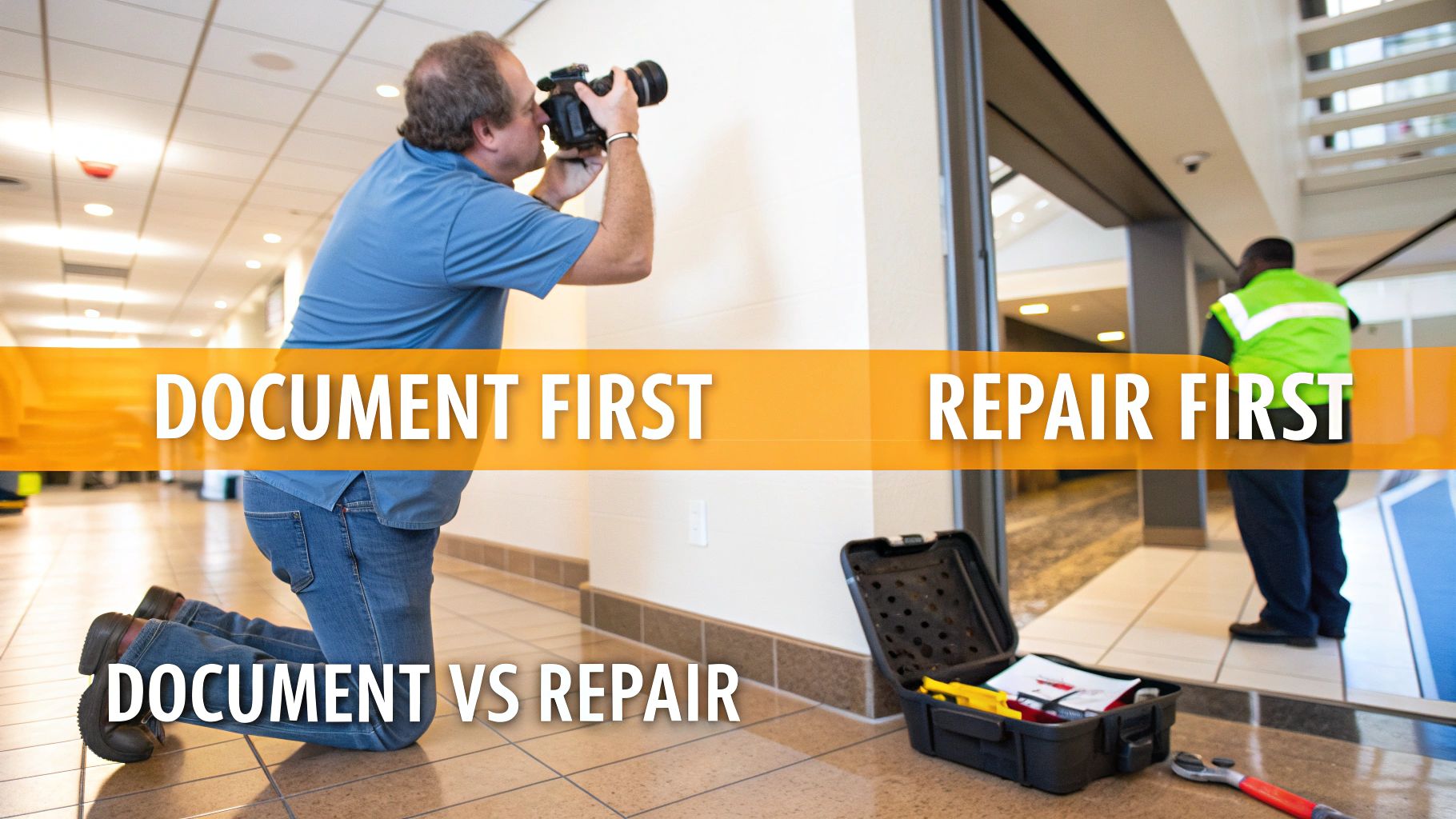
When property damage occurs, UAE facility managers, asset owners, and hospitality engineering leaders face a critical decision point: do we initiate immediate repairs, or do we secure comprehensive documentation first?
For any incident that does not pose a direct threat to life or safety, the protocol is unambiguous: document first, then mitigate. Rushing into repairs without a verifiable, time-stamped record of the initial damage is the most common reason for insurance claim disputes and rejections in the UAE's compliance-driven commercial environment.
The Critical First 60 Minutes: A Protocol for Asset Protection
How your team responds within the first hour of discovering damage dictates the financial outcome for the asset. The natural impulse is to rectify the issue immediately. However, premature repairs can permanently destroy the evidence required by insurers to validate a claim.
In the UAE, an absence of proof is often interpreted as an absence of grounds for a claim, potentially leaving your organisation with 100% of the liability.
This initial phase is not about permanent fixes. It is about a disciplined, sequential response framework.
- Ensure Safety: Address immediate life-safety risks. This includes isolating water mains, de-energising electrical circuits, or evacuating the area. Personnel safety is the overriding priority.
- Document the Scene: Utilise mobile devices to capture detailed, time-stamped photographs and videos of the damage before any clean-up or repair work commences.
- Mitigate Further Damage: Only after evidence is secured, implement temporary measures to prevent escalation. This may involve deploying tarps over a leaking roof or relocating sensitive equipment from a flooded area.
This "document, then mitigate" sequence separates a managed claims process from a financial liability. It establishes the clean, auditable trail that regional insurers and loss adjusters mandate.
Financial Impact Analysis: Proceeding with repairs before documentation can result in claim denials of up to 100%. Insurers operate on verifiable evidence. Without a clear "before" state, they can argue the damage was pre-existing or less severe than claimed. Your initial documentation is your primary negotiating asset.
The following framework provides decision-making clarity for on-site teams in the crucial first 15 minutes, prioritising actions based on damage type and associated risks.
Immediate Action Protocol: A Risk-Based Framework
| Damage Scenario | Immediate Priority (First 15 Mins) | Justification (Primary Risk Factor) | Indicative Response Time SLA (Industry Benchmark) |
|---|---|---|---|
| Major Water Leak/Burst Pipe | 1. Isolate water main. 2. Document source & spread. |
High risk of rapid structural saturation, mold growth (critical in UAE climate), and electrical hazards. | < 1 Hour |
| Fire Incident (Post-Extinguishing) | 1. Secure the area. 2. Document all untouched areas. |
High risk of evidence contamination. Soot, smoke, and water damage from suppression are crucial to capture for the claim. | < 2 Hours |
| Structural Damage (e.g., impact) | 1. Evacuate & restrict access. 2. Document from a safe distance. |
Extreme safety risk. Immediate danger of progressive collapse or further structural failure. | Immediate |
| HVAC Failure (e.g., chiller leak) | 1. Isolate power. 2. Document leak source & affected equipment. |
Risk of electrical faults, costly equipment damage, and significant business interruption (downtime). | < 4 Hours |
| Vandalism/Break-in | 1. Do not touch anything. 2. Document the entire scene. |
Critical for both police reports and insurance claims. Scene preservation is paramount for liability assessment. | < 2 Hours |
This table serves as a training tool to standardise your team's response, shifting their mindset from reactive panic to a structured protocol that protects your organisation's financial interests.
Understanding the critical difference between a simple damage report and an insurance-ready claim file is foundational. It transforms a chaotic event into a managed process, ensuring a clear path from incident to resolution without incurring preventable financial loss.
Why Insurers Mandate Documentation Before Repairs
From an insurer's perspective, undertaking permanent repairs before a formal assessment is akin to destroying evidence. Loss adjusters are tasked with verifying the cause, scope, and liability associated with the damage, and this requires an unaltered scene.
Without clear, time-stamped proof, it is difficult to distinguish a new incident from pre-existing wear and tear or poor maintenance—common exclusions in many commercial property policies. A well-intentioned but premature repair can be misinterpreted as an attempt to obscure the true nature of the incident, immediately raising red flags.
Preserving the Chain of Evidence
The damaged area constitutes critical evidence. Your photographic and written records create an unbroken "chain of custody" that validates what happened, where, and when. This documentation is the primary tool for successful claim settlement.
The entire claims process is predicated on this initial evidence. It provides the loss adjuster with the necessary data to:
- Establish Causation: Was the damage from a sudden and unforeseen event (typically covered), or a slow leak resulting from deferred maintenance (often excluded)?
- Validate Scope of Work: Does the evidence support a full replacement of an asset, or merely a localised repair?
- Assess Third-Party Liability: Could a contractor, neighbouring tenant, or other third party be responsible for the loss?
Insurers operate on verifiable data. Missing documentation creates ambiguity, and in the context of insurance, ambiguity leads to delays, disputes, or claim denials.
Lessons from Recent UAE Weather Events
The importance of the "document first" protocol was starkly highlighted during major weather events in the UAE.
Following the unprecedented rainfall in April 2024, which generated estimated insured losses approaching US$850 million, many asset managers who initiated immediate clean-up and repairs without comprehensive documentation faced claim rejections. Insurers had no verifiable way to link the claimed damage directly to the insurable event.
Data from the aftermath showed that properties with immediate, systematic digital documentation systems in place recovered their financial losses up to 40% more efficiently than those relying on manual processes. This event provided a clear lesson: in the UAE's commercial property market, documentation must precede action.
Guidance for Procurement Teams: This risk mitigation strategy can be embedded directly into your service contracts. Mandate specific photo-documentation standards and response protocols within your Annual Maintenance Contracts (AMCs). This makes your service provider contractually obligated to preserve evidence before commencing work, shielding your organisation from the financial impact of a denied claim.
To facilitate claim approval, it is essential to understand why your insurance company might refuse to pay a claim and avoid common procedural errors. Providing the technical proof your insurer expects transforms a potentially contentious negotiation into a straightforward administrative process.
Creating Damage Reports That Secure Claim Approval
Once the decision to document is made, the objective is to compile a report that leaves no room for ambiguity or dispute. An incomplete report invites scrutiny from loss adjusters. A thorough, evidence-backed file streamlines the approval process. This is about building a verifiable narrative that substantiates the cause and quantum of the loss.
Constructing the Visual Narrative
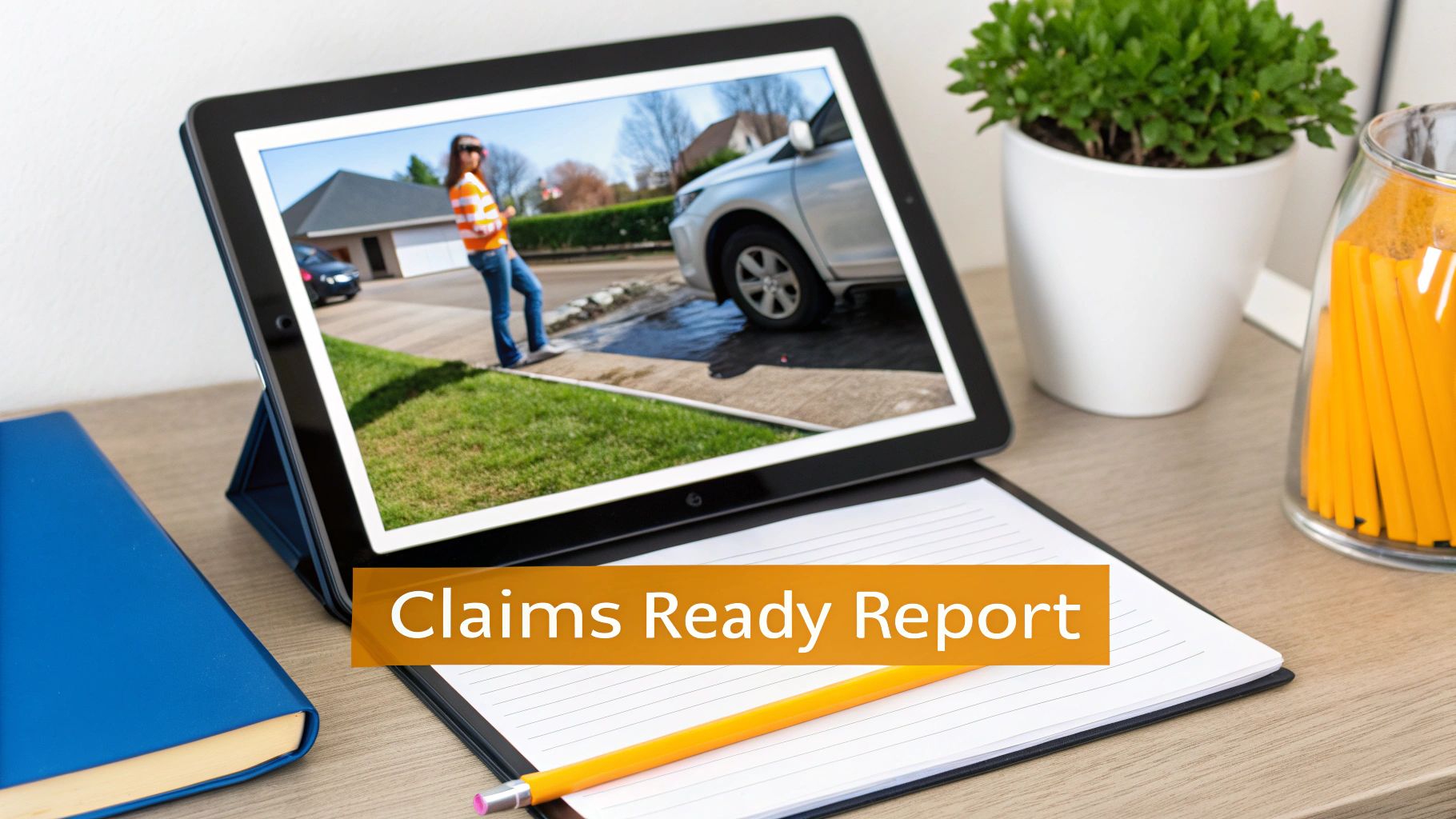
Visual evidence is the cornerstone of a successful claim. It must provide a complete, multi-layered view for the loss adjuster.
- Establishing Shots (Wide Angle): Begin with wide-angle photographs of the entire affected area to establish context and scale, whether it is a retail unit, office floor, or hotel lobby.
- Relationship Shots (Medium Angle): Capture medium shots that illustrate the causal link between different elements of damage (e.g., a water-stained ceiling, the soaked carpet beneath, and the affected IT equipment).
- Close-up Shots (Root Cause): Finally, secure detailed, close-up images of the specific point of failure—a cracked pipe fitting, a damaged roof membrane, or compromised electrical wiring. This is critical for proving causation.
The Critical Role of Metadata
Insurers in the UAE increasingly rely on data integrity to validate claims. Metadata—the digital information embedded within photo and video files—provides non-negotiable proof.
Time-stamps and GPS location tags automatically verify when and where each piece of evidence was recorded, removing any doubt about authenticity. Many modern CAFM and facility management platforms automate this, ensuring every photo is tagged with the requisite data for a compliant claim file.
Case Study Analysis: A UAE commercial property's initial storm damage claim was denied after a 90-minute manual inspection missed significant roof damage. By integrating historical weather data with AI-analysed, time-stamped photo documentation captured immediately after the event, the claim decision was reversed to a full payout. With an estimated 20% of regional insurers operating near minimum capital requirement levels, ironclad proof is necessary to ensure claims are paid.
Assembling a Comprehensive Claim File
Beyond visual evidence, a structured report is essential. A complete file should anticipate and answer every question a loss adjuster might have.
Essential Components of a Damage Report
| Component | Description | Why It's Critical in the UAE Market |
|---|---|---|
| Written Narrative | A detailed, chronological account of the incident, from discovery to initial mitigation. Include specific dates, times, and actions taken by personnel. | Provides a clear, auditable timeline consistent with regulatory and insurer expectations for incident management and reporting. |
| Damaged Asset Inventory | A granular list of every affected item, including make, model numbers, serial numbers, and replacement cost estimates. | Crucial for calculating the total value of the loss and ensuring accurate indemnification for high-value commercial assets and equipment. |
| Mitigation Records | Verifiable proof of temporary actions taken to prevent further damage (e.g., invoices for water extraction, photos of temporary roof coverings). | Demonstrates fulfillment of the policyholder's duty of care to mitigate loss, a key factor in claim validation. |
| Witness Statements | Concise, signed statements from staff or tenants who witnessed the event or its immediate aftermath. | Corroborates the primary narrative and adds credibility, especially for incidents in multi-tenanted commercial properties. |
Following this structured approach elevates an incident log into a robust claim file. For a more detailed guide, review how to prepare a successful property damage insurance claim in Dubai to ensure all requirements are met.
Coordinating Repairs with Vendors and Insurers
With the scene documented and immediate risks controlled, the next phase involves engaging your maintenance vendors and notifying your insurer. This stage requires a clear process to avoid actions that could jeopardise the claim. The focus is on controlled, approved steps to stabilise the property.
A critical distinction exists between temporary mitigation and permanent repairs. Mitigation involves immediate, low-cost actions to prevent further loss, such as water extraction or applying temporary coverings to a damaged roof. Insurers expect and require these actions as part of your duty of care.
Permanent repairs—such as replacing drywall, flooring, or electrical systems—must not be authorised without explicit approval from your insurer. Proceeding prematurely denies the loss adjuster the opportunity to assess the original scope of damage and is a leading cause of claim denial.
Engaging Vendors and Managing Quotations
For asset managers with an established Annual Maintenance Contract (AMC), this process is streamlined. Pre-vetted vendors with contractually obligated Service Level Agreements (SLAs) can often guarantee emergency response times of under two hours, a significant advantage in the UAE commercial property market.
For ad-hoc contractor engagement, insurers typically require multiple quotations (usually three) for any permanent repair work exceeding a specified threshold (often AED 10,000 – 20,000). A detailed Request for Quotation (RFQ), based on the documented scope of work, should be issued to ensure comparable, transparent bids suitable for insurer evaluation.
A well-managed vendor process aligns all stakeholders—the property manager, the contractor, and the insurance adjuster—and transforms a potentially contentious situation into a straightforward administrative workflow.
Repair and Vendor Engagement Decision Matrix
The choice between leveraging an existing AMC provider versus sourcing ad-hoc services significantly impacts cost, speed, and claim success. This matrix provides a comparative analysis for decision-makers.
| Decision Point | Option A (AMC Contract) | Option B (Ad-Hoc Call-Out) | Key Consideration for UAE Market |
|---|---|---|---|
| Response Time | Typically < 2 hours due to pre-defined SLAs. | Variable; can be hours or days depending on market demand and availability. | Speed is critical in the UAE's high-humidity environment to prevent secondary damage like mold. |
| Cost Control | Pre-negotiated rates for labour and materials. Budget predictability. | Market rates, subject to surge pricing for emergency call-outs. | AMCs provide cost certainty, crucial for OpEx forecasting and budget management. |
| Quality & Vetting | Vendors are pre-vetted against technical and compliance standards. | Quality is inconsistent; requires rapid due diligence under pressure. | An established AMC partner mitigates the risk of engaging unqualified contractors during a crisis. |
| Documentation | Standardised, streamlined invoicing and reporting suitable for insurers. | Requires collation and standardisation of documents from multiple sources. | Insurers in the UAE favour the clear, auditable trail provided by professional AMC providers. |
| Insurer Relations | Major AMC providers often have established workflows with insurers. | Each new vendor may require separate assessment and approval by the insurer. | Familiarity between vendor and insurer can significantly expedite claim approval. |
While ad-hoc services may be suitable for minor, non-urgent issues, an AMC provides the structured, efficient, and reliable framework required for managing significant property damage incidents and navigating the associated insurance claim.
Record Keeping Protocol: Maintain a meticulous log of all communications with insurers and vendors. Professional tools for insurance call transcription can create an indisputable record of verbal discussions, authorisations, and agreements, which is invaluable in case of disputes.
How Technology Resolves the "Repair vs. Document" Dilemma
The debate over repairing or documenting first is largely rendered obsolete by modern facility management technology. Digital platforms transform a reactive, high-stress event into a structured, auditable workflow from the moment damage is identified. For managers of Grade A commercial assets or large hospitality portfolios, a consistent, tech-driven response protocol is no longer optional—it is a core component of risk management.
These platforms provide capabilities that are critical in a damage control scenario. Real-time photo uploads with immutable time and GPS metadata provide irrefutable evidence. Centralised communication logs eliminate ambiguity and "he said, she said" disputes.
Quantifying the Impact of a Digital-First Response
The benefits are not merely operational; they directly impact OPEX and asset availability. Implementing a digital-first damage response protocol can reduce asset downtime by up to 35%. For a retail mall experiencing an HVAC failure, faster, evidence-backed repairs translate directly to reduced business interruption for tenants.
Digital documentation prior to any physical intervention can reduce the total cost of repair and recovery by as much as 60%. This is achieved by avoiding the common pitfalls of insurance claims in the UAE, a market with unique regulatory and commercial characteristics. The specifics of how digital tracking helps UAE property investors recover more efficiently are well-documented and provide a clear business case for technology adoption.
For Facility & Asset Managers: This represents a strategic shift from reactive problem-solving to proactive control. With a single click, you can generate a compliant, data-rich report that satisfies the stringent requirements of insurers and loss adjusters. What was once a multi-week process of email exchanges and document collation becomes a single, streamlined submission.
Core Technology Features for Damage Response
To effectively manage an incident, a few core platform functions are non-negotiable for a modern, compliant response protocol.
- Geo-tagged Photo and Video Logs: Ensures every piece of visual evidence is immutably tied to a specific location and time, making it indisputable for insurance purposes.
- Centralised Work Order Management: A single source of truth for tracking mitigation tasks, assignments, and real-time progress, ensuring alignment across all teams.
- Automated Report Generation: Compiles all photos, notes, and communication logs into a professional, insurance-ready PDF, drastically reducing administrative burden.
- Offline Capability: Enables technicians to capture data in areas with no connectivity (e.g., basements, service corridors), with the system automatically syncing when a connection is restored.
By embedding these tools into your standard operating procedures, the question evolves from "should you repair first or document first?" to "how quickly can our system capture the evidence so compliant mitigation can begin?" This change in focus is what separates high-performing asset management from costly, reactive fire-fighting.
Post-Damage Action Checklist
In a high-stress damage situation, a clear, repeatable action plan is the most effective tool for mitigating financial loss. This decision tree is designed for on-site teams to ensure a structured response that protects the asset and the insurance claim.
Immediate Safety Assessment (First 5 Minutes)
The overriding priority is human safety. This assessment precedes all other actions.
- Is there an immediate life-safety risk? (e.g., risk of electrocution, fire, structural collapse, hazardous material exposure).
- Yes: Evacuate all personnel immediately. If safe to do so from a distance, isolate electrical and water supplies. The first call must be to Dubai Civil Defence or the relevant emergency services. Do not enter the area to document. Safety is absolute.
- No: The area is safe to enter. Proceed to the next phase.
Documentation and Mitigation Protocol (Next 60 Minutes)
With the area secured, the focus shifts to preserving the scene exactly as found.
Capture the Five Essential Photographs:
- Wide-angle of the entire scene for context.
- Medium shot showing the relationship between damaged elements.
- Close-up of the specific point of failure (e.g., the burst pipe, faulty valve).
- Close-up of any manufacturer labels or serial numbers on failed equipment.
- A shot indicating the extent of spread (e.g., high-water mark on a wall).
Mitigate Further Damage (Temporary Measures Only): After photos are secured, take temporary steps to prevent escalation. This includes covering equipment or using a wet vacuum for water extraction. Do not begin any permanent repairs.
Initiate Internal Reporting: Inform direct line management, providing initial photos and observations to begin the formal incident reporting process.
A technology-driven approach streamlines this entire sequence, delivering quantifiable results.
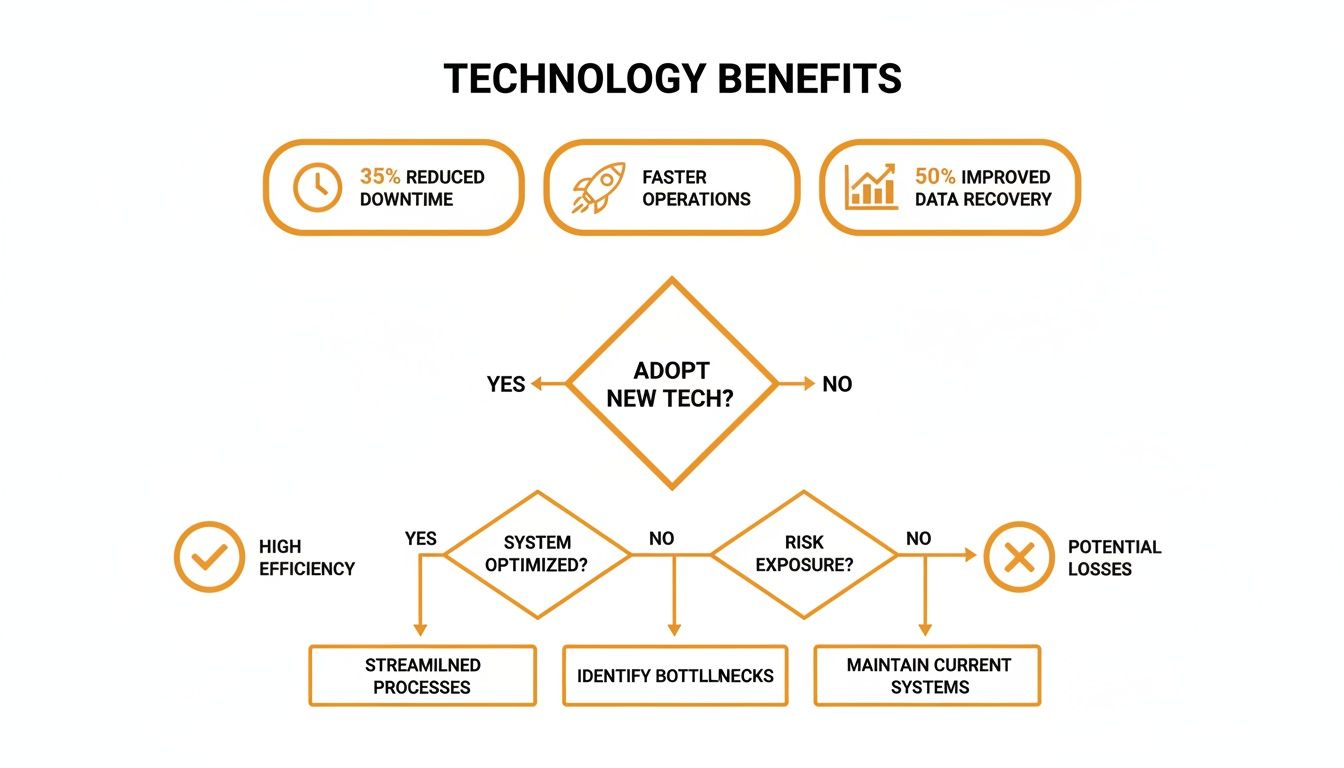
As the data shows, a systematic, tech-enabled response can reduce asset downtime and recovery costs by up to 35%, enabling a faster return to normal operations.
Formal Notification and Vendor Engagement
Who to notify first: your insurer or your contractor? The correct sequence is to notify your insurer first. Provide preliminary details, submit initial photos, and obtain a claim reference number. Then, instruct your approved AMC vendor to commence mitigation work, providing them with the claim number. This sequence ensures all subsequent actions are aligned with your policy from the outset, preventing future claim disputes.
Frequently Asked Questions for UAE Property Professionals
Can minor repairs be performed before the insurer's assessment?
Yes, but only actions that fall under mitigation. Your insurance policy requires you to take reasonable steps to prevent further loss. This includes immediate, temporary actions like shutting off a water main, boarding a broken window, or placing a tarp over a damaged roof.
The critical distinction is between mitigation (permissible) and restoration (requires approval). Do not proceed with permanent repairs like replacing drywall or flooring until you have explicit authorisation from your insurer.
What if my AMC provider begins repairs before documentation is complete?
This risk should be addressed contractually within your Annual Maintenance Contract (AMC). A well-defined Service Level Agreement (SLA) must stipulate that for all non-life-threatening incidents, documentation is the first mandated action.
A best practice is to require your maintenance provider to capture and submit geo-tagged photos via a shared platform before commencing any work. This transfers the responsibility for evidence preservation to the vendor and protects your organisation from procedural errors that could compromise a claim.
What is the time limit for reporting damage to an insurer in the UAE?
Most commercial property policies in the UAE require "prompt" or "immediate" notification. While a strict deadline is not always specified, the industry best practice is to provide a preliminary notice of claim within 24 to 72 hours of discovery.
Delaying notification can provide the insurer grounds to argue that you failed to act in a timely manner to mitigate further loss, which could potentially reduce the final settlement amount. It is always advisable to report immediately, even if full details are not yet available.
Regardless of the scenario, the guiding principle is clear. When faced with the decision to repair first or document first, the correct, risk-averse, and financially prudent action is always to document. This is the single most important step in protecting your claim, establishing a clear audit trail, and ensuring a smooth recovery process.
For professional, SLA-driven maintenance and insurance-ready damage reporting, trust SnapFixNow. Our photo-based work order system ensures every incident is documented correctly from the start. Learn more about our Annual Maintenance Contracts and protect your assets today.