When a critical incident occurs in a high-value commercial property in the UAE—such as major water damage from a burst pipe or a catastrophic HVAC system failure—a detailed engineering report is the mechanism that transforms an insurance claim from a subjective narrative into an objective, evidence-backed case.
For property managers, asset owners, and engineering leaders, these reports provide the impartial, technical data needed to establish causation, liability, and the full financial scope of the damage. This is precisely the level of validation insurers in Dubai and the wider UAE require to mitigate ambiguity, approve claims efficiently, and facilitate a swift resolution.
From Damage to Documentation: The Role of Engineering Reports

In the highly regulated UAE insurance market, technical validation is a prerequisite for claim settlement. Insurers operate on quantifiable risk, and a professional engineering report provides the neutral, third-party analysis they need to proceed with confidence. Without it, a claim can become mired in protracted information requests, disputes over causation, and negotiations based on opinion rather than empirical data.
A professionally prepared report fundamentally alters the claim dynamic. It serves as the definitive, auditable record of the incident, its root cause, and the necessary remediation scope. This document anticipates the technical questions loss adjusters are mandated to ask, providing clear answers substantiated by engineering principles and relevant industry standards.
Quantifying the Scope of Damage
A primary challenge in any significant property claim is establishing an agreed-upon scope of damage. An engineering report systematically documents every detail, moving far beyond superficial visual assessment.
- Primary Damage: The immediate, obvious impact of the incident—for example, a burst chilled water line flooding a data centre or a failed electrical busbar causing a power outage across an entire office floor.
- Secondary Damage: The consequential or knock-on effects, such as delamination of finishes from water ingress, hidden mould growth within wall cavities, or damage to sensitive electronic equipment from voltage fluctuations. In the UAE context, secondary damage often accounts for 30-50% of the total claim value and is frequently underestimated without a formal technical assessment.
- Business Interruption: The report's technical data can establish a direct causal link between a specific equipment failure and the subsequent operational downtime, forming the undeniable basis for a business interruption claim.
This level of detail shifts the conversation from subjective interpretation ("how bad it looks") to objective proof ("what the data demonstrates"). It provides a factual foundation that is difficult for insurers to dispute, creating a more efficient pathway to a fair settlement.
A vague claim invites scrutiny; a technical report commands respect. It establishes the claimant as an organised and credible stakeholder, setting a professional tone for all subsequent negotiations with loss adjusters and contractors.
To maximise the utility of these reports, robust document management system best practices are essential. Organised, accessible documentation further strengthens the claimant's position.
Ultimately, investing in a professional report is an investment in certainty. Decision-makers can discover more about the specific technical proof your insurer expects and how to prepare it for maximum impact.
What a Structurally Sound Insurance Claim Report Contains
A report that accelerates claim approval is not defined by its length but by its logical structure and irrefutable evidence. A robust engineering report transitions a claim from a simple narrative of "what happened" to an objective, factual file that anticipates and answers the loss adjuster's key questions.
This is critical in the UAE's insurance landscape. The objective is not merely to list damages but to meticulously connect the incident to its root cause and the true cost of reinstatement. Deficiencies in this area can invite delays, disputes, and potential claim reductions of 15-30% due to ambiguity alone.
Nailing the Forensic Causation Analysis
The forensic analysis is the core of the report, where technical expertise is paramount. The engineer's role is to draw a clear, evidence-backed distinction between gradual deterioration (i.e., wear and tear, a common policy exclusion) and a sudden and unforeseen event (the typical trigger for coverage).
- Sudden Failure: A catastrophic failure of a pressurised vessel or an instantaneous electrical short circuit.
- Wear and Tear: A slow, seeping leak from a pipe that has corroded over an extended period due to inadequate water treatment.
In the UAE, the climate can blur this distinction. Extreme ambient temperatures and humidity can accelerate material fatigue. A precise report will pinpoint the specific moment and mechanism of failure, isolating it from general environmental stress. This forensic detail is crucial. Without it, an insurer may attribute the damage to inadequate maintenance or pre-existing conditions rather than a covered peril.
Documenting with Unshakeable Precision and Clarity
Photographic and video evidence is essential, but it requires context to be effective. A simple image of water on a floor is insufficient. Modern, photo-based reporting workflows create a verifiable timeline with time-stamped, geo-tagged images of the incident, its immediate aftermath, and the progression of damage.
A well-structured engineering report essentially becomes the 'scope of truth' for all involved parties. It establishes clear, evidence-based boundaries for discussions with loss adjusters and contractors, preventing scope creep and ensuring repair estimates are based on reality, not assumptions.
This level of detail is a game-changer for achieving a successful outcome. For a deeper dive into this process, further insights are available on how to prepare a successful property damage insurance claim in Dubai.
Preliminary Scope and Cost Benchmarks
Finally, the report must translate technical findings into practical, financial terms. This involves outlining a preliminary scope of required repairs and providing indicative cost estimates aligned with current UAE construction and engineering market rates.
To illustrate the importance of this, consider the following framework comparing weak evidence with robust, engineering-backed documentation.
Evidence Quality Framework for Insurance Claims
| Claim Element | Weak Evidence (High Risk of Rejection/Delay) | Strong Evidence (Accelerates Approval) |
|---|---|---|
| Incident Cause | "The AC unit stopped working." | Forensic analysis pinpointing compressor seizure due to a specific electrical fault, supported by Building Management System (BMS) diagnostic data logs. |
| Damage Scope | A general statement like "water damage in the lobby." | A moisture map, photographic log, and itemised list of all affected materials (drywall, flooring, electrical sockets) with precise measurements (sqm, linear metres). |
| Repair Estimate | A single, unsubstantiated quotation from one contractor. | A detailed bill of quantities (BOQ) with labour and material costs benchmarked against current Dubai market rates (e.g., AED/sqm for specific finishes), referencing standard costing guides. |
The difference is stark. One approach invites questions and reductions; the other presents a closed case that is difficult to dispute. This demonstrates the power of a properly engineered report.
Using Maintenance Histories to Prove Due Diligence
A common scenario for facility and asset managers in the UAE: a critical asset fails, a claim is filed, and the insurer's first line of inquiry is, "Can you provide evidence of proper maintenance prior to the incident?" This is not a procedural formality; it is a critical test of due diligence.
Insurers will scrutinise maintenance records for any indication of negligence or pre-existing conditions that could constitute a breach of policy terms. This is where a complete maintenance history—particularly detailed logs from Annual Maintenance Contracts (AMCs)—transforms from an operational record into a powerful claims validation tool.
Consistent, logged upkeep of MEP, HVAC, and life safety systems provides an authoritative baseline of asset health. Before submitting a claim, it is beneficial to review understanding what due diligence entails, as this principle underpins the entire argument. A detailed service history is the direct counter-argument to any allegation of neglect.
Building a Narrative of Responsible Stewardship
AMC records function as an objective log of a building's operational health. Each entry, from a routine filter change on an Air Handling Unit (AHU) to a quarterly fire pump inspection, contributes to a compelling narrative of responsible management. This is not mere paperwork; it is a persuasive chronology that carries significant weight during claim negotiations.
When an incident occurs, the property team is not forced into a defensive posture. Instead, they can present a complete file demonstrating that all reasonable preventive measures were in place. This immediately shifts the focus of the investigation from "what did you fail to do?" to "what was the specific external or internal cause of this incident?"
The flowchart below illustrates the key components of a robust claim report, highlighting the foundational role of historical evidence.
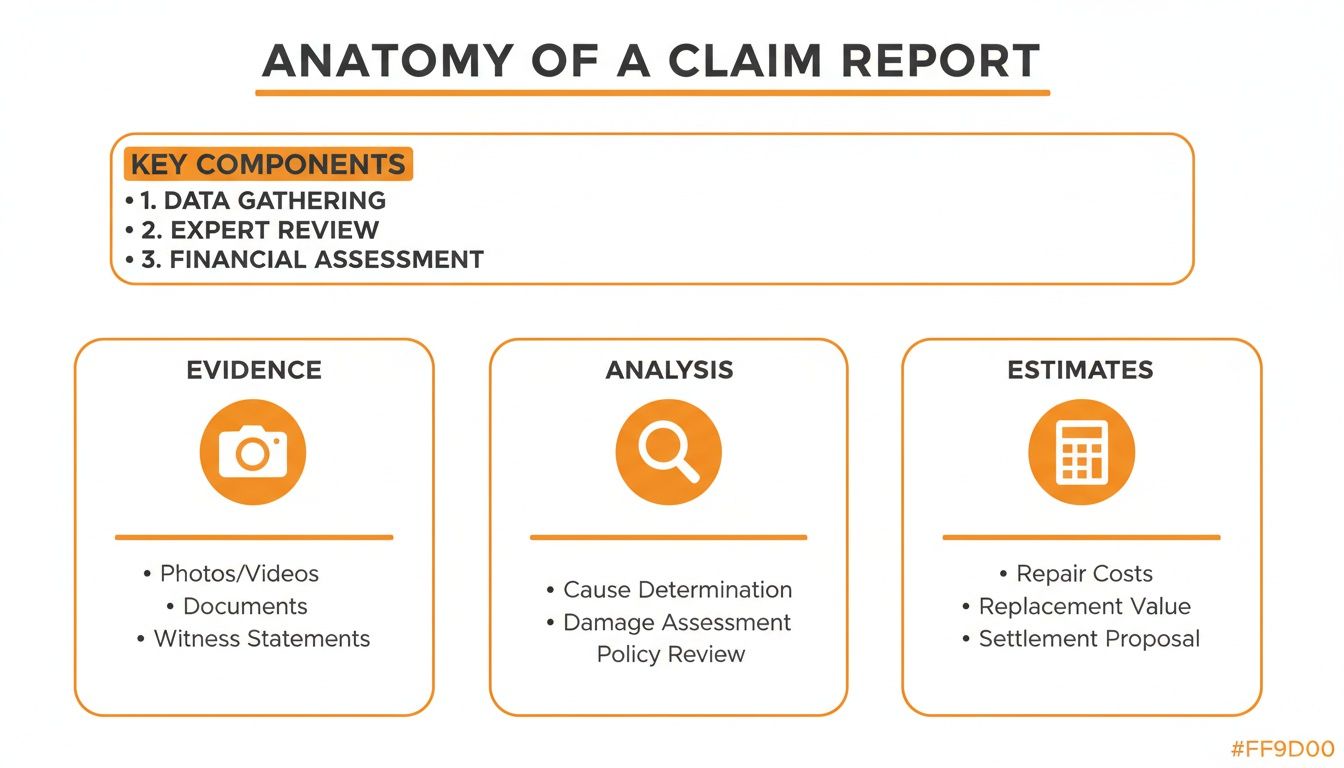
As shown, evidence, analysis, and cost estimates are interdependent, but the process begins with solid proof of prior condition and care.
The Financial Impact of Proactive Documentation
The financial stakes are high. Historically, the property loss ratio across the MENA region has often been in the 75-90% range. Water damage has consistently been a major cost driver, and recent extreme weather events in the UAE have exacerbated this trend.
An engineering report substantiated by detailed maintenance logs provides insurers with tangible proof of stewardship. This proof can directly reduce disputes and accelerate payment approvals.
An engineering report for an insurance claim is not just about the damage itself; it’s about the asset's entire lifecycle up to the point of failure. A clean maintenance history is the strongest defence against allegations of contributory negligence.
Well-maintained records demonstrate that a failure was sudden and accidental, not the predictable outcome of deferred maintenance. This distinction is often the determining factor between a claim being paid in full or being significantly reduced. When documentation is airtight, the engineering report can focus squarely on the incident’s root cause, making the entire claim more resilient to challenge.
Managing Stakeholders with Your Engineering Report
Following a significant incident at a commercial property, clear and consistent communication is paramount. The engineering report is not solely for the insurer; it is the central tool for managing every subsequent interaction, from the loss adjuster to repair contractors and tenants. It acts as a single source of truth, eliminating confusion from the outset.
Presenting this technical document to the insurer's loss adjuster immediately establishes a professional and organised dynamic. It signals a commitment to a fair and efficient resolution. This act positions the claimant to control the narrative, shifting the focus from subjective opinions to objective, verifiable data.
Aligning Insurers and Contractors
A common point of friction in the claims process is the discrepancy between the insurer's approved scope of work and the contractor's repair quotation. Without an independent, technically sound reference point, this can lead to disputes, scope creep, and costly delays. This is precisely where how engineering reports strengthen insurance claims for commercial buildings becomes a practical advantage.
The report serves as the definitive scope of work. It specifies not just what requires repair, but details how and why, based on sound engineering principles.
- For the Loss Adjuster: The report provides a clear, itemised justification for each necessary repair, enabling them to approve costs confidently within their delegated authority.
- For the Contractor: The report functions as a precise technical brief. It prevents over-quoting or, equally problematic, under-scoping the work. Their proposed method statement must directly address the root cause and remediation recommendations identified by the engineer.
This alignment minimises the protracted negotiations that can stall a project for weeks, ensuring all parties are working from the same technically validated blueprint.
A detailed engineering report is the ultimate tool for managing expectations. It provides the loss adjuster with the confidence to approve funds and gives the contractor the clarity needed to execute repairs correctly the first time.
Preventing Disputes and Scope Creep
When a contractor’s scope is contractually tied to the engineering report, scope creep becomes significantly more difficult to justify. Any proposal for additional work must be measured against the original, independent assessment. If a contractor suggests a more expensive repair methodology, the report’s recommendations can be used to validate whether it is technically necessary or merely a preference.
This process is the best defence against inflated costs and ensures the insurer is only indemnifying for work directly related to the covered incident. It transforms potential disputes into structured, evidence-based discussions.
For facility managers in Dubai, who often manage multiple vendors, this impartial document is a critical governance tool. It helps clarify the difference between a simple damage report and a comprehensive, insurance-ready claim file. By anchoring every stakeholder conversation to the report, the entire repair and settlement process is streamlined from start to finish.
Pinpointing the Real Cost: How Technical Data Quantifies Your Business Interruption Losses
Physical repairs are only one part of the financial equation. When a critical system in a commercial building fails, the most significant financial damage often stems from business interruption (BI). Every hour a facility is not fully operational represents a direct revenue loss. This is a substantial and often contentious component of any major insurance claim.
An engineering report translates a BI claim from a financial projection into a documented, technical reality. It provides the evidence-based backbone, drawing a direct and undeniable causal link from a specific mechanical or electrical failure to the precise duration of operational downtime. For insurers, this clarity is non-negotiable; they require a logical, evidence-based pathway from cause to financial impact before settling a BI claim.
Building an Ironclad Timeline of Downtime
The validity of a business interruption claim rests on a precise and verifiable timeline. The engineering report establishes the foundation of this timeline by pinpointing the exact moment of failure and meticulously documenting each step of the restoration process.
This is not a simple log but a detailed narrative constructed from key data points:
- Initial Incident Log (BMS/SCADA): Records the exact time and nature of the system failure (e.g., "Chiller #2 tripped on high-pressure fault at 02:15 on 15/05").
- Technician Work Logs: Provides a time-stamped record of all diagnostic and repair activities undertaken by the internal maintenance team.
- Third-Party Contractor Reports: Captures the scope and duration of specialised repair work, including critical path details like parts procurement lead times and installation schedules.
- System Re-commissioning Data: Documents the precise moment the asset was officially brought back online and passed all performance verification tests, marking the end of the interruption period.
This chronological, data-driven trail removes ambiguity. It provides the loss adjuster with a clear, auditable breakdown of the interruption period, from the initial failure to the certified resumption of normal operations.
An engineering report transforms a vague business interruption claim from "we lost revenue because the AC was off" to "a documented compressor failure at 14:30 on Monday resulted in a 48-hour operational outage affecting 150 hotel rooms, as verified by BMS logs and the contractor's completion certificate."
Backing Up Financial Losses with Hard Engineering Facts
The technical findings in the report directly substantiate the financial calculations of the claim. For example, if a hotel's main water pump set fails, the report does not just identify the cause; it quantifies the operational impact—e.g., noting that 75% of the hotel's rooms were rendered uninhabitable due to loss of water pressure. This technical justification gives the finance team a solid, defensible basis for their revenue loss calculations.
This level of detail is increasingly critical as the UAE’s property and casualty insurance market expands. According to market analysis, the sector is projected to reach USD 20.13 billion by 2026, driven by a USD 100 billion project pipeline. In this high-stakes environment, detailed engineering reports are the standard for providing the technical proof insurers demand. You can find more insights on the UAE insurance market on mordorintelligence.com.
Ultimately, by grounding a financial claim in objective engineering data, the claimant provides the insurer with everything required for a straightforward settlement. It is the most efficient path to claim approval and business recovery.
Got Questions About Engineering Reports and Insurance Claims? We've Got Answers.
Navigating the insurance claims process after a property incident can be complex, particularly within the dynamic commercial property sector of Dubai and the UAE. Facility managers, asset owners, and engineering leads frequently have practical questions about leveraging engineering reports to their advantage.
Here are answers to the most common queries, designed to provide clarity, support confident decision-making, and facilitate a fair and timely settlement.
How Quickly Do I Really Need to Get an Engineering Report Done?
Immediate action is critical. An initial assessment should be commissioned as soon as safely possible, ideally within 24 to 48 hours of the incident. The objective is to have a qualified expert document the scene before any significant cleanup or alteration occurs. This preserves the evidence in its most authentic state.
This rapid response achieves two key goals. First, it creates an unbiased, time-stamped baseline of the damage, which is a powerful component of the claim file. Second, it demonstrates to the insurer that you are proactive and diligent, setting a cooperative and professional tone for the entire claims process.
Can I Just Have My In-House Maintenance Team Write the Report?
Your in-house team's knowledge is invaluable. Their maintenance records, initial photographic evidence, and first-hand observations form the bedrock of a strong claim. However, for a significant insurance claim, the formal engineering report carries substantially more weight when prepared or validated by an independent, qualified engineering professional.
The reasons are clear:
- Objectivity is Paramount: Insurers inherently view a third-party assessment as more objective. An independent report is perceived as an impartial analysis of facts, not a document prepared by a party with a vested interest, which reduces scrutiny and potential disputes.
- They Play a Supporting Role: Your team's detailed logs and photos serve as crucial first-responder evidence. The external engineer then uses this foundation to conduct a forensic analysis, interpreting the evidence in a format that insurers understand and respect.
Consider this framework: your team gathers the vital initial evidence, and the independent engineer acts as the forensic specialist who presents a conclusive case.
What’s the Typical Cost for a Technical Report in Dubai?
The cost of an engineering report is directly correlated with the complexity of the incident. It is essential to view this not as an operational expense but as an investment in securing a full and fair settlement.
A preliminary report for a localised incident, such as a burst pipe affecting a single commercial unit, may fall within the AED 2,500 to AED 5,000 range. For more complex events, like a major HVAC plant failure or minor structural damage requiring detailed analysis, a full forensic report could range from AED 10,000 to AED 30,000+.
Crucially, this cost is often a recoverable expense under the "professional fees" clause of many commercial property insurance policies. It is advisable to review your policy, as the insurer will often cover the reasonable costs of investigations required to validate a claim, making it a sound financial decision.
How Does Having a Solid AMC Affect the Claim Process?
A well-documented Annual Maintenance Contract (AMC) is one of the most powerful tools available during a claim. By producing a clear, verifiable history of professional, preventive upkeep, you systematically dismantle any potential argument from an insurer regarding negligence or poor maintenance.
Instead of being mired in questions about the general condition of the asset, the entire conversation is reframed. With detailed service logs and technician reports in hand, the focus shifts to the specific circumstances of the incident itself. This documentation doesn't just assist the process—it significantly streamlines it and can accelerate claim approvals.
At SnapFixNow, our services are positioned at the intersection of diligent maintenance and successful insurance outcomes. Our engineering-led approach, which includes creating detailed technical documentation and providing direct insurance claim support, is designed to give commercial property stakeholders the factual foundation needed to protect their assets.
See how our unique photo-based reporting and SLA-driven maintenance can strengthen your next claim at https://www.SnapFixNow.com.