Executive Summary for Decision-Makers
Planned Preventive Maintenance (PPM) is a structured, proactive maintenance strategy where inspections and servicing are scheduled in advance to mitigate failures before they occur. Unlike reactive maintenance, which addresses breakdowns as they happen, PPM converts unpredictable repair costs into a managed, predictable operational expense (OPEX). For asset managers in the UAE, this approach is critical for extending asset lifecycle, ensuring regulatory compliance (Dubai Municipality, Civil Defence), managing operational budgets, and mitigating the heightened risk of failure caused by severe climate conditions like high heat, humidity, and dust loading.
What PPM Means for Facility and Asset Management in the UAE
In the context of Dubai and the UAE, Planned Preventive Maintenance (PPM) is a core operational strategy, not merely a set of scheduled tasks. For facility managers, asset owners, and procurement teams, PPM signifies a shift from reactive, emergency-driven expenditure to proactive, data-informed operational planning.
Instead of addressing equipment failures post-event (reactive maintenance), PPM involves systematic, scheduled interventions. This is particularly critical in the UAE, where high ambient temperatures, humidity cycles, and significant dust loading place extreme stress on mechanical, electrical, and plumbing (MEP) systems. A scheduled approach is not a matter of preference but an operational and financial necessity for sustaining asset performance.
From a technical standpoint, PPM is the implementation of a risk-based plan to control asset condition and financial outlay through preventive actions, thereby transforming maintenance from an unpredictable liability into a budgeted operational activity.
The Core Objectives of a PPM Strategy
A correctly implemented PPM program delivers measurable outcomes that directly impact a facility's financial health and operational stability.
The primary engineering and financial goals are:
- Extend Asset Lifecycle: Regular servicing according to OEM (Original Equipment Manufacturer) specifications minimises wear and tear, deferring significant capital expenditure (CAPEX) on asset replacement.
- Reduce Operational Downtime: Proactive identification of potential failure points allows for planned rectification during low-impact periods, ensuring business continuity and upholding Service Level Agreements (SLAs) with tenants or users.
- Achieve Budgetary Control: By scheduling maintenance, associated costs become predictable OPEX line items, eliminating the financial volatility of un-budgeted emergency repairs.
- Ensure Safety and Regulatory Compliance: A documented PPM schedule provides a clear audit trail, demonstrating due diligence and ensuring compliance with regulations from authorities like Dubai Municipality and Civil Defence, particularly for critical life safety systems.
Understanding the definition of PPM is the first step. The next is applying it to specific systems, such as implementing proactive strategies for preventative maintenance in plumbing service and other critical building infrastructure.
How a Technical PPM Framework Operates
A Planned Preventive Maintenance (PPM) framework is a systematic process designed to transition maintenance from a reactive cost centre into a predictable, value-preserving operational function.
The process begins with the creation of a comprehensive asset register. This is a detailed inventory of all critical equipment within the facility, from primary HVAC chillers and air handling units (AHUs) to electrical distribution boards and fire safety pumps. Each asset is catalogued with essential data: manufacturer, model, installation date, and specified operational parameters. This register forms the foundational database for the entire PPM strategy.
Following asset registration, a criticality analysis is performed. This is a risk assessment to classify assets based on the operational, financial, and safety impact of their potential failure. An elevator failure in a commercial high-rise, for instance, represents a significantly higher operational risk than a lighting fixture failure in a utility corridor.
Developing the Maintenance Schedule
With assets catalogued and ranked by criticality, the maintenance schedules are developed. These schedules are not arbitrary; they are derived from technical data sources:
- OEM Specifications: The manufacturer's baseline recommendations for service frequency and scope.
- Operational Duty Cycles: Equipment operating 24/7 requires more frequent intervention than assets with intermittent use.
- Local Environmental Conditions: This is a critical factor in the UAE. High ambient temperatures accelerate HVAC component stress, while high dust loading necessitates more frequent filter cleaning and coil servicing to maintain efficiency and prevent failure.
This structured methodology ensures that skilled technical resources are allocated to high-criticality assets that pose the greatest risk to business operations. It also facilitates strategic spare parts management, mitigating the costly delays associated with sourcing critical components during an emergency. Modern technology-enabled maintenance solutions can significantly enhance the accuracy and efficiency of these processes.
A PPM framework is fundamentally about creating a predictable system to manage complex facilities. It ensures every critical component is inspected, serviced, and optimised according to a data-driven plan, not in response to a failure.
Ensuring Compliance and Operational Alignment
A robust PPM framework is integral to maintaining regulatory compliance. The schedules and documented work orders create a verifiable audit trail for authorities such as Dubai Municipality and Civil Defence, providing evidence that critical life safety systems are maintained in accordance with legal mandates.
For facility managers of high-value assets in the UAE—be it commercial towers, retail malls, or hospitality venues—a structured PPM program is non-negotiable. An analysis of building maintenance compliance data from Dubai Municipality indicated that properties with formal PPM programs experienced up to 45% fewer critical system failures compared to those operating on a reactive basis. For more context, see building maintenance compliance on quickfixmaintenance.ae.
Ultimately, a PPM framework translates strategic objectives—asset preservation, OPEX control, and risk management—into tangible, daily actions for the engineering team, ensuring that every task contributes to the long-term operational integrity of the facility.
Comparing PPM and Reactive Maintenance Models: A Risk-Based Analysis
The choice between a proactive and reactive maintenance strategy is a fundamental decision that directly influences OPEX, asset lifecycle, and operational risk. For facility and asset managers in the UAE, this decision must be weighed against significant environmental and operational pressures.
The reactive model ("breakdown maintenance") dictates that action is taken only after a failure has occurred. While this approach minimizes upfront scheduled maintenance costs, it is a high-risk strategy that often results in significantly higher total costs and operational disruption.
Conversely, Planned Preventive Maintenance (PPM) is a risk-mitigation strategy based on scheduled interventions designed to prevent failures.
Operational and Financial Trade-Offs
The primary differentiator between the two models is control.
PPM provides control over scheduling, budget allocation, and operational continuity. Reactive maintenance cedes this control to chance, rendering the entire maintenance function an unpredictable series of emergency events.
This framework illustrates the logical progression from asset inventory to a data-driven plan that ensures operational control.
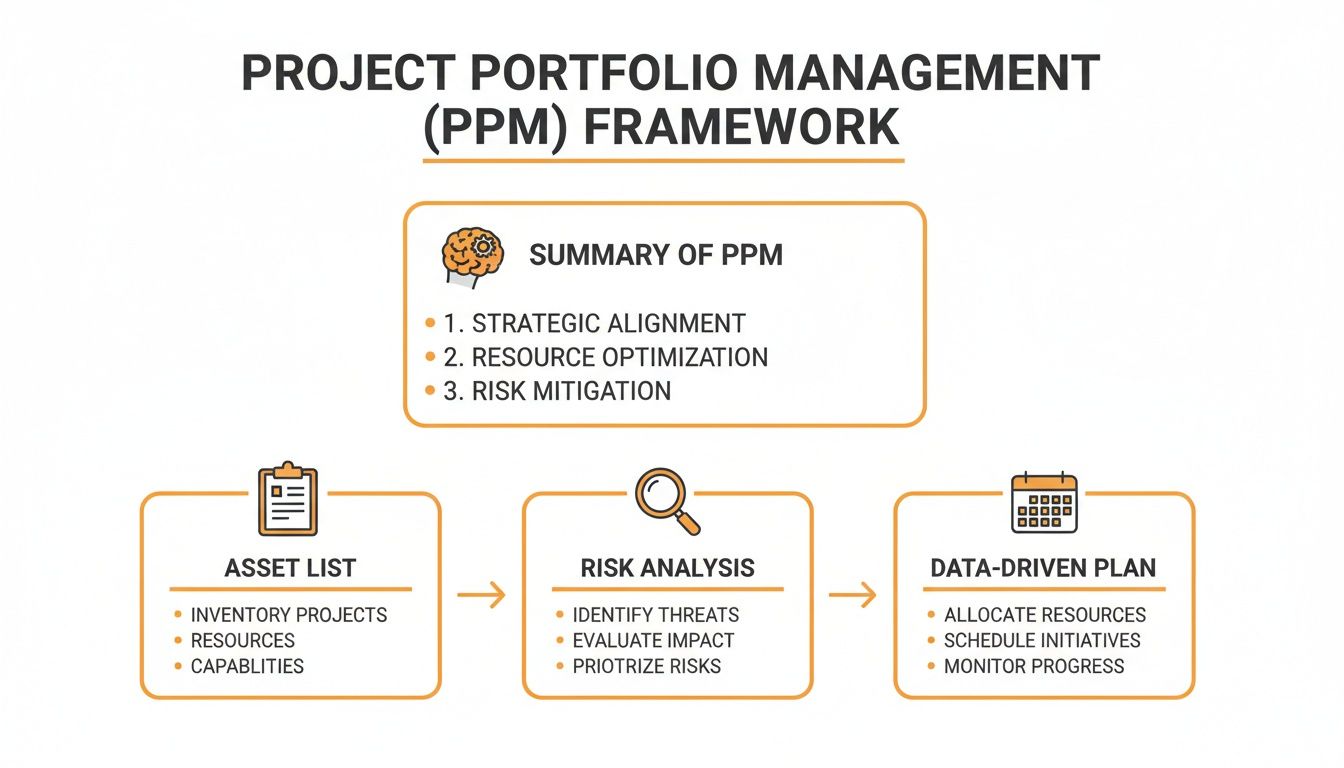
This structured methodology is essential for shifting from a state of operational volatility to one of predictability and proactive risk management.
Consider a critical HVAC chiller failure in a Grade-A commercial tower in Dubai during peak summer conditions. The emergency rectification costs, including premium labor rates and expedited parts procurement, are typically 3 to 5 times higher than the cost of the scheduled PPM tasks that would have prevented the failure. This does not account for the financial impact of tenant dissatisfaction or reputational damage.
For a quantitative breakdown, review this preventive vs reactive maintenance cost analysis for different property types.
A reactive approach treats maintenance as an unpredictable capital expense (CAPEX) event, driven by failure. A PPM strategy converts maintenance into a predictable, manageable operational expense (OPEX), driven by planning.
Operational Model Comparison: Planned Preventive vs. Reactive Maintenance
This table provides a comparative analysis of the two models from an engineering and financial perspective, contextualized for the demands of facility management in the UAE.
| Metric | Planned Preventive Maintenance (PPM) | Reactive Maintenance (Breakdown) | Impact on UAE Facilities |
|---|---|---|---|
| Total Cost of Ownership (TCO) | Lower TCO due to optimized performance, fewer major repairs, and extended asset life. | Higher TCO driven by emergency labor rates, premium costs for urgent parts, and secondary damage from failures. | PPM helps control long-term OPEX and CAPEX, crucial for assets under constant climate-induced stress. |
| Asset Lifecycle | Maximized asset lifecycle. Industry practice often shows an extension of 15-25% beyond the baseline. | Reduced asset lifecycle due to unmanaged wear and tear, leading to premature capital replacement. | Proactive maintenance is vital for protecting high-value assets like chillers and elevators from premature failure. |
| Operational Downtime | Minimal and scheduled. Maintenance is planned for low-impact periods, ensuring business continuity. | Unplanned and often extensive. Failures occur during peak operational hours, causing maximum disruption. | In hospitality or retail, unplanned downtime directly translates to lost revenue and negative guest experiences. |
| Budget Predictability | High predictability. Costs are forecasted and managed as a consistent OPEX line item. | Extremely low predictability. Costs are volatile, unplanned, and often require emergency CAPEX allocation. | PPM allows for stable, accurate annual budget forecasting, a key requirement for property and asset managers. |
| Risk Management & Compliance | Low operational risk. A documented audit trail supports compliance with Dubai Municipality and Civil Defence. | High, unmanaged operational risk. Lack of documentation poses significant compliance and safety liabilities. | A robust PPM plan is a non-negotiable component of ensuring life safety and regulatory adherence. |
The decision for asset owners in the UAE is whether to manage a predictable system or react to an unpredictable one. For any high-value commercial, residential, or hospitality asset, the operational and financial logic overwhelmingly supports a strategic, preventive framework.
Building a Practical PPM Schedule for Key Systems
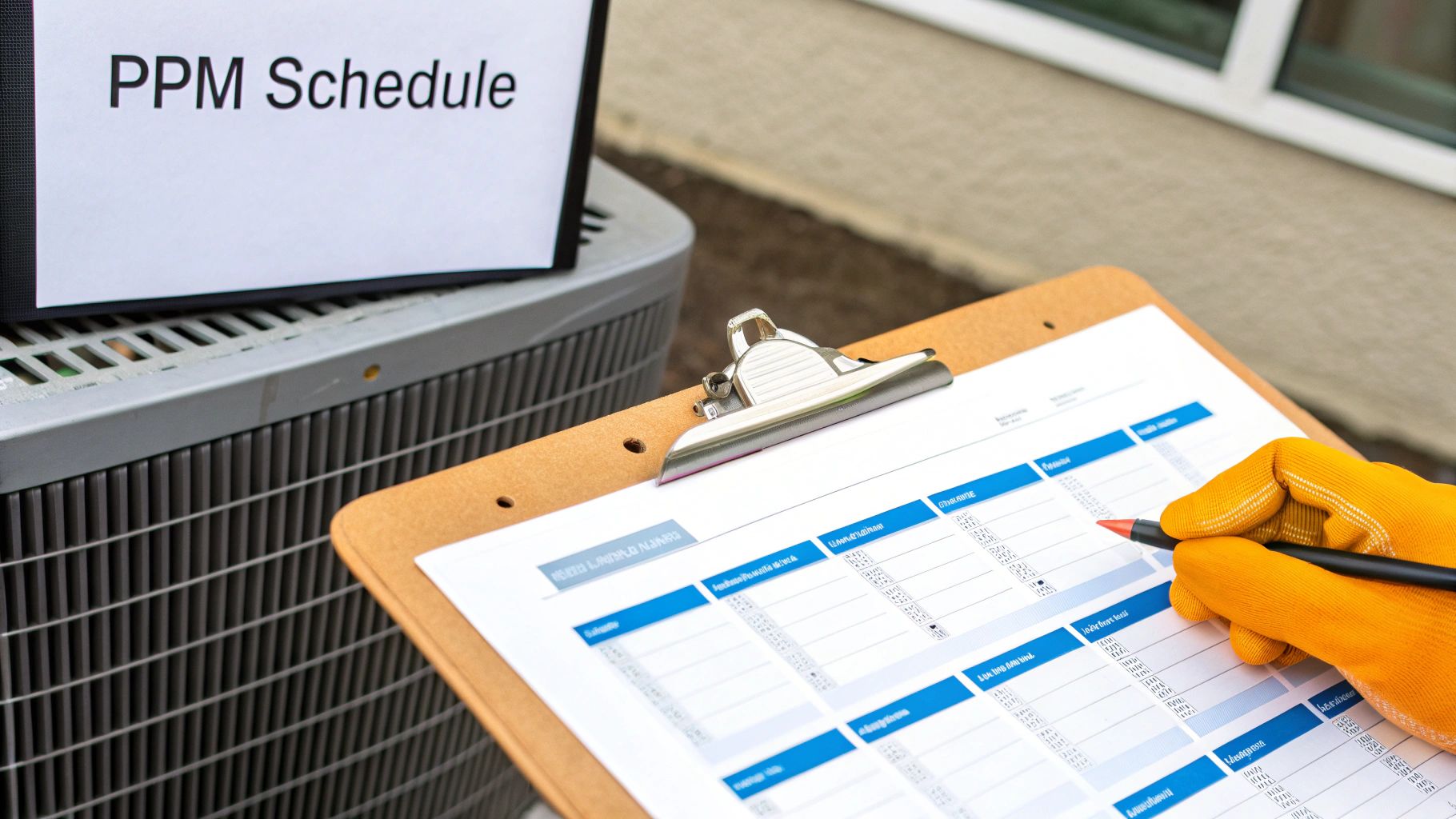
A practical PPM schedule is the operational document that translates maintenance strategy into a sequence of tangible, scheduled tasks for critical systems. This is not a generic template but a tailored plan reflecting the specific operational demands and environmental stresses of a facility in the UAE.
A well-defined schedule is the backbone of an effective Annual Maintenance Contract (AMC). It defines the scope of work and provides a clear benchmark for performance measurement, moving from a paper-based plan to value-preserving actions.
Core System Scheduling Examples
Task frequency is determined by OEM guidelines, asset duty cycle, and local conditions. In Dubai, the combination of high heat, humidity, and dust loading accelerates component degradation, requiring more rigorous schedules than in temperate climates.
The following are baseline schedule examples for critical systems in UAE properties.
1. HVAC Systems (Chillers, AHUs, FCUs)
- Weekly: Visual inspection of chiller plant for leaks or abnormal vibration. Inspection and cleaning of Air Handling Unit (AHU) and Fan Coil Unit (FCU) filters—a non-negotiable task in high-dust environments to maintain indoor air quality and efficiency.
- Monthly: Cleaning of evaporator and condenser coils. Verification of refrigerant levels, leak detection, and inspection/tightening of electrical connections subject to thermal stress.
- Quarterly: Comprehensive testing of controls and safety cut-outs. Lubrication of motors and bearings to reduce friction and energy consumption.
- Annually: Detailed compressor oil and refrigerant analysis. Eddy current testing for chiller tubes to detect corrosion or wear before catastrophic failure. A detailed furnace maintenance checklist can serve as a useful guide for heating component specifics.
2. MEP Systems (Electrical & Plumbing)
- Monthly: Thermal imaging of main electrical distribution boards (DBs) to identify hotspots indicative of loose connections or overloading. Functional testing of water pumps and inspection of booster pump sets for leaks.
- Quarterly: Functional testing of all Earth Leakage Circuit Breakers (ELCBs) and Residual Current Devices (RCDs). Water tank cleaning and water quality testing to comply with Dubai Municipality regulations.
- Annually: Full load testing of backup generators and Automatic Transfer Switches (ATS). Comprehensive servicing of major pumps, including motor alignment and bearing inspection.
3. Life Safety Systems (Fire Alarms & Sprinklers)
- Weekly: Visual inspection of fire alarm control panels for fault indicators. Verification of pressure gauges on sprinkler systems.
- Monthly: Rotational functional testing of a sample of smoke detectors, heat detectors, and manual call points to ensure system-wide integrity over time with minimal disruption.
- Quarterly: Sprinkler system flow switch test via the inspector's test valve to confirm water flow.
- Annually: Full-scale system test, coordinated with Dubai Civil Defence, including fire pump operation and alarm activation. This is a mandatory compliance activity.
The Financial and Compliance Impact of Scheduling
A documented PPM schedule is a financial and risk management instrument. Data from the Dubai Land Department (DLD) indicates that communities with mandated PPM contracts under RERA regulations report significantly lower overall repair and rectification costs.
Furthermore, a comprehensive PPM history can positively influence property valuation in the secondary market, as informed buyers prioritize well-maintained, compliant assets. Modern reporting, especially photo-based service reports, creates a timestamped, geo-located digital asset history that is invaluable for compliance audits, insurance claims, and CAPEX planning.
How to Measure the Success of a PPM Contract
An effective Planned Preventive Maintenance (PPM) contract is a performance-driven agreement delivering measurable results. For asset owners and facility managers in the UAE, success is quantified through specific Key Performance Indicators (KPIs) and enforceable Service Level Agreement (SLA) clauses. These metrics provide objective proof that the maintenance strategy is reducing operational risk, preserving asset value, and controlling costs.
Vague agreements lead to budget overruns and asset degradation. A well-structured, data-driven contract is essential for accountability and performance management.
Core KPIs for PPM Performance Evaluation
To objectively evaluate PPM contract performance, focus on KPIs that link preventive actions to operational outcomes.
Percentage of Planned Maintenance Completion: This foundational KPI tracks the ratio of completed scheduled tasks against the total planned tasks per period (monthly/quarterly). For the UAE market, a completion rate of 95% or higher is the standard expectation. A rate below 90% is a red flag indicating potential under-resourcing or poor planning by the service provider, which elevates the risk of deferred maintenance issues.
Reduction in Reactive/Emergency Call-outs: A primary objective of PPM is to reduce unplanned failures. A successful program must yield a quantifiable decrease in emergency calls. A year-over-year reduction in reactive calls for critical systems (HVAC, MEP) in the range of 15-25% is a strong indicator of an effective PPM strategy.
Mean Time Between Failures (MTBF): This technical metric measures the average operational time of an asset between one failure and the next. A consistently increasing MTBF for critical assets like chillers or elevators provides direct evidence that preventive actions are enhancing asset reliability and preventing breakdowns.
Demystifying Service Level Agreement (SLA) Clauses
SLAs are the contractual enforcement mechanisms of a PPM agreement. They define service standards and penalties for non-compliance. Decision-makers must scrutinize these clauses.
A robust SLA differentiates between response time and rectification time:
- Response Time: The maximum allowable time for a technician to arrive on-site and acknowledge an issue after a call is logged.
- Rectification Time: The maximum allowable time to resolve the issue and restore the system to operational status.
These times are tiered by priority. A "Priority 1" emergency (e.g., total power failure) may require a 1-hour response and a 4-hour rectification time. A "Priority 3" issue (e.g., non-critical lighting failure) may have a 24-hour SLA. Understanding these terms is crucial when evaluating an annual maintenance contract in Dubai.
The ROI of a well-managed contract is evident in high-stakes environments. In Dubai's hospitality sector, where operational continuity is paramount, properties with stringent PPM programs report significantly higher guest satisfaction and fewer critical system outages during peak periods. This directly links operational success to proactive maintenance of key infrastructure. For further reading, consult the benefits of PPM for businesses on planonsoftware.com.
Decision Framework: Selecting the Right PPM Service Model
Selecting the appropriate Planned Preventive Maintenance (PPM) service model requires a strategic assessment of your facility's specific needs, budget structure, and risk tolerance. This decision directly influences OPEX, asset lifecycle, and operational resilience. An improper fit can lead to service gaps, unforeseen costs, and asset degradation, even with a PPM plan in place.
In-House Teams vs. Outsourced Providers
The first decision point is whether to build an internal technical team or engage an external provider.
In-House Teams: This model offers maximum control and immediate response, suitable for large, highly specialized facilities where deep institutional knowledge of unique systems is a significant advantage. The trade-off is high overhead costs, including salaries, training, specialized tools, and administrative management.
Outsourced Providers: Engaging a specialized Facility Management Company (FMC) provides access to a broad pool of certified technicians without the fixed overheads. FMCs offer economies of scale, leading to more predictable maintenance budgets. The key challenge is ensuring the provider's standards, communication protocols, and quality of work align with your operational requirements.
A common hybrid model in the UAE for commercial and residential towers involves an in-house facilities coordinator managing an outsourced FMC. This structure aims to balance direct control with specialized technical expertise, with success heavily dependent on clearly defined Service Level Agreements (SLAs).
Comparing Contract Structures: A Risk-Based Approach
The type of Annual Maintenance Contract (AMC) dictates the allocation of financial risk for component failures. The two primary models present a clear trade-off between higher upfront costs for budget certainty and lower initial costs with higher risk exposure.
| Contract Model | Scope of Coverage | OPEX Predictability | Who Holds the Financial Risk? | Best Suited For… |
|---|---|---|---|---|
| Comprehensive Contract | Covers labor, scheduled spare parts, and often consumables and emergency call-outs for specified equipment. | High. The maintenance budget is largely fixed, facilitating accurate financial planning and forecasting. | The Provider. The FMC absorbs the cost if a covered component fails, incentivizing them to perform high-quality preventive work. | Critical assets (chillers, elevators, fire pumps) where downtime costs are high and budget certainty is paramount. |
| Labour-Only Contract | Covers only the technician’s time for PPM visits and emergency response. All parts and materials are billed separately. | Low. The initial contract cost is lower, but total annual expenditure is unpredictable and exposed to parts price volatility. | The Client. The asset owner bears the full financial risk for all component failures and material costs. | Less critical assets or where an in-house procurement team can source parts more cost-effectively than the provider. |
The optimal choice is a risk-based decision. A comprehensive contract for a building's critical HVAC system is a prudent investment to mitigate the risk of a high-cost failure. Conversely, a labour-only contract for non-critical plumbing fixtures may be a commercially sensible approach. The final decision should be based on a thorough criticality analysis of your assets, your in-house capabilities, and your organization's tolerance for financial unpredictability.
Frequently Asked Questions
What Is the Typical Cost of a PPM Contract in Dubai?
A single price for a Planned Preventive Maintenance contract does not exist; costs are determined by asset scope, age, facility size, and contract type. In the UAE market, contracts are generally structured in two ways:
- Comprehensive Contracts: Higher initial cost but cover labor, spare parts, and consumables, providing high budget predictability.
- Non-Comprehensive (Labour-Only) Contracts: Lower initial cost, but all spare parts are billable. This model exposes the client to unpredictable costs if major components fail.
As a general benchmark for financial planning, a comprehensive Annual Maintenance Contract (AMC) for critical MEP systems in a mid-sized commercial tower typically ranges between 1.5% and 3% of the asset replacement value per annum. A well-executed PPM contract should, however, reduce the total cost of ownership over the asset lifecycle by minimizing high-cost emergency rectifications and extending equipment lifespan.
How Does PPM Affect My Building's Compliance with Regulations?
PPM is the operational backbone of regulatory compliance. It is essential for meeting the stringent requirements of authorities like Dubai Municipality, Dubai Civil Defence (DCD), and the Real Estate Regulatory Agency (RERA). These bodies mandate regular, documented inspections and maintenance of critical life safety and building systems.
A structured PPM program generates a time-stamped audit trail, providing verifiable proof of due diligence during annual inspections and permit renewals. For example, DCD mandates quarterly and annual testing of fire alarm and suppression systems—a standard component of any compliant PPM schedule. Failure to provide this documentation can result in significant fines and operational restrictions.
Can PPM Improve Energy Efficiency in Older Buildings?
Yes, the impact can be substantial. In older buildings with legacy systems that have degraded in efficiency, a targeted PPM strategy can yield significant energy savings, often in the range of 15-20%.
Energy efficiency gains are achieved through specific PPM tasks:
- Regular cleaning of HVAC coils and filters to improve heat transfer and reduce fan motor load.
- Calibration of thermostats and control system sensors to prevent unnecessary system operation.
- Inspection and lubrication of motors and pumps to reduce frictional losses and electricity consumption.
This proactive maintenance helps legacy systems operate closer to their original design specifications, directly resulting in lower utility costs (OPEX reduction) and an improved building sustainability profile.
For asset owners and facility managers seeking to implement a structured, engineering-led maintenance strategy to protect asset value and control operational costs, SnapFixNow provides SLA-driven Annual Maintenance Contracts and 24/7 facility management services across Dubai. Learn more at https://www.SnapFixNow.com.