Executive Summary
Planned Preventive Maintenance (PPM) is an engineering-led framework for managing physical assets to reduce operational risk and control expenditure. In the UAE's demanding climate, a reactive, break-fix maintenance model leads to unpredictable costs, accelerated asset degradation, and significant business disruption. An effective PPM program, based on asset criticality, aligns maintenance resources with operational priorities, transforming maintenance from a volatile cost centre into a predictable, budgetable investment. This guide provides a technical framework for facility managers, asset owners, and procurement teams in the UAE to evaluate, structure, and implement PPM programs that extend asset lifecycle, ensure regulatory compliance, and optimise operational expenditure (OPEX).
An Operational Framework for PPM in the UAE
Planned Preventive Maintenance (PPM) is a systematic approach to asset management designed to transition maintenance activities from a reactive state to a controlled, proactive framework. The primary objective is to mitigate the operational and financial risks associated with unplanned equipment failure.
In the UAE, environmental factors such as high ambient temperatures, humidity, and significant dust loading place extreme stress on mechanical and electrical systems. A reactive maintenance approach under these conditions guarantees operational instability. For example, a primary HVAC system failure in a commercial tower during peak summer months results not only in direct rectification costs but also in tenant dissatisfaction, business interruption, and exposure to premium rates for emergency labour and parts.
A structured PPM program mitigates this risk through a calendar of scheduled inspections, servicing, and component replacements. This systematically addresses wear and tear, ensuring assets operate within their design parameters.
A well-executed PPM strategy transforms maintenance from an unpredictable operational cost into a predictable, budgetable investment in asset longevity and reliability. It is the primary tool for managing the total cost of ownership.
For facility managers and asset owners, implementing a formal PPM program delivers measurable operational advantages:
- Budgetary Control: Maintenance expenditure shifts from a volatile, reactive budget line to a planned, predictable OPEX allocation, enabling accurate financial forecasting.
- Enhanced Asset Lifecycle: Industry practice often shows that assets under a consistent PPM schedule can achieve an operational life extension of 20-30%, deferring significant capital replacement expenditure.
- Compliance and Safety: PPM generates a verifiable audit trail of all maintenance activities, which is essential for meeting the compliance mandates of regulatory bodies like Dubai Municipality and Civil Defence.
- Operational Uptime: By identifying and rectifying potential faults before they escalate into failures, PPM directly reduces unplanned downtime—a critical performance metric in hospitality, retail, and commercial property management.
PPM vs. Reactive Maintenance: An Operational and Financial Analysis
The decision between Planned Preventive Maintenance (PPM) and a reactive, break-fix approach is a fundamental choice with significant financial and operational consequences. It represents a strategic decision between controlling operational expenditure (OPEX) and being subjected to its volatility.
A reactive model inherently accepts unpredictable costs, operational disruptions, and accelerated asset decay. In contrast, a PPM framework treats maintenance as a calculated investment designed to mitigate risk and preserve long-term asset value. The methodology involves systematically addressing wear and tear before it results in catastrophic failure—a critical strategy for systems under constant stress from the UAE's climate. This proactive approach transforms maintenance from an emergency-driven cost centre into a manageable and predictable budget line item.
Direct and Indirect Financial Implications
The financial argument for PPM extends beyond the direct cost of a single repair. A reactive approach creates a cumulative financial drain across multiple operational areas.
- Premium Labour and Parts: Emergency call-outs are subject to premium labour rates. Urgent sourcing of components eliminates cost negotiation leverage, often resulting in inflated procurement expenses.
- Escalating Rectification Costs: A minor fault, such as a clogged filter in an Air Handling Unit (AHU), can cascade into a major component failure like a compressor burnout. A scheduled PPM task costing a nominal amount prevents a reactive rectification that could incur costs in the tens of thousands of dirhams.
- Operational Disruption: In commercial or hospitality assets, the failure of a primary chiller or main electrical system results in direct revenue loss, tenant dissatisfaction, and potential breaches of lease agreements. These indirect costs frequently exceed the direct cost of the repair.
The infographic below illustrates the core operational benefits that drive superior financial performance in a PPM model.
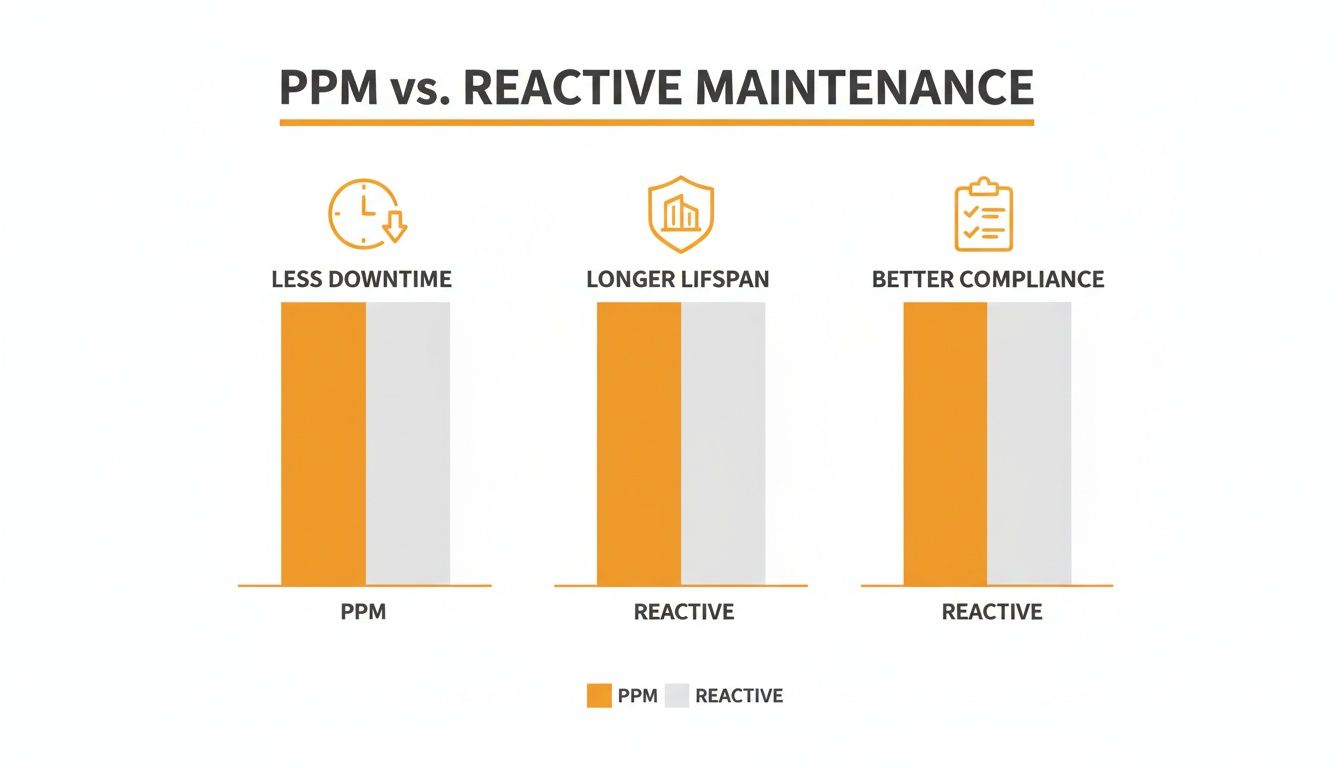
The data confirms a direct correlation between structured maintenance and superior asset performance, reliability, and compliance—the cornerstones of effective facility and asset management.
Quantifying the Performance Gap
The performance differential between PPM and reactive maintenance is operationally verifiable. Industry analysis indicates that unplanned maintenance typically costs 3 to 9 times more than planned work due to the compounding effect of secondary costs like lost productivity and expedited logistics.
For a deeper dive into these financial trade-offs, explore our detailed cost analysis of preventive vs. reactive maintenance.
Adopting a structured PPM program is one of the most effective risk mitigation strategies a facility manager can employ. It replaces uncertainty with a data-driven schedule, enabling precise allocation of labour, parts, and budget.
The regional market for predictive maintenance—a technological extension of PPM—is projected to grow from USD 497.15 million in 2021 to USD 25,878.63 million by 2029. This growth reflects the documented success of proactive strategies. A well-implemented PPM plan can reduce maintenance costs by 25-30%, decrease asset breakdowns by 70-75%, and cut downtime by 35-45%. In UAE conditions, this often translates to a 20% increase in asset uptime, preventing the common scenario where over 60% of maintenance expenditure is allocated to reactive emergencies.
This operational shift allows facility teams to transition from firefighting to strategic asset management, directly protecting the building's financial performance and operational integrity.
Operational Model Comparison: PPM vs. Reactive Maintenance
A side-by-side comparison of the two maintenance models clarifies the strategic advantage of a proactive approach. The following table outlines key operational and financial differentiators for decision-makers in the UAE.
| Metric | Planned Preventive Maintenance (PPM) | Reactive (Break-Fix) Maintenance |
|---|---|---|
| Budgeting | OPEX is predictable, stable, and forecastable. | Highly unpredictable; costs are volatile and driven by emergencies. |
| Asset Lifespan | Maximised. Regular servicing extends operational life. | Reduced. Continuous stress cycles and breakdowns lead to premature failure. |
| Operational Downtime | Minimal and scheduled during non-peak hours. | Significant, unplanned, and occurs during peak operational hours. |
| Safety & Compliance | High. Regular inspections ensure adherence to safety and regulatory standards. | High risk. Undetected faults can lead to safety hazards and compliance breaches. |
| Resource Planning | Efficient. Labour and parts are scheduled in advance, optimising procurement. | Inefficient. Resources are scrambled in response to crises, incurring premium costs. |
| Total Cost of Ownership | Lower. Prevents expensive cascading failures and extends asset life. | Higher. Includes premium repair costs and indirect business losses. |
While a reactive model may appear to have lower upfront costs by avoiding maintenance fees, the total cost over an asset's lifecycle is invariably higher. PPM is a strategic investment in operational reliability, safety, and financial control.
Designing a Risk-Based PPM Program for UAE Assets
An effective Planned Preventive Maintenance program is not a uniform checklist applied universally across an asset. It is a strategic framework engineered to allocate resources—labour, time, and budget—to areas of highest operational risk and financial impact. This methodology moves beyond generic manufacturer guidelines to a tailored asset management strategy optimised for the operational realities of the UAE.
The foundation of this strategy is a comprehensive asset criticality assessment. This process involves systematically evaluating each piece of equipment to determine its importance to operational continuity, safety, and regulatory compliance. The risk profile of a primary chiller in a commercial tower is fundamentally different from that of a secondary water pump in a basement.
A structured, risk-based PPM program requires a systematic methodology to identify, assess, and mitigate risks. As detailed in A Practical Guide to Enterprise Risk Management, this ensures maintenance efforts are directly proportional to the potential consequences of asset failure.
Conducting an Asset Criticality Assessment
The initial step is to inventory and rank all maintainable assets. This involves understanding each asset's function and the operational impact of its failure. A practical method is a three-tier classification system:
- Critical Assets: Equipment whose failure would cause an immediate and severe cessation of operations, create a significant safety hazard, or result in a major compliance breach. Examples include life safety systems (fire alarms, sprinklers), main electrical switchgear, and primary HVAC chillers.
- Essential Assets: Equipment whose failure would degrade performance and result in significant operational inconvenience or financial loss, but not a complete shutdown. Examples include secondary HVAC pumps, lobby lighting systems, or backup generators.
- Non-Essential Assets: Assets whose failure would have a minimal impact on core operations or safety. Examples include decorative water features or lighting in low-traffic back-of-house areas.
This classification directly informs the maintenance strategy. Critical assets require the most rigorous PPM schedules with near-zero tolerance for missed tasks. Conversely, non-essential assets may be managed with less frequent inspections or a "run-to-failure" approach if rectification is simple and inexpensive.
Aligning Maintenance Frequency with UAE Conditions
After establishing asset criticality, the next step is to define the servicing frequency and scope. This requires balancing manufacturer guidelines with factors specific to the aggressive environmental conditions in the UAE.
Key considerations for schedule development:
- Manufacturer Recommendations: This serves as the baseline. Deviation can void warranties and is generally inadvisable for new or critical equipment.
- Operational Demands: An HVAC system operating 24/7 in a data centre requires a more intensive PPM schedule than an identical unit in an office with a 10-hour operational day.
- Environmental Stress (Dubai Climate): High ambient heat places continuous strain on cooling systems. Heavy dust loading necessitates more frequent cleaning of coils and replacement of air filters to maintain efficiency and prevent failures. High humidity accelerates corrosion on electrical contacts and outdoor units.
- Regulatory Requirements: Local authorities, such as Dubai Municipality and Dubai Civil Defence, have non-negotiable mandates for the inspection and maintenance of specific systems, including fire safety and elevators.
A common error is applying a uniform maintenance schedule to all similar assets. A risk-based approach dictates that a rooftop AHU exposed to direct solar radiation requires a more aggressive PPM plan than an identical unit situated in a protected basement plant room.
In the UAE's climate, where temperatures can exceed 45°C, PPM for electrical assets is vital. DEWA’s preventive maintenance program achieved 100% reliability and reduced maintenance costs by $0.54 million by addressing UAE-specific issues like dust accumulation and voltage fluctuations. Industry data shows a properly executed PPM program via an annual maintenance contract in Dubai can extend the lifespan of HVAC and MEP assets by up to 30%, while buildings with structured PPM experience 40% fewer breakdowns.
Developing Asset-Specific PPM Checklists
With asset criticality and maintenance frequency defined, the final step is to create detailed, actionable checklists for each major equipment type. These documents form the core of the maintenance scope of work within an Annual Maintenance Contract (AMC) and provide technicians with a clear, step-by-step methodology.
The following are foundational examples for key systems in a typical UAE property.
HVAC System Checklist (e.g., AHU/FAHU)
- Monthly: Inspect and clean or replace air filters (critical in high-dust environments).
- Quarterly: Check and tighten electrical connections to prevent failures due to thermal cycling.
- Quarterly: Inspect fan belts for tension and wear; adjust or replace as specified.
- Semi-Annually: Clean condenser and evaporator coils to maintain heat exchange efficiency.
- Annually: Perform full motor and bearing lubrication; conduct vibration analysis to detect anomalies.
Electrical System Checklist (e.g., SMDB/DB)
- Quarterly: Conduct a visual inspection for signs of overheating, discolouration, or physical damage.
- Semi-Annually: Utilise infrared thermography scanning to identify high-resistance connections (hot spots) before they fail.
- Annually: Function-test all Earth Leakage Circuit Breakers (ELCBs) and Residual Current Devices (RCDs).
- Annually: Torque-check all terminal connections to manufacturer specifications.
Documenting the completion of these tasks is essential for demonstrating compliance during audits by bodies like RERA/DLD and for validating insurance claims. This structured, risk-based approach ensures a PPM program functions as a strategic investment in operational resilience.
Structuring Effective Annual Maintenance Contracts and SLAs
An Annual Maintenance Contract (AMC) serves as the operational and legal framework for a preventive maintenance program. For facility managers and procurement teams in the UAE, this document is a critical tool for risk transfer, performance management, and establishing provider accountability.
Within the AMC, the Service Level Agreement (SLA) translates general service commitments into specific, measurable metrics that are tracked, reported, and can be enforced contractually.
The structure of the contract determines the allocation of financial risk for unforeseen equipment failures between the client and the service provider.

Comparing AMC Structures: Comprehensive vs. Labour-Only
Two primary contract models are prevalent in the UAE facilities management market: comprehensive and non-comprehensive (labour-only). The selection is a strategic decision based on the organisation's risk tolerance.
Comprehensive AMC: This is an all-inclusive model where the service provider assumes full responsibility for labour, spare parts, and consumables required for both scheduled maintenance and reactive repairs. It offers complete budget predictability, as a single annual fee covers most eventualities. This structure effectively transfers the financial risk of component failures from the asset owner to the FM provider. It is the preferred model for critical assets where downtime carries significant financial or reputational consequences.
Non-Comprehensive (Labour-Only) AMC: This model covers only technician labour for scheduled PPM tasks and reactive call-outs. The cost of all spare parts is billed back to the client. While the initial contract price is lower, the total annual maintenance expenditure becomes unpredictable. This structure places the financial risk for component failure squarely on the asset owner.
The decision framework is asset-dependent. For a new property with equipment under warranty, a labour-only contract may be viable. However, for an older facility with aging assets, the budget stability offered by a comprehensive AMC often provides greater long-term value.
Defining Measurable KPIs for PPM Execution
A robust SLA is defined by its Key Performance Indicators (KPIs). Vague commitments are operationally insufficient. An effective SLA utilises quantifiable metrics to measure provider performance against the agreed-upon scope of work, forming the basis for performance reviews and penalty clauses.
An SLA without specific, measurable KPIs is merely a statement of intent. For an AMC to have operational teeth, it must define what success looks like in numerical terms, holding the provider accountable for tangible outcomes, not just effort.
The following are essential KPIs to incorporate into a PPM-focused SLA:
Key Performance Indicators (KPIs) for PPM Service Level Agreements
To ensure an AMC is effective, it must be built upon clear, quantifiable metrics. This table outlines core KPIs for evaluating facility management providers in the UAE, ensuring service delivery aligns with operational and financial objectives.
| KPI Category | Specific Metric | Typical UAE Benchmark | Operational Significance |
|---|---|---|---|
| Schedule Compliance | PPM Schedule Adherence | >95% | Measures the provider's discipline in executing the preventive maintenance plan. A high score indicates proactive asset care. |
| Emergency Response | On-site Response Time | 1-2 hours for P1 emergencies | Defines how quickly a technician arrives to contain a critical failure, minimizing initial damage and downtime. |
| Technical Competency | First-Time Fix Rate (FTFR) | 80-85% | Tracks the ability to resolve issues on the first visit. A high FTFR signals skilled technicians and good parts management. |
| Asset Performance | Critical Asset Uptime | >99.5% | Measures the operational availability of mission-critical systems (e.g., chillers, main electrical panels), directly impacting business continuity. |
Embedding these specific, benchmarked KPIs into an SLA transforms the contract from a simple agreement into a powerful performance management tool.
Critical Clauses for a Watertight AMC
Beyond KPIs, several clauses are essential to prevent ambiguity and future disputes. A well-drafted AMC provides clarity and protection for both the client and the service provider.
Essential AMC Checklist:
- Detailed Scope of Work: The scope must list every covered asset, including make, model, and location. It must define the specific PPM tasks and their frequencies for each piece of equipment.
- Exclusions List: Clearly define what is not covered. This typically includes major capital replacements, damage from tenant misuse, or force majeure events.
- Spare Parts Policy: For comprehensive contracts, specify the policy on using original equipment manufacturer (OEM) parts versus approved aftermarket alternatives. For labour-only contracts, outline the approval process and any markup limits for parts procured by the provider.
- Penalty Clauses: Link financial penalties directly to KPI failures. For example, failure to meet the PPM schedule adherence target could trigger a pre-defined percentage reduction in the monthly invoice.
Focusing on these core structural elements, measurable KPIs, and critical clauses allows for the negotiation of AMCs that drive performance, mitigate risk, and deliver measurable value on the PPM investment.
Leveraging Technology for PPM Execution and Reporting
Traditional paper-based Planned Preventive Maintenance systems are operationally inefficient and introduce significant compliance risks. Manual work orders, paper checklists, and delayed reporting are susceptible to data entry errors and make it nearly impossible to verify if scheduled work was completed to the required standard. This lack of transparency undermines the core purpose of PPM.
The adoption of a digital platform is transformative. By centralising PPM execution and reporting, facility managers gain real-time visibility into all maintenance activities. Ambiguity is replaced with verifiable data, which is essential for both operational control and regulatory compliance.

From Paper Trails to Digital Audit Trails
The primary advantage of a technology-driven PPM program is the creation of an irrefutable digital audit trail. Photo-based platforms, for example, provide time-stamped, geo-tagged visual evidence of task completion. A technician servicing an Air Handling Unit (AHU) must upload photos showing the condition of filters before and after replacement. This provides simple, powerful proof of work.
This verifiable data offers several key benefits:
- SLA Compliance: Eliminates disputes over work completion. It allows for instant verification of the provider's adherence to schedule and scope, enforcing contractual accountability.
- Regulatory Audits: When authorities like Dubai Municipality or Civil Defence conduct inspections, a complete digital maintenance history for life safety systems can be produced immediately.
- Asset Owner Confidence: Provides remote oversight for owners and property managers, allowing them to confirm the quality of maintenance without being physically on-site.
This transition is becoming an operational necessity. With Dubai's FM market projected to reach AED 50 billion by 2025, digital reporting is the emerging standard for ensuring SLA adherence and protecting asset value. This is part of a broader trend, with the Middle East's predictive maintenance market expecting a 29.77% CAGR from 2025-2030, driven by IoT and AI adoption.
Data-Driven Reporting and Asset Intelligence
A centralised platform accumulates data that facilitates more informed decision-making. By analysing the maintenance history of an asset, managers can identify recurring issues that may indicate an impending failure. This is why modern PPM programs are increasingly integrated with tools like Building Energy Management Systems to optimise both reliability and energy consumption.
A digital PPM system transforms maintenance data from a simple record of past events into a predictive tool for future asset management. It allows managers to move from reacting to problems to anticipating and preventing them.
This data-driven approach enables a more dynamic PPM strategy. For example, if data shows that a specific model of water pump consistently requires premature bearing replacement, the procurement team has the evidence needed to specify a more durable alternative, thereby lowering the total cost of ownership.
For a deeper analysis of how technology is reshaping maintenance, explore our article on technology-enabled maintenance and IoT monitoring solutions.
Ultimately, leveraging technology for PPM provides the clarity and control required to manage modern building portfolios, ensuring that maintenance expenditure translates directly into enhanced asset reliability and an extended operational lifecycle.
Decision Framework for Implementing a PPM Program
Implementing a Planned Preventive Maintenance (PPM) program begins with an internal assessment of operational requirements, in-house capabilities, and organisational risk tolerance. This initial analysis determines the most appropriate service delivery model: in-house, fully outsourced, or a hybrid approach.
Key Evaluation Questions for Decision-Makers
Before evaluating market proposals, key internal questions must be addressed. The answers will form the business case for investing in a preventive strategy and define the procurement approach.
- In-House vs. Outsourced Model: Does the organisation possess the necessary certified technical staff, management oversight, and specialised equipment to execute a compliant PPM program? An in-house model offers greater control but incurs higher fixed overheads. Outsourcing transfers execution risk but requires robust contract management and provider oversight capabilities.
- Return on Investment (ROI) Analysis: What is the current annual expenditure on emergency and reactive maintenance? This figure serves as the baseline. Industry data indicates that unplanned reactive work costs 3 to 9 times more than planned maintenance. A conservative ROI calculation should project a 25-30% reduction in these reactive costs. Additionally, factoring in a typical 20% extension of asset lifecycle defers significant capital replacement expenditure.
- Asset Criticality and Scope Definition: A risk-based approach is mandatory. The PPM scope for a primary chiller plant must be far more rigorous than for non-essential assets like ambient lighting. This criticality assessment directly influences the contract's scope of work and its overall cost.
The Four Pillars of a Successful PPM Program
Regardless of the delivery model, the success of any PPM program depends on four foundational pillars. A weakness in any one of these areas compromises the entire strategy.
A successful PPM program is not a simple task list; it is a complete operational system built on accurate data, precise contracts, verified execution, and transparent reporting.
- Accurate Asset Data: The foundation of any PPM program is a complete and verified asset register. An inaccurate or incomplete register of equipment, its location, and its condition guarantees program failure from the outset.
- Ironclad Contract Terms: The Annual Maintenance Contract (AMC) and its Service Level Agreement (SLA) must be technically precise. They must explicitly define the scope of work (inclusions and exclusions), response times, and the KPIs used to measure performance. Ambiguity leads to disputes and service degradation.
- Proof of Execution: Scheduling work is insufficient; completion and quality must be verified. Modern digital platforms that mandate photo-based proof of work are becoming the standard for ensuring compliance and accountability.
- Transparent Reporting: Performance reports must be data-driven, tracking KPI adherence, critical asset uptime, and total maintenance expenditure. This provides the business intelligence needed for continuous improvement and strategic asset management decisions.
Common PPM Operational Questions
This section addresses frequently asked questions regarding the implementation of planned preventive maintenance programs in the UAE, providing clear, quantified guidance for facility and asset managers.
How is the ROI of a PPM Program Calculated?
The Return on Investment (ROI) calculation for a PPM program re-frames maintenance as an investment in asset reliability and longevity, rather than a cost centre. The formula provides an operational tool for weighing cost avoidance against value preservation.
The standard calculation is:
ROI (%) = [(Gain from Investment – Cost of Investment) / Cost of Investment] x 100
A breakdown for a real-world asset includes:
- Cost of Investment: The total annual cost of the PPM contract, including any internal management overhead.
- Gain from Investment: This is a sum of several key financial benefits:
- Reduced Reactive Repair Costs: Industry data shows unplanned maintenance costs 3 to 9 times more than planned work. A well-structured PPM program typically reduces these emergency expenditures by 25-30%.
- Extended Asset Lifecycle: In the UAE climate, PPM can extend the operational life of major assets like HVAC systems by 20-40%. This defers major capital replacement costs.
- Reduced Downtime Costs: Calculate the cost of one hour of operational downtime for your specific business, then multiply it by the number of outage hours the PPM program prevents.
What is the Recommended PPM Frequency for HVAC Systems in Dubai?
A single "ideal" frequency does not exist; the schedule must be derived from an asset criticality assessment. However, for HVAC systems operating under the high heat, humidity, and dust loads in Dubai, clear industry benchmarks have been established.
- Critical Systems (e.g., Primary Chillers, Data Centre CRAC units): Monthly inspections of filters, electrical connections, and refrigerant levels are standard. This is supplemented by more intensive quarterly and semi-annual servicing protocols.
- Essential Systems (e.g., AHUs, FAHUs in commercial spaces): Monthly filter inspection and replacement are non-negotiable. A quarterly service schedule for belts, coils, and drainage is a common and effective baseline.
- Non-Essential Systems (e.g., supplementary DX units): Service frequency can often be reduced to quarterly or semi-annually without introducing unacceptable operational risk.
A risk-based approach is paramount. An AHU located on a sun-exposed rooftop requires a more aggressive PPM schedule than an identical unit situated in a climate-controlled basement plant room.
How Can We Ensure Our FM Provider Is Performing the Scheduled PPM?
Verifiable proof of work is the only reliable method for ensuring SLA compliance and operational assurance. Relying on paper reports or simple checklist software is inadequate, as it confirms only that a task was marked as complete, not the quality or reality of the work performed.
The most effective methodology is a photo-based digital work order system. This requires technicians to upload time-stamped, geo-tagged photographs of the asset before, during, and after each PPM task. This creates an undeniable digital audit trail, proving that filters were changed, coils were cleaned, and connections were torqued. It provides transparent, remote oversight and enforces accountability.
Gain complete control and transparency over your maintenance operations. SnapFixNow provides engineering-led facility management with a photo-based platform that delivers verifiable proof of work, ensuring your PPM program is executed to the highest standard. Learn more at https://www.SnapFixNow.com.