An Annual Maintenance Package, commonly termed an Annual Maintenance Contract (AMC), is a formal service agreement between an asset owner and a maintenance provider. It defines a clear scope of preventive, corrective, and emergency maintenance services for specified assets over a one-year period. Functionally, it serves as a framework for predictable operational expenditure (OPEX) and systematic risk mitigation.
Executive Summary for Decision-Makers
For facility, asset, and procurement managers in the UAE, an AMC is a strategic tool for financial and operational governance. It translates volatile, reactive repair costs into a fixed, forecastable OPEX line item. The primary objective is to shift from a high-cost, high-risk "break-fix" model to a proactive, preventive maintenance strategy. A properly structured AMC optimises asset lifecycle, ensures operational uptime, and provides a documented framework for regulatory compliance (e.g., Dubai Municipality, Civil Defence), thereby protecting the asset's long-term financial value.
An Engineering Perspective on Annual Maintenance Contracts
For asset owners and procurement leaders in the UAE, an annual maintenance package is a financial and operational instrument designed to protect asset value against the region's harsh environmental conditions. High heat, humidity cycles, and significant dust loading place extreme stress on critical systems, particularly HVAC and MEP infrastructure.
An AMC transfers the risk of unforeseen equipment failure and performance degradation from the asset owner to the service provider for a fixed annual fee. This action converts unpredictable repair expenditures into a manageable OPEX item, enabling more accurate financial forecasting and budget control.
Core Objectives of an AMC
The primary purpose of an annual maintenance package is to transition operations from a reactive "break-fix" model to a proactive, preventive one. This shift is critical for achieving key operational and financial targets. Understanding the meaning of PPM in maintenance is fundamental to appreciating its role in modern asset management.
A well-structured AMC is engineered to deliver specific outcomes:
- Asset Lifecycle Optimisation: Through scheduled servicing and inspections, an AMC mitigates wear and tear, directly extending the operational life of capital equipment and deferring high-cost replacements.
- Operational Uptime and Continuity: For commercial, hospitality, and residential properties, system downtime translates directly to revenue loss and tenant dissatisfaction. An AMC functions as an operational continuity plan, minimising the frequency and duration of critical asset failures.
- Regulatory and Safety Compliance: Adherence to standards from bodies like Dubai Municipality and Civil Defence is non-negotiable. AMCs provide a documented maintenance trail, ensuring systems such as fire safety and vertical transport meet mandatory compliance obligations.
From an engineering standpoint, an AMC is a risk management tool. It is a calculated investment in operational stability, designed to reduce the probability of catastrophic failure in high-stress environments and secure the long-term financial performance of a physical asset.
Deconstructing The Core Components Of An AMC
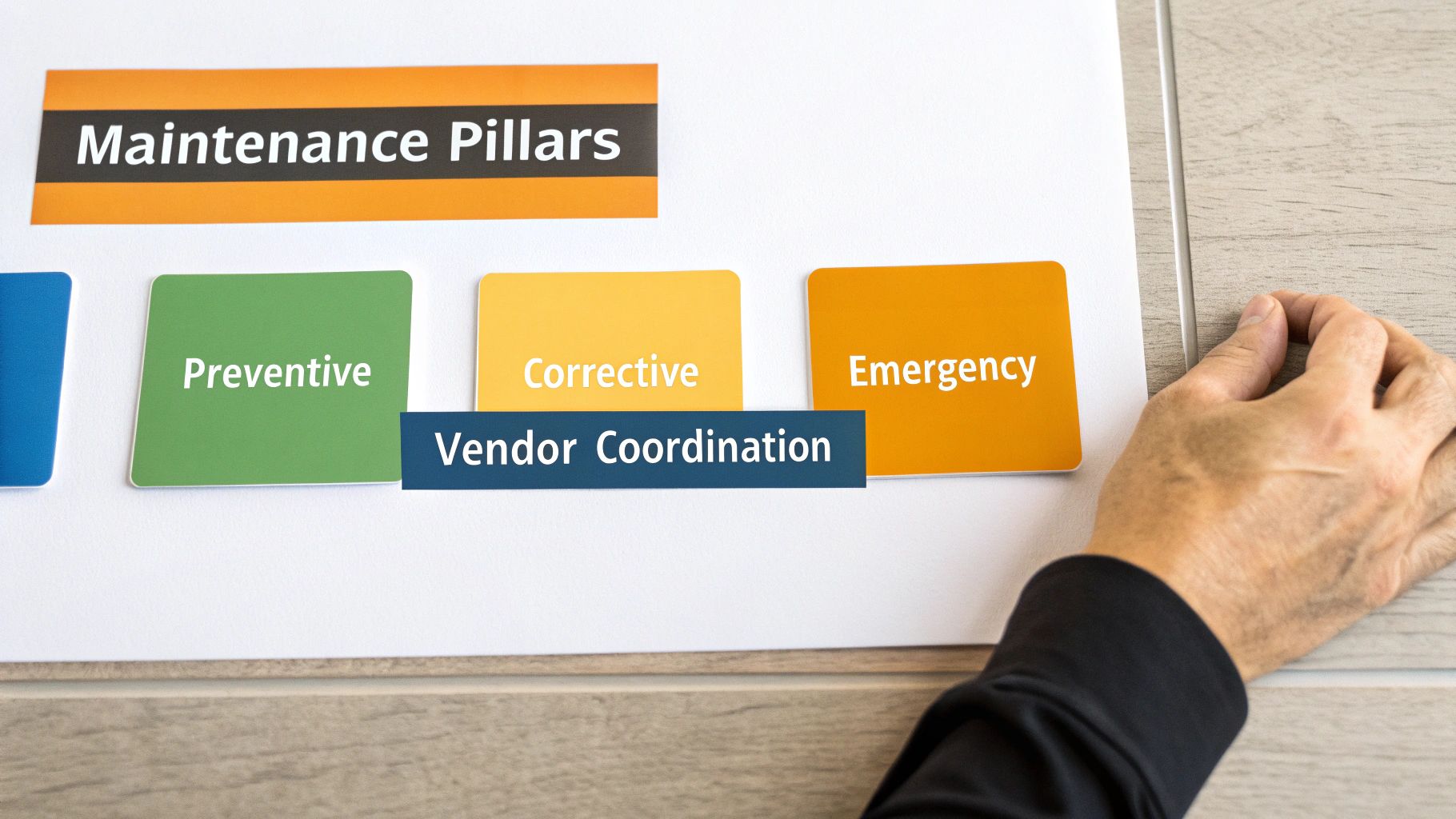
An Annual Maintenance Package is a structured agreement built on distinct pillars, each designed to address a different facet of asset management and operational risk. For facility and property managers in the UAE, understanding these components is crucial for evaluating a provider's scope of work and ensuring it aligns with the building's operational requirements.
Preventive Maintenance (PPM)
This is the proactive foundation of any effective AMC. Planned Preventive Maintenance (PPM) involves scheduled, routine servicing of assets to identify and rectify minor issues before they escalate into major failures. The objective is to maximise operational uptime and extend asset lifecycle.
In the UAE's high-stress climate, PPM is non-negotiable for MEP systems. This includes:
- HVAC Systems: Regular cleaning of coils and filters to mitigate high dust loading, verification of refrigerant levels, and calibration of thermostats to maintain efficiency under extreme ambient temperatures.
- Electrical Systems: Thermographic scanning of distribution boards to detect overheating connections and functional testing of circuit breakers and safety devices.
- Plumbing Systems: Descaling of water heaters, cleaning of drainage lines, and inspection of booster pumps to prevent pressure drops or leaks.
A documented and correctly executed PPM schedule is the single most effective tool for controlling long-term operational expenditure (OPEX).
Corrective Maintenance
Even with robust PPM, component failures are an operational reality. Corrective Maintenance—also known as reactive maintenance—is the process of rectifying breakdowns and malfunctions as they occur. This component of the annual maintenance package is governed by the Service Level Agreement (SLA).
The SLA defines the parameters for rectification, specifying metrics like acknowledgement time, mobilisation time, and resolution time based on the priority of the issue. For example, a critical HVAC failure in a data centre is a high-priority incident requiring a significantly faster response than a non-critical lighting failure in a common area.
Emergency Response
This pillar covers unforeseen, critical failures that pose an immediate risk to safety, property, or business continuity. Emergency response services operate 24/7/365 and are defined by stringent response time guarantees in the SLA, often requiring technician mobilisation within 60 to 120 minutes.
Typical emergencies in the UAE context include:
- Major water leaks or pipe bursts
- Complete power outages or short circuits
- Critical HVAC system failure during peak summer months
- Fire alarm or suppression system malfunctions
The value of this component lies in the guaranteed rapid mobilisation to contain damage and restore essential services, thereby minimising operational disruption and potential liability. To see how these contracts vary by building, our guide on residential vs commercial property requirements in Dubai provides further context.
Specialist Vendor Coordination
No single provider can possess expert-level competency in every specialised system within a complex facility. A critical, often undervalued, component of a comprehensive AMC is the management of specialist third-party vendors for systems requiring OEM certification or specific regulatory approvals.
A capable AMC provider acts as a single point of contact, coordinating and overseeing critical third-party services. This centralises accountability and reduces the administrative burden on the facility management team.
This coordination includes managing services for:
- Elevators and Escalators: Liaising with certified technicians for mandatory inspections and servicing.
- Fire Fighting and Alarm Systems: Managing compliance inspections as required by Dubai Civil Defence.
- Building Management Systems (BMS): Coordinating with system integrators for software updates and diagnostics.
This function is vital for major systems like HVAC. The UAE's HVAC services market trends show a market valued at USD 1,327.0 million, projected to reach USD 1,997.4 million by 2030. This growth is driven by a focus on extending equipment life, where managing specialist upgrades—which account for 64.97% of the market—is a key function of the primary AMC provider.
Comparing Comprehensive Versus Labour-Only Contracts
Selecting the appropriate Annual Maintenance Contract model is a critical decision for any facility manager in the UAE, directly impacting the operational budget (OPEX), risk exposure, and the administrative load on the in-house team. The decision typically centres on two primary models: a Comprehensive AMC or a Labour-Only AMC.
The core distinction lies in how each model allocates financial risk and operational responsibility. The optimal choice aligns the contract structure with the property's asset profile and the organisation's tolerance for financial volatility.
A Comprehensive AMC is an all-inclusive agreement covering technician labour for all preventive and corrective work, all required spare parts, and any necessary consumables. It functions as a fixed-price instrument, offering complete budget predictability.
Conversely, a Labour-Only AMC covers the cost of technician deployment for scheduled servicing and breakdown response. The cost of any spare parts or materials is billed separately to the client. This results in a lower initial contract price but introduces financial volatility.
Contract Model Comparison: Comprehensive vs. Labour-Only AMC
This matrix clarifies the key operational and financial differences between the two primary AMC structures, enabling a direct comparison of the trade-offs.
| Evaluation Criterion | Comprehensive AMC | Labour-Only AMC |
|---|---|---|
| Budget Predictability | High: Fixed annual cost provides a predictable OPEX line item. | Low: Variable costs for parts introduce budget uncertainty. |
| Financial Risk | Transferred: Financial risk of component failure is borne by the service provider. | Retained: Financial risk of component failure remains with the asset owner. |
| Upfront Cost | Higher due to inclusion of parts and risk premium. | Lower, reflecting the exclusion of parts and consumables. |
| Administrative Burden | Low: Single contract payment simplifies procurement and financial processes. | High: Requires internal processes for parts approval, procurement, and payment. |
| Optimal Use Case | Critical assets, strict OPEX control (e.g., data centres, Grade A commercial towers). | Newer assets, higher risk tolerance, or properties with in-house parts procurement capabilities. |
Risk Allocation and Financial Predictability
The fundamental difference between these two models is the allocation of risk.
Under a comprehensive contract, the service provider assumes the financial risk of a major component failure. If a high-value component like a chiller compressor or an elevator drive fails, the replacement cost is absorbed by the provider. This predictability is essential for budget-sensitive operations where controlling OPEX is a primary objective.
With a labour-only contract, this risk remains with the asset owner. While the initial contract cost is lower, a single catastrophic failure can result in an unforeseen capital expense that negates any initial savings. This model may be suitable for properties with newer assets or less critical systems, but it necessitates a dedicated contingency fund for component replacement. To make a valid comparison, it is necessary to understand the full scope of comprehensive maintenance services.
A comprehensive contract functions as a financial hedge, insulating the budget from the unpredictable costs of component failure. A labour-only contract prioritises a lower fixed cost but exposes the budget to potentially high and sudden variable expenses.
Analysing AMC Pricing Structures In The UAE
Understanding the cost of an annual maintenance package requires an analysis of its underlying pricing structure. In the UAE, an AMC quotation is the result of a detailed risk and cost calculation by the service provider. For a procurement team, deconstructing these proposals is essential for benchmarking value, identifying potential hidden costs, and making a financially sound decision.
The final price is determined by several interconnected variables. A provider’s quotation reflects their assessment of the labour, materials, and risk required to maintain a specific asset portfolio under a defined Service Level Agreement (SLA).
Primary Cost Drivers In AMC Proposals
Several core factors directly influence the annual cost of a maintenance package. Scrutinising how a provider has weighted these elements reveals the realism of their proposal. An unrealistically low price often indicates a miscalculation of asset condition or an intention to reduce the scope or frequency of preventive maintenance.
Key pricing drivers include:
- Asset Inventory (Type, Age, and Condition): This is the single largest cost driver. A portfolio of new, well-maintained assets presents a lower failure risk and thus a lower AMC cost. Conversely, ageing equipment or assets with a history of frequent breakdowns require more intensive preventive work and carry a higher risk of component failure, driving up the cost, particularly for comprehensive contracts.
- Scope of Services: The breadth of maintenance activities is critical. A contract covering only core MEP (Mechanical, Electrical, Plumbing) systems will be significantly less expensive than a scope that includes specialised systems like fire safety, elevators, Building Management Systems (BMS), and swimming pools.
- Service Level Agreement (SLA) Mandates: More stringent SLAs require higher resource allocation and therefore command higher costs. A contract guaranteeing a one-hour emergency response time, 24/7/365, necessitates a larger, dedicated rapid-response team compared to a contract with a four-hour response window during standard business hours.
- Building Type and Usage: A high-traffic commercial tower or a luxury hotel has near-zero tolerance for downtime, demanding more intensive, often after-hours, maintenance schedules to avoid business disruption. This operational complexity increases labour costs compared to a standard residential building with more flexible service windows.
Quantifying Costs In The UAE Market
While each property is unique, certain benchmarks provide a baseline for evaluating quotations. In the UAE market, service charges, which include significant AMC components, have seen an approximate 6% year-over-year increase, reflecting rising labour costs and more stringent maintenance standards.
Typically, the general maintenance component of an annual maintenance package for common areas—covering basic MEP and routine inspections—ranges from AED 1.0 to 2.5 per square foot annually. In UAE conditions, HVAC-related utility and maintenance costs can add another AED 1.0 to 2.0 per sq. ft. to the operational budget. For more context on these figures, you can explore insights into Dubai's service charge trends.
These figures are heavily influenced by the local climate. The intense heat and humidity in Dubai place extreme stress on HVAC systems, necessitating more frequent PPM cycles (e.g., quarterly filter changes and coil cleaning) compared to temperate climates, which directly impacts the AMC price. A deeper analysis is available in our complete guide to annual maintenance contract packages and prices in Dubai. Your analysis should always balance the fixed annual cost against the potential for unforeseen expenditure.
The Strategic Impact On OPEX And Asset Lifecycle
A well-structured annual maintenance package is more than an operational line item; it is a strategic financial tool designed to control long-term operational expenditure (OPEX) and protect the lifecycle value of critical assets. For facility and asset managers, viewing an AMC through this financial lens is essential for justifying its cost and understanding its return on investment.
This strategic impact is driven by the shift to planned preventive maintenance (PPM). By replacing a reactive "break-fix" approach with a scheduled maintenance regimen, an organisation can systematically reduce the frequency and severity of unexpected equipment failures, which has a direct and measurable effect on the budget.
Mitigating Unforeseen OPEX
Reactive emergency maintenance is significantly more expensive than planned work. Industry practice often shows that unplanned, emergency maintenance typically costs three to five times more than the same repair conducted on a planned basis. These inflated costs are driven by several factors:
- Premium Labour Rates: Emergency call-outs are frequently required after hours or on weekends, incurring overtime charges.
- Expedited Parts Sourcing: Sourcing critical components at short notice often involves premium pricing and express shipping costs.
- Secondary Damage: A catastrophic failure, such as a major water leak, can cause extensive collateral damage to surrounding structures and assets, multiplying the total rectification cost.
An effective annual maintenance package is engineered to minimise these high-cost events. By identifying and rectifying potential failure points during scheduled PPM visits, the AMC converts volatile repair costs into a fixed, manageable line item in the annual OPEX budget.
Extending Asset Lifecycles And Deferring CAPEX
Every physical asset has a finite operational lifespan. In the UAE's high-stress environment, factors like extreme heat and dust loading accelerate wear and tear, shortening this lifecycle. An AMC acts as a direct countermeasure.
Consistent, manufacturer-recommended servicing maintains equipment efficiency, reduces operational stress, and extends its functional life. This proactive approach enables organisations to defer major capital expenditures (CAPEX) for asset replacement. Postponing a multi-million dirham chiller replacement by two or three years can have a significant positive impact on an organisation's capital budget and cash flow. Gaining a clear understanding of how AMCs impact long-term financials is crucial, as highlighted by insights into reducing Total Cost of Ownership.
Ensuring Compliance And Preserving Asset Value
An AMC plays a critical role in governance and risk management. Regulatory bodies like Dubai Municipality and RERA impose strict standards for building safety and maintenance. A documented AMC programme provides a clear audit trail, demonstrating due diligence and ensuring compliance with mandatory service requirements for fire safety, elevators, and other critical systems.
This documented compliance not only mitigates liability but also protects the property's overall value. A well-maintained building commands higher rental or resale values and reinforces stakeholder confidence. This is reflected at a national level, where the broader UAE facilities management market, valued at USD 18.29 billion, shows a clear focus on hard services.
A Framework For Evaluating AMC Proposals
Selecting a provider for an Annual Maintenance Contract is a high-stakes decision that extends beyond price comparison. A low quotation can mask operational deficiencies, future risks, and compliance gaps that result in higher long-term costs.
A structured evaluation framework is required to identify the most reliable operational partner. This framework helps scrutinise technical capability, operational maturity, and financial stability, ensuring the selected AMC provides genuine asset protection.
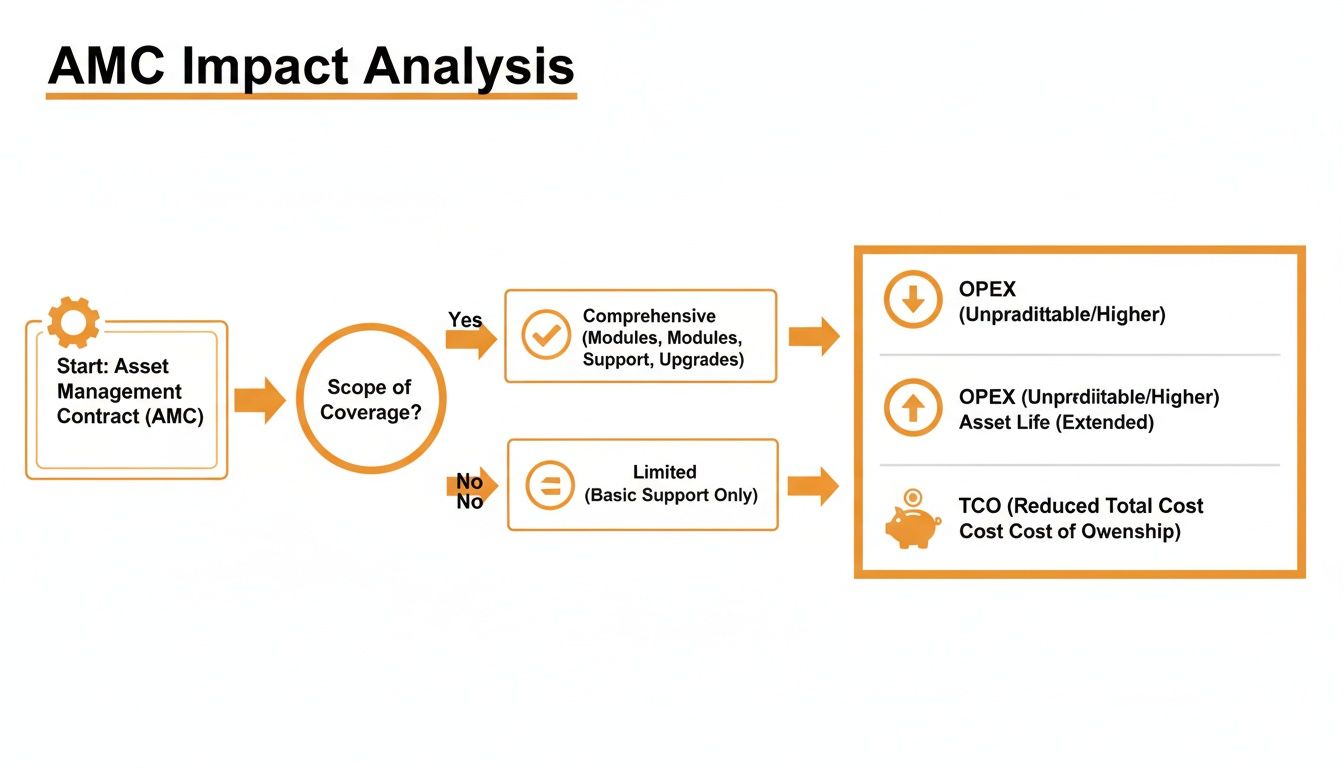
A strategic AMC is structured to reduce OPEX, extend asset lifecycle, and ultimately lower the Total Cost of Ownership.
Decision Framework: Key Evaluation Criteria
1. Technical Capability & Resource Allocation
- Team Structure: Verify whether the provider uses in-house technicians for core MEP services or relies on subcontracting. In-house teams typically offer greater control over quality, response times, and accountability.
- Certifications & Training: Request documentation of technician certifications, particularly for critical systems (e.g., manufacturer-specific HVAC training, Dubai Civil Defence compliance for fire safety).
- Resource Depth: Assess the number of available technicians and their geographical distribution. This determines their capacity to meet SLA commitments without being overextended during peak periods.
2. Operational Processes & Reporting Standards
- Work Order Management System: Scrutinise their system for logging, tracking, and closing work orders. A modern CAFM or digital platform indicates operational maturity. A lack of a transparent system for tracking requests from initiation to rectification is a significant red flag.
- Reporting & Analytics: Review their standard performance reporting. Expect detailed monthly reports with key performance indicators (KPIs) such as PPM completion rates, first-time fix rates, and statistics on SLA adherence.
- Escalation Procedures: Confirm the existence of a documented escalation matrix for unresolved issues or SLA breaches, defining contact points and resolution timelines at different management levels.
3. SLA Scrutiny & Financial Viability
- SLA Clarity: Ensure response and rectification times are clearly defined for different priority levels (e.g., emergency, urgent, routine). Penalties for non-compliance should be specified and meaningful.
- Financial Stability: Verify trade licenses and proof of insurance. For comprehensive contracts, the provider's ability to finance a high-cost component replacement without delay is critical.
- Client References: Request references from clients in the UAE with properties of a similar scale and complexity. Inquire specifically about their experience with emergency response times and adherence to the PPM schedule.