A landlord usually realises the maintenance problem is legal, not technical, the moment a tenant files an RDC complaint after an AC failure, water ingress, or repeated electrical trips. By then, the question isn’t only who should repair the fault. It’s whether the owner can prove they responded correctly, appointed the right contractor, documented the work, and met the standard implied by rera building maintenance requirements dubai landlords need to manage.
That’s the operational reality in Dubai. Maintenance isn’t just upkeep. It sits at the intersection of habitability, asset preservation, service charge governance, vendor control, and dispute exposure. Owners who still run buildings or rental units through ad hoc call-outs often underestimate how quickly a simple repair issue turns into a file of notices, invoices, photos, tenant communications, and legal submissions.
Table of Contents
- Executive Summary A Consultant's View on Compliance Risk
- Decoding Maintenance Obligations Under Dubai Law
- The Required Scope of RERA Building Maintenance
- Service Charges Annual Maintenance Contracts and Budgeting
- Ensuring Compliance and Mitigating RDC Disputes
- Developing a Compliant Maintenance Action Plan
- Frequently Asked Questions on RERA Maintenance Rules
- Q: If the tenant caused the damage, is the landlord still responsible?
- Q: How fast does a landlord need to respond to an emergency issue?
- Q: Can a tenancy contract transfer all maintenance obligations to the tenant?
- Q: Is a handyman enough for compliance?
- Q: What about recurring problems like leaks or pest issues?
Executive Summary A Consultant's View on Compliance Risk
Most landlord maintenance disputes in Dubai don’t begin with deliberate non-compliance. They begin with delay, ambiguity, or poor records. An AC fails in peak summer. The tenant sends messages to the building team, the owner, and a broker. A technician attends without a formal diagnosis. Someone approves a temporary fix. Two weeks later, the complaint reaches the RDC and the owner has no coherent maintenance file.
That’s why rera building maintenance requirements dubai landlords deal with should be treated as an operating control, not a legal footnote. The issue is broader than whether a landlord pays for a repair. It includes habitability, contract drafting, emergency response, contractor scope, and the quality of documentary proof.
Owners who manage single units face one type of risk. Owners of towers, hospitality assets, or mixed-use buildings face another. In both cases, the pattern is similar. Reactive maintenance increases cost volatility and weakens legal defensibility. Structured maintenance reduces ambiguity because responsibilities, response thresholds, approvals, and records are established before the failure happens.
Operational view: In an RDC dispute, a landlord with a complete work-order trail is in a stronger position than a landlord relying on WhatsApp messages and verbal instructions.
For legal teams or in-house counsel reviewing maintenance disputes, tools that organise legal workflows can also help when dispute files expand across vendors, notices, and evidence packs. A useful reference is this resource on find legal tech for your firm, particularly where legal and FM documentation need tighter coordination.
From an FM standpoint, the practical solution is usually a controlled reporting and contractor framework, whether managed internally or through a specialist building maintenance company in Dubai. What matters is the system. The owner needs clear allocation of responsibility, documented response, and technical evidence that stands up under scrutiny.
Decoding Maintenance Obligations Under Dubai Law
The legal default is broader than many landlords assume
Dubai law starts from a simple position. Under Dubai's Law No. 26/2007, Article 16, landlords carry default legal obligation for structural maintenance and major system repairs, with the critical qualifier that tenancy contracts can reassign maintenance responsibilities. However, most Dubai tenancy agreements include a 'minor maintenance clause' that shifts responsibility for repairs below a specified threshold, commonly AED 500 or AED 1,000, to tenants. Any clause attempting to shift structural maintenance to tenants faces legal challenge at the RDC according to this explanation of landlord maintenance obligations in Dubai.
That distinction matters because many landlords assume the threshold itself is a RERA rule. It isn’t presented that way in practice. The threshold is usually contractual. If the clause is poorly drafted, the dispute doesn’t disappear. It becomes harder to defend.
A landlord can often assign routine consumables or low-value wear-and-tear items to the tenant. A landlord usually can’t contract away responsibility for failures that affect habitability, safety, or the basic use of the property. If the unit becomes unfit for normal occupation because of HVAC, plumbing, electrical, or structural failure, the legal and practical burden shifts back to the owner very quickly.
Why the minor maintenance clause causes disputes
The phrase “minor maintenance” looks tidy in a tenancy contract. Operationally, it’s one of the most disputed parts of the document.
A dripping trap under a basin may be minor on day one. The same leak can become a ceiling repair, joinery replacement, mould issue, and tenant compensation argument if the response is delayed. That’s why good tenancy drafting should define not only value thresholds, but also asset type, urgency, and approval route.
A useful non-Dubai reference for framing responsibilities clearly is this guide for independent landlords on maintenance. The legal regime differs, but the operational lesson is the same. Ambiguous clauses create avoidable disputes.
If the contract only states “tenant handles minor repairs,” both parties will interpret “minor” differently once the fault disrupts occupancy.
Maintenance Responsibility Matrix Landlord vs Tenant
| Maintenance Issue | Default Legal Responsibility (Landlord) | Common Contractual Assignment (Tenant) | Compliance Risk Factor |
|---|---|---|---|
| Full AC system failure | Yes | Usually not transferable in practice if habitability is affected | High if delayed or undocumented |
| Electrical circuit fault affecting room use | Yes | Rarely appropriate to assign | High due to safety exposure |
| Plumbing failure causing loss of water service | Yes | Rarely appropriate to assign | High due to usability and damage risk |
| Structural crack or ceiling damage | Yes | Not suitable for tenant assignment | High, especially if ignored |
| Light bulb replacement | Yes by default, but often reassigned by contract | Commonly assigned | Low if clearly stated |
| Small fixture adjustment | Yes by default, but often reassigned by contract | Commonly assigned | Moderate if the clause is vague |
| Damage caused by tenant misuse | No, if documented as tenant-caused | Often assigned to tenant | Moderate, depends on proof quality |
For owners and property managers, the practical contract audit questions are straightforward:
- Does the clause define thresholds clearly: If it refers to minor maintenance, does it also state examples and exclusions?
- Does it separate system failures from consumables: Filters, bulbs, and handles are not the same category as a compressor, riser leak, or DB fault.
- Does it define emergency reporting: A maintenance clause without a reporting and approval process is incomplete.
- Does it preserve habitability obligations: If a clause undermines basic use of the property, it creates litigation risk rather than reducing it.
The Required Scope of RERA Building Maintenance
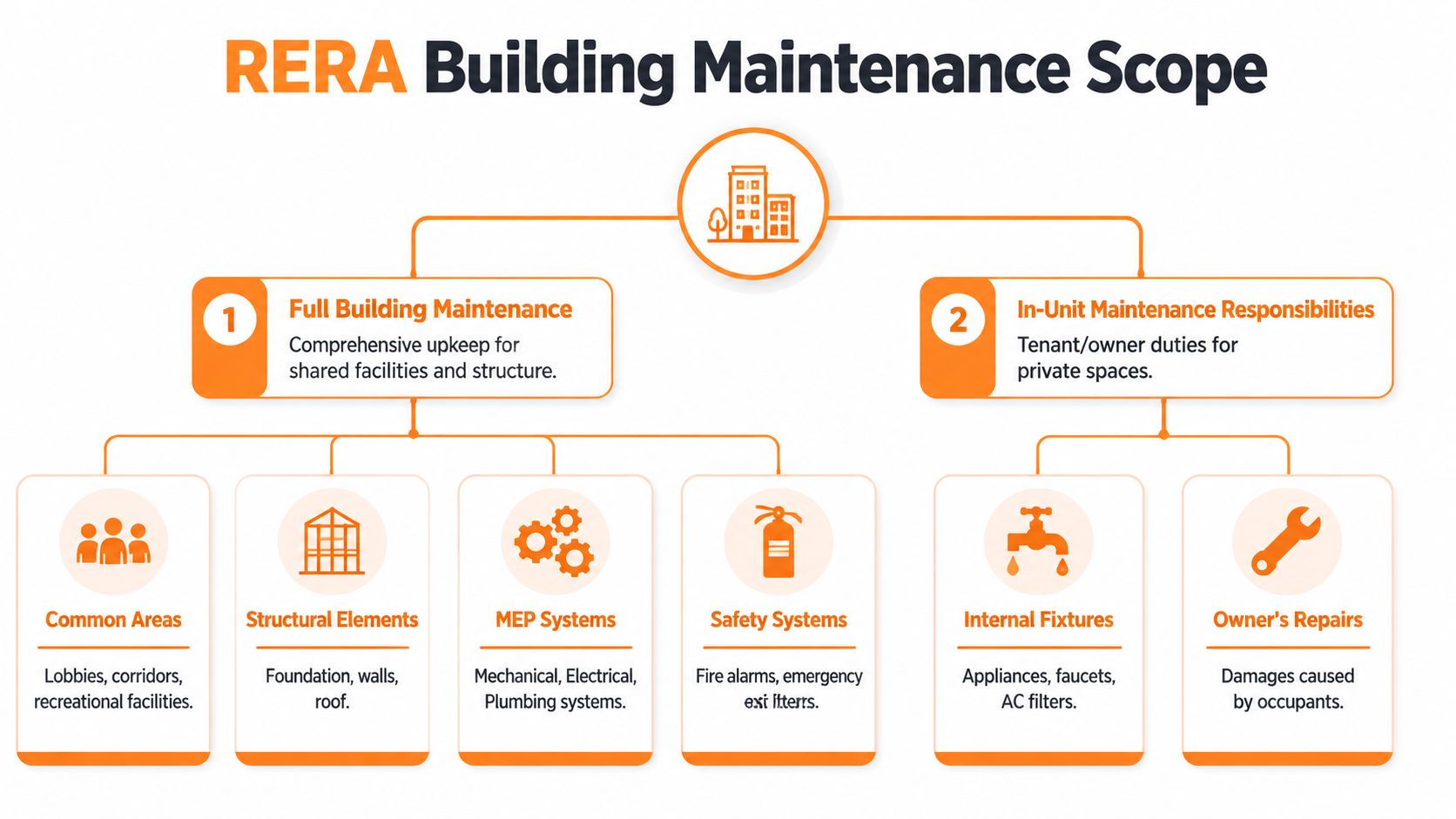
The landlord’s maintenance exposure isn’t limited to what happens inside a single apartment. In Dubai, the actual maintenance scenario includes private unit obligations, common area obligations, and system interfaces that cross both. That’s where many owners underestimate their risk.
Common areas and private units are funded differently
For jointly owned property, common area maintenance is generally funded through approved service charge structures. That includes the systems and spaces that support the full building, not just one tenancy. Lobbies, corridors, lifts, shared HVAC components, common lighting, security infrastructure, and housekeeping functions sit in that category.
Private unit maintenance is different. The owner still carries the core responsibility for major failures that affect use of the rented premises, subject to the tenancy contract. In practical terms, many disputes arise at the boundary between the two, such as chilled water issues, vertical stack leaks, façade-related water ingress, or central plant problems that appear inside a private unit but originate elsewhere.
Dubai climate changes the maintenance profile
Dubai’s climate puts recurring stress on core systems. HVAC takes the first hit. High ambient heat, humidity cycles, and dust loading accelerate fouling, reduce efficiency, and increase the consequences of missed servicing. Electrical components also operate under heavier thermal load, especially in buildings with ageing distribution equipment or inconsistent preventive maintenance.
That means a compliant maintenance model has to cover more than emergency attendance. It should include planned inspection, cleaning, testing, and rectification across MEP and life-safety interfaces. In practice, this is why many owners use structured HVAC maintenance contracts and integrated building-side support rather than relying on one-off call-outs.
Site reality: The fault the tenant sees is often only the symptom. The actual failure may sit in a control panel, riser, pump set, FCU valve, or drainage line outside the occupied room.
A complete maintenance scope for Dubai assets typically includes:
- HVAC systems: Preventive servicing, filter management, condensate control, coil cleaning, and fault diagnosis.
- Electrical systems: Distribution checks, breaker integrity, lighting systems, and fault tracing.
- Plumbing infrastructure: Leakage response, pressure issues, drainage blockages, and shared line coordination.
- Fire and life-safety interfaces: Alarm devices, emergency routes, and building-side coordination with required authorities.
- Building fabric: Waterproofing defects, sealant deterioration, façade-related ingress, and internal damage reinstatement.
Owners who separate these scopes badly usually create cost duplication and accountability gaps. One contractor attends the symptom. Another disputes the root cause. The tenant sees only delay.
Service Charges Annual Maintenance Contracts and Budgeting
Maintenance funding in Dubai is partly regulated and partly operational. For landlords, that distinction matters because it affects what can be budgeted through approved building structures and what remains a direct owner liability inside the leased unit.
Service charges fund mandatory common area upkeep
The RERA Service Charge Index establishes mandatory annual maintenance cost benchmarks, with charges ranging from AED 3 to over AED 70 per square foot. Law No. 6 of 2019 requires RERA to regulate, audit, and approve all service charge budgets before management companies can collect funds, ensuring consistent funding for essential services like elevator and HVAC maintenance, security, and cleaning as outlined in this overview of Dubai service charges and RERA regulations.
That benchmark system matters because owners in jointly owned property can’t treat common area maintenance as optional or informal. The budget is controlled, and the spending categories are tied to actual building operation. In market terms, the variation can be substantial. The same source notes that charges range from AED 3 to over AED 70 per square foot, and provides examples showing large differences between communities.
For landlords, the practical implication is simple. Service charges support the building’s shared systems. They don’t remove the need for a unit-level maintenance strategy. If a tenant’s apartment has an FCU problem, internal plumbing defect, electrical failure, or damaged fixture, the owner still needs a separate delivery model for repair and documentation.
Reactive spend versus structured maintenance planning
Reactive maintenance looks cheap until the asset starts failing under load. Then costs move from predictable OPEX to unplanned rectification, emergency attendance, tenant dissatisfaction, and possible legal cost.
A structured annual maintenance model does something different. It defines system coverage, visit frequency, exclusions, emergency response, reporting, and escalation routes before the fault appears. That doesn’t eliminate failures. It reduces disorder around them.
Here is the practical comparison:
| Model | Budget Behaviour | Operational Control | Dispute Exposure |
|---|---|---|---|
| Reactive call-out only | Irregular and difficult to forecast | Low | Higher, because response and records vary |
| Labour-only maintenance arrangement | Moderate predictability, but parts remain uncertain | Medium | Moderate, depends on diagnostics and approvals |
| Comprehensive planned maintenance | More predictable within agreed scope | Higher | Lower, if records and SLAs are enforced |
For owners managing multiple units or mixed-use assets, Annual Maintenance Contracts (AMC) and broader MEP services in Dubai thus become decision tools rather than procurement line items. The key question isn’t whether an AMC exists. It’s whether the scope matches the asset profile and the landlord’s actual liabilities.
One example of a provider model in this category is SnapFixNow, which uses photo-based work orders, SLA-driven response, and in-house technical delivery across HVAC, electrical, plumbing, and civil scopes. That kind of model is useful when the owner wants a single evidentiary trail rather than fragmented subcontract records.
Budget rule: If the owner funds maintenance only after failure, the owner is also choosing delay, approval friction, and weaker proof.
Ensuring Compliance and Mitigating RDC Disputes
In maintenance disputes, the landlord often loses control of the narrative because the file is incomplete. The tenant has screenshots, follow-up messages, and photos of damage. The owner has invoices and verbal explanations from contractors. That isn’t enough.
In disputes documentation usually decides the outcome
RERA-mandated documentation for building maintenance compliance is becoming critical. Recent enforcement surges in 2025-2026, with Dubai Municipality inspections rising 35%, have resulted in over AED 10M in fines for MEP/HVAC non-compliance. Landlords retain liability for third-party coordination, and 52% of RDC wins are tied to proof of timely response (under 48 hours for emergencies), making digital logging via photo-reporting and SLA-driven AMCs an essential risk mitigation tool according to this summary of landlord obligations in Dubai.
That set of figures supports what facility managers already see in practice. Compliance isn’t proved by intention. It’s proved by timestamped action. If the owner appoints a contractor but can’t show the instruction, attendance, diagnosis, approval chain, and closure evidence, the maintenance response is hard to defend.
This is also why owners should pay attention to recurring operational failures that tend to trigger claims. A useful checklist of common maintenance compliance failures in Dubai buildings helps frame the common weak points before they become disputes.
What an auditable maintenance trail should contain
A defensible maintenance file usually includes five elements.
- Tenant notification record: The first complaint, date, time, and communication channel.
- Triage classification: Whether the issue affected safety, cooling, power, water, access, or another critical function.
- Attendance evidence: Technician arrival record, site photos, fault diagnosis, and temporary or permanent action taken.
- Approval chain: Landlord instruction, quotation approval where relevant, and any delay caused by access, parts, or third-party constraints.
- Close-out record: Completion photos, test result where applicable, and tenant acknowledgement or documented refusal.
A contractor invoice proves that money was spent. It doesn’t prove that the owner responded properly, on time, and to the correct technical standard.
Many landlords still rely on fragmented communication. The broker speaks to the tenant. The owner messages a handyman. The building team shares updates informally. That approach fails when a chronology has to be reconstructed.
A stronger operating model uses one reporting channel, one job reference, fixed response categories, and mandatory photo closure. For larger portfolios, the maintenance platform should also show open jobs by age, repeat failures, and overdue critical actions. That lets the owner manage exposure before a complaint reaches formal dispute resolution.
Developing a Compliant Maintenance Action Plan
A practical owner checklist
A compliant maintenance strategy doesn’t need to be complicated. It needs to be controlled. For most landlords and asset managers, the starting point is an audit of contract language, delivery model, and records.
Use this checklist to move from reactive maintenance to defensible compliance:
Review tenancy agreements
Check whether the maintenance clause distinguishes clearly between consumables, minor wear-and-tear items, and major system failures. If the wording is vague, legal risk sits with the owner.
Map the asset systems
Identify which risks sit inside the unit and which depend on building-side systems. HVAC, drainage, electrical distribution, water supply, and envelope-related defects often overlap.
Classify response priorities
Not every job is urgent, but critical systems need defined response rules. Cooling loss, water interruption, electrical failure, and active leaks should never be handled through casual scheduling.
Standardise work-order evidence
Require photos before and after rectification, technician notes, time logs, and close-out confirmation. If a contractor can’t provide that consistently, they’re increasing dispute risk.
Align the contract model to the asset
Single-unit landlords may use a lighter structure. Towers, hospitality assets, and mixed-use sites usually need SLA-based FM support with specialist escalation for MEP systems.
Create one reporting path for tenants
Multiple communication channels create confusion. One intake method, one reference number, and one follow-up process reduce argument about timing and accountability.
Decision filter: If the owner can’t retrieve the full maintenance history of a complaint within minutes, the process is too loose.
In practice, these systems are usually managed under structured maintenance contracts with defined scope, documentation standards, and escalation routes. That’s the operational path that reduces both OPEX volatility and legal ambiguity.
Frequently Asked Questions on RERA Maintenance Rules
Q: If the tenant caused the damage, is the landlord still responsible?
A: For major repairs, landlord liability remains the default position unless tenant-caused damage is documented. The key word is documented. If the owner alleges misuse but has no inspection record, photos, or technician report, that argument weakens quickly.
Q: How fast does a landlord need to respond to an emergency issue?
A: RERA regulations establish clear maintenance responsibility divisions, with landlords legally liable for major repairs exceeding AED 1,000 unless tenant-caused damage is documented. According to Article 16 of the Dubai Rent Law, landlords must fix any problems preventing tenants from fully using the property and are required to respond to reports within 24 hours for critical systems during summer months. Failure to do so is considered neglect according to this guide on handling apartment maintenance issues in Dubai.
Q: Can a tenancy contract transfer all maintenance obligations to the tenant?
A: No. Contracts can reassign some minor maintenance responsibilities, but they don’t safely remove the landlord’s responsibility for structural or major system failures where habitability is affected. Clauses that overreach can become a dispute trigger rather than a protection.
Q: Is a handyman enough for compliance?
A: Not for every issue. Minor cosmetic or routine works may be straightforward, but major HVAC, electrical, plumbing, structural, or building-interface faults need competent technical diagnosis and proper records. The compliance risk comes from misdiagnosis as much as non-attendance.
Q: What about recurring problems like leaks or pest issues?
A: A recurring issue should be treated as a root-cause problem, not a repeat service ticket. If the same complaint returns, the owner should escalate the diagnosis, document the pattern, and check whether the fault originates from common area systems, neighbouring units, or unresolved building defects.
For landlords and property managers who want a more defensible operating model, the practical next step is to review whether their maintenance delivery can produce fast response records, photo-based work orders, and clear scope allocation. If that framework isn’t in place, a structured FM partner such as SnapFixNow is one way to organise HVAC, MEP, and general maintenance under documented service levels rather than ad hoc call-outs.
Meta description: RERA building maintenance requirements Dubai landlords must meet. Learn legal duties, service charges, AMC strategy, and documentation to reduce RDC risk.