You’re probably looking at several proposals right now that all claim to cover “integrated” facility management, yet none of them are comparable. One quote is built around manpower, another around output, another around exclusions and provisional sums. The result is familiar: procurement sees price variance, operations sees service gaps, and asset owners inherit the risk later.
That’s why an integrated facility management company dubai quote shouldn’t be judged as a purchasing line item. It should be treated as a lifecycle decision covering uptime, compliance exposure, contractor control, and OPEX predictability in a Dubai operating environment defined by heat stress, dust loading, humidity cycling, and strict inspection requirements.
Table of Contents
- Executive Summary A Framework for Evaluating IFM Quotes in Dubai
- Preparing Your Request for Quotation to Elicit High-Quality Bids
- How to Decode an Integrated Facility Management Company Dubai Quote
- Evaluating SLAs Warranties and Compliance Beyond the Price
- A Practical Checklist for Comparing IFM Vendor Proposals
- Negotiation Tactics and Critical Red Flags to Watch For
- Frequently Asked Questions on IFM Vendor Selection
Executive Summary A Framework for Evaluating IFM Quotes in Dubai
The commercial logic behind IFM in Dubai is straightforward. Building owners want single-point accountability across hard and soft services, fewer contractor interfaces, stronger SLA governance, and better control of recurring operating spend. That’s happening in a market that is projected to grow from USD 6.2 billion in 2025 to USD 10.69 billion by 2032 at a 9.5% CAGR, with demand tied to commercial and residential towers where single-point accountability can cut operating costs by 15 to 20% and improve asset uptime, according to Dubai facility management market data.
Most quote comparisons fail before the first number is reviewed. The client issues an incomplete RFQ, bidders apply different assumptions, and each proposal prices a different operational model. A lower headline figure often means reduced scope, weaker supervision, reliance on subcontracted technical labour, or a reactive maintenance bias that shifts cost into breakdowns and rectification.
A more reliable approach is to judge each proposal on four layers:
- Commercial structure: pricing logic, exclusions, provisional items, payment triggers
- Operational model: preventive planning, staffing mix, technical depth, subcontracting exposure
- Control environment: SLAs, reporting discipline, escalation, audit trail
- Lifecycle effect: impact on downtime, asset condition, compliance, and recurring OPEX
For Dubai properties, these layers matter because HVAC, MEP, fire life safety interfaces, water systems, and façade-related issues don’t fail in isolation. One weak contractor interface can create tenant complaints, energy waste, delayed inspections, and expensive emergency call-outs.
If you’re reviewing options for facility management in UAE, the useful question isn’t “Which quote is cheapest?” It’s “Which quote most clearly defines responsibility, protects uptime, and limits commercial surprises over the contract term?”
Practical rule: If two IFM quotes differ substantially in price, assume they differ in assumptions first, not efficiency.
Preparing Your Request for Quotation to Elicit High-Quality Bids
A poor RFQ produces a poor quote. That isn’t a vendor problem. It’s a data problem.

Start with the asset reality not the service wish list
Most buyers start with a generic service list. That’s backwards. Start with the building’s asset profile, condition, occupancy pattern, compliance obligations, and pain points.
A structured IFM methodology that begins with a detailed current-state assessment and defined scope can reduce downtime by 20 to 30% and achieve 95% compliance rates, while helping avoid penalties that can average AED 50,000 per violation in Dubai, according to this IFM implementation guidance.
For UAE buildings, your RFQ should reflect actual operating stressors:
- HVAC load profile: chillers, VRV or DX systems, fresh air handling, filtration regime, summer peak sensitivity
- Dust and humidity exposure: cleaning cycles for coils, filters, drain lines, shafts, and external air paths
- Vertical transport and access constraints: service lift availability, roof access, permit control, fit-out interference
- Regulatory touchpoints: Dubai Municipality, Civil Defense, landlord or master community requirements, inspection logs
What a robust RFQ package should contain
A serious RFQ package usually includes more than a scope sheet and floor area. At minimum, include:
Asset register
List major plant and equipment by type, location, make, model, age, and known defects. If maintenance history exists, attach it.Scope matrix
Separate hard FM, soft FM, specialist systems, statutory inspections, consumables, and exclusions. If security or landscaping are outside the current package, say so clearly.Service standard definitions
Define what “preventive”, “corrective”, “emergency”, and “minor civil” mean for your site. Without this, bidders will price different service depths.Site operating conditions
Occupancy hours, critical tenant zones, hotel back-of-house sensitivity, retail trading restrictions, permit-to-work rules, and noise windows.Compliance schedule
Required records, test certificates, inspection support, incident reporting, and document retention expectations.
A quote becomes unreliable when the buyer knows the assets but doesn’t disclose their condition.
A concise RFQ outline often works better than a long narrative. Use annexures. Force line-item responses. Require bidders to state assumptions, exclusions, subcontracted scopes, planned site staffing, software platform used for reporting, and mobilisation requirements.
Also ask each bidder to identify what data was missing and what they priced on an assumed basis. That single step exposes where future variations are likely to arise.
How to Decode an Integrated Facility Management Company Dubai Quote
Once proposals arrive, the reading order matters. Don’t start with the total price. Start with scope assumptions, exclusions, service frequency, and labour model. The total only becomes meaningful after that.
Why one quote is higher than another
In the UAE, hard FM contracts typically range from AED 5 to 15 per sqm annually for commercial buildings, while integrated bundles that combine MEP and soft services can be 20 to 30% higher. The same source notes that photo-based work order platforms can reduce quoting errors by up to 25% by using real-time asset data, according to UAE quote benchmarking notes.
That range explains why two bids can both be legitimate yet materially different. Common cost drivers include:
- Asset intensity: a tower with dense MEP plant, booster systems, kitchen exhaust, and specialist controls costs more to maintain than a basic office shell
- Building age and condition: deferred maintenance pushes contractors to price for corrective exposure
- Service delivery model: in-house technical teams usually price differently from subcontract-led delivery
- Hours of coverage: 24/7 attendance, shift engineering, or hotel-grade response windows increase fixed cost
- Technology stack: CMMS, mobile reporting, photo verification, and audit logging add cost but improve control
- Commercial inclusions: consumables, minor materials, specialist subcontractor coordination, and warranty obligations materially affect price
For high-occupancy buildings in Dubai, cheap labour-only structures often look attractive in year one and become expensive in year two because the client retains too much coordination risk.
Comparison of IFM Contract Models
| Attribute | Comprehensive IFM Contract | Labour-Only Contract | Reactive Call-Out Model |
|---|---|---|---|
| Commercial basis | Fixed recurring fee with defined scope and service frequencies | Fee mainly tied to supplied labour and attendance | Pay only when work is raised |
| Scope certainty | Higher if inclusions and exclusions are well written | Moderate. Materials, specialist works, and supervision may sit outside | Low. Scope is event-driven |
| Budget predictability | Stronger OPEX forecasting | Moderate. Variations are common | Weak. Failures drive spending |
| Preventive planning | Usually embedded | Often inconsistent unless tightly supervised by client | Minimal |
| Client coordination load | Lower | High | Very high |
| Downtime risk | Lower where SLA governance is strong | Moderate to high | Highest |
| Best fit | Multi-asset portfolios, mixed-use buildings, hospitality, critical commercial sites | Owners with strong in-house engineering control | Small non-critical assets or interim arrangements |
| Main trade-off | Higher upfront contract value | Lower headline price but more owner-managed risk | Lowest entry cost, highest lifecycle uncertainty |
A practical reading test helps. If the quote is low, ask what the vendor has removed to reach that number. Common answers are hidden in technician coverage, spare parts assumptions, after-hours attendance, reporting depth, and subcontracted specialist works.
For hard-services-heavy sites, review technical line items alongside linked service pages such as HVAC maintenance contracts and MEP services in Dubai. These scopes often contain the cost drivers that most affect uptime in UAE conditions.
Lower price is only positive when the same risk, same scope, and same response model are preserved. That rarely happens by accident.
Evaluating SLAs Warranties and Compliance Beyond the Price
The most important pages in an IFM proposal are usually not the commercial summary. They’re the SLA schedules, rectification obligations, escalation matrix, and warranty language.
The clauses that actually protect the asset owner
UAE FM Association data indicates that 40% of Dubai facility managers report 15 to 20% annual downtime losses, averaging AED 500,000 per building, and that integrated FM with real-time tracking can reduce those losses by up to 35% through SLA-driven response, according to UAE FM operational data.
That’s why response language matters. A serious contract should define:
- Priority levels: emergency, urgent, routine, and planned works
- Response versus rectification: arrival time is not the same as restoration time
- SLA credits or penalties: what happens if targets are missed
- Preventive completion expectations: whether planned maintenance is measured monthly, quarterly, or annually
- First-time fix intent: whether the vendor is committing to technical resolution or just attendance
If you need a plain-language reference when reviewing wording, this outline of the key components of a Service Level Agreement is useful because it separates service scope, measurable targets, reporting, remedies, and responsibilities.
Warranty coverage deserves the same scrutiny. Many buyers see “warranty-backed” in a proposal and assume broad protection. Check whether workmanship warranty applies only to labour, whether supplied parts are covered separately, and whether failures caused by deferred asset condition are excluded.
Why digital evidence matters in Dubai operations
In Dubai, compliance and dispute control often come down to records. If a vendor says preventive maintenance was done, can they produce time-stamped evidence, technician notes, photographs, closure approvals, and inspection logs?
Structured Annual Maintenance Contracts (AMC) are more than a budgeting tool. They formalise reporting cadence, evidence standards, escalation paths, and accountability for repeated faults.
A practical SLA review should also test summer resilience. If a chilled water issue, VRV fault, or major electrical disruption occurs during peak occupancy, the financial effect isn’t limited to repair cost. It can affect tenant comfort, room inventory, trading conditions, and brand risk.
Operational warning: A fast response SLA without a defined rectification path often gives the appearance of control without restoring performance.
A Practical Checklist for Comparing IFM Vendor Proposals
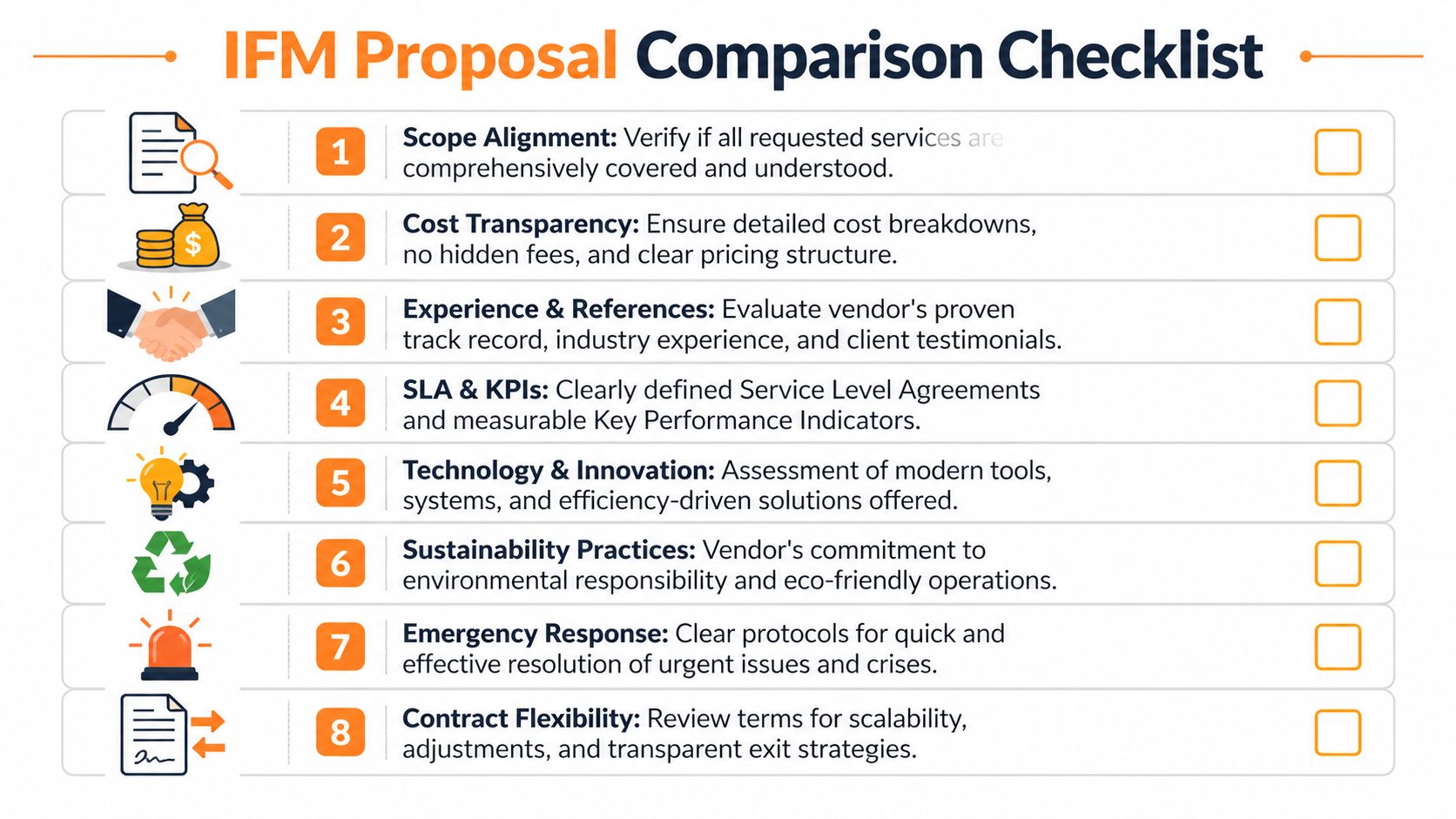
A side-by-side comparison works only if every proposal is tested against the same risk filters. Price should be one column, not the full decision.
What good looks like versus what should concern you
When benchmarking proposals, assess technician certifications, including whether the delivery model includes a substantial in-house team with VRV and chiller capability, and target a 97% first-time fix rate. The same benchmarking guidance notes that strong Dubai IFM firms achieve 85 to 90% client retention by reducing reactive repairs by 40% through proactive methods, according to IFM benchmarking guidance for Dubai.
Use the checklist below as a practical lens.
Financial clarity
Good looks like transparent line items, clear exclusions, payment terms tied to deliverables, and a stated variation process. Risk shows up as lump-sum pricing with broad assumptions.Scope alignment
Good means every requested hard and soft service is mapped to frequency, responsibility, and measurable output. Risk appears when words like “as required” replace actual service definitions.Technical delivery model
Good means direct control of core technical labour, named specialist capability, and clear subcontract governance. Risk appears when core MEP response depends on external parties with unclear mobilisation.Technology and reporting
Good means mobile closure evidence, asset-linked work orders, escalation tracking, and trend reporting. One factual example is SnapFixNow’s photo-based work order platform, which is relevant because it supports real-time tracking and evidence-led closure in Dubai operating conditions. Risk appears when reporting is manual and retrospective.
A working evaluation lens for procurement teams
A practical internal review often uses four weighted questions:
| Category | What to test | Good sign | Risk sign |
|---|---|---|---|
| Operations | Can the bidder prevent failures, not just respond to them? | Preventive schedule linked to asset criticality | Generic PPM template |
| Commercial | Is the price built on declared assumptions? | Clear inclusions and variation logic | Hidden exclusions |
| Governance | Can performance be audited monthly? | KPI dashboard and closure evidence | Narrative reports only |
| Resilience | Can the model absorb urgent events? | Named escalation chain and emergency process | Reliance on ad hoc coordination |
Use this kind of matrix before negotiation starts. It stops the discussion from collapsing into a single rate comparison.
Negotiation Tactics and Critical Red Flags to Watch For
A low quote isn’t automatically a bad quote. But an unusually low quote for a technically dense building usually means someone has priced a different contract than the one you think you’re buying.

Red flags that usually surface after mobilisation
Watch for these issues during final review:
Vague scope language
If reactive, minor, specialist, emergency, and consumable terms aren’t defined, disputes are likely.Heavy subcontract dependency for core hard FM
Subcontracting specialist works is normal. Subcontracting core daily technical delivery introduces control risk.No site-specific mobilisation plan
A serious bidder should explain onboarding, asset verification, staff induction, permit access, and backlog review.Weak reporting method
If the proposal doesn’t show how work orders are raised, tracked, evidenced, and closed, governance will suffer.Unclear warranty exclusions
Such exclusions often lead to many “included” repairs later becoming disputed chargeable works.
If a bidder can’t explain how repeated faults will be investigated, they’re pricing attendance, not reliability.
Negotiation points that improve contract value
Useful negotiation improves clarity before mobilisation. It doesn’t just remove cost.
Ask for:
A line-by-line assumption register
This reduces argument later.Revised SLA wording for priority assets
Especially HVAC, electrical rooms, pumps, and life safety interfaces.A defined defect liability or workmanship period
Particularly for recurring rectification works.Monthly KPI format before contract award
If they can’t show the dashboard now, they won’t produce it later.A site walk with the proposed account lead
You want to assess technical reasoning, not just sales coverage.
For internal procurement discipline, a documented review path helps. This Supatool guide for contract management is useful because it frames approval, obligation tracking, and post-award controls in an orderly way.
Negotiation should also test exit logic. Check handover obligations, asset data ownership, report transfer, and close-out duties if the contract ends. A flexible exit clause protects continuity of operations.
Frequently Asked Questions on IFM Vendor Selection
Below is a concise working FAQ for final-stage selection decisions.
| Question | Answer |
|---|---|
| Q: How many quotes should a property owner compare? | A: Compare enough proposals to see where assumptions differ, but only if all bidders received the same RFQ package. Three properly structured bids are usually more useful than many inconsistent ones. |
| Q: Should I choose a bundled IFM model or separate specialist contracts? | A: It depends on asset complexity and your in-house management capacity. Bundled IFM usually suits multi-asset or high-occupancy sites where coordination risk is high. Separate contracts can work if the owner has strong technical oversight. |
| Q: What’s the most common reason IFM contracts underperform after award? | A: Poor scope definition at RFQ stage. When service boundaries, technical assumptions, and evidence requirements are vague, the contract becomes reactive and variation-heavy. |
| Q: How should I validate a bidder beyond the written proposal? | A: Meet the operational team, not only the commercial team. Review sample reports, escalation logic, and technical supervision. For a broader buyer’s framework, this guide on how to choose the right facility management company in UAE for long-term reliability is a useful supporting reference. |
| Q: What should I do if two bids look technically similar but the prices differ? | A: Run a clarification round focused on assumptions, subcontracting, attendance model, materials, and warranty limits. The hidden difference is usually there, not in the summary page. |
The right decision usually comes from treating the quote as an operating model, not just a commercial offer. In practice, buyers get better outcomes when they force comparability at RFQ stage, test SLA enforceability before award, and place the contract under a structured maintenance framework that can be audited month by month.
If you need a practical next step, ask for a site-based review that tests scope clarity, asset criticality, SLA structure, and reporting requirements before requesting a final commercial submission. For teams that want to move that process into an operational maintenance framework, SnapFixNow is one example of a Dubai-based facility management company supporting AMC, hard FM, and engineering-led building maintenance under structured service delivery.
Meta description: Evaluate an integrated facility management company Dubai quote using TCO, SLA, compliance and risk-based procurement guidance for UAE buildings.