You’re probably dealing with the same procurement tension that shows up across Dubai and the wider UAE. One team wants a lower contract value. Another wants tighter SLAs. Engineering wants competent hard services coverage. Finance wants budget predictability. Operations wants fewer tenant complaints, fewer repeat call-outs, and less disruption during peak occupancy.
That’s where emirates facility management stops being a vendor shortlist exercise and becomes a risk allocation decision. The wrong scope, wrong contract structure, or weak performance controls don’t just create maintenance headaches. They affect asset life, compliance exposure, and operating cost over time.
Table of Contents
- An Operational Framework for Facility Management in the UAE
- Defining the Scope of Emirates Facility Management Services
- Service Models An Operational and Financial Comparison
- Navigating UAE Regulatory and Compliance Mandates
- Decoding SLAs and KPIs for Performance Management
- A Framework for Vendor Selection and Risk Assessment
- Frequently Asked Questions on Facility Management
- Q: What’s the main difference between emirates facility management and a basic maintenance service?
- Q: When should a building move from reactive call-outs to an AMC?
- Q: What should procurement ask for before awarding an FM contract?
- Q: How do I know whether an SLA is strong enough?
- Q: Why do digital reporting tools matter in UAE FM operations?
An Operational Framework for Facility Management in the UAE
For asset owners in Dubai, Abu Dhabi, and the wider Emirates, FM is no longer a back-office support function. It sits directly inside business continuity, compliance, tenant retention, and lifecycle cost control. That matters in a market where building systems are increasingly complex and expectations around uptime are high.
The scale of the sector makes that plain. The UAE FM market was valued at USD 6.83 billion in 2024 and is projected to reach USD 12.33 billion by 2033, with a 6.90% CAGR from 2025 to 2033, driven by urban development and smart infrastructure initiatives, according to UAE FM market projections reported by GlobeNewswire.
In practice, procurement mistakes usually happen in three places. Scope is underspecified. Risk transfer is assumed rather than written. Performance is measured by ticket volume instead of building outcomes.
What procurement committees should test first
A sound FM review starts with a short set of operational questions:
- Asset criticality: Which systems can’t fail without affecting trading, occupancy, safety, or guest experience?
- Failure mode: Are you mainly exposed to sudden outages, gradual degradation, statutory non-compliance, or recurring defects?
- Commercial structure: Does the contract reward prevention, or does it only pay for rectification after failure?
- Evidence trail: Can the provider produce auditable maintenance records, escalation logs, and close-out verification?
Practical rule: If a contract makes emergency response visible but preventive discipline invisible, it usually drives reactive behaviour.
For regulated and resilience-sensitive environments, FM governance increasingly overlaps with broader operational resilience programmes. Teams handling critical facilities can borrow useful thinking from DataLunix's guide to CBUAE compliance, especially around documented controls, incident response, and traceable service workflows.
A local operating model also matters. In UAE conditions, dust loading, heat stress, high seasonal humidity, and mixed-use occupancy patterns put more pressure on HVAC, plumbing, controls, façade interfaces, and drainage systems than many generic tender templates recognise. That’s why committees usually get better outcomes when they review service delivery through a UAE-specific lens rather than using imported FM scopes.
For a baseline view of how local delivery models are typically structured, it helps to review current facility management services in the UAE before drafting tender packages.
Defining the Scope of Emirates Facility Management Services
A large share of procurement confusion comes from treating FM as one line item. It isn’t. In UAE buildings, emirates facility management usually combines technical asset care, compliance support, occupant services, and front-line operational response. If those workstreams are blended without clear boundaries, cost comparisons become misleading.
The cleanest starting point is to separate Hard FM from Soft FM.
Hard FM keeps critical assets operating
Hard FM covers the maintainable systems that determine whether the building can function safely and reliably. That includes HVAC, chilled water interfaces, pumps, ventilation, LV electrical systems, lighting controls, plumbing, drainage, fire life safety interfaces, BMS-linked assets, and civil defects that affect weatherproofing or service continuity.
This area dominates the UAE market. Hard services hold a 60.92% market share in 2025, driven by investment in smart MEP systems, fire safety infrastructure, and predictive maintenance technologies, according to Mordor Intelligence’s UAE facility management market analysis.
That weighting makes operational sense in the Gulf. In Dubai conditions, HVAC failure isn’t a minor inconvenience. It can quickly become a business interruption issue in offices, retail, hospitality, and multi-unit residential stock. Electrical quality, pump reliability, condensate management, water pressure stability, and controls integrity also matter more in high-occupancy assets than generic service lists suggest.
Typical Hard FM scope includes:
- HVAC and ventilation: Preventive servicing, filter strategy, coil cleaning, balancing checks, controls review, and fault rectification.
- Electrical maintenance: DB inspections, lighting systems, emergency lighting, breaker condition, load-related issues, and minor power quality troubleshooting.
- Plumbing and drainage: Leak detection, pressure issues, pump servicing, blockage response, sanitaryware rectification, and water ingress response.
- Fire and life safety coordination: Routine checks, defect logging, interface coordination with specialist contractors, and compliance documentation.
- Building fabric support: Sealant failures, masonry defects, waterproofing-related observations, and snag rectification tied to asset protection.
Soft FM protects usability, hygiene, and presentation
Soft FM covers the operational services that shape how occupants experience the building day to day. This commonly includes cleaning, waste handling, landscaping, pest control, helpdesk coordination, front-of-house support, and some security coordination depending on the site model.
These services don’t usually drive the same capex exposure as Hard FM, but they still affect risk. Poor cleaning standards damage hospitality perception. Weak waste management creates hygiene and compliance problems. Poorly coordinated front-line support slows issue reporting and escalations.
A practical Soft FM scope should define:
- Cleaning standards by area type: Lobbies, BOH zones, washrooms, guest rooms, common areas, and high-touch surfaces.
- Shift coverage and occupancy logic: Peak-hour staffing is different from night coverage and seasonal demand.
- Consumables responsibility: Who procures, who replenishes, and who verifies stock levels.
- Escalation channels: How occupants report issues and how those reports connect to engineering workflows.
For teams reviewing front-line communications and resident-facing coverage, how property management answering services help is a useful operational reference because response handling often affects FM performance long before a technician reaches site.
In real buildings, the failure point is often not the repair itself. It’s the handoff between occupant complaint, helpdesk triage, technician dispatch, and verified close-out.
A good scope document separates routine tasks from specialist works, consumables from labour, and statutory responsibilities from convenience services. Without that separation, bids look comparable on paper while carrying very different delivery assumptions.
Service Models An Operational and Financial Comparison
A procurement team approves a low-fee reactive contract to control OPEX. Six months later, the same asset is carrying higher emergency call-out spend, more occupant complaints, and a growing list of repeat faults because root causes were never addressed. This represents the actual comparison in UAE FM procurement. It is not a menu of services. It is a decision about who carries failure risk, how performance is verified, and whether the contract supports asset preservation or gradual degradation.
Why contract structure changes total cost
The service model sets the financial behaviour of the building. Reactive contracts convert maintenance into event-driven spend. AMCs introduce planned intervention and clearer cost visibility. Integrated FM shifts a wider share of coordination risk to one provider, but only if the scope, exclusions, and reporting rules are written tightly.
Three models appear most often in UAE tenders.
Ad-Hoc or Reactive suits isolated repairs, short-term asset holds, and low-criticality environments where downtime has limited commercial effect. The apparent saving is straightforward. The client pays only when a fault occurs. The trade-off is less attractive in operation. Failure timing controls cost, technician familiarity with the asset is inconsistent, and the client team spends more time approving works, checking quotations, and chasing close-out.
Annual Maintenance Contract (AMC) puts preventive maintenance, attendance obligations, and routine service frequencies into a fixed commercial structure. This usually improves budget control and reduces avoidable breakdowns, especially for MEP systems that deteriorate predictably when inspection and cleaning cycles slip. AMCs still need careful treatment of exclusions. Labour-only pricing, parts caps, and vague specialist coverage can leave the client exposed at exactly the point the contract was supposed to reduce risk.
Integrated FM combines engineering, helpdesk, front-line coordination, and often soft services under one management system. This model works best where service failure is visible and expensive: mixed-use assets, hospitality, large residential communities, healthcare-adjacent environments, and multi-building portfolios. The benefit is not merely convenience. It is tighter control over interfaces between complaint logging, triage, dispatch, subcontractor management, and verified completion.
Comparison of Facility Management Service Models in the UAE
| Criteria | Ad-Hoc / Reactive Model | Annual Maintenance Contract (AMC) | Integrated FM Model |
|---|---|---|---|
| Cost structure | Variable and event-driven | Fixed recurring base with defined exclusions | Wider fixed monthly structure with managed variable items |
| Budget predictability | Low | Moderate to high | High if scope and change-control rules are clear |
| Risk allocation | Client carries most failure and coordination risk | Shared risk, subject to exclusions and asset condition | Provider carries more delivery risk if outputs are measurable |
| Response management | Call-out based, often inconsistent by vendor | Contract-led attendance by priority and asset criticality | Centralised helpdesk, escalation routes, and coordinated dispatch |
| Preventive planning | Limited | Scheduled PPM for covered systems | Unified PPM across engineering and support services |
| Lifecycle impact | Weak. Assets are repaired after performance loss | Better preservation if PPM completion and rectification are enforced | Strongest where condition reporting feeds renewal planning |
| Administrative load on client | High | Moderate | Lower day-to-day load, higher setup and governance requirement |
| Best fit | Small assets, one-off repairs, low-consequence failures | Offices, residential assets, standard retail and hospitality | Complex towers, mixed-use sites, large portfolios, high-visibility operations |
The selection point is consequence of failure, not portfolio size. A small site with critical plant may justify an AMC or integrated structure faster than a larger but low-risk asset. Chillers, booster pumps, ventilation systems, LV distribution, and water infrastructure do not perform well under contracts that wait for failure before funding action.
Exclusions deserve the same scrutiny as price. If consumables, specialist subcontractors, statutory testing support, temporary access equipment, or after-hours attendance sit outside the base fee, the headline number can understate the true operating cost by a wide margin. Committees should test each model against a simple question: which costs remain hidden until the building is already under stress?
The lowest tendered fee often shifts cost into emergency works, management time, tenant disruption, and earlier capital replacement.
Integrated FM also has its own risks. A single-provider structure can reduce interface failures, but poor mobilisation, weak CAFM discipline, or unclear self-performance versus subcontracting rules can create a large accountability gap under one contract. That is why performance verification matters as much as model selection. Monthly reporting should show PPM completion, repeat faults, emergency response, backlog ageing, asset condition trends, and rectification close-out by system. Without that evidence, a bundled contract can mask underperformance for too long.
The strongest procurement outcomes usually come from matching the contract form to asset criticality, then pricing the model against downtime exposure, management overhead, and lifecycle impact rather than fee alone. Prevention usually costs less than disruption once the full operating picture is visible.
Navigating UAE Regulatory and Compliance Mandates
Compliance in UAE FM sits inside routine operations. It isn’t a once-a-year audit issue. The maintenance regime, permit discipline, inspection records, and defect close-out process all feed into whether a building remains safe, auditable, and commercially usable.

Compliance sits inside daily FM operations
For Dubai assets, facility teams usually work across several overlapping authorities and frameworks depending on location, use class, and ownership structure. That may involve Dubai Municipality, Dubai Civil Defense, RERA and DLD for managed property environments, and jurisdiction-specific authorities such as Trakhees in relevant developments.
From an FM standpoint, the question isn’t whether a certificate exists. The question is whether maintenance execution supports continued compliance. That means inspection records must be retrievable, statutory tasks must be calendared, rectification must be traceable, and specialist contractor work must be coordinated rather than left floating between vendors.
Three operational weak points show up often:
- Documentation gaps: Work was done, but there’s no complete service report, permit history, or close-out evidence.
- Interface failure: One contractor identifies a defect, another is expected to fix it, and nobody owns the timeline.
- Deferred minor defects: Small failures in drainage, fire door hardware, pressurisation interfaces, or controls become larger compliance issues later.
Sustainability rules now affect maintenance strategy
Sustainability is now part of operational compliance, not a separate ESG discussion. UAE green building mandates targeting 50% clean energy by 2050 are increasing demand for energy-efficient FM practices, and post-pandemic hygiene requirements have also increased cleaning demand. Hard FM retrofits through Building Management Systems can achieve 20% to 35% energy reductions, according to Research and Markets’ UAE facilities management report.
That has two direct implications for procurement.
First, engineering maintenance and energy performance can’t be separated. If controls are overridden, sensors drift, filters are neglected, or scheduling logic is poor, the building may still operate but at higher OPEX and lower comfort stability.
Second, compliance teams increasingly need evidence, not declarations. FM providers should be able to show planned maintenance records, BMS trend reviews, air-side and water-side observations, and closed-loop reporting on corrective actions.
Buildings rarely fall out of compliance because of one dramatic event. More often, teams allow a backlog of ordinary defects, missing records, and unresolved specialist recommendations to build up over time.
For committees, the practical test is simple. Ask whether the proposed FM model can prove compliance in an audit, not merely promise to maintain it.
Decoding SLAs and KPIs for Performance Management
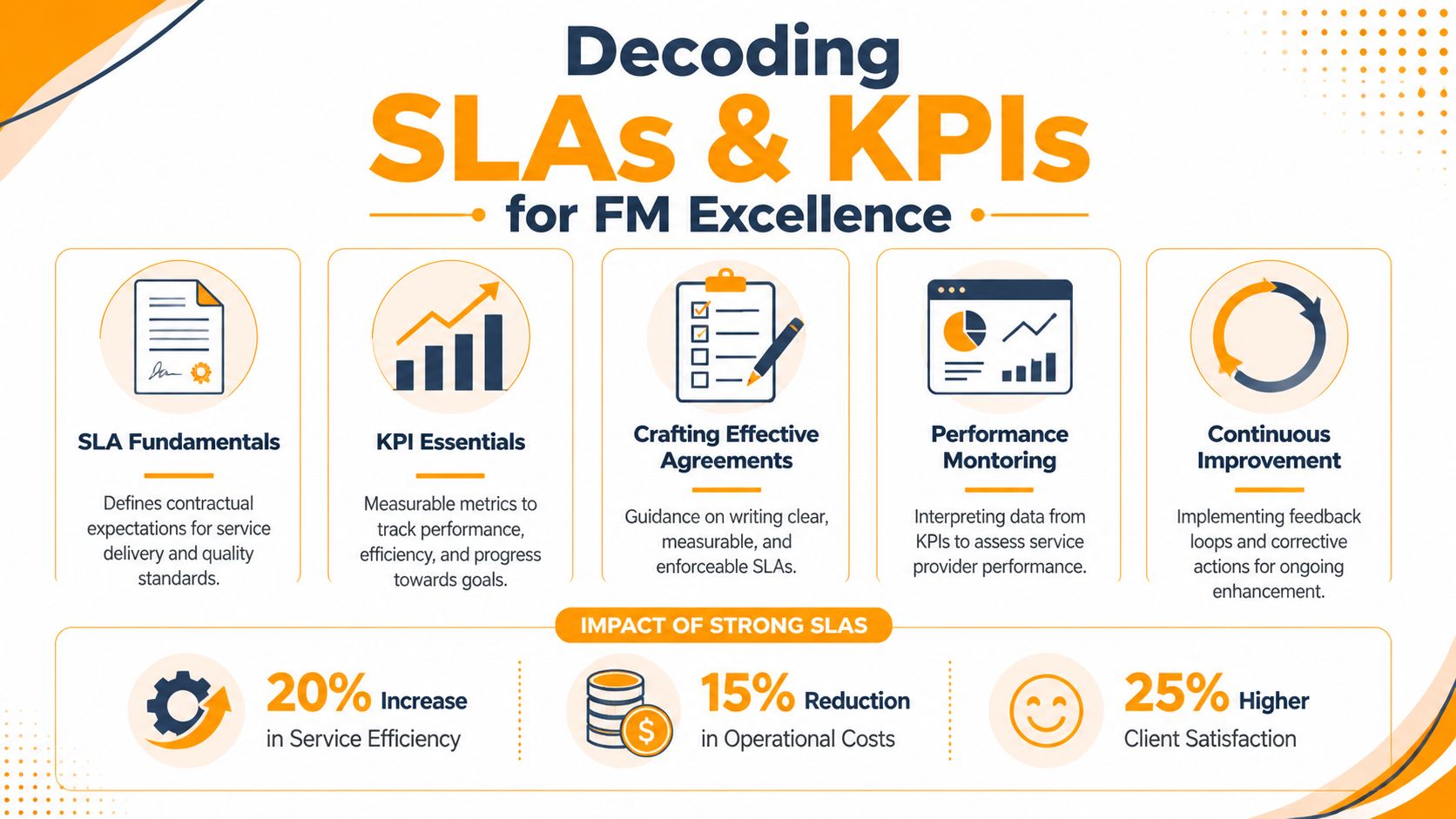
Most FM contracts fail at the point where expectations are translated into measurable obligations. A service provider can attend site quickly and still manage the asset badly. A helpdesk can close tickets quickly and still leave recurring failures unresolved. That’s why SLAs and KPIs need to measure performance in a way that reflects operational reality.
A visual reference helps clarify the distinction between contractual standards and management metrics.
A usable SLA is specific and auditable
An SLA should define more than attendance. It should state priority levels, reporting obligations, escalation rules, temporary make-safe requirements, and what counts as completion. If the document only says “respond promptly” or “rectify as required”, the client is buying ambiguity.
In UAE building operations, practical SLA drafting usually includes:
- Emergency incidents: Immediate life-safety, major leakage, critical power loss, complete HVAC failure in sensitive areas, or severe access failure.
- Urgent incidents: Partial service loss, comfort-impacting HVAC faults, pump issues with redundancy still available, blocked drainage in occupied areas.
- Routine incidents: Minor plumbing, lighting, carpentry, cosmetic civil defects, and non-critical snags.
Good contracts also distinguish response time from rectification time. Attendance only confirms that a technician arrived. It doesn’t confirm diagnosis quality, parts availability, temporary containment, or permanent close-out.
For teams building governance around measurable service performance, OpenClaw KPI monitoring solutions show the kind of dashboard logic that’s useful when SLA performance needs to be tracked consistently across multiple buildings or workstreams.
KPIs should measure outcomes, not activity
The most useful FM KPIs are the ones that show whether the maintenance system is reducing risk and preserving asset performance.
A workable KPI pack often includes:
- First-time fix rate: Indicates diagnostic quality, technician capability, and van stock logic.
- PPM completion adherence: Shows whether preventive tasks were delivered on programme.
- Repeat fault frequency: Highlights poor rectification quality or unresolved root causes.
- Asset uptime by critical system: Useful for chillers, AHUs, pumps, vertical transport, and key electrical infrastructure.
- Work order ageing: Shows whether backlog is under control or accumulating.
- Close-out quality: Confirms whether reports include photos, readings, observations, recommendations, and client sign-off where needed.
Operational note: If a provider reports high closure volume but can’t show repeat-fault trends or backlog ageing, the reporting system is describing activity, not performance.
The strongest contracts attach these KPIs to review cadence. Weekly operational review, monthly performance review, and quarterly contract governance each serve a different purpose. Weekly meetings clear blockers. Monthly reviews test SLA compliance. Quarterly reviews assess whether the model itself is improving reliability and cost control.
For a local benchmark on how service expectations are typically framed, it helps to review facility management SLA standards in Dubai. The useful part isn’t the wording itself. It’s seeing how obligations can be made measurable enough to enforce.
A Framework for Vendor Selection and Risk Assessment
A tender return can look compliant and still hide delivery risk. The committee’s task is to test whether the bidder can sustain performance in the building type, operating hours, and risk profile you manage.

Technical diligence before commercial negotiation
Start with delivery mechanics, not headline price.
Review whether the bidder uses in-house technical teams for core hard services or relies heavily on layered subcontracting. Subcontracting isn’t automatically a problem, but it changes control, mobilisation speed, supervision quality, and accountability for rectification. In high-rise commercial, hospitality, and mixed-use environments, this matters a great deal.
A practical due diligence checklist should cover:
- Relevant asset experience: A contractor that works well in low-rise residential stock may struggle in hospitality or complex office towers.
- Supervisor capability: Site engineering quality often depends more on supervisory discipline than on tender wording.
- Technical reporting: Ask for anonymised sample reports. They should show findings, asset references, readings where relevant, photos, and recommendations.
- Work order platform: A usable system should time-stamp attendance, track status changes, and retain evidence for disputes or audits.
- Specialist coordination: Clarify who owns escalation to fire systems specialists, BMS controls contractors, lift vendors, or water treatment partners.
- Critical trade strength: In UAE conditions, pay close attention to MEP contractors in Dubai and how the bidder manages HVAC, electrical, and plumbing capability under one reporting structure.
For HVAC in particular, committee members should test maintenance logic rather than accepting generic promises. Ask how filter strategy is adjusted for dust, how coil fouling is monitored, how condensate risks are managed, and how comfort complaints are separated from actual plant defects. A provider with weak HVAC maintenance contracts may still price competitively, but cost usually returns later through energy waste, repeat complaints, and shortened equipment life.
Financial stability matters more than many tenders recognise
Commercial risk doesn’t stop at unit rates. Industry analysis has identified payment delays and cash flow vulnerability as chronic pain points in the UAE FM sector, which directly affects provider stability and service reliability, as noted in Gulf News coverage of payment issues in UAE facilities management.
That point is often missed in procurement. A vendor under cash pressure may still mobilise well at contract start, then struggle with technician retention, supplier payments, parts procurement, or specialist subcontractor responsiveness. The client experiences that as service inconsistency, backlog growth, and slower rectification.
When reviewing bidders, ask for clarity on:
- Payment terms and escalation pathways: Not just what the client will pay, but how disputes and approvals are handled.
- Material procurement logic: Who carries stock, who approves purchases, and what happens when urgent parts are needed.
- Warranty and defect liability handling: Weak cash flow often appears first in delayed callback attendance or disputed repeat works.
- Management continuity: Staff churn can be an early operational signal of financial stress.
Lowest price can be the highest delivery risk if the provider can’t support labour continuity, parts availability, or subcontractor confidence throughout the contract period.
A sound award decision weighs technical competence, reporting maturity, commercial clarity, and financial resilience together. Any one of those in isolation can mislead.
Frequently Asked Questions on Facility Management
Q: What’s the main difference between emirates facility management and a basic maintenance service?
A: Basic maintenance usually focuses on repairing faults when they appear. Emirates facility management is broader. It combines preventive planning, breakdown response, compliance support, helpdesk workflows, reporting, and asset lifecycle control. For commercial towers, hotels, retail assets, and residential communities, that wider structure matters because building performance depends on coordination, not just repairs.
Q: When should a building move from reactive call-outs to an AMC?
A: Usually when the site has critical HVAC, repeated fault patterns, tenant sensitivity, guest-facing operations, or budgeting problems caused by irregular repair spend. If management spends too much time chasing approvals, expediting contractors, and dealing with repeat complaints, a structured AMC is often the more stable model. The key test is whether consequence of failure is high enough that preventive planning becomes cheaper than disruption.
Q: What should procurement ask for before awarding an FM contract?
A: Ask for sample service reports, escalation matrices, PPM methodology, exclusions schedule, staffing structure, supervisor details, and evidence of how work orders are tracked and closed. Also ask how recurring defects are analysed. A vendor that can only show attendance logs, but not diagnosis quality or root-cause reporting, is giving you limited control over long-term performance.
Q: How do I know whether an SLA is strong enough?
A: Check whether it defines incident categories, response obligations, rectification expectations, reporting requirements, and escalation routes. It should also state what happens when a permanent repair isn’t immediately possible. A useful SLA is one the client can audit and enforce without argument over terminology.
Q: Why do digital reporting tools matter in UAE FM operations?
A: Because they reduce ambiguity. Time-stamped work orders, technician notes, photos, asset references, and closure evidence make it easier to verify attendance, challenge incomplete work, support insurance or warranty discussions, and maintain an audit trail for compliance. In portfolios with several stakeholders, digital reporting also shortens the gap between engineering action and management visibility.
FM decisions rarely fail because the committee didn’t compare enough vendors. They fail because the contract didn’t define scope clearly, the SLA didn’t measure the right outcomes, or the bidder’s delivery model wasn’t stress-tested against the building’s real operating conditions. A better approach is to treat the selection process as a risk review across technical scope, commercial structure, reporting discipline, and provider stability.
For organisations that need to move from theory into a workable delivery model, SnapFixNow is one example of a UAE-based FM operator aligned with structured AMC delivery, engineering-led hard services, and SLA-backed building maintenance. In practice, the next step is usually to review asset criticality, define scope by system rather than by generic trade labels, and issue a contract package that makes performance verifiable from day one.
Meta description: Emirates facility management explained for UAE asset owners. Compare FM models, SLAs, compliance duties, and vendor risk with a practical procurement lens.