If you manage a commercial building in Dubai, you’re probably dealing with the same pattern repeatedly. A crack appears in a corridor wall, tiles start lifting near a wet area, waterproofing fails after being ignored too long, and the repair request arrives only after tenants complain. By then, the issue is no longer a minor civil defect. It has become an operational, budget, and compliance problem.
That’s why civil maintenance services dubai commercial property decisions shouldn’t sit in the same category as ad hoc handyman work. In 2024, Dubai’s commercial property market recorded 9,038 transactions, a 24% year-on-year increase, with transaction values reaching AED 90.1 billion, according to CRC Property’s Dubai commercial market review. More assets, more occupancy pressure, and more refurbishment activity mean more wear on building envelopes, finishes, access areas, and structural elements.
For facility managers, procurement teams, and asset owners, civil maintenance is part of lifecycle control. It affects tenant disruption, safety exposure, OPEX stability, and when CAPEX gets forced forward. The practical question isn’t whether defects will appear. It’s whether your contract model identifies and rectifies them early, documents them properly, and allocates risk in a way that protects the asset.
Table of Contents
- Introduction The Critical Role of Civil Maintenance in Dubai's Commercial Sector
- Defining the Scope of Civil Maintenance Services
- Contract Models A Comparison of AMC vs Reactive Maintenance
- Navigating Dubai's Regulatory and Compliance Landscape
- Key Cost Drivers for Civil Maintenance Services in Dubai
- Implementation The Role of Digital Platforms in Quality Assurance
- A Framework for Selecting a Civil Maintenance Vendor
- Conclusion Structuring for Long-Term Asset Value
- Frequently Asked Questions (FAQ)
Introduction The Critical Role of Civil Maintenance in Dubai's Commercial Sector
Dubai’s commercial expansion has changed the maintenance brief. When transaction activity rises this quickly, existing buildings don’t just compete on location or leasing terms. They compete on reliability, presentation, compliance history, and how well the owner controls deterioration.
Civil maintenance covers the physical shell and finishes that people see first and damage first. That includes cracks, spalling, tiling failures, waterproofing defects, plaster breakdown, joint deterioration, kerbstone displacement, and similar issues that begin as visible defects but often point to moisture ingress, movement, abrasion, or deferred repair.
For a commercial property, the risk isn’t limited to repair cost. A failed podium waterproofing system can affect occupied space below. Loose external paving can become a safety incident. Repeated patch repairs without root-cause diagnosis can hide a larger building envelope problem that keeps returning as rework.
Practical rule: Treat civil maintenance as an asset-preservation function. If it only starts when tenants report visible damage, you’re already paying the reactive premium.
The better operating model links inspection, defect classification, method statements, response SLAs, and completion records into one maintenance framework. In practice, that framework usually sits alongside broader MEP services in Dubai because envelope defects, water ingress, and internal environmental conditions often interact.
Defining the Scope of Civil Maintenance Services
Civil maintenance is often specified too loosely in tenders. That creates disputes later. One party assumes structural crack treatment is included. The other assumes only superficial making-good is covered. The result is delayed approvals, variation claims, and unresolved defects.
Structural fabric and concrete repair
The first category is structural fabric. This includes crack monitoring, crack injection where appropriate, concrete patch repair, spalling rectification, and treatment of corroded reinforcement where the defect has progressed beyond cosmetic repair.
In Dubai, the distinction between a surface crack and a durability issue matters. Heat, humidity, and exposure conditions can convert a neglected defect into concrete deterioration that needs access equipment, substrate preparation, repair mortar, and reinstatement of finishes. Labour-only patching usually doesn’t solve that.
A useful procurement test is simple. Ask whether the contractor’s scope includes defect investigation, substrate preparation, repair methodology, and post-repair documentation, or only visible patching.
Finishes waterproofing and external works
The second category is masonry and finishes. That covers plaster repairs, blockwork rectification, partition reinstatement, skimming, painting interfaces, tile replacement, grout renewal, and façade-adjacent surface repairs.
Tile and masonry maintenance in Dubai’s high-traffic commercial spaces requires precise specifications because alkaline groundwater and abrasion accelerate failure. Failure rates can reach 15-20% in porcelain tiles within 3-5 years without proper intervention, including the use of S1 flexible adhesives and epoxy grouts to prevent moisture wicking, according to Pioneer-Gulf’s regional technical guidance.
The third category is waterproofing. Roofs, planter boxes, basements, wet areas, service yards, and podium slabs all fall into this area. Waterproofing failure is expensive because the visible damage often appears far from the entry point. If the contract only pays for internal making-good and excludes leak tracing, you haven’t transferred much risk at all.
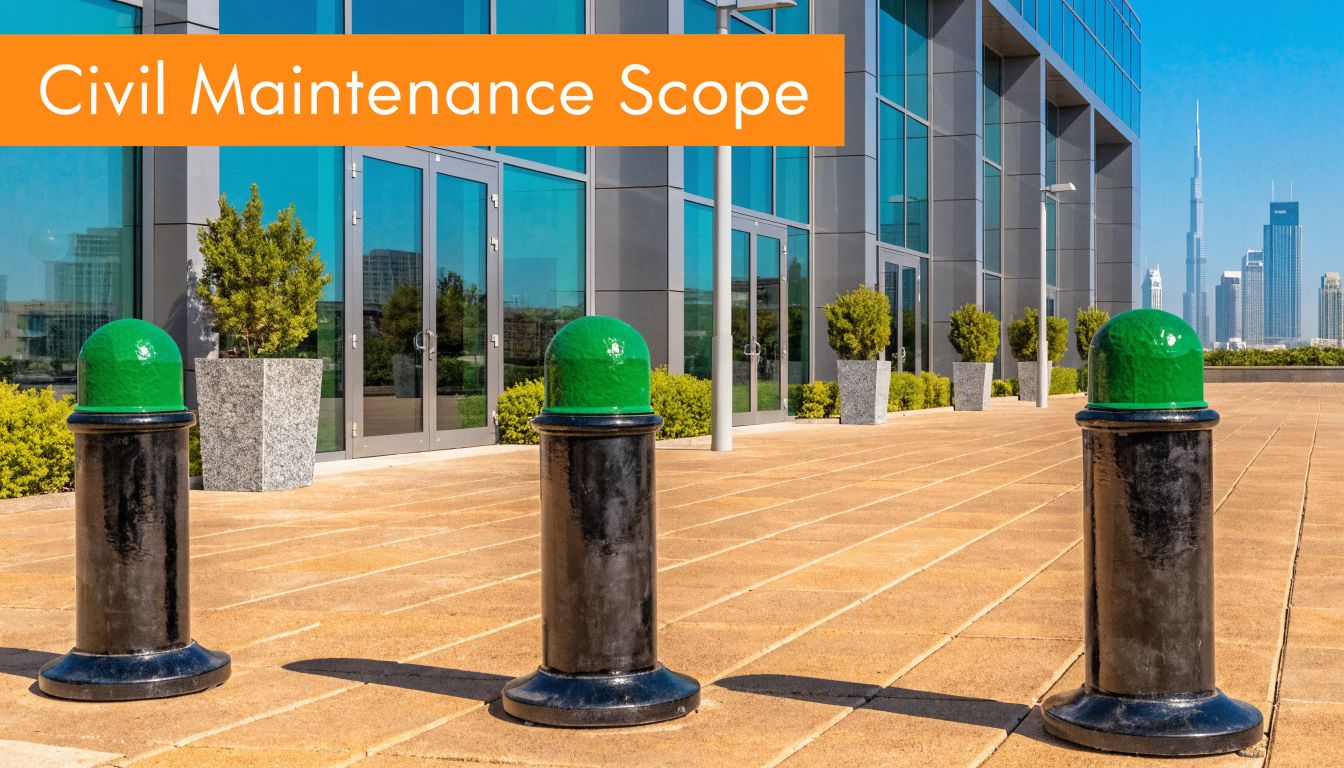
The fourth category is external works. Interlock resetting, kerbstone alignment, ramps, boundary walls, access paths, and hardscape repairs often sit outside the headline civil scope even though they create recurring liability in commercial assets.
For teams writing service scopes, a useful benchmark is to map civil maintenance under four headings:
- Structural repairs: Crack treatment, concrete repair, spalling, and load-related defects.
- Internal finishes: Tiles, plaster, paint interfaces, blockwork, and partition repairs.
- Waterproofing systems: Wet areas, roofs, basements, joints, and leak rectification.
- External hardscape: Interlock, kerbs, steps, ramps, boundary walls, and surface reinstatement.
Security and maintenance planning often intersect in access routes, perimeter conditions, and service yards. For readers reviewing broader site upkeep controls, Wisenet Security's expert maintenance provides a useful example of how maintenance thinking can support operational reliability outside the core civil scope.
Contract Models A Comparison of AMC vs Reactive Maintenance
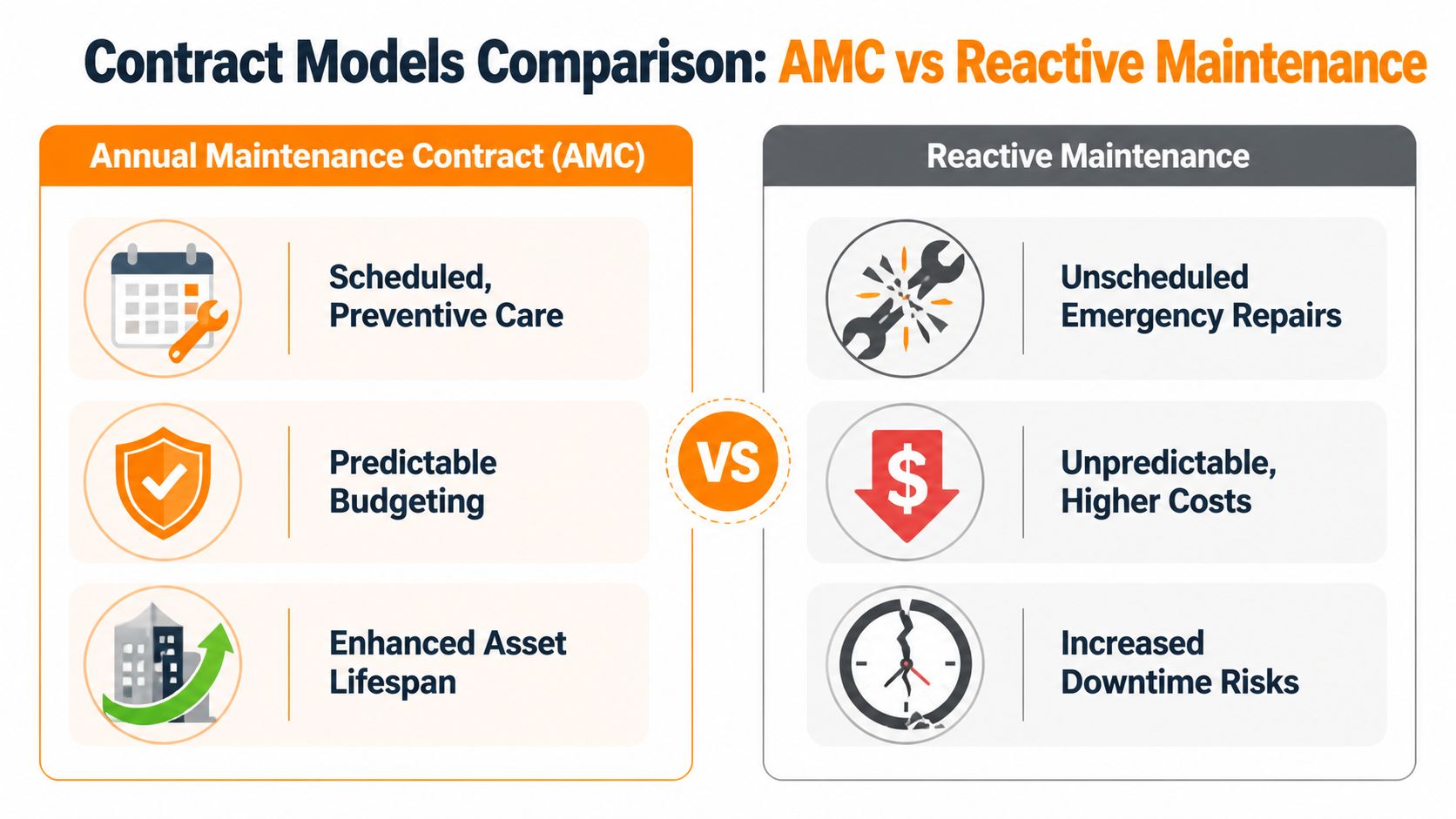
Contract structure determines whether defects are found early or merely processed after failure. That’s the main commercial difference between a reactive model and an AMC.
The wider market direction already supports structured maintenance. The UAE Property and Community Management Market is projected to reach USD 7.68 billion by 2030, and the commercial segment is the largest end-user, where structured AMCs for hard services such as civil and MEP maintenance are essential for asset uptime and regulatory compliance, according to Grand View Research’s UAE property and community management market report.
How the two models behave in practice
A reactive contract works when failure frequency is low, asset condition is stable, and the building owner accepts budget volatility. It doesn’t work well when defects spread across multiple locations, tenant response expectations are tight, or the building carries compliance exposure from incomplete records.
An AMC works differently. It converts part of the uncertainty into scheduled inspection, planned rectification, pre-agreed response logic, and known reporting outputs. That doesn’t eliminate all major repair costs, but it usually reduces repeat failures and unnecessary emergency mobilisation.
A labour-only contract may look cheaper on award day. It often becomes more expensive once access, repeat visits, temporary repairs, and internal administration are counted properly.
Operational comparison matrix
| Contract factor | AMC model | Reactive model |
|---|---|---|
| Budget behaviour | More predictable through planned scope and recurring service structure | Volatile, driven by defect timing and emergency call-outs |
| Defect detection | Earlier, because inspections are built into the model | Late, because work starts after complaint or visible failure |
| Downtime exposure | Lower where SLAs and access planning are defined | Higher where mobilisation begins only after escalation |
| Administrative burden | Lower if reports, approvals, and tracking are standardised | Higher because each event becomes a separate instruction |
| Root-cause treatment | More likely if inspections and defect logs are contractual requirements | Less likely if each job is priced as isolated repair |
| CAPEX deferral | Better where preventive rectification slows deterioration | Weaker because deferred small repairs can become replacement works |
For buyers comparing models in more depth, this guide to Annual Maintenance Contract types for residential vs commercial property requirements in Dubai is useful because it frames scope and contract logic by asset type, not by sales package.
Navigating Dubai's Regulatory and Compliance Landscape
Civil defects in Dubai don’t stay cosmetic for long. High humidity, thermal cycling, and exposure conditions accelerate deterioration in ways that have direct compliance implications once cracks, leakage, loose finishes, or structural distress become visible.
Why Dubai climate turns minor defects into compliance issues
In Dubai’s climate, humidity levels above 60% accelerate concrete carbonation and rebar corrosion. Proactive AMC-driven repairs addressing cracks and spalling can reduce long-term OPEX by 25-35%, and Dubai Municipality compliance can involve fines up to AED 50,000 per violation, according to Clairvoyant’s AMC cost breakdown for commercial properties.
That matters because compliance isn’t only about major structural events. It’s also about whether the owner can demonstrate inspection, condition tracking, rectification action, and closure. A stain on a soffit may indicate failed waterproofing. A hollow tile in a circulation area may indicate debonding and trip risk. A crack at a service shaft may indicate moisture movement affecting adjacent systems.
What contract documentation should prove
A civil maintenance contract for a commercial asset in Dubai should produce records that support authority inspections and internal governance. At minimum, the file should show:
- Asset location and defect description: Exact area, condition, and likely failure mode.
- Rectification method: Not just “repair completed”, but what was cut out, treated, reinstated, and tested.
- Material traceability: Product type used for waterproofing, adhesive, grout, mortar, or protective treatment.
- Closure evidence: Before and after records, sign-off, and any monitoring requirement.
For managers aligning maintenance governance with local authority obligations, this resource on meeting Dubai Municipality requirements through AMC compliance and safety standards is a practical reference point.
Compliance failure in civil maintenance usually starts as a documentation failure. The physical defect comes first. The liability grows when nobody can prove what was inspected, approved, and closed.
Key Cost Drivers for Civil Maintenance Services in Dubai
Two quotations can describe the same defect and price it very differently. That doesn’t always mean one contractor is inefficient. It often means the scope assumptions are different.

Where quotations diverge
The first driver is scope depth. A simple plaster patch and repaint is one level of intervention. A leaking wet area requiring removal, substrate treatment, waterproofing reinstatement, curing, retile, and sealant replacement is a different cost structure entirely.
The second driver is material specification. Standard cementitious products, flexible adhesives, epoxy grout, polymer-modified repair mortar, sealants, and waterproofing systems do not carry the same performance profile or procurement cost. If a quotation doesn’t state product class clearly, comparison becomes unreliable.
The third driver is access. Internal defects reachable from a stepladder are one thing. High-level façade interface repairs, podium edge works, atrium defects, or basement leak tracing can require permits, isolation, after-hours work, temporary protection, or specialist access methods.
Where cutting cost usually creates future liability
Low pricing is often achieved by excluding one of the elements below:
- Investigation work: No moisture tracing, no sounding, no substrate assessment.
- Making-good interfaces: Repair included, reinstatement of adjacent finishes excluded.
- Access and protection: Scaffolding, barriers, floor protection, or out-of-hours permits treated as extras.
- Defect recurrence terms: No meaningful warranty on workmanship or water ingress rectification.
The right commercial question isn’t “Which quote is lowest?” It’s “Which quote closes the defect with the least residual risk?”
This matters across building systems. Civil defects often overlap with internal environmental or leak-related issues that sit under HVAC maintenance contracts and broader hard FM responsibilities. If a contractor prices civil work in isolation without considering adjacent systems, the owner may still carry coordination risk.
Implementation The Role of Digital Platforms in Quality Assurance
Most commercial maintenance failures aren’t caused by the absence of trades. They’re caused by weak control over information. The repair may have been done, partially done, or done in a way that won’t survive the next season. Without verifiable records, the facility manager still carries the risk.
That’s where digital maintenance platforms change the operating model for civil works.
Why photo based verification changes contract control
A 2025 Dubai FM report noted that 68% of commercial property managers report non-compliance fines, often due to unverified maintenance logs. The adoption of photo-based work order systems can reduce audit risks by 40% and cut manual process error rates as post-2025 regulations increasingly mandate digital AMC documentation, according to Maareb’s discussion of civil works and maintenance.
For civil maintenance, this is more important than many buyers realise. A completed work order with text alone doesn’t prove that tiles were rebedded correctly, waterproofing termination points were reinstated, or crack routing and sealing were carried out. Time-stamped images, site notes, approval trails, and closure evidence create a defensible maintenance history.
Site advice: If a contractor can’t show before, during, and after records for recurring defects, you can’t verify quality. You can only verify attendance.
Minimum digital workflow for Dubai commercial assets
A practical digital workflow should include:
- Defect logging with location tagging so recurring problems can be tracked by zone or asset type.
- Photo capture at three stages before opening up, during rectification, and at completion.
- Approval checkpoints for material changes, scope expansion, and tenant-facing work.
- Closure records linked to SLA timing, sign-off, and recurrence review.
This approach also supports operational coordination beyond engineering. For organisations reviewing how mobile systems improve field execution and service visibility, the broader workflow principles in optimize sales team execution are useful because the same logic applies to dispatch, proof of activity, and field accountability.
For maintenance teams specifically, technology-enabled maintenance with IoT monitoring and predictive maintenance solutions shows how digital tracking can sit inside a wider hard FM control framework rather than operating as a standalone reporting app.
A Framework for Selecting a Civil Maintenance Vendor
Vendor selection should be based on risk transfer, not brochure language. In civil maintenance, poor vendor choice usually shows up later as repeat defects, weak reporting, unresolved liability at interfaces, and difficulty defending costs internally.
Technical and commercial screening criteria
Use a structured evaluation sheet with weighted criteria. The most useful categories are these:
- Technical capability: Can the contractor handle crack treatment, waterproofing, tile systems, plastering, and external works under one controlled process, or will most tasks be subcontracted?
- Commercial building experience: Office towers, retail centres, hospitality assets, and industrial sites each have different access constraints, finish standards, and downtime tolerance.
- SLA competence: Response time means little without rectification logic, escalation paths, and closure standards.
- HSE and permit control: Civil works often create dust, access restrictions, wet trades, and pedestrian interface risk.
- Reporting discipline: Digital, photo-based reporting should be a requirement, not an optional extra.
A compliant process culture matters because civil defects often need repeat inspection and staged repair. If the vendor can’t maintain method consistency, quality will vary by supervisor and by day.
Questions procurement should ask before award
A short interview usually reveals more than the proposal. Ask:
- How do you distinguish cosmetic cracks from structural or moisture-related defects?
- What evidence do you provide for waterproofing reinstatement before tiling or making-good?
- Which items are excluded from your standard AMC scope and likely to become variations?
- How do you document recurring defects and decide when patch repair is no longer suitable?
- What does a closed work order contain besides technician notes?
Then review actual sample reports, not mock-ups.
The safest contractor isn’t the one promising zero defects. It’s the one whose method statements, exclusions, and reporting make failure visible early.
Conclusion Structuring for Long-Term Asset Value
The central decision isn’t whether a commercial building in Dubai needs civil maintenance. It does. The main decision is how that maintenance is structured, evidenced, and governed.
If the contract is reactive, labour-led, and loosely defined, the owner keeps most of the risk. Defects are discovered late, root causes stay unresolved, budgets swing, and compliance records remain weak. If the contract is structured around inspections, SLAs, defined inclusions, method-based rectification, and digital verification, more of that risk becomes manageable.
That’s the practical value of a disciplined civil maintenance services dubai commercial property strategy. It protects presentation, lowers repeat failure exposure, improves audit readiness, and helps delay avoidable capital replacement. It also creates clearer separation between routine defects, latent issues, and true CAPEX events, which is critical for budgeting.
A useful mindset is to treat civil maintenance the same way engineers treat durability planning. The objective isn’t to spend less on the next work order. It’s to preserve the asset at the lowest defensible whole-life cost. For readers thinking about long-term material performance in external structures, the Retaining Wall Supplies wall durability guide is a helpful reminder that lifecycle outcomes are driven by specification, exposure, and maintenance discipline together.
In practice, the strongest implementation path is a structured maintenance contract that defines scope boundaries, links civil works with adjacent FM systems, and requires photo-verified closure for every meaningful defect. That won’t remove every failure. It will make failure easier to control, cost, and prove.
Frequently Asked Questions (FAQ)
Q: What’s included in civil maintenance services for a Dubai commercial property?
A: Typically, the scope includes concrete and crack repairs, plaster and paint rectification, tile and masonry works, waterproofing repairs, sealant replacement, and external hardscape items such as interlock or kerbstone reinstatement. The exact inclusions should be written clearly in the contract to avoid disputes.
Q: Is an AMC better than reactive civil maintenance for commercial buildings?
A: For most occupied commercial assets, yes. An AMC is usually better where downtime, tenant coordination, compliance records, and budget predictability matter. Reactive maintenance may suit limited or isolated defects, but it usually gives the owner less control over recurrence and lifecycle cost.
Q: Why do civil defects recur in Dubai buildings?
A: Common reasons include moisture ingress, thermal movement, high humidity exposure, poor substrate preparation, unsuitable materials, and patch repairs that treat symptoms rather than causes. Recurrence is often a scope and quality-control problem, not just a workmanship problem.
Q: What should a facility manager require in a civil maintenance report?
A: Require defect location, condition notes, before and after photos, rectification method, material details where relevant, completion date, and sign-off. For recurring issues, ask for trend tracking and a recommendation on whether a deeper intervention is needed.
Q: How should procurement compare civil maintenance quotations?
A: Compare scope assumptions first. Check exclusions, access provisions, material specifications, testing requirements, making-good responsibilities, and reporting outputs. A lower price can still be the higher-risk option if key elements are excluded.
For organisations that want to move from ad hoc repairs to a more controlled model, the next practical step is to review current defect history, map recurring civil issues by area, and then align those findings with a structured SnapFixNow maintenance framework covering AMC scope, SLA expectations, and photo-based reporting requirements.
Meta description: Civil maintenance services Dubai commercial property guide for asset owners and FMs. Compare AMC vs reactive models, costs, compliance, and digital reporting.