Selecting a partner from the array of building maintenance companies in Dubai is a strategic decision that directly impacts asset value, operational expenditure (OpEx), and tenant satisfaction. A precise evaluation framework is critical to move beyond procurement-led cost comparisons and into a partnership focused on asset lifecycle management and risk mitigation.
This guide provides a vendor-neutral methodology for property managers, facility directors, and asset owners to assess technical capabilities, contractual structures, and performance metrics. The objective is to equip decision-makers with a structured, data-driven approach to selecting a maintenance partner in the UAE's demanding real estate environment.
Decoding the Dubai Building Maintenance Landscape
In Dubai's high-value real estate market, a maintenance provider acts as a custodian of asset integrity and operational continuity. The selection process must therefore be rigorous, focusing on a company's documented ability to meet the unique operational, climatic, and regulatory demands of the UAE.
This framework is designed for B2B decision-makers, providing quantifiable benchmarks to assess a provider's true capabilities and ensure alignment with long-term asset management strategies.
Key Evaluation Pillars for Dubai Properties
A systematic evaluation process should be structured around core pillars that address the specific challenges of Dubai's built environment, from the high ambient temperatures impacting HVAC systems to the stringent compliance standards set by Dubai Civil Defence and Dubai Municipality.
Your assessment framework should focus on:
- Technical Capability and Scope: Verification of certified, in-house expertise for critical systems (MEP, HVAC, fire safety) versus reliance on subcontractors. The ratio of in-house to outsourced technicians directly impacts quality control and response times.
- Contractual and Financial Models: Analysis of how different contract types—comprehensive vs. labour-only Annual Maintenance Contracts (AMCs)—affect budget predictability and risk allocation. A comprehensive AMC may present a higher initial cost but typically lowers the Total Cost of Ownership (TCO).
- Performance Metrics and SLAs: Insistence on contractually guaranteed Service Level Agreements (SLAs) with quantifiable metrics, including response times (e.g., <60 mins for P1 emergencies), first-time fix rates (>85%), and Planned Preventive Maintenance (PPM) completion percentages (>95%).
- Regulatory and Compliance Adherence: Due diligence on mandatory certifications, including up-to-date trade licenses, Dubai Municipality approvals, and Dubai Civil Defence certifications for relevant technicians and services.
A thorough due diligence process focuses less on a provider's marketing claims and more on their documented ability to deliver against quantifiable, asset-specific requirements. The goal is to establish a partnership based on transparent performance, not just a service transaction.
By focusing on these pillars, decision-makers can create an objective scorecard to compare potential partners, ensuring the selected firm is equipped to manage the operational intensity of Dubai's commercial, residential, and hospitality assets.
Evaluating Technical Capabilities and Service Scopes
A provider's technical expertise is the bedrock of service delivery. The evaluation must penetrate beyond surface-level checklists to verify the depth of their capabilities, particularly concerning the specific asset types and systems prevalent in Dubai.
The quality of hard Facility Management (FM) execution directly influences asset lifecycle, operational costs, and occupant safety. The UAE's facility management market is projected to grow from approximately USD 18.3 billion to USD 33.6 billion by 2030, with hard FM services like HVAC and MEP constituting a significant 61–62% of revenue. This underscores the criticality of technical proficiency. For more detail, review these UAE facility management sector growth trends on datainsightsmarket.com.
Dissecting In-House Expertise vs. Subcontractor Reliance
A primary evaluation metric is the provider's operational model: the balance between their in-house technical team and their reliance on third-party subcontractors. This factor has direct implications for accountability, quality consistency, and emergency response mobilisation.
A provider with a robust, certified in-house team for core MEP and HVAC disciplines offers superior control and standardised service delivery. Technicians are trained to a single corporate standard and can be dispatched without third-party coordination delays.
Conversely, a model heavily reliant on subcontractors can introduce operational variability and communication lags. While it may provide access to niche specialisations, it can compromise response times for critical failures—a significant risk for assets like a commercial tower's chiller plant during Dubai's peak summer months.
Core Hard FM Service Evaluation Matrix
To standardise the evaluation process, a matrix enables an objective, like-for-like comparison of provider capabilities against your asset's specific requirements. This framework facilitates an evidence-based assessment of building maintenance companies in Dubai.
| Service Area | Key Evaluation Criteria for Dubai Properties | Common Scope Inclusions | Potential Risks of Underspecified Scope |
|---|---|---|---|
| HVAC Systems | Experience with high-capacity chillers, FAHU/AHU systems common in the UAE climate. Certifications for specific brands (e.g., Trane, Carrier). | Scheduled filter/belt changes, coil cleaning, refrigerant level checks, duct cleaning, thermostat calibration. | Increased energy consumption (up to 15-20% higher), poor indoor air quality, premature system failure, non-compliance with Dubai Municipality standards. |
| MEP Services | Electrical (DEWA compliance, load balancing), Plumbing (water pump systems, drainage), and Mechanical systems. | PPM for water pumps, electrical panel testing, drainage line jetting, emergency lighting checks. | Fire hazards from faulty wiring, major water damage from pump failures, business disruption from unexpected power outages. |
| Fire & Life Safety | Dubai Civil Defence (DCD) certified technicians. Experience with addressable fire alarm systems and suppression systems (FM-200, sprinklers). | Monthly/quarterly testing of fire pumps, alarm panel checks, smoke detector cleaning, emergency exit light function tests. | DCD penalties, voided insurance claims, catastrophic failure during a real emergency, significant legal liability. |
| Specialised Systems | Expertise in Building Management Systems (BMS), access control, CCTV, and elevator maintenance coordination. | BMS alarm monitoring and calibration, software updates, integration checks with other systems. | Inefficient building operations, security vulnerabilities, inability to troubleshoot integrated system failures effectively. |
This matrix serves as a foundational tool for a deeper technical due diligence process.
Moving Beyond the Basics to Asset-Specific Needs
Technical requirements vary significantly across different property types. A competent provider will demonstrate experience specific to your asset class.
- Hospitality: Requires immediate response times for guest-facing issues and technicians trained for discreet, 24/7 operations to minimise impact on the guest experience.
- Commercial Towers: Demands expertise in high-capacity vertical transport, complex HVAC and chiller plant management, and advanced BMS integration for energy efficiency.
- Residential Communities: Focuses on high-volume service request management, effective tenant communication, and maintenance of shared assets like swimming pools and gyms.
When assessing technical depth, always request case studies or references from properties with similar operational profiles and asset types. Proven success in a comparable environment is a stronger indicator of capability than any marketing collateral.
The objective is to confirm that the provider's technical team possesses the specific, documented experience required to maintain your building's systems. This includes proficiency with modern diagnostic tools and technology-enabled maintenance solutions that leverage data for predictive and preventive maintenance, a crucial component of a forward-thinking asset management strategy.
Comparing Maintenance Contracts: Annual vs On-Demand
The selection of a maintenance contract structure is a strategic financial decision that dictates budget predictability, risk exposure, and operational efficiency. For property and facility managers in Dubai, the primary choice lies between a comprehensive Annual Maintenance Contract (AMC) and a reactive, on-demand service model.
The on-demand or reactive model is transactional: an asset fails, a service call is placed, and payment is rendered for the specific job. This pay-as-you-go approach may appear cost-effective for properties with few non-critical assets due to the lack of upfront financial commitment.
However, for most commercial, residential, and hospitality assets in Dubai, this model introduces significant financial and operational risks. Unpredictable costs can disrupt operational budgets, and critical system downtime can lead to tenant dissatisfaction or direct revenue loss. The provider's business model is inherently reactive, with no incentive for preventive measures.
The Spectrum of Annual Maintenance Contracts
The Annual Maintenance Contract (AMC) is the industry standard for professional property management as it shifts the focus from reactive repair to proactive prevention. However, AMCs exist on a spectrum of coverage, and understanding these variations is crucial for value assessment.
-
Labour-Only AMC: The most basic tier, covering technician labour for scheduled PPM visits and potentially for emergency call-outs. All spare parts and materials are billable, exposing the asset owner to significant cost variability.
-
Parts-Inclusive AMC: This model includes labour and a predefined list of common spare parts and consumables (e.g., filters, belts). It offers improved cost control, but high-value components like compressors or pumps are typically excluded.
-
Fully Comprehensive AMC: The highest tier of service, covering labour, all spare parts (major and minor), and consumables for both scheduled and emergency work. While the initial investment is higher, it delivers maximum budget predictability by transferring the financial risk of major component failure from the asset owner to the maintenance provider.
A comprehensive AMC creates a powerful partnership. The provider is now financially motivated to perform high-quality preventive maintenance because it minimises their own costs on emergency repairs. Their goals are finally aligned with yours: maximising uptime and protecting the asset.
This decision tree provides a framework for evaluating a provider's technical capabilities against your asset's specific requirements.
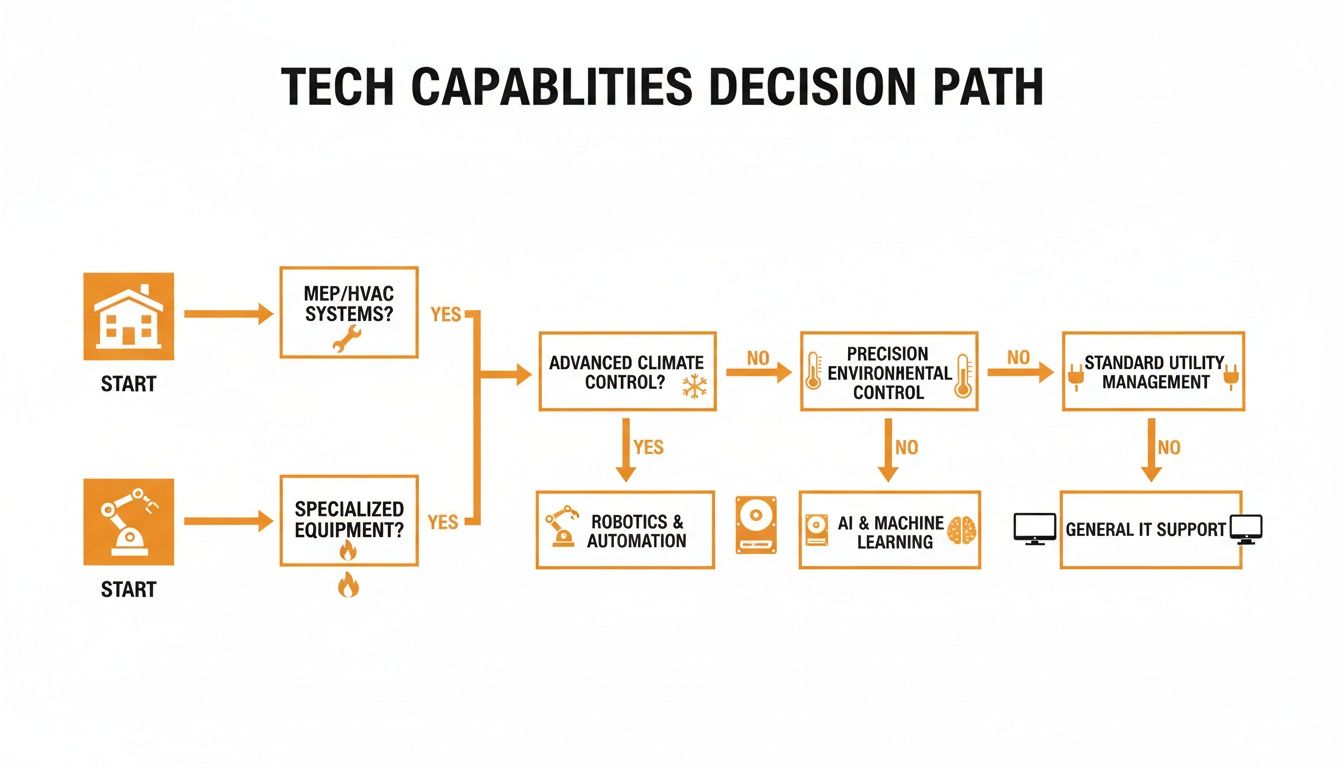
As the chart illustrates, the initial step is to categorise core asset requirements, which in turn dictates the necessary technical specialisations and certifications for a potential partner.
Picking a Contract That Fits Your Property
The optimal contract model is a function of your property's operational criticality and your organisation's risk tolerance.
For a Grade-A commercial tower in DIFC, where a chiller plant failure in August would have severe financial consequences, a fully comprehensive AMC is the only prudent option. The predictable OpEx and guaranteed uptime provide a justifiable return on the higher premium.
Conversely, for a low-complexity industrial warehouse in Jebel Ali, a labour-only AMC for essential systems, supplemented by on-demand services for incidental issues, could represent a sound, cost-effective strategy where the risk of business-halting failure is minimal.
For a more detailed analysis, refer to our guide on understanding annual maintenance contract types for different properties in Dubai.
A Framework for Financial and Operational Comparison
To facilitate an informed decision, the following table provides a direct comparison of these models, helping you align contract type with asset strategy when evaluating building maintenance companies in Dubai.
Contract Model Comparison: Preventive AMC vs. Reactive Service
This table outlines the trade-offs between upfront investment and long-term risk for different property types.
| Evaluation Factor | Comprehensive Annual Maintenance Contract (AMC) | Reactive On-Demand Service Model | Best-Fit Property Scenario |
|---|---|---|---|
| Cost Structure | Fixed annual fee, offering high budget predictability. Higher initial outlay. | Variable, pay-per-job costs. Lower initial commitment but prone to budget spikes. | AMC: High-value commercial, hospitality, and premium residential assets. On-Demand: Low-complexity, non-critical facilities. |
| Risk Allocation | Transfers significant risk of component failure and repair costs to the service provider. | Asset owner retains all financial and operational risk of unexpected breakdowns. | AMC: Assets where uptime is business-critical. On-Demand: Assets where downtime has minimal financial impact. |
| Asset Lifecycle | Proactive PPM extends asset lifespan and improves energy efficiency, protecting capital investment. | Can lead to premature asset failure due to a lack of preventive care, increasing lifecycle costs. | AMC: Long-term asset hold strategies. On-Demand: Short-term or low-value asset management. |
| Response Times | Contractually guaranteed response times (SLAs) for different priority levels (e.g., <1 hour for emergencies). | No guaranteed response; subject to provider availability, often leading to longer downtimes. | AMC: 24/7 operational environments like hotels or hospitals. On-Demand: Properties with low occupancy or non-urgent needs. |
Ultimately, choosing a contract model is an exercise in risk management. A comprehensive AMC is an investment in operational reliability and asset preservation, while an on-demand model prioritises short-term cash flow at the expense of long-term predictability and asset health.
Defining Performance Metrics and Response Times
Vague service promises are a significant liability in facilities management. Accountability requires shifting the focus from subjective assurances to objective, measurable outcomes through a robust framework of Service Level Agreements (SLAs) and Key Performance Indicators (KPIs).
Effective performance management extends beyond response speed. A rapid response that fails to resolve the issue is inefficient. The objective is to define, negotiate, and track metrics that reflect the true operational health of the building and the effectiveness of the maintenance program.
This requires looking beyond simple response times to more meaningful KPIs that hold a maintenance partner accountable for tangible results.
Setting Realistic SLA Benchmarks for Dubai
In a market where operational continuity is paramount, SLAs must be specific and tiered by urgency. A single response time is inadequate. A well-structured SLA categorises issues to manage expectations and allocate resources effectively.
Indicative benchmarks for a Dubai maintenance contract include:
- Emergency (P1 – Critical Failure): Total power outage, major flood, fire system failure. Expected on-site response time: under 30-60 minutes. The priority is immediate containment to mitigate catastrophic damage or safety risks.
- Urgent (P2 – Service Impairment): Significant disruption, e.g., failure of an entire floor's AC or a major drainage blockage. A reasonable response time is within 2-4 hours.
- Routine (P3 – Non-Critical): Minor issues like a flickering light or a dripping tap. A 24-hour response window is a standard industry practice.
These thresholds provide a clear baseline for performance evaluation and should be a non-negotiable component of any service agreement.
Moving Beyond Response Time to Impactful KPIs
While response times measure mobilisation speed, they do not measure resolution effectiveness. True performance management relies on KPIs that assess both efficiency and quality. When evaluating building maintenance companies in Dubai, the discussion must include these metrics.
A provider's willingness to commit to and report on metrics like First-Time Fix Rate and PPM completion is a strong indicator of their operational maturity and confidence in their technical teams. These numbers separate process-driven firms from those just reacting to calls.
Key performance indicators to insist upon include:
- First-Time Fix (FTF) Rate: The percentage of issues resolved on the initial visit without requiring a follow-up. A high FTF rate (target: 80-90%) indicates skilled technicians, adequate van stock, and accurate initial diagnostics, reducing tenant disruption and operational cost.
- Planned Preventive Maintenance (PPM) Completion Percentage: Tracks the on-time completion of scheduled maintenance tasks. The target should be 95-100%. A low completion rate is a significant red flag, indicating a reactive rather than preventive maintenance culture.
- Asset Uptime: The ultimate measure of maintenance effectiveness for critical equipment (chillers, elevators, pumps). A competent provider should track and report the percentage of time key assets are operational, with a target of 99.5% or higher for critical systems.
This data-driven approach is vital in Dubai's commercial sector, where commercial and retail properties account for over half of the facility management market demand. As detailed in reports on trends shaping the UAE's facility management market on globenewswire.com, uptime is directly correlated with revenue and brand reputation, making stringent SLAs a commercial necessity.
By embedding these metrics into the contract, you establish a transparent, accountable partnership that delivers quantifiable value and protects the asset.
Navigating Compliance and Sustainability in Dubai
For facility and asset managers in Dubai, regulatory compliance is the foundation of a safe, legal, and insurable operation. The selection of a maintenance partner must include a deep verification of their credentials to ensure they can maintain the asset's compliance with all relevant authorities.
This process begins with confirming that a provider’s documentation is current and relevant to the required scope of work. A valid trade licence from the Dubai Department of Economy and Tourism (DET) is a baseline requirement. However, the listed activities on the licence must specifically cover the specialised MEP or civil work required; a generic "general maintenance" licence is often insufficient.
Beyond the trade licence, specific systems mandate specialised approvals. Competent building maintenance companies in Dubai will readily provide evidence of these certifications.
Non-Negotiable Compliance Verifications
Before contract execution, a thorough due diligence of key regulatory approvals is essential to mitigate risks of fines, operational shutdowns, or invalidated insurance claims.
A practical verification checklist for procurement teams includes:
- Dubai Civil Defence (DCD) Certification: Mandatory for any company servicing fire alarm and firefighting systems. Verification should confirm that technicians are DCD-certified for the specific systems installed in the building.
- Dubai Municipality (DM) Approvals: Required for a range of activities, including water tank cleaning, pest control, and certain civil works. Request copies of recent DM permits or certificates.
- DEWA Regulations: Technicians performing electrical work must be proficient in Dubai Electricity and Water Authority standards to ensure safety and compliance during inspections.
- Trakhees or Other Free Zone Approvals: If the asset is located within a free zone (e.g., JAFZA, DMCC), the provider may require additional permits specific to that jurisdiction.
A potential partner's inability or hesitation to produce these documents upon request should be considered a significant red flag. A transparent, compliant organisation will maintain an organised file of all necessary certifications for review.
Our guide on how compliance and safety standards can be met through an AMC offers further detail on these requirements.
The Growing Importance of Sustainability
Beyond mandatory compliance, sustainability is becoming a key driver in maintenance practices across the UAE. National initiatives for energy efficiency and Green Building regulations are reshaping property management protocols. A forward-thinking maintenance partner must actively contribute to the property's environmental performance goals.
This includes supporting energy audits, recommending efficiency-improving asset upgrades, and providing detailed documentation required for ESG (Environmental, Social, and Governance) reporting. Maintenance activities must be tracked and reported in a manner that aligns with green certification standards, from optimising chiller plant performance to ensuring water fixtures meet efficiency targets. When evaluating providers, inquire about their specific services and reporting capabilities that support sustainability objectives and green building certifications.
Pulling It All Together: A Framework for Final Decision-Making
Following technical reviews, contract analysis, and performance metric evaluation, the final step is to synthesise this data into a structured, objective decision. This process uses a weighted scorecard to compare potential partners based on criteria prioritised for your specific asset.
This documented rationale provides a final governance check before committing to a multi-year contract with one of the many building maintenance companies in Dubai.
Building Your Evaluation Scorecard
A generic checklist is insufficient. The scorecard must be tailored to your asset’s operational priorities, translating qualitative needs into a quantifiable evaluation tool.
A high-end hotel, for example, would assign a higher weight to response times and technician presentation, whereas an industrial facility would prioritise MEP uptime and compliance with specific safety standards.
A baseline framework, with weights adjusted for your asset type, could be:
- Technical Capability & In-House Expertise (30% Weight): Strength of in-house MEP/HVAC teams, relevant certifications (DCD, DM), and proven experience with similar asset types.
- Contractual & Financial Model (25% Weight): Scope of the proposed AMC (comprehensive vs. limited), clarity of exclusions, and overall value proposition relative to cost.
- Performance Metrics & SLAs (20% Weight): Commitment to quantifiable KPIs, such as a First-Time Fix Rate >85%, a PPM Completion >95%, and clearly defined, tiered response times.
- Compliance & Safety (15% Weight): Verifiable trade licenses, adequate insurance coverage, and a documented Health, Safety, and Environment (HSE) management system and track record.
- Technology & Reporting (10% Weight): Utilisation of a CAFM/CMMS system for work order management and ability to provide clear, data-driven performance reports.
The Final, Crucial Checks
Once the scorecard has identified one or two preferred providers, final due diligence is required.
A provider's response to these final verification steps is telling. A confident, well-organised company will welcome a site visit and reference checks as an opportunity to validate their capabilities. Any resistance should be considered a warning sign.
Request a site visit to one of their current contracts, preferably a property similar to your own. Assess the condition of plant rooms and the professionalism of their on-site team. This provides a real-world view of their operational standards.
Finally, conduct direct reference calls with their current clients. Inquire specifically about their performance against contractual SLAs. This feedback is the ultimate validation of whether their operational delivery matches their contractual promises.
Frequently Asked Questions
Key questions frequently arise among facility managers and property owners in Dubai. The following provides concise, professional answers to common queries.
What Is the Biggest Difference Between a Comprehensive AMC and a Basic One?
The primary difference lies in risk allocation and budget predictability.
A comprehensive Annual Maintenance Contract (AMC) is an all-inclusive model that bundles labour, all spare parts, and consumables into a single fixed annual fee for both planned and emergency maintenance. This structure transfers the financial risk of major component failure (e.g., an HVAC compressor) to the service provider, ensuring predictable operational expenditure (OpEx).
A basic or labour-only AMC covers only the technician's time for scheduled maintenance. All spare parts, consumables, and labour for emergency call-outs are billed separately. While the initial contract cost is lower, the total annual cost is unpredictable and can escalate significantly following a single major equipment failure, often resulting in a higher Total Cost of Ownership (TCO).
How Do I Verify a Maintenance Company's Certifications in Dubai?
Verification is a critical due diligence step that requires requesting and reviewing original documentation.
Your verification checklist should include:
- Trade Licence: Issued by the Dubai Department of Economy and Tourism (DET). Verify that the listed commercial activities align precisely with the required scope of services (e.g., "MEP contracting" vs. "general maintenance").
- Dubai Civil Defence (DCD) Approval: Mandatory for any provider servicing fire alarm and firefighting systems.
- Dubai Municipality (DM) Permits: Required for specific activities like water tank cleaning or specialised civil works.
- Technician Qualifications: Request evidence of certifications for individual technicians relevant to the specific systems and equipment within your property.
A professional and compliant company will have these documents organised and readily available for client review.
What Are Realistic Emergency Response Times to Expect in an SLA?
A Service Level Agreement (SLA) in Dubai should feature tiered response times based on issue priority. A one-size-fits-all approach is inadequate for professional asset management.
For a critical (P1) failure (e.g., total power loss, major water leak, fire system activation), an on-site response time of 30 to 60 minutes is a reasonable and standard industry benchmark.
For urgent (P2) issues that impair service but are not catastrophic (e.g., failure of an AC unit in a tenanted area), a 2 to 4-hour response is a typical expectation. Non-urgent (P3) requests are generally scheduled for resolution within a 24-hour window.
At SnapFixNow, we deliver engineering-led building maintenance with the transparency and accountability that Dubai's premier properties demand. Our ISO-certified processes and SLA-driven performance ensure your assets are protected and your operations run smoothly. Discover how our flexible AMCs and real-time reporting can bring predictability and control to your facility management.