Selecting a maintenance partner in Dubai requires a critical decision on the service model that aligns with your asset strategy and budget. This initial choice—between a predictable, all-inclusive contract and a more flexible, pay-as-you-go approach—forms the foundation of your engagement with any building maintenance company in Dubai. It directly shapes your operational expenditure (OPEX), risk allocation, and asset lifecycle management.
Choosing the Right Maintenance Model for Your Dubai Property
A maintenance model is the financial blueprint for your property's operational health. In Dubai's dynamic real estate market, this decision governs cost control, mitigates the impact of the harsh climate on assets, and influences tenant or occupant satisfaction. The primary models are Comprehensive Annual Maintenance Contracts (AMCs), Non-Comprehensive (or Labour-Only) AMCs, and reactive On-Demand services. Each model is structured for different property types, risk appetites, and management philosophies.
Dubai's real estate expansion drives significant demand for structured maintenance. The UAE's facility management market was valued at US$ 11.6 billion in 2024 and is projected to grow at a CAGR of 11.5%. This growth is fuelled by continuous development; for instance, Dubai registered 30,098 real estate sales in Q2 2023 alone, a 35% increase from 22,322 transactions in the same quarter of 2022. Each new asset requires a defined facility management strategy to preserve its value.
Matching the Model to Your Asset
The risk profile and operational requirements vary significantly by asset type. A Grade-A commercial tower in DIFC with mission-critical MEP (Mechanical, Electrical, Plumbing) systems has a different risk tolerance than a large-scale residential community in a suburban area. The tower's facility manager requires guaranteed uptime and budget certainty, making a comprehensive AMC the logical choice to transfer operational risk. The community manager might favour the cost control of a non-comprehensive model, where routine inspections are covered, but major capital repairs require separate approval and funding.
A maintenance contract is more than a service agreement; it is a strategic risk allocation tool. The core decision for an asset manager is determining the optimal balance of financial and operational risk to retain versus transfer to the service provider.
This decision tree provides a framework for selecting a maintenance model based on key business drivers like budget predictability, cost flexibility, or response urgency.
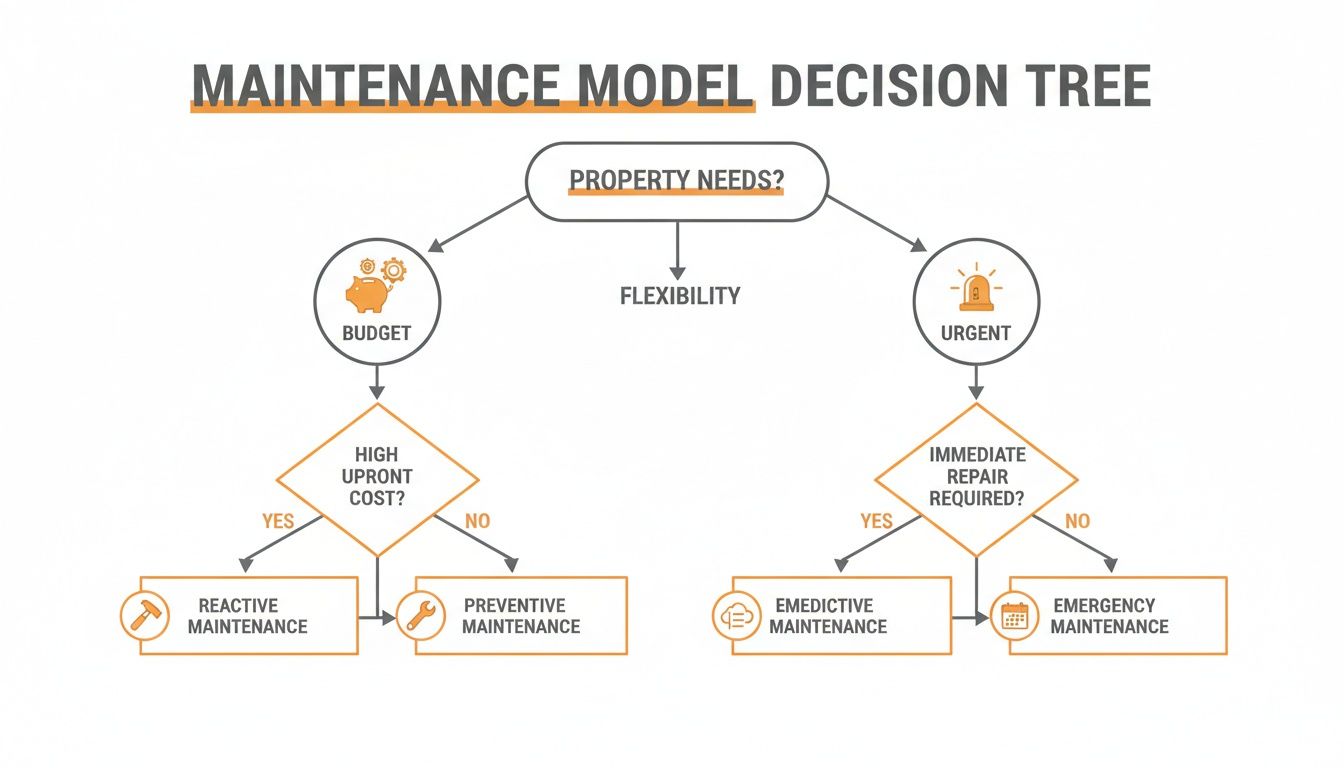
As the diagram illustrates, if fixed annual costs and minimal budget variance are primary objectives, a comprehensive model is indicated. If greater control over variable expenses and a higher tolerance for risk are acceptable, a non-comprehensive or on-demand solution may be more suitable.
Breaking Down the Core Models
A detailed understanding of these agreement structures is essential for proper vendor evaluation. Each model has distinct implications for your budget, asset lifecycle planning, and risk management.
-
Comprehensive AMCs: This is an all-inclusive model covering labour, spare parts, and consumables for both planned preventive maintenance (PPM) and emergency reactive call-outs. It offers maximum budget predictability, simplifying financial forecasting. This model is standard for critical infrastructure and premium properties where asset downtime carries significant financial or reputational consequences.
-
Non-Comprehensive AMCs: This is primarily a "labour-only" agreement. It typically covers the cost of technicians for scheduled PPM and emergency responses. However, spare parts, materials, and major repairs are billed separately as incurred. This model offers a lower fixed upfront cost and greater flexibility, but it exposes the budget to fluctuations and requires the owner to carry the risk of major component failure.
-
On-Demand (Pay-Per-Use) Services: This is a purely reactive model. A service provider is engaged only when a fault occurs. It can be suitable for smaller properties with non-critical systems or for organisations with an in-house team managing routine tasks. The significant drawback is the lack of proactive maintenance, which can lead to catastrophic failures and higher long-term costs.
The following table provides a side-by-side comparison to aid in selecting the appropriate contract type based on specific property requirements.
Comparing Maintenance Contract Models at a Glance
| Contract Model | Scope of Work | Cost Structure | Best Suited For | Risk Allocation (Owner vs. Provider) |
|---|---|---|---|---|
| Comprehensive AMC | Covers all labour, spare parts, and consumables for preventive and reactive tasks. | Fixed annual fee. | Critical infrastructure, premium commercial towers, properties where uptime is paramount. | Low risk for owner; most financial and operational risk is transferred to the provider. |
| Non-Comprehensive AMC | Covers labour for scheduled preventive work and call-outs. Parts and major repairs are extra. | Lower fixed annual fee + variable costs for parts/repairs. | Residential communities, mid-range commercial buildings, owners wanting more cost control. | Shared risk; owner retains risk for part costs and major failures. |
| On-Demand (Pay-Per-Use) | Reactive repairs and services only when requested. No preventive maintenance included. | Billed per job (labour + materials). | Small properties, non-critical assets, businesses with in-house teams for basic tasks. | High risk for owner; all financial and operational risk is retained by the owner. |
Ultimately, the right choice balances your tolerance for financial risk against your need for operational certainty.
When defining the scope, understanding the quality of specific services, such as top-quality commercial door repairs and maintenance services, is crucial. The true value of any contract is defined by how well it preserves the specific assets you rely on. For a more detailed analysis of contract structures, see this guide on understanding annual maintenance contract types for residential versus commercial properties.
Understanding Hard and Soft Maintenance Services

To effectively evaluate a building maintenance company in Dubai, decision-makers must distinguish between the two pillars of facility management: Hard Services and Soft Services. This distinction is fundamental, as it defines the scope of work, key cost drivers, and the technical competencies required to maintain an asset's operational integrity and value.
Hard Services are analogous to a building's vital organs and central nervous system—the critical systems physically integrated into the structure that are essential for its function. Soft Services, conversely, relate to the occupant experience, creating a clean, safe, and productive environment within the building.
Defining Hard Maintenance Services
Hard Services encompass all maintenance related to the physical fabric and core systems of a building. These tasks require certified, skilled technicians and are strictly governed by regulatory bodies such as Dubai Municipality and Dubai Civil Defence.
In Dubai's climate, where high temperatures and humidity place extreme stress on building infrastructure, the effective delivery of Hard Services is non-negotiable for preserving asset lifespan and ensuring business continuity.
Core examples of Hard Services include:
- MEP (Mechanical, Electrical, and Plumbing) Maintenance: The cornerstone of Hard Services, covering HVAC systems (including chillers), electrical switchgear and panels, water pumps, and drainage networks.
- Fire Safety and Life Support Systems: Maintenance of fire alarms, sprinkler systems, smoke extraction, and emergency lighting, a critical area for compliance.
- Building Management Systems (BMS): Management of the automated controls for HVAC, lighting, and other integrated systems.
- Structural Maintenance: Addressing issues with the building's foundation, facade, roof, and other structural components.
The technical specialisation of these services accounts for their significant share of maintenance budgets. Hard Services represent 61.64% of the UAE's facility management market revenue in 2024. This focus is driven by the critical need for high-performance MEP, fire safety, and predictive maintenance in Dubai's sophisticated infrastructure. With the market projected to grow at a 12.34% CAGR through 2030, the demand for these technical skills will intensify. More details are available in the UAE facility management growth trends from Mordor Intelligence.
Defining Soft Maintenance Services
Soft Services are variable services focused on enhancing the user experience within a facility. While often less technical, their impact on tenant retention, brand perception, and operational efficiency is significant.
The quality of Soft Services is immediately perceptible to occupants and directly influences their satisfaction. These services improve the building's environment but are not physically integrated into its structure.
Common Soft Services include:
- Cleaning and Janitorial Services: Ranging from daily cleaning to specialized deep cleaning and sanitization protocols.
- Security Services: Encompassing manned guarding, CCTV surveillance, and access control systems.
- Landscaping and Pest Control: Maintenance of external green areas and implementation of pest management programs.
- Waste Management: Systematic collection, segregation, and disposal of waste in compliance with municipal regulations.
While Hard Services keep a building operational, Soft Services make it habitable. A failing HVAC system (Hard Service) renders an office unusable. A lapse in cleaning (Soft Service) makes it unpleasant. Both are vital for protecting asset value.
Integrated vs. Specialised Contracting Models
When engaging a building maintenance company in Dubai, a key strategic decision is whether to bundle services under a single Integrated Facility Management (IFM) contract or to procure services from separate, specialised providers.
Integrated Facility Management (IFM) Model
| Pros | Cons |
|---|---|
| Single Point of Contact: Simplifies vendor management, communication, and accountability. | Risk of Diluted Expertise: The provider may have core strengths in one area (e.g., Soft Services) but weaker capabilities in complex technical areas (e.g., MEP). |
| Potential Cost Savings: Bundling services can create economies of scale and operational efficiencies. | Less Flexibility: Challenging to replace a single underperforming service line without rebidding the entire contract. |
| Streamlined Operations: Improved coordination between different service teams, reducing operational friction. | Complex Contracts: SLAs and KPIs must be meticulously defined for each distinct service line within the single contract. |
Specialised (Single-Service) Model
| Pros | Cons |
|---|---|
| Best-in-Class Expertise: Allows for the selection of market specialists for each critical function (e.g., a dedicated chiller maintenance expert). | Increased Management Overhead: Requires managing multiple contracts, vendors, and points of contact. |
| Greater Flexibility: Easier to replace an underperforming provider for a specific service without disrupting other operations. | Potential for Higher Costs: Forfeits economies of scale achieved through service bundling. |
| Clearer Accountability: Direct responsibility is clear when a service-specific issue arises. | Coordination Challenges: Potential for operational gaps or conflicts between different service providers. |
The optimal choice depends on asset complexity, in-house management capacity, and risk strategy. A technologically advanced commercial tower may benefit from a specialised Hard Services contract to ensure expert MEP management. Conversely, a large residential community could achieve significant efficiencies with an IFM model that streamlines cleaning, security, and general maintenance under a single vendor.
Setting Performance Standards with SLAs and KPIs
A maintenance contract without defined metrics is unenforceable and exposes an asset to operational risk. To translate service commitments into measurable performance, facility managers in Dubai must establish precise Service Level Agreements (SLAs) and monitor Key Performance Indicators (KPIs).
These instruments are the contractual mechanisms that ensure a building maintenance company in Dubai is held accountable for delivering agreed-upon standards.
An SLA is the governing document defining the specific, measurable standards the service provider must meet. It replaces ambiguous terms like "prompt service" with concrete targets (e.g., "on-site response within 30 minutes for critical faults"). KPIs are the specific metrics used to measure compliance with the SLA. Together, they form a transparent framework for performance management.
Core KPIs for Dubai Properties
While specific KPIs vary by asset, a core set should form the basis of any maintenance contract in the UAE. These metrics focus on responsiveness, technical proficiency, and proactive asset care.
Key KPIs to establish include:
- Emergency Response Time: The time elapsed from the reporting of a critical issue to the arrival of a technician on-site. For a major water leak in a five-star hotel, a benchmark of under 30 minutes is expected. For a similar issue in an industrial warehouse in Jebel Ali, 60-90 minutes might be the agreed standard.
- First-Time Fix Rate (FTFR): The percentage of issues resolved during the initial service visit without requiring a follow-up. A high FTFR, ideally above 85-90% for common MEP faults, indicates a skilled, well-equipped, and efficient technical team, minimising asset downtime.
- Planned Preventive Maintenance (PPM) Completion Rate: A measure of proactive maintenance execution. A target of 98-100% completion for all scheduled PPM tasks is critical. In Dubai’s climate, missed PPM is a leading cause of premature equipment failure.
- Asset Uptime: The percentage of time a critical asset (e.g., chiller, elevator, BMS) is fully operational. For mission-critical systems in a commercial tower, the target should be no less than 99.5%.
Tailoring SLAs to Your Property Type
SLA requirements must align with the building's function and occupant expectations. A uniform approach results in either overpaying for unnecessary service levels or accepting unacceptable operational risks.
For example, a luxury hotel in Downtown Dubai requires extremely stringent SLAs for guest-facing areas. An HVAC failure in a hotel suite is a critical incident demanding a response within 15-20 minutes. The same failure in a back-of-house administrative office might have a response window of 2-4 hours.
An effective SLA does not merely set targets; it aligns the maintenance provider's priorities with your business objectives. It ensures they focus their most rapid response on the issues that have the greatest impact on your revenue, reputation, and tenant satisfaction.
This context-driven approach ensures that service expenditure is directed where it is most needed. An industrial facility's SLA will prioritise production machinery uptime, whereas a residential community's SLA will focus on common area amenities and in-unit MEP systems.
A Framework for SLA Benchmarks
When negotiating an SLA, having an understanding of achievable benchmarks in the Dubai market is essential. This table provides a baseline for discussions, categorising benchmarks by issue severity and property type.
Sample SLA Benchmarks for Dubai Properties
| Issue Severity | Example Fault | Typical Response Time (Commercial/Hospitality) | Typical Resolution Time (Commercial/Hospitality) | Typical Response Time (Residential/Industrial) |
|---|---|---|---|---|
| Critical | Major water leak, complete power failure, fire alarm fault | < 30 minutes | < 2 hours | < 60 minutes |
| High | Single AC unit failure, elevator breakdown, blocked drainage | < 1 hour | < 4 hours | < 2 hours |
| Medium | Flickering lights, minor plumbing leak, faulty access control | < 4 hours | Within 24 hours | < 6 hours |
| Low | Damaged door handle, cosmetic repairs, bulb replacement | Within 24 hours | Within 48 hours | Within 48 hours |
These benchmarks are a guide. When finalising a contract with a building maintenance company, it is critical to define the terms "response" (technician arrives on-site) versus "resolution" (the fault is permanently rectified). Clear escalation procedures for unresolved issues are also necessary to eliminate ambiguity and ensure all parties understand their obligations.
Decoding Maintenance Costs and Pricing Models
Procurement teams often receive a wide range of quotes from building maintenance companies in Dubai, leading to questions about price variance. The final quoted price is not arbitrary; it is a calculated figure based on labour costs, parts sourcing, risk assumption, and the operational realities of the UAE market.
Understanding these cost drivers allows decision-makers to evaluate proposals based on value rather than price alone.
The primary cost driver is labour. This includes not just hourly rates but also the level of technical expertise. Servicing a complex district cooling heat exchanger in a JLT tower requires a certified HVAC engineer with extensive experience, whose cost base is significantly different from that of a general technician addressing a minor plumbing issue in a villa. Specialised skills for systems like Building Management Systems (BMS), fire suppression, and advanced access control command a premium.
A second major cost driver is spare parts. Much of the high-specification equipment in Dubai's premium properties is sourced from Europe or North America. Sourcing critical components like compressor motors or proprietary control boards can involve long lead times and import duties, inflating costs. A maintenance provider with an established local supply chain and effective inventory management can mitigate these delays and costs.
Comparing Common Pricing Structures
The selected pricing model directly influences budget management and financial risk exposure. Each structure allocates costs and responsibilities differently.
- Fixed-Fee Comprehensive AMCs: This model bundles labour, parts, and preventive maintenance into a single, predictable annual fee. It provides maximum budget certainty but typically has a higher upfront cost, as the provider absorbs the financial risk of major component failures.
- Labour-Plus-Materials Contracts: Common for non-comprehensive AMCs, this model involves a fixed fee for scheduled labour (PPM and call-outs), with spare parts and materials billed at cost or with a defined markup. This lowers the initial fixed cost but introduces budget variability.
- Pay-Per-Use (Call-Out) Agreements: In this reactive model, services are billed on a per-job basis. While it may seem cost-effective for properties with low incident rates, it can become expensive during major failures and does not include proactive planned maintenance.
At its core, any maintenance contract is a trade-off between predictable costs and flexible spending. A fixed-fee AMC functions as an insurance policy against high-cost, unpredictable repairs. A labour-plus-materials model offers greater control over expenditure but places the financial risk on the asset owner.
For a more detailed analysis, our guide provides a breakdown of annual maintenance contract packages and prices in Dubai.
Financial Trade-Offs Analysed
Consider two scenarios: a five-year-old commercial office building and a fifteen-year-old residential tower. Their asset lifecycle stages dictate different financial strategies.
For the newer commercial building, a labour-plus-materials contract may be prudent. Its systems are relatively new, potentially still under warranty, and the probability of major failure is low. The property manager can secure a lower fixed annual fee while maintaining a contingency fund for parts.
For the older residential tower, the risk of age-related failures in HVAC, plumbing, and electrical systems is substantially higher. A comprehensive fixed-fee AMC is the more sensible choice for the owners' association. It transfers the high financial risk of unpredictable, and potentially large, repair costs to the maintenance provider, enabling stable service charges and budget adherence.
This table summarises the financial implications of each model, helping to align contract type with property lifecycle.
| Pricing Model | Budget Predictability | Upfront Cost | Long-Term Risk (for Owner) | Ideal Scenario |
|---|---|---|---|---|
| Comprehensive AMC | High | Higher | Low | Ageing properties, critical infrastructure, or when budget certainty is paramount. |
| Labour-Plus-Materials | Medium | Lower | Medium | Newer buildings, properties with in-house oversight, or for more hands-on budget control. |
| Pay-Per-Use | Low | Lowest | High | Non-critical assets, small properties, or as a supplement to an in-house team. |
Selecting the right building maintenance company in Dubai requires looking beyond the initial quote. By understanding cost drivers and pricing models, decision-makers can structure a partnership that delivers demonstrable value, mitigates financial surprises, and preserves asset integrity over the long term.
How Technology and Compliance Shape Service Quality
In modern facility management, technology is the engine of transparency, efficiency, and risk mitigation. When evaluating a building maintenance company in Dubai, its technology stack serves as a key indicator of its operational maturity and accountability. A lack of digital tools can result in opaque service delivery and poor data for asset management decisions.
Platforms like Computer-Aided Facility Management (CAFM) systems and photo-based work order management tools are standard for professional operators. They transform maintenance from an anecdotal process into a data-driven operation, providing real-time visibility into every task, from routine PPM to emergency repairs. This digital audit trail is crucial for accountability and reporting.
The adoption of technology is accelerating in response to Dubai's growth. The UAE's integrated facility management market is projected to grow at a 12.2% CAGR from 2025-2032, with the construction sector expanding by 4-5% in 2025. Despite shifts in work models, Dubai saw a 44% surge in office buyers, creating sustained demand for efficient, verifiable maintenance. As detailed in this analysis of the UAE facility management market, tools that reduce downtime and operational costs are no longer optional.
The Role of Technology in Operational Transparency
Effective technology transforms service promises into verifiable evidence. A time-stamped photo of a completed repair provides objective proof of work, which is invaluable for property managers overseeing large portfolios or multiple sites.
Key advantages of a tech-enabled approach include:
- Real-Time Work Order Tracking: Visibility into technician dispatch, arrival, and job completion times.
- Digital Proof of Work: Photographic and video evidence confirms that tasks were completed to standard, creating an audit trail for compliance and stakeholder reporting.
- Asset History Logs: A digital record of all maintenance and repair activities for each piece of equipment, enabling predictive analysis and informed capital replacement decisions.
- Automated Reporting: Instant generation of reports on team performance, asset health, and SLA compliance, eliminating manual data compilation.
To see how these systems function in practice, explore our guide on technology-enabled maintenance and predictive solutions.
Navigating Dubai’s Regulatory Landscape
Beyond technology, strict adherence to local regulations is the foundation of safe and legal building operations in Dubai. This is a non-negotiable requirement, and a provider's commitment to compliance directly affects the property owner's liability. Any professional building maintenance company in Dubai must possess a deep, operational understanding of local codes.
The key regulatory authorities include:
- Dubai Municipality (DM): Sets standards for building codes, public health, and safety.
- Dubai Civil Defence (DCD): Enforces regulations for fire safety and life support systems, which are critical for obtaining and maintaining building certifications.
- Real Estate Regulatory Agency (RERA): Governs the management of jointly owned properties, essential for residential and commercial communities.
A maintenance partner who treats compliance as a superficial, box-ticking exercise is a significant liability. True compliance is a continuous process of training, certification, and meticulous documentation that protects the asset, its occupants, and the owner's reputation from legal and financial repercussions.
During the vetting process, request evidence of compliance. This includes technician certifications, records of DCD-mandated inspections, and internal audit reports. A provider that combines modern technology with a robust compliance framework offers not only operational efficiency but also the verifiable proof needed to demonstrate that an asset is managed safely, effectively, and in accordance with UAE law.
Your Framework for Selecting the Right Maintenance Partner
Selecting a maintenance partner should be a structured due diligence process, not merely a price comparison. A clear framework is needed to assess technical competencies, safety protocols, and financial stability to identify a long-term partner capable of preserving and enhancing asset value.
This process is a critical risk management function. A methodical approach allows decision-makers to look past marketing claims and verify a provider's ability to navigate the unique operational and regulatory challenges of the Dubai market.
Technical and Operational Evaluation
The initial step is to verify a provider's technical depth and operational readiness. This involves assessing team qualifications and their track record with assets of a similar scale and complexity.
- Certifications and Training: Request documentation of technician certifications for specialized systems (HVAC, fire safety, BMS). Inquire about their program for continuous professional development to keep pace with evolving technology and regulations.
- Subcontractor Management: Evaluate their process for vetting and managing third-party specialists. A robust process includes verifying trade licences, insurance, and compliance history. You must have clarity on who is performing work on your property.
- Case Studies and References: Request case studies from properties of a similar size, use, and complexity. More importantly, ask to speak directly with current clients. Direct references provide unfiltered, real-world feedback on performance and responsiveness.
Providers with demonstrable experience in complex environments, such as critical high-rise building maintenance, often possess a deeply ingrained culture of safety and precision that is valuable across all maintenance disciplines.
A site visit to one of the provider's current contracts is non-negotiable. Observe their teams in action, inspect the condition of their equipment, and speak with their on-site staff. A 30-minute site visit often reveals more about a company's operational culture and standards than a 30-page proposal.
Health, Safety, and Financial Due Diligence
A provider's commitment to Health, Safety, and Environment (HSE) standards is a primary indicator of their professionalism and risk management maturity. Similarly, their financial stability is your assurance of their ability to deliver on contractual promises without compromising on quality.
Key areas to investigate include:
- HSE Record: Request their incident frequency rates (e.g., Lost Time Injury Frequency Rate) and records of safety training. A strong safety culture should be evident in both their documentation and operational practices.
- Insurance Coverage: Verify that they hold adequate public liability and workmen’s compensation insurance. Confirm that the coverage limits are appropriate for your property's value and risk profile.
- Financial Stability: Conduct due diligence on their trading history and financial health. A stable building maintenance company in Dubai will have the necessary cash flow to invest in qualified personnel, appropriate tools, and modern technology.
Using a structured evaluation framework shifts the focus from cost to value, helping you identify a provider that will function as a true partner in asset protection and deliver operational peace of mind.
Frequently Asked Questions
When selecting a maintenance partner in Dubai, facility and property managers often have recurring questions. Here are answers to common queries to support an informed decision-making process.
What Is the Difference Between a Comprehensive and Non-Comprehensive AMC in Dubai?
A Comprehensive Annual Maintenance Contract (AMC) is an all-inclusive service model. It typically covers all costs for labour, spare parts, and materials for both planned preventive maintenance and reactive repairs, consolidated into a single fixed annual fee. This model provides high budget predictability by transferring the financial risk of unexpected equipment failure to the service provider.
A Non-Comprehensive AMC is primarily a labour-only contract. It covers the cost of technicians for scheduled PPM and emergency call-outs. However, any spare parts, materials, or consumables required for repairs are billed separately. While the upfront contract fee is lower, the total annual maintenance expenditure is variable and depends on the frequency and severity of equipment failures.
How Do I Set a Realistic Maintenance Budget for My Commercial Property?
As a preliminary benchmark, allocating 1-3% of the property's replacement value for annual maintenance is a common starting point. However, for a more accurate budget in the Dubai market, several factors must be considered:
- Asset Age and Condition: An older building with legacy MEP systems will require a higher budget, potentially approaching 4%, to account for increased reactive maintenance and component replacement.
- Building Usage: A high-traffic asset like a hotel or hospital that operates 24/7 experiences accelerated wear and tear, necessitating a more intensive and costly maintenance regime compared to a standard office building.
- System Complexity: Properties with sophisticated systems such as advanced BMS, district cooling connections, or specialized life safety equipment require higher budgets to cover the cost of specialized technicians and proprietary parts.
The most accurate method for budget setting is to commission a professional asset condition audit. This provides a data-driven forecast of expected maintenance and capital replacement costs over a 5- to 10-year horizon.
What Are the Most Important KPIs to Include in a Maintenance Contract?
While numerous metrics can be tracked, four Key Performance Indicators (KPIs) are essential for any maintenance Service Level Agreement (SLA) in the UAE to ensure performance and value.
- Emergency Response Time: This measures the time from a critical fault report to a technician's arrival on-site. For a commercial tower experiencing a power failure, a contractual target of under 30 minutes is a reasonable benchmark.
- First-Time Fix Rate (FTFR): This KPI measures technician competency and preparedness. An FTFR above 85% indicates that the team is effective at diagnosing and resolving issues on the first visit, which minimizes asset downtime.
- Planned Preventive Maintenance (PPM) Completion Rate: This ensures proactive maintenance is executed as scheduled. In Dubai's climate, a PPM completion rate of 98-100% is critical to prevent premature asset failure.
- Asset Uptime: This measures the operational availability of critical systems like elevators, chillers, and power systems. A target of 99.5% or higher is a standard expectation for critical infrastructure.
At SnapFixNow, our services are built on SLA-driven performance and transparent, photo-based reporting to provide asset managers with complete operational confidence. Our engineering-led approach ensures your facility remains compliant, efficient, and operates at peak performance.
Discover how our comprehensive maintenance solutions can benefit your asset at https://www.SnapFixNow.com.