Selecting a facility management partner in the UAE is a critical procurement decision that directly impacts asset value, operational expenditure, and tenant satisfaction. For property managers, asset owners, and procurement teams, the primary challenge lies in structuring a scope of work that aligns with both operational realities and financial objectives. This process begins with a clear understanding of the fundamental service categories: Hard FM (technical services) and Soft FM (support services). A precise delineation between the two is the foundation of a robust, cost-effective FM strategy.
Decoding The UAE Facility Management Landscape
Before evaluating proposals from facility management companies in the UAE, a thorough needs analysis of the property is essential. The region's unique environmental factors—specifically its extreme climate—and the high density of modern, complex buildings dictate which services are mission-critical versus discretionary.
The local market reflects this concentration. Dubai and Abu Dhabi represent the epicentres of the UAE's FM sector, with commercial and retail properties accounting for a significant portion of market activity. The industry's projected growth underscores an increasing demand for specialised, engineering-led services to maintain the integrity of new and existing real estate assets. This growth necessitates a sophisticated approach to service procurement, moving beyond simple cost comparisons to a more nuanced evaluation of technical capability and risk management.
Hard FM vs Soft FM: A Critical Distinction for Budgeting and Risk
A core component of any effective FM strategy is the clear separation and balanced allocation of resources between Hard and Soft FM. This distinction is crucial for accurate budgeting and risk mitigation, preventing critical, legally mandated maintenance from being deprioritised in favour of services that, while important, carry less operational risk.
- Hard Facility Management (Hard FM): Encompasses the technical and engineering services required to maintain the physical structure and systems of a building. These services are often governed by regulatory compliance and are integral to asset integrity, safety, and operational continuity.
- Soft Facility Management (Soft FM): Includes services that enhance the occupant experience and operational efficiency of the built environment. While often less regulated, these services are vital for maintaining property value, tenant retention, and brand reputation.
A common pitfall in FM procurement is consolidating all services into a single cost centre. By creating distinct budgets for Hard and Soft FM, decision-makers gain granular control, ensuring that mandatory technical maintenance is sufficiently funded and insulated from discretionary spending adjustments.
The following matrix provides a framework for categorising services based on property type, a crucial step in defining a relevant scope of work.
Hard FM vs Soft FM Service Matrix For UAE Properties
This table outlines typical services, helping procurement teams align service scope with asset-specific requirements.
| Service Category | Hard FM Examples (Technical Services) | Soft FM Examples (Support Services) | Primary Cost Driver | Applicable Property Types |
|---|---|---|---|---|
| Building Fabric & MEP | HVAC Maintenance, Electrical Systems, Plumbing & Drainage, Building Management System (BMS), Lifts/Escalators | General Cleaning, Waste Management, Pest Control, Landscaping | Asset Complexity, Age & SFAR | All Property Types (High-Rise, Malls, Villas) |
| Safety & Compliance | Fire Safety Systems (Alarms, Sprinklers), CCTV Maintenance, Access Control Systems | Manned Security Guards, Concierge/Reception Services, Patrols | Manpower & Technology Integration | Commercial Towers, Residential Communities, Retail |
| Occupant Experience | Specialised Equipment Maintenance (e.g., gym, pool pumps) | Helpdesk Management, Mailroom Services, Event Support, Car Park Management | Staffing Levels & Service Frequency | Offices, Hospitality, High-End Residential |
| Specialised Operations | Water Tank Cleaning & Testing, Façade/Cradle Systems, Energy Management Audits | Indoor Plant Care, Recycling Programmes, Deep Cleaning/Sanitisation | Regulatory Standards & Scope Depth | Hospitals, Schools, Industrial Facilities, Commercial |
Climate Impact and Asset-Specific Priorities
In the UAE, Hard FM strategy is inextricably linked to climate. The sustained high temperatures and humidity place extreme operational stress on mechanical and electrical systems, elevating certain services to non-negotiable status.
HVAC (Heating, Ventilation, and Air Conditioning) is a life-critical system. A robust preventive maintenance programme is not optional; it is a core risk mitigation measure. System failure can render a property uninhabitable within hours, leading to significant business interruption, financial loss, or breaches of tenancy agreements. Consequently, any evaluation of facility management companies in the UAE must rigorously assess their HVAC expertise, technician availability, and contractually guaranteed emergency response times.
Similarly, the building envelope—including the façade, roofing, and glazing—requires a proactive maintenance schedule to combat degradation from intense UV radiation and airborne particulates. This prevents water ingress, preserves structural integrity, and maintains thermal efficiency.
Mapping the service mix to the asset type is paramount. A commercial tower in DIFC requires sophisticated BMS monitoring and specialised rope access for façade maintenance. In contrast, a villa community in Mirdif may prioritise landscaping, swimming pool maintenance, and security patrols. For a detailed guide on scope definition, review our analysis on understanding facility management services in the UAE. Correctly defining these needs is the first step toward a strategic and financially sound FM partnership.
Selecting the Appropriate Contract and Pricing Model
The contractual agreement with a facilities management company defines the operational and financial parameters of the partnership. In the UAE market, the choice of contract model directly influences budget predictability, risk allocation, and service quality. Moving beyond a one-size-fits-all approach is critical to aligning expenditure with asset requirements.
For example, a luxury hotel on Palm Jumeirah, where guest experience is paramount, cannot tolerate unplanned downtime of critical systems like HVAC or elevators. This operational imperative justifies a Comprehensive Annual Maintenance Contract (AMC), which offers budget certainty and guaranteed response times, effectively outsourcing the operational risk to the service provider.
Conversely, a low-traffic warehouse in Jebel Ali storing non-perishable goods would find a comprehensive contract an inefficient use of capital. A more flexible, call-out (ad-hoc) model for non-critical assets combined with a basic preventive maintenance plan for essential systems presents a more commercially viable structure.
Comprehensive vs. Labour-Only Contracts: A Risk-Based Analysis
Proposals from FM companies in the UAE typically feature two primary contract structures. The selection hinges on the client's risk appetite and the need for budget predictability.
A Comprehensive Contract is an all-inclusive model where the provider's fixed fee covers labour, spare parts, and consumables for both planned preventive maintenance (PPM) and reactive repairs. This structure provides complete budget certainty, as unforeseen equipment failures do not result in additional invoices. For high-value, mission-critical assets—such as chillers in a commercial tower or the Building Management System (BMS) in a mall—this model is standard practice.
In contrast, a Labour-Only Contract covers only the technician's time for scheduled maintenance and reactive call-outs. The client remains financially responsible for all spare parts and materials. While this model presents a lower initial fixed cost, it introduces significant budget volatility. A single major component failure, such as a chiller compressor, could incur costs far exceeding several months' worth of the contract fee.
A practical decision framework often correlates contract type with asset age. For a new building with assets under manufacturer warranty, a labour-only contract for routine PPM can be a cost-effective solution. However, for an older property with ageing equipment, the financial risk mitigation provided by a comprehensive contract is often a prudent investment.
Deconstructing Pricing Structures and Cost Drivers
An informed comparison of proposals requires an understanding of the key cost drivers that constitute the final price.
Key cost drivers in FM contracts include:
- Technician Skill Level: Contracts requiring certified, multi-skilled technicians for complex systems are priced higher than those serviceable by general handymen.
- Response Time Guarantees (SLAs): A contractually guaranteed one-hour response for critical emergencies carries a significant cost premium over a standard four-hour or next-business-day service level.
- Asset Density and Complexity: Maintaining a facility with 100 high-specification fan coil units has a different cost structure than one with 20 standard split AC units.
- Service Frequency: A quarterly PPM schedule is less expensive than a monthly one but may not align with manufacturer recommendations or operational demands, potentially increasing long-term failure risk.
The following table summarises the trade-offs between common contract models:
| Contract Model | Cost Structure | Optimal Use Case | Inherent Risk Factor |
|---|---|---|---|
| Comprehensive AMC | Fixed Annual Fee | Mission-critical assets; budget certainty is paramount | Higher fixed cost; potential for overpayment if assets are highly reliable |
| Labour-Only AMC | Fixed Fee (Labour) + Variable (Parts) | Newer assets under warranty; clients with in-house procurement | Unpredictable OPEX due to major component failures |
| Ad-Hoc / Call-Out | Pay-Per-Job (Labour + Parts) | Non-critical assets; low-frequency service needs | High per-incident cost; no guaranteed response or service levels |
The optimal strategy often involves a blended approach. A comprehensive AMC for critical MEP systems can be paired with an ad-hoc model for minor civil works and cosmetic repairs. For a deeper analysis of contract structuring, our guide on the essentials of an Annual Maintenance Contract in Dubai provides practical frameworks. This ensures that investment is strategically allocated, providing maximum service and financial protection where it is most needed.
Assessing Technical Capabilities And Compliance
Beyond commercial proposals, the critical phase of vendor evaluation involves a thorough due diligence of technical capabilities and adherence to regulatory standards. The measure of a competent facility management provider lies in its proven ability to execute services safely, consistently, and in full compliance with UAE regulations. This is the point where procurement must shift from evaluating proposals to verifying operational reality.
With the UAE's outsourced FM market representing a substantial portion of the industry, decision-makers must possess the tools to differentiate between providers with genuine, documented capabilities and those with well-crafted marketing materials.
Interpreting ISO Certifications as a Proxy for Process Maturity
ISO certifications are prevalent in proposals but should be scrutinised beyond their logo value. They represent a formal commitment to structured processes that have a direct impact on service delivery quality and risk management.
-
ISO 9001:2015 (Quality Management): This is the foundational standard. It confirms the provider has an established Quality Management System (QMS) for ensuring process control, driving customer satisfaction, and fostering continual improvement. It indicates the presence of defined procedures for core functions from technician dispatch to complaint resolution.
-
ISO 45001:2018 (Occupational Health & Safety): This is non-negotiable for any on-site work. It demonstrates the provider has a robust framework for managing OHS risks, protecting its staff and your occupants, and complying with UAE labour and safety laws.
-
ISO 14001:2015 (Environmental Management): This certification signals a commitment to sustainable practices. It means the company has implemented procedures to manage waste streams, conserve resources, and handle hazardous materials responsibly, which can be critical for aligning with corporate sustainability goals and Dubai's environmental regulations.
When a provider holds all three certifications under an Integrated Management System (IMS), it indicates a high level of operational maturity. This investment in repeatable, safe, and environmentally conscious systems translates into lower operational and reputational risk for the client.
In-House Expertise vs. Subcontractor Reliance: A Question of Accountability
A critical area of inquiry is the provider's self-performance capability versus its reliance on subcontractors. While subcontracting highly specialised services like elevator maintenance or fire system recertification is standard practice, excessive outsourcing of core MEP services can be a significant operational risk.
The primary issue is one of accountability and control. When the provider's directly employed, uniformed technicians are on-site, there is a clear chain of command, consistent training standards, and direct oversight of quality. The introduction of a subcontractor adds a layer of communication, potentially leading to delays, inconsistent service quality, and disputes over responsibility.
A key performance indicator of a technically proficient company is a high percentage of self-performed core services. A benchmark to look for is over 80% self-performance for MEP maintenance. Explicitly request a breakdown of which services are delivered in-house versus subcontracted. This clarity is vital for risk assessment. For additional context, review resources on mastering standard operating procedure templates.
Staffing Ratios And Regulatory Adherence
Finally, examine the proposed operational structure. An established industry benchmark for effective site management is a technician-to-supervisor ratio between 10:1 and 15:1. A ratio exceeding this range, such as 25:1, suggests that supervisors may be overextended, which can compromise quality control, site supervision, and adherence to safety protocols.
Verification of compliance with local authorities is mandatory. All facility management companies in the UAE must demonstrate compliance with entities such as Dubai Municipality (DM), Trakhees, and Dubai Civil Defence (DCD).
Request copies of trade licenses that explicitly cover the required technical activities, along with evidence of technician certifications and any necessary gate passes for specific free zones or master communities. This due diligence ensures the provider is legally authorised and technically competent to operate on your asset.
Establishing Quantitative SLAs and Performance Metrics
Vague service promises are operationally meaningless. The foundation of a successful facility management agreement in the UAE is the translation of these promises into measurable, contractually binding metrics. The objective is to move beyond subjective assessments and focus on quantitative KPIs that safeguard asset value and operational continuity.
Without quantified targets defined in a Service Level Agreement (SLA), a client is effectively procuring effort, not outcomes. For a facility manager in Dubai, the contractual difference between "prompt service" and a "one-hour response time for P1 critical failures with a four-hour resolution target" is the difference between manageable incidents and operational crises.
Moving Beyond Response Time to Resolution Effectiveness
While rapid technician arrival is important, it is an incomplete metric. A fast response is of little value if the technician lacks the correct spare parts or diagnostic skills, leading to prolonged downtime. Effective performance measurement must encompass the entire service lifecycle and its ultimate impact on asset availability.
A robust performance framework should track these critical KPIs:
-
Planned Preventive Maintenance (PPM) Completion Rate: This is a leading indicator of proactive maintenance. It measures the percentage of scheduled tasks completed within the specified window. A consistently high rate, ideally 95% or greater, signifies a disciplined approach to preventing failures before they occur.
-
Asset Uptime Percentage: For mission-critical systems (e.g., HVAC chillers, elevators, data centre cooling), this is the definitive measure of success. It calculates the percentage of time an asset is operational. A contractual requirement for 99.5% uptime or higher for critical systems is a reasonable expectation within a comprehensive contract.
-
First-Time Fix Rate (FTFR): This metric measures the percentage of reactive work orders resolved on the first visit. A high FTFR, with a target of 85-90%, indicates proficient technicians, accurate remote diagnostics, and effective spare parts management. It is a key driver of operational efficiency and reduced disruption.
The purpose of an SLA is not punitive; it is to create a shared, unambiguous definition of success. It aligns both client and provider on the operational priorities that protect the asset and ensure a high-quality environment for occupants.
A UAE-Specific SLA Framework Based on Priority
Not all service requests carry the same operational weight. A minor leak in a common area washroom is not equivalent to a total failure of the cooling system. The SLA must reflect this by categorising issues and assigning tiered response and resolution times based on their potential impact.
The table below provides a quantitative baseline for SLA negotiations. These benchmarks are standard within the UAE market and provide a clear framework for performance accountability.
Benchmark SLA And KPI Framework For FM Contracts
Use this data as a starting point to build a fair and effective agreement, with realistic targets categorized by priority level.
| Priority Level | Typical Scenarios | Target Response Time | Target Resolution Time | Associated KPI |
|---|---|---|---|---|
| P1 – Critical Emergency | Total power loss, major water leak/flooding, fire system failure, lift entrapment, critical AC failure (e.g., server room) | Within 60 Minutes | Within 4 Hours | Critical Asset Uptime |
| P2 – High Priority | Partial power/lighting failure, single AC unit failure in an occupied area, plumbing blockage, security system malfunction | Within 4 Hours | Within 8 Hours | First-Time Fix Rate |
| P3 – Medium Priority | Minor leaks, single light fixture failure (non-critical area), faulty door lock, pest control request | Within 24 Hours | Within 48 Hours | Work Order Ageing |
| P4 – Low Priority | Routine cosmetic repairs (e.g., painting), loose fixture adjustments, non-urgent carpentry or masonry work | Scheduled within 72 Hours | Scheduled within 5-7 Days | PPM Completion Rate |
By contractually defining these service tiers, all ambiguity is removed. When a service request is logged, it is immediately categorised, triggering a pre-agreed set of actions and deadlines. This structure ensures the provider's resources are dynamically allocated to the highest-risk issues first, protecting the asset and maintaining operational stability.
Leveraging Technology for Transparency and Data-Driven Governance
In modern facility management, particularly in the technologically advanced UAE market, reliance on manual processes is obsolete. A provider's technology stack is a direct indicator of its commitment to transparency, efficiency, and accountability. It is the operational engine that converts service commitments into verifiable performance data.
A robust technology platform provides clients with an unfiltered, real-time view into their property's operational health. It shifts performance discussions from subjective opinions ("service feels slow") to objective facts supported by time-stamped evidence and immutable audit trails. This digital-first approach is the most effective tool for mitigating disputes, verifying service delivery, and making informed capital expenditure decisions.
The Role of CMMS/CAFM in Modern FM
A Computerised Maintenance Management System (CMMS) or Computer-Aided Facility Management (CAFM) system is the operational core of any professional FM provider. It functions as a centralised platform for managing assets, tracking work orders from initiation to closure, and generating performance analytics. A well-implemented CMMS provides complete transparency throughout the service delivery lifecycle.
This system becomes the single source of truth for both the client and the provider. For property managers, it offers a live dashboard of all work orders, eliminating the need for constant follow-up. For asset owners, it provides invaluable data on asset lifecycle costs, failure rates, and maintenance history—all essential for accurate long-term financial planning.
The strategic value of a CMMS lies in its ability to enable a shift from a reactive maintenance posture to a proactive, data-driven strategy. By identifying trends—such as recurring failures of a specific asset type or frequent issues in a particular building zone—management can address root causes, preventing costly failures and optimising maintenance schedules.
Non-Negotiable Technology Features for Vendor Selection
When evaluating potential FM partners, certain technology features should be considered mandatory baseline requirements for ensuring quality control and creating an indisputable service record.
Ensure their system includes:
- Photo-Based Work Orders: Technicians must be required to upload "before" and "after" photographs for every reactive and planned maintenance task. This simple feature provides instant visual verification that work was completed to the required standard.
- Real-Time Work Order Tracking: Clients must have access to a portal or mobile application that displays the live status of every service request, including time-stamps for ticket creation, technician assignment, on-site arrival, and job closure.
- Automated Reporting: The system must be capable of automatically generating and distributing regular performance reports. These should summarise key metrics such as PPM completion rates, SLA compliance, and cost per asset, eliminating the delays and potential inaccuracies of manually compiled reports.
For industrial facilities with complex compliance requirements, such as those managing hazardous materials, technology is even more critical. Specialised chemical inventory management software may be necessary to ensure regulatory adherence and provide auditable transparency.
Practical Technology Questions for Potential Vendors
To move beyond generic claims of "state-of-the-art platforms," procurement teams should ask specific, scenario-based questions to probe the real-world functionality of a vendor's systems.
A checklist of due diligence questions should include:
- Provide a live demonstration of your client-facing portal.
- Illustrate the workflow for a work order from creation through to escalation to ensure SLA compliance.
- Specify the data export capabilities of your system for our own analysis and reporting.
- Detail the process and feasibility of integrating your CAFM system with our existing Building Management System (BMS).
- Explain how your technology is used for spare parts inventory management to support a high first-time fix rate.
The responses will differentiate providers who use technology as a strategic tool for service optimisation from those who use it merely as a digital record-keeper. Prioritising a partner with a robust, transparent technology platform is an investment in governance and accountability. For further reading, explore these insights into technology-enabled maintenance and predictive solutions.
Creating Your Vendor Evaluation Scorecard
Following the submission of proposals, a structured evaluation methodology is required to make an objective, data-driven selection. A vendor evaluation scorecard is an essential tool for this process, converting qualitative assessments and proposal data into a quantitative comparison. This ensures all stakeholders evaluate potential partners against the same predefined criteria, leading to a transparent and defensible procurement decision.
This is not a box-ticking exercise; it is the construction of a clear, evidence-based rationale for selecting a long-term partner responsible for safeguarding a high-value asset.
Building The Scorecard Framework and Weighting Criteria
The scorecard's criteria and their respective weightings must reflect the specific priorities of the asset. For a modern commercial tower, criteria related to technology and BMS integration would be heavily weighted. For a luxury hotel, the provider's proven experience in the hospitality sector and the quality of their proposed on-site staff would be paramount.
A recommended framework is based on four key pillars with adaptable weightings:
- Technical & Operational Capability (Weight: 40%): The core of the service delivery. This assesses the self-performance rate for core services, the depth of the PPM strategy, and the proposed staffing model. It answers the question: can they execute the work to the required standard?
- Commercial & Contractual Terms (Weight: 30%): Focuses on financial transparency and contractual fairness. It evaluates the clarity of the pricing model, the presence of robust SLA penalty clauses, and acceptable liability and termination terms.
- Compliance & Technology (Weight: 20%): Scores the provider's professional credentials (e.g., ISO certifications) and the capability of their technology stack. A sophisticated CMMS/CAFM platform is essential for transparency and data-driven reporting.
- Relevant Experience & References (Weight: 10%): Verifies the provider's track record with similar assets in the UAE market and the quality of feedback from current, verifiable client references.
A transparent technology-driven workflow is a key component of the 'Compliance & Technology' pillar. The ability to track a work order from creation to closure is a fundamental requirement.
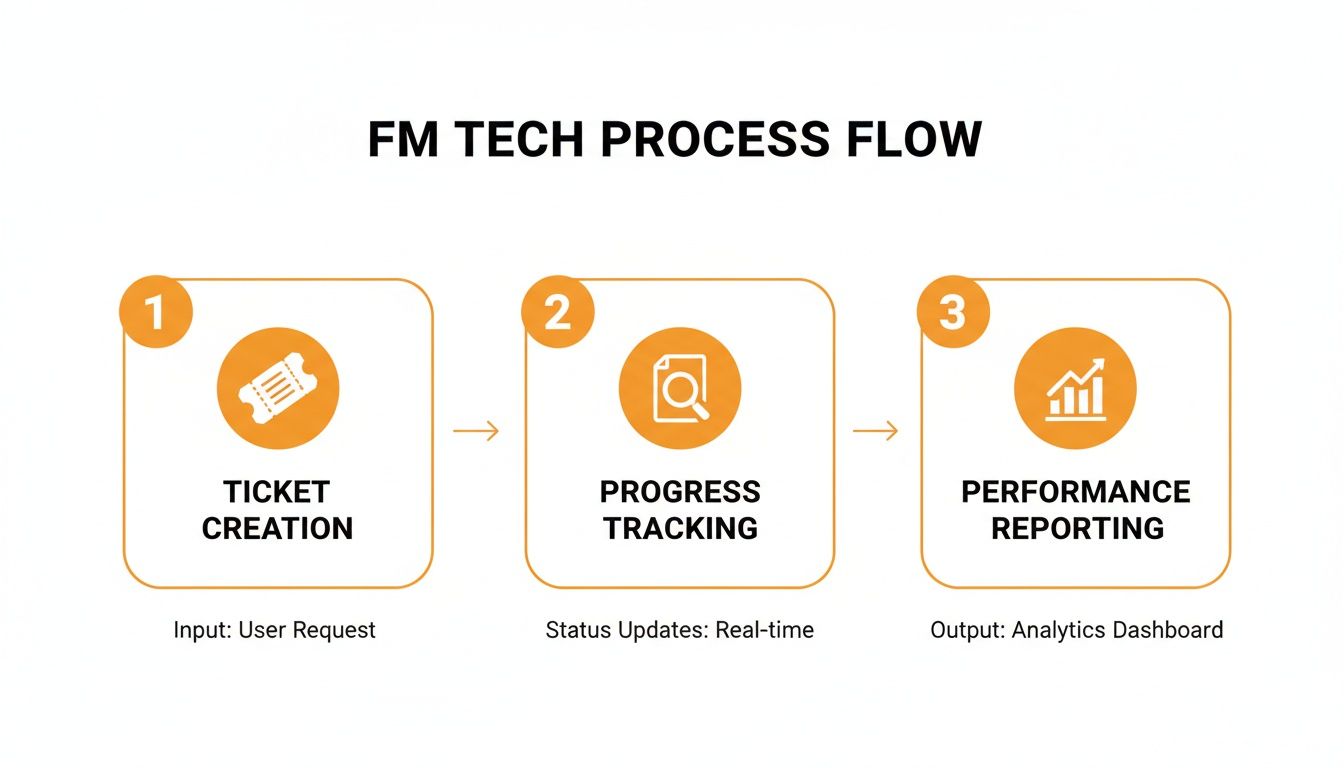
This type of auditable, system-managed process provides the data necessary for effective performance management.
Sample Evaluation Scorecard Matrix
This template can be adapted for specific procurement needs. Score each criterion on a scale of 1 (Poor) to 5 (Excellent), then multiply the score by the assigned weight to calculate a weighted score for objective, side-by-side comparison.
| Category (Weight) | Sub-Category | Scoring Criteria (1-5) | Weight | Weighted Score |
|---|---|---|---|---|
| Technical (40%) | Self-Performance Rate (MEP) | >85% in-house technicians for core MEP services. | 15% | |
| PPM Strategy | Detailed, asset-specific PPM schedule provided. | 15% | ||
| Staffing Plan | Clear technician-to-supervisor ratio (~10:1 to 15:1). | 10% | ||
| Commercial (30%) | Pricing Transparency | Detailed cost breakdown; no vague "sundries" or hidden fees. | 15% | |
| SLA Penalties & Warranties | Clearly defined financial penalties for SLA breaches. | 10% | ||
| Contract Flexibility | Options for termination or scope adjustment. | 5% | ||
| Compliance & Tech (20%) | Certifications & Licenses | Valid ISO 9001/45001/14001 and trade licenses. | 10% | |
| CMMS Capabilities | Real-time tracking, photo-based orders, client portal. | 10% | ||
| Experience (10%) | Relevant UAE Portfolio | Proven experience with similar property types. | 5% | |
| Client References | Strong, verifiable feedback from current clients. | 5% | ||
| Total Score | 100% |
Probing Questions for Your Request for Proposal (RFP)
The RFP document is the primary tool for gathering the specific information needed to populate the evaluation scorecard. Generic questions will elicit generic, templated responses. The RFP must be designed to compel providers to demonstrate their operational depth.
The quality of the RFP questions directly dictates the quality of the proposals received. Focus on "how" and "provide evidence of" questions, not just "do you have" questions. This forces providers to substantiate their claims with process descriptions and data.
Incorporate questions designed to test operational competence:
- Scenario-Based Questions: "Describe your mobilisation plan and communication protocol for a P1 critical AC failure in a fully occupied office building at 2:00 PM on a weekday. Detail the roles, responsibilities, and escalation triggers."
- Data & Reporting Questions: "Provide a sample monthly performance report generated directly from your CMMS for a comparable property, including anonymised data on SLA compliance, asset uptime, and PPM completion rates."
- Risk Management Questions: "Explain your process for the management and oversight of specialised subcontractors for fire safety system maintenance to ensure both regulatory compliance and quality control."
By combining a weighted scorecard with a strategically crafted RFP, procurement teams can implement a powerful and objective evaluation framework. This structured methodology moves the decision beyond superficial factors and ensures the selection of a partner based on proven capability, setting the stage for a successful, transparent, and performance-driven relationship.
For organisations seeking engineering-led hard FM services backed by transparent technology and SLA-driven performance, SnapFixNow provides comprehensive Annual Maintenance Contracts and 24/7 support across Dubai. Learn more about our building maintenance solutions.