Effective facility management in the UAE is not an operational cost but a strategic lever for asset value enhancement. It encompasses the proactive maintenance of a building's physical systems—Hard FM—and the management of occupant-facing services, or Soft FM. The primary objective is to optimise operational expenditure (OPEX) and preserve long-term asset value, a critical function within the region's demanding climate and high-performance real estate market.
Why Strategic Facility Management is a Financial Imperative in the UAE
In the UAE's sophisticated property market, facility management has matured from a reactive repair function to a core business discipline directly influencing an asset's profitability, safety, and market reputation. For asset owners and operators in Dubai and Abu Dhabi, a strategic approach is a commercial necessity, not an operational choice.
This strategic shift is driven by the region's unique operational challenges. The extreme climate imposes significant stress on Mechanical, Electrical, and Plumbing (MEP) systems. HVAC systems, for instance, can account for up to 70% of a building's total energy consumption during peak summer months. A reactive, "break-fix" approach is not merely inefficient; it represents a direct financial and operational risk.
The Core Pillars of Facility Management
A resilient operational strategy requires a clear understanding of the two interdependent components of facility management.
- Hard FM (Hard Services): This discipline covers the physical fabric and core engineering systems of a building. It includes technical services requiring certified professionals, such as MEP maintenance (HVAC, electrical, plumbing), civil works, and critical fire and life safety systems.
- Soft FM (Soft Services): This component focuses on services that enhance the occupant experience and ensure a safe, functional environment. Key services include security, cleaning, pest control, landscaping, and waste management.
A purely reactive maintenance model can result in lifecycle costs three to nine times higher than a proactive, preventive strategy. Integrating Hard and Soft FM creates a unified operational intelligence network. For example, a cleaning operative (Soft FM) reporting a minor water leak can trigger a swift plumbing response (Hard FM), preventing significant water damage and subsequent civil works.
From Reactive Firefighting to Proactive Capital Planning
The objective of strategic facility management in UAE is to transition from a cycle of reactive firefighting—addressing unexpected failures—to a model of forward planning. This involves leveraging data from scheduled maintenance to predict potential system failures, allocate resources effectively, and make informed capital expenditure (CAPEX) decisions.
A well-executed FM strategy extends beyond asset protection. It ensures continuous compliance with local regulatory bodies like Dubai Municipality and Civil Defence while enhancing the tenant and visitor experience. This proactive stance is fundamental to maintaining the value and marketability of a Grade A property.
Decoding FM Contracts and Service Models: A Risk-Based Analysis
The selection of an appropriate contract model is the foundation of a successful facility management strategy. In the UAE, the agreement structure dictates cost allocation, risk distribution, and the operational performance of your property. Understanding the nuances between models is critical for aligning service delivery with financial objectives.
The decision invariably involves a trade-off between predictable fixed costs and direct control over variable expenditures. The two most prevalent structures are Comprehensive and Labour-Only Annual Maintenance Contracts (AMCs), each designed for different risk appetites and management philosophies.
Comprehensive Versus Labour-Only AMCs
A Comprehensive AMC is an all-inclusive model where the service provider assumes the risk for both technician labour and the cost of most spare parts required for repairs. This structure provides a fixed, predictable annual cost, simplifying budget forecasting. It is the preferred model for critical assets and facilities with high operational uptime requirements, such as hotels, hospitals, and Grade A commercial towers.
Conversely, a Labour-Only AMC covers the cost of technician labour for both planned preventive maintenance (PPM) and reactive call-outs, but the client bears the cost of all spare parts and consumables. This model offers lower fixed costs and greater control over material expenditure but introduces budget volatility. The failure of a major component, such as a chiller compressor, can result in a significant, unplanned capital expense.
For a deeper dive into how these contracts are applied across different property types, refer to this guide on annual maintenance contract types for residential vs commercial properties in Dubai.
This decision tree outlines the strategic choice between a proactive, planned maintenance approach and a reactive, failure-based one.
The optimal path depends on your asset's condition and your organisation's tolerance for operational risk.
The Financial Impact of Service Models
The underlying service philosophy—preventive versus reactive—has a profound long-term financial impact. A purely reactive, call-out model may appear less expensive initially as you only pay per incident. However, this approach is laden with hidden costs.
Over an asset's lifecycle, a reactive maintenance strategy can be three to nine times more expensive than a proactive one due to catastrophic failures, emergency labour rates, and extended operational downtime.
A preventive maintenance schedule, the core of most AMCs, is designed to identify and rectify minor issues before they escalate. For example, regular cleaning of HVAC filters and coils—a standard PPM task—can improve energy efficiency by 5% to 15%. In the UAE climate, this translates to substantial savings on utility bills.
Comparative Analysis of FM Contract Models
This evaluation matrix breaks down common models against key decision-making criteria in the UAE market, helping you select the structure that best aligns with your property's risk profile and financial strategy.
| Decision Factor | Comprehensive AMC | Labour-Only AMC | Reactive Call-Out Model |
|---|---|---|---|
| Budget Predictability | High: Fixed annual cost for predictable OPEX. | Medium: Labour is fixed, but parts costs are variable. | Low: Costs are entirely event-driven and unpredictable. |
| Risk Allocation | Provider: Provider assumes financial risk for most parts failures. | Client: Client assumes full financial risk for parts and materials. | Client: Client assumes all risk for labour, parts, and downtime. |
| Operational Focus | Proactive (Maximising asset uptime & lifecycle) | Proactive (Labour planning & scheduled maintenance) | Reactive (Break-fix response only) |
| Ideal Application | Critical assets, 24/7 facilities, risk-averse stakeholders (e.g., hospitality, data centres). | Cost-conscious clients with in-house procurement capabilities; non-critical assets. | Low-use facilities; non-essential assets; interim solutions. |
| Cost Structure | Fixed annual fee covering labour and parts. | Lower fixed annual fee + variable parts costs. | Per-incident charge (call-out fee + hourly rate) + parts. |
Choosing the right service model is an exercise in risk management. A comprehensive contract for facility management in UAE functions like an insurance policy, insulating your budget from unexpected high-cost events. A labour-only model offers more control but requires active management and a budget resilient enough to absorb unforeseen expenses. The decision should be informed by a thorough assessment of your asset's age, criticality, and your organisation’s financial strategy.
Setting SLAs and KPIs That Drive Performance
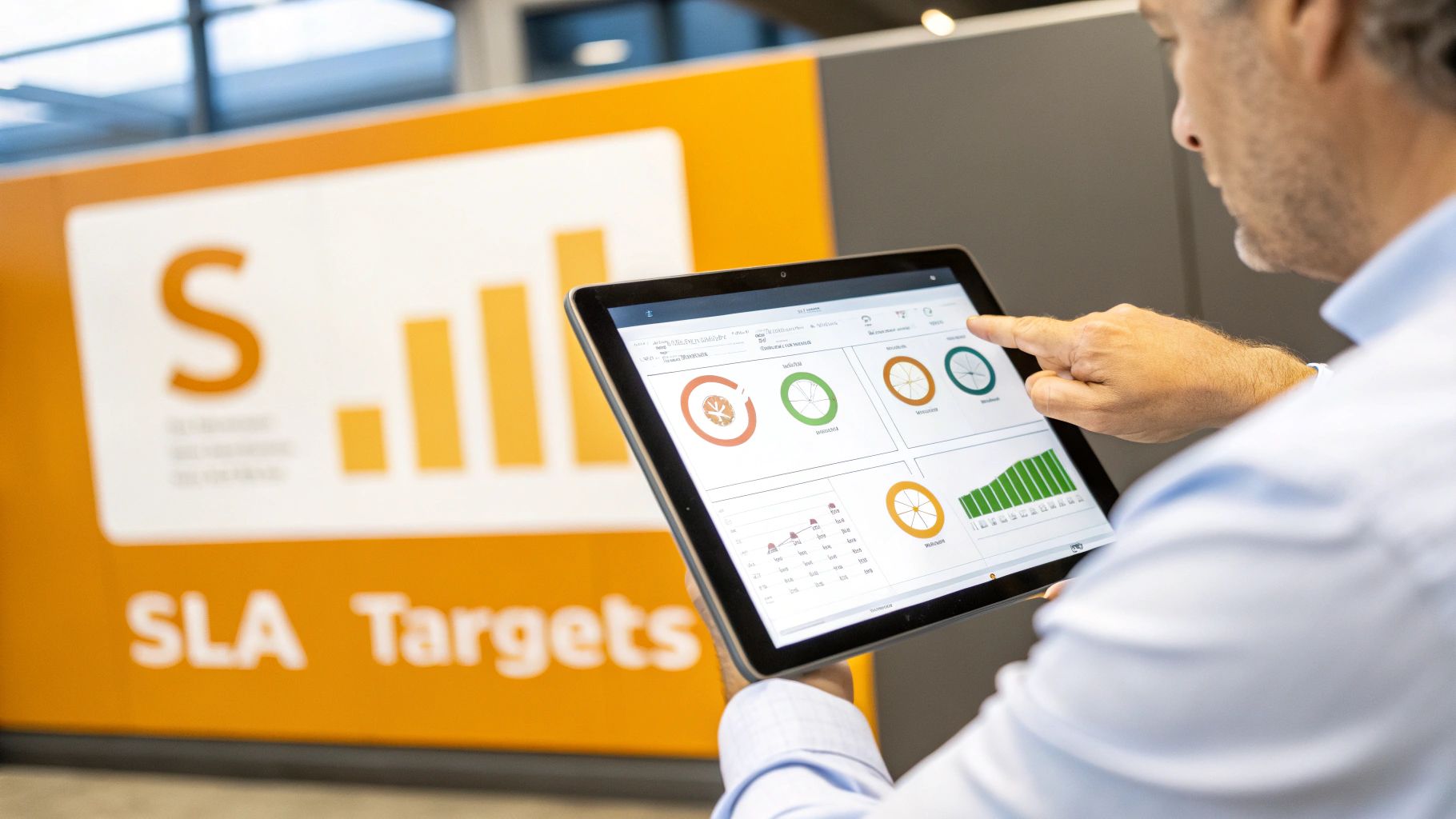
An outsourced facility management partnership is only as effective as the metrics that govern it. Vague agreements lead to inconsistent service and disputes. In the UAE's high-stakes operational environment, establishing clear Service Level Agreements (SLAs) and Key Performance Indicators (KPIs) is essential for ensuring accountability and performance.
These metrics transform a subjective service into an objective, measurable partnership. They provide a quantitative definition of "good performance," creating a robust framework for performance reviews and continuous improvement.
Differentiating Response from Resolution: A Critical Distinction
A common pitfall in FM contracts is the conflation of response time and resolution time. They measure two distinct and equally important actions.
- Response Time: This metric measures logistical efficiency—the time taken for a qualified technician to acknowledge an issue and arrive on-site to begin diagnosis.
- Resolution Time: This metric measures technical competence—the total time from incident reporting to the full restoration of the asset to normal operational status.
For a critical MEP failure in a high-end Dubai hotel, a response time of under 30 minutes is a reasonable expectation. However, the resolution time could extend to several hours, contingent on fault complexity and parts availability. Both metrics must be tracked independently.
Establishing Realistic SLA Benchmarks for the UAE Context
Not all failures carry the same operational weight. A complete HVAC failure in a data centre is a P1 (Critical) event; a flickering bulb in a storeroom is a P3 (Routine) task. SLAs must be tiered based on the business impact of the failure, ensuring resources are deployed strategically.
A well-defined SLA framework is not a punitive tool but a strategic alignment mechanism. It directs the FM provider’s resources to what matters most to your business, aligning their operational priorities with your asset's specific requirements.
The following table provides indicative benchmarks used in facility management in UAE contracts. These should be adapted based on your property type, asset criticality, and stakeholder expectations.
Indicative SLA Benchmarks for UAE Facility Management
| Priority Level | Typical Response Time | Indicative Resolution Target | Example Scenarios (Property-Type Specific) |
|---|---|---|---|
| Critical (P1) | < 30 Minutes | 2-4 Hours | Complete AC failure (summer); major power outage; lift entrapment; fire system fault; commercial kitchen exhaust failure. |
| Urgent (P2) | 2-4 Hours | Within 24 Hours | Localised AC unit failure; single office power trip; significant but contained water leak; public restroom blockage. |
| Routine (P3) | 24-48 Hours | 3-5 Business Days | Dripping tap; faulty light fixture; minor door repair; non-critical cosmetic issues; landscape irrigation adjustment. |
These benchmarks ensure that the most critical issues receive the fastest attention, safeguarding people, property, and business continuity.
Moving Beyond Timers to Core Performance KPIs
While SLAs are crucial, a holistic performance assessment requires a balanced scorecard of KPIs that reflect the overall health and efficiency of the maintenance program.
Key performance indicators to monitor include:
- Planned Preventive Maintenance (PPM) Completion Rate: The percentage of scheduled maintenance tasks completed on time. A consistent rate of >95% is a strong leading indicator of a proactive, well-managed operation and predicts fewer reactive failures.
- Asset Uptime Percentage: Critical for industrial, hospitality, and retail sectors, this measures the percentage of time a key asset (e.g., chiller, generator, escalator) is fully operational. Targets often exceed 99.5%.
- First-Time Fix Rate (FTFR): This measures the percentage of issues resolved on the first visit without requiring a follow-up. A high FTFR (target: 80-90%) indicates skilled technicians, accurate diagnostics, and effective parts management, directly reducing operational disruption.
- Mean Time Between Failures (MTBF): This calculates the average operational time of a specific asset between failures. An increasing MTBF demonstrates the effectiveness of the preventive maintenance program in extending asset reliability and lifespan.
By implementing a clear framework of SLAs and KPIs, you transition the dialogue with your FM provider from subjective feedback to data-driven performance management, ensuring the partnership delivers quantifiable value.
What Really Drives Facility Management Costs in the UAE?
When evaluating a facility management proposal, a superficial comparison of the final price is insufficient. To understand value and negotiate effectively, procurement teams must deconstruct the cost drivers. The price of facility management in the UAE is a calculated figure based on specific variables tied directly to the asset's profile and operational demands.
Comparing quotes on a simple cost-per-square-foot basis is often misleading. Two buildings of identical size can have vastly different maintenance requirements and, consequently, legitimately different service costs.
Asset Age and Condition: The Primary Cost Driver
The age and current condition of a building's core MEP assets are the most significant factors influencing the FM budget.
- Newer Assets (0-5 years): Costs are at their lowest, focusing primarily on preventive maintenance to uphold warranty conditions and establish a performance baseline. The risk of major component failure is minimal, leading to stable and predictable pricing.
- Mid-Life Assets (6-15 years): Costs escalate as preventive maintenance becomes more critical for extending asset lifecycle. The budget must now account for a higher probability of corrective repairs and minor component replacements. Proactive strategies in this phase yield the highest ROI.
- Older Assets (15+ years): These properties represent the highest operational cost and risk. Major capital equipment (chillers, elevators, generators) may be approaching end-of-life, requiring major overhauls or replacement. FM pricing will be higher to reflect the increased risk and labour intensity associated with managing aging equipment.
Property Type and Usage Intensity
A building's operational profile is a direct determinant of its maintenance needs. A facility operating 24/7 will experience significantly more wear and tear than a standard 9-to-5 office.
A property's operational intensity dictates its maintenance rhythm. A luxury hotel, for example, can demand two to three times the MEP maintenance budget of a commercial office tower of the same size due to continuous usage and a zero-tolerance policy for service disruption.
Consider these distinct operational environments:
- Hospitality (Hotels): 24/7 operations place constant strain on HVAC, plumbing, and electrical systems. The cost model must factor in immediate response times and round-the-clock technician availability.
- Commercial (Offices): A standard 9-to-5, weekday schedule allows for planned maintenance during off-peak hours (evenings, weekends), generally resulting in lower costs compared to 24/7 facilities.
- Retail (Malls): High footfall places extreme stress on public area infrastructure (escalators, lifts, HVAC, restrooms). Costs are driven by the need for high-visibility cleaning and robust MEP support during peak hours.
- Industrial (Warehouses/Manufacturing): The focus shifts to specialised equipment, heavy-duty HVAC, and critical systems like loading bays and fire suppression. Costs are directly tied to machinery criticality and compliance with specific industrial safety regulations.
Complexity of On-Site Systems
The sophistication of the installed equipment is a final key cost variable. Buildings with complex, centralised systems require specialised expertise and command higher maintenance budgets.
A facility with a central chiller plant and an integrated Building Management System (BMS) will have a higher maintenance cost than one using simple split AC units. The reason is the requirement for technicians with specialised certifications, advanced diagnostic tools, and specific system experience.
Similarly, properties with advanced fire and life safety systems, on-site data centres, or automated parking solutions will see these reflected in their maintenance budgets. This specialised technology elevates the overall cost compared to buildings with more basic infrastructure.
How Technology Is Modernizing Facility Management
Facility management has evolved from a manual, reactive function into a proactive, data-driven discipline. For property and asset managers in the UAE, technology is no longer an optional extra but an essential tool for achieving the efficiency, transparency, and performance demanded by modern real estate portfolios.
The fundamental shift is toward creating a single source of truth for all maintenance activities. Modern platforms replace paper-based work orders and verbal updates with a clear, auditable digital trail for every service request, from initiation to closure.

From Work Orders to Actionable Data
A Computerized Maintenance Management System (CMMS) serves as the operational backbone of modern FM. It functions as a central repository for asset data, maintenance schedules, and a complete service history. The system automates the scheduling of preventive tasks and maintains a detailed log of all reactive interventions.
Simple innovations like photo-based work order systems enhance accountability. A tenant can report a leak by uploading a photo; the assigned technician then uploads "before" and "after" photos upon completion. This workflow eliminates disputes and provides robust documentation for every action.
By digitising work orders, property managers gain real-time oversight of operations. They can track SLA compliance, identify recurring faults with specific assets, and analyse team productivity without relying on manual reports. This data is invaluable for informed operational and capital planning.
The Rise of Predictive Maintenance
The next frontier for facility management in UAE is the transition from preventive to predictive maintenance, enabled by the Internet of Things (IoT).
IoT sensors are deployed on critical assets—such as chillers, pumps, and generators—to monitor their operational health in real-time. These sensors track key parameters that provide early warnings of potential failure.
- Vibration Analysis: An increase in motor vibration can indicate impending bearing failure.
- Temperature Monitoring: An alert is triggered if a critical compressor is overheating, long before a catastrophic shutdown occurs.
- Pressure Differentials: Sensors can determine the precise moment an HVAC filter is clogged and requires cleaning for optimal efficiency, moving beyond fixed schedules.
This continuous data stream allows the FM system to identify anomalies and predict failures before they happen. In the UAE's climate, using IoT to pre-empt an HVAC failure is a strategic advantage. It prevents costly emergency repairs, minimises tenant disruption, and can significantly extend asset lifecycle. Explore these concepts further in our guide to technology-enabled maintenance and IoT monitoring solutions.
This technology empowers decision-makers with the evidence needed to reduce downtime, optimise resource allocation, and justify maintenance budgets with hard data.
A Practical Framework for Procuring FM Services
Selecting a facility management provider in the UAE requires a structured, risk-based evaluation that extends beyond price comparison. This framework helps procurement teams and asset managers verify the commercial, technical, and operational capabilities of potential partners to ensure alignment with specific property requirements.
The objective is to identify a provider with the documented processes, qualified personnel, and robust compliance procedures necessary to protect and enhance asset value.
This methodical approach is increasingly critical. The UAE facility management market, valued at USD 18.29 billion, is projected to reach USD 33.64 billion by 2030, with a compound annual growth rate of 10.69%. This growth reflects a market-wide shift towards performance-based outsourced contracts as owners seek greater control over operational expenditure. You can dive deeper into these market trends in this detailed industry report.
Technical and Operational Verification
The initial phase of due diligence should confirm a potential partner's core technical and operational competencies, independent of commercial considerations.
- Certifications and Compliance: Verify internationally recognised standards such as ISO 9001:2015 (Quality Management), which demonstrates a commitment to repeatable processes. Equally critical are ISO 14001 (Environmental Management) and ISO 45001 (Occupational Health and Safety), which are non-negotiable for risk mitigation in the UAE.
- Team Qualifications: Request details on the structure and expertise of the in-house technical team. Specify the number of certified technicians (e.g., Dubai Municipality-approved engineers, SIRA-certified security staff) and their specialisations. A heavy reliance on subcontracted labour versus in-house specialists can be a red flag for service inconsistency.
- Health, Safety, and Environment (HSE) Protocols: A credible provider must present documented HSE policies, including risk assessments, incident reporting procedures, and safety training records. This is a primary indicator of a professional operation committed to the well-being of its staff and your tenants.
Performance and Commercial Scrutiny
Once technical competence is established, the focus shifts to validating past performance and scrutinising the commercial proposal.
A provider’s proposal is a promise; their reporting and client references are proof of delivery. Scrutinise their reporting capabilities to understand the level of transparency you can expect on SLA compliance, PPM completion rates, and asset performance.
To conduct a thorough commercial and performance review:
- Relevant Case Studies: Request case studies specific to your property type (e.g., hospitality, commercial tower, industrial facility). This confirms relevant experience with your unique operational challenges.
- Reporting and Technology: Ask for sample reports generated from their CMMS or work order platform. These should clearly display metrics like response times, resolution times, and first-time fix rates, demonstrating a commitment to data-driven performance management.
- Financial Stability: Ensure the provider is financially stable, particularly for long-term comprehensive AMCs where they carry the risk for procuring high-value spare parts and materials.
Following a structured evaluation framework enables an informed, evidence-based decision. For more detailed guidance, our article on how to choose the right facility management company in UAE for long-term reliability offers additional insights for selecting a partner that aligns with your operational, financial, and compliance objectives.
Frequently Asked Questions
Decision-makers responsible for facility management in the UAE frequently encounter similar queries. The following provides direct, practical answers to common questions.
What Should a Standard Annual Maintenance Contract in Dubai Cover?
A robust Annual Maintenance Contract (AMC) in Dubai must cover core Hard FM services, including scheduled and reactive maintenance for HVAC, electrical, and plumbing (MEP) systems, along with basic civil works.
A comprehensive AMC should detail scheduled preventive visits, specify the number of unlimited emergency call-outs, and define the scope of parts coverage (e.g., including the cost of spare parts up to a certain value, such as AED 500 per incident). In contrast, a labour-only contract exclusively covers technician time, with all materials billed separately. The contract must explicitly list all covered assets and define the associated service levels.
How Can I Measure the ROI of a Preventive Maintenance Programme?
Measuring the Return on Investment (ROI) of a planned preventive maintenance (PPM) program involves comparing its cost against the savings it generates through cost avoidance.
A well-executed PPM programme transforms an unpredictable, reactive expense into a manageable, forecastable operational cost. It shifts the financial model from emergency expenditure to strategic asset stewardship.
Key metrics to quantify ROI include:
- Reduction in Emergency Repair Costs: Track the frequency and cost of reactive call-outs before and after PPM implementation.
- Reduction in Asset Downtime: Quantify the financial impact of avoided downtime, which is particularly critical in revenue-generating environments like retail and hospitality.
- Extended Asset Lifespan: Calculate the deferred capital expenditure from pushing back the replacement date of major equipment.
- Improved Energy Efficiency: A properly maintained HVAC system can reduce energy consumption by 5-15%, yielding direct savings on utility bills.
By tracking these metrics, you can calculate the tangible financial benefit of a structured PPM program.
What Are the Main Compliance Risks in UAE Facility Management?
The most significant compliance risks in facility management in UAE stem from non-adherence to local regulations. The appointed service provider must demonstrate full compliance with standards set by authorities such as Dubai Municipality (DM) and Dubai Civil Defence, particularly concerning fire and life safety systems.
FM providers must use certified technicians who adhere to official codes of practice. Furthermore, compliance with Health, Safety, and Environment (HSE) standards, evidenced by certifications like ISO 45001, is mandatory. All operations must also comply with UAE labour laws. Pre-contract due diligence should include verification of the provider's trade licenses, technical certifications, and documented compliance procedures to mitigate operational and legal risks.
Ready to lock in your asset's performance with a reliable, engineering-led maintenance partner? SnapFixNow delivers ISO-certified facility management services across Dubai, ensuring your property stays safe, compliant, and runs like clockwork. Learn more about our flexible Annual Maintenance Contracts.