Choosing a facility management service in the UAE isn't just another line item on your expense sheet—it's a critical investment in your asset's long-term value and operational resilience. For procurement teams, asset owners, and engineering leaders, the objective is to move beyond simple price comparison and select a partnership that safeguards asset integrity and ensures operational continuity within a uniquely demanding commercial landscape.
Why Strategic Facility Management Is Non-Negotiable
In the UAE's high-value real estate market, a facility management service functions as the operational backbone of an asset. This service directly impacts tenant retention, regulatory standing, and long-term profitability.
Poorly managed facilities invariably lead to escalating operational costs, unplanned downtime, and accelerated asset degradation—risks magnified by the UAE's harsh climate and stringent building performance standards. The goal for decision-makers is to shift from a reactive, cost-centric approach to a strategic, value-driven framework. This involves a clear understanding of how different service models and scopes of work protect the asset's financial and operational performance.

Key Focus Areas For Decision-Makers
- Operational Resilience: This entails ensuring critical systems—HVAC, MEP, and life safety equipment—maintain uptime thresholds, typically benchmarked at 99.5% or higher for essential assets. In a climate where cooling is a mission-critical utility, this is a core operational imperative.
- Cost Control and Efficiency: Evaluation must extend beyond the initial quote to the total cost of ownership (TCO). This includes quantifying how structured preventive maintenance can reduce utility consumption, a significant factor given DEWA tariffs. For a deeper analysis, see how strategic AMC planning can improve energy efficiency through maintenance.
- Regulatory Compliance: Navigating the complex requirements from authorities such as Dubai Municipality and Dubai Civil Defence is paramount. Non-compliance can result in financial penalties and operational suspension.
A proactive facility management strategy is not about fixing what is broken; it is about engineering an operational environment where asset failure is a managed exception, not a recurring event. This shift protects capital value and enhances occupant experience.
Differentiating Hard and Soft FM Services for Budgeting and Risk Allocation
To select an appropriate facility management service, it is essential to distinguish between its two primary components. A practical analogy is to view a building as a human body. Hard FM represents the vital systems: the skeleton, circulatory network, and nervous system. Soft FM constitutes the elements that create a productive and pleasant environment: the presentation and daily user experience.
Correctly categorising services is fundamental for accurate budgeting, risk allocation, and defining performance expectations. A balanced approach does not just maintain operational functionality; it directly contributes to occupant satisfaction and asset value preservation.
Hard FM: The Technical Backbone
Hard facility management services encompass the tangible, physical systems integrated into the building's structure. This includes all mechanical, electrical, and plumbing (MEP) infrastructure essential for safe and efficient operation.
In the UAE climate, these services are non-discretionary. An underperforming HVAC system, for instance, is not a minor inconvenience but a critical failure with immediate commercial and safety implications.
Core Hard FM services include:
- HVAC Systems: Maintenance of air conditioning, heating, and ventilation to meet both comfort and regulatory standards.
- Electrical Systems: Management of power distribution, lighting, and critical backup power systems (e.g., generators, UPS).
- Plumbing & Water Systems: Ensuring reliable potable water supply, drainage, and sanitation infrastructure.
- Fire Safety & Life Support: Maintenance of alarms, sprinkler systems, and emergency egress systems in compliance with Civil Defence codes.
Soft FM: The People-Focused Services
Soft facility management services are centred on the human occupants of the building. The objective is to ensure the space is clean, secure, and conducive to its intended use. While less technical, the impact of these services on tenant satisfaction and corporate reputation is significant, particularly in the competitive commercial and hospitality sectors of the UAE.
These services shape the daily user experience for employees, visitors, and residents, defining the quality of the built environment.
Hard FM ensures a building is functional and compliant. Soft FM makes it an environment where people and businesses can thrive. Maximising a modern UAE property's value requires excellence in both domains.
Market data validates this focus on physical infrastructure. Hard services are projected to constitute 60.92% of the UAE facility management market share in 2025, driven by investment in smart MEP systems and predictive maintenance. Concurrently, soft services are expected to see significant growth, reflecting an increasing emphasis on occupant well-being and experience. This data, available in the latest UAE facility management report, is valuable for informing budget allocation between these two critical service categories.
Choosing The Right Facility Management Contract Model
The selection of a facility management contract is a pivotal decision that directly defines financial risk allocation, budget predictability, and accountability. In the UAE, the choice typically narrows to two primary structures, each with distinct implications for an asset's financial management.
Understanding the fundamental trade-offs is key to aligning the service model with an organisation's financial strategy and desired level of operational oversight. The core differentiator is the allocation of responsibility for the cost of spare parts and materials, a factor that shapes the entire risk and cost profile.
Comprehensive vs Labour-Only Contracts: A Risk and Cost Comparison
A Comprehensive Contract is an all-inclusive model. It consolidates labour, all required spare parts, and consumables into a single, fixed fee. In this structure, the service provider assumes the financial risk of equipment failure. This offers high budget certainty, making it suitable for organisations that require predictable operational expenditures. This risk transfer comes at a premium, reflected in a higher initial contract value.
Conversely, a Labour-Only Contract covers only the cost of technician time. The client remains responsible for procuring and funding all spare parts and materials. This model typically has a lower upfront fee but introduces significant budget volatility. A major, unplanned failure—such as a chiller compressor failure during peak summer months—can result in a substantial, unbudgeted capital expense for the client.
The core decision is a calculated trade-off: pay a premium for predictable costs and risk transfer (Comprehensive) or accept potential budget volatility in exchange for a lower fixed fee (Labour-Only). The choice is contingent on the organisation's risk appetite.
To structure this initial decision, the following flow chart helps categorise needs before delving into contract specifics.
This chart facilitates the crucial first step of segregating core operational requirements (Hard FM) from occupant-focused services (Soft FM), ensuring the subsequent contract selection is aligned with the primary service objective.
For a practical understanding of these structures, it is useful to examine the framework of an annual maintenance contract in Dubai. These agreements form the basis for both comprehensive and labour-only models, defining scope, service levels, and financial terms.
Comparing FM Contract Models
To clarify the decision-making process, this matrix provides a direct comparison of the two primary contract types.
| Attribute | Comprehensive Contract | Labour-Only Contract |
|---|---|---|
| Cost Structure | Fixed annual or monthly fee covering labour, parts, and consumables. | Lower fixed fee covering labour only. Client bears the variable cost of parts. |
| Budget Predictability | High. Opex is fixed, simplifying financial planning and forecasting. | Low. Exposed to significant, unbudgeted expenditure for major component failures. |
| Risk Allocation | Provider Assumes Risk. The FM provider bears the financial risk of equipment failure. | Client Assumes Risk. The asset owner is financially responsible for all part replacements. |
| Typical Suitability | Mission-critical assets (e.g., chillers, elevators, data centres) and organisations prioritising budget stability. | Less critical assets or clients with robust in-house procurement and technical oversight capabilities. |
Ultimately, the choice between a Comprehensive and Labour-Only model depends on the criticality of the assets under management and the organisation's tolerance for financial risk.
Decoding Pricing and Hidden Cost Drivers
It is common for decision-makers in Dubai to receive proposals for a facility management service that appear similar in scope but differ significantly in price. The variance is almost always attributable to specific, quantifiable cost drivers that extend beyond a simple per-square-foot rate. Understanding these factors is essential for accurately assessing the value proposition of each proposal.

The age, condition, and complexity of assets are the primary cost influencers. For example, maintaining a new, high-specification commercial tower in DIFC with an integrated Building Management System (BMS) can cost 20-30% more per square foot than servicing an older, simpler industrial warehouse in Jebel Ali. This premium accounts for the specialised technical competencies, advanced diagnostic equipment, and higher-cost spare parts required for modern, complex systems.
Asset Profile and Service Intensity
The operational function of a property directly dictates the required service intensity. A 24/7 luxury hotel, for example, has zero tolerance for HVAC or plumbing downtime, necessitating a higher on-site technician-to-asset ratio and more frequent preventive maintenance cycles compared to a standard 9-to-5 commercial office.
- Property Type: Hospitality and high-end retail environments demand near-instantaneous response times and impeccable cosmetic standards, driving up labour and supervision costs.
- Asset Density: A facility with a high density of complex assets—multiple elevators, chillers, and sophisticated access control systems—will have a higher baseline maintenance cost than a building with a simpler MEP profile.
- Operational Hours: Facilities operating 24/7 incur higher labour costs due to shift differentials for night and weekend coverage, which can increase staffing costs by 25-50% compared to standard business hours.
Evaluating Pricing Models
The fee structure itself is a key differentiator. A fixed monthly fee, typical of comprehensive contracts, offers budget predictability and is well-suited for critical assets where the cost of downtime far exceeds the maintenance premium.
Conversely, a variable, call-out-based model offers a lower fixed cost but introduces financial unpredictability. This can be a viable economic approach for properties with non-critical assets and a higher tolerance for occasional unbudgeted repair expenditure.
To manage these variables, many decision-makers use software for managing estimates and invoices to provide transparency in financial workflows. Analysing these drivers allows for an evaluation that moves beyond price comparison to an assessment of the true operational value a facility management service delivers.
How To Measure Real Performance With SLAs and KPIs
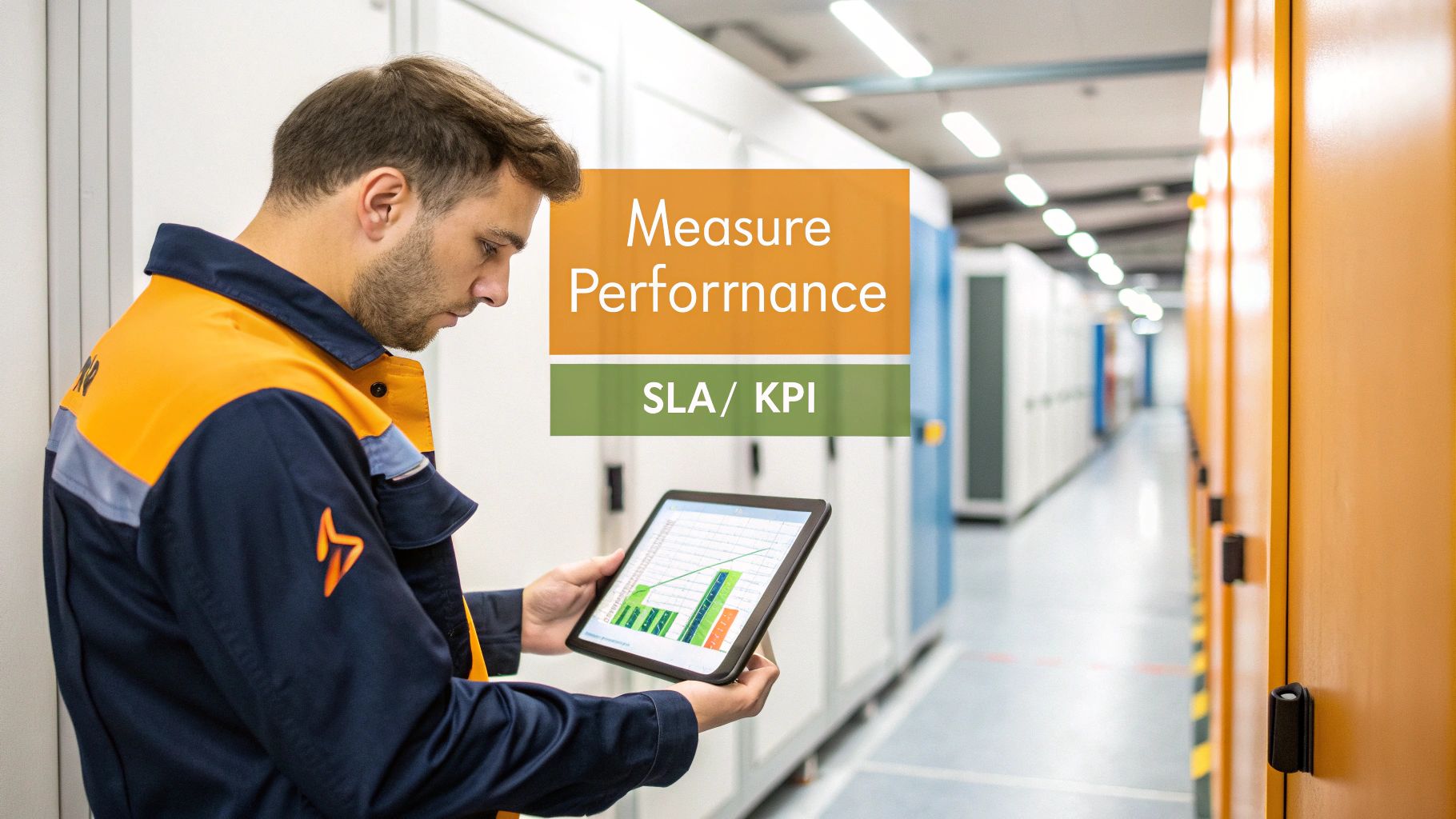
Effective facility management is impossible without objective measurement. Attempting to manage a property without clear metrics is inefficient and introduces unacceptable risk. To move from subjective feedback to data-driven performance management, asset managers in the UAE rely on two fundamental tools: Service Level Agreements (SLAs) and Key Performance Indicators (KPIs).
An SLA is a contractual document that establishes firm, measurable timelines for service delivery. It is critical to differentiate between response time (the time taken for a technician to arrive on-site) and resolution time (the time taken to complete the repair and restore service). A robust SLA defines both metrics with clarity.
Core KPIs for UAE Properties
While SLAs define the required speed of service, KPIs measure the quality and effectiveness of the maintenance work. For any high-value commercial, residential, or hospitality asset in Dubai, monitoring these KPIs is non-negotiable for ensuring contract compliance and asset health.
Key KPIs include:
- Planned Preventive Maintenance (PPM) Completion Rate: This measures the percentage of scheduled maintenance tasks completed on time. A benchmark of >95% is a standard expectation. Achieving this target is the most effective method for reducing unplanned failures and extending asset lifecycle.
- Asset Uptime: This metric quantifies the operational availability of critical systems like chillers, elevators, and life safety equipment. The target for critical assets is typically 99.5% or higher.
- First-Time Fix Rate (FTFR): This KPI indicates the percentage of issues resolved on the first technician visit. A high FTFR, typically in the 80-90% range, signifies competent technicians, accurate diagnostics, and effective spare parts management.
A well-defined SLA for a critical MEP failure in a Dubai commercial tower might mandate a sub-60-minute response time, while a routine lighting repair could have a 4-8 hour window. These benchmarks align operational urgency with asset criticality.
The following table provides indicative SLA benchmarks for commercial properties in the UAE, demonstrating how response and resolution times are tiered by priority.
Indicative SLA Benchmarks for Commercial Properties in Dubai
| Priority Level | Description | Typical Response Time | Typical Resolution Time Target |
|---|---|---|---|
| P1 – Critical | Major system failure impacting safety or core business (e.g., chiller outage, fire alarm fault) | < 1 Hour | Within 4 Hours |
| P2 – High | Significant disruption to operations or multiple users (e.g., elevator malfunction, major leak) | < 2 Hours | Within 8 Hours |
| P3 – Medium | Localized issue impacting a small area or single user (e.g., faulty AC unit in one office) | < 4 Hours | Within 24 Hours |
| P4 – Low | Minor, non-urgent repair or request (e.g., flickering light, cosmetic repair) | < 24 Hours | Within 72 Hours |
These targets ensure that resources are allocated efficiently, with the most urgent issues receiving immediate attention.
For a more detailed exploration of performance measurement, it is beneficial to review frameworks for mastering operational efficiency metrics. Effective KPI tracking relies heavily on data integrity, which is increasingly supported by technology-enabled maintenance solutions.
A Strategic Look at the UAE Facility Management Market
Before finalising a facility management service contract, it is prudent to understand the broader market context. The UAE market is driven by large-scale infrastructure development and a growing demand for smart, sustainable buildings. This context underscores the long-term value of professional FM in maintaining asset competitiveness.
Market analysis shows significant growth potential. The UAE’s facility management market was valued at USD 18.29 billion in 2024 and is projected to reach USD 33.64 billion by 2030, reflecting a compound annual growth rate (CAGR) of 10.69%. The commercial sector currently represents the largest segment, accounting for approximately 43.47% of total revenue. You can review these market trends on futuremarketinsights.com.
The Rules of the Game: Regulations and Sustainability
The market operates within a stringent regulatory framework. Compliance with standards set by bodies like Dubai Municipality and the Civil Defence is mandatory, making a knowledgeable FM partner essential for risk management.
An effective facility management strategy in the UAE must align with national objectives for sustainability and smart city development. This requires a focus on energy efficiency, digital asset management, and adherence to green building codes to ensure a property remains compliant and competitive.
Frequently Asked Questions
What's the Real Difference Between an AMC and Just Calling for Service When I Need It?
An Annual Maintenance Contract (AMC) is a proactive, strategic approach to asset management. It involves a predetermined fee for scheduled, preventive maintenance designed to optimise performance, identify potential failures early, and extend the lifecycle of critical equipment like HVAC systems and elevators. It provides budget predictability.
On-demand, or reactive, service is a purely tactical response to an existing failure. It is invoked and paid for only when a breakdown occurs. An AMC is a risk mitigation strategy for mission-critical systems, whereas on-demand service is better suited for non-critical, ad-hoc repairs.
Why Do People Say Preventive Maintenance Is Cheaper in the Long Run?
The cost-effectiveness of preventive maintenance stems from the avoidance of high-cost, unplanned failures. While it represents a consistent operational expense, it significantly reduces the probability of catastrophic breakdowns, which incur premium costs for emergency call-outs, operational downtime, and potential collateral damage to other systems. Furthermore, well-maintained equipment operates more efficiently, leading to quantifiable reductions in utility consumption (e.g., DEWA charges) and extending the asset's useful life, thereby deferring capital replacement costs.
How Do I Figure Out Exactly What Services I Need in My Contract?
Defining an accurate scope of work is critical to avoid paying for unnecessary services while ensuring complete coverage for essential systems. The process should be structured:
- Asset Audit: Conduct a comprehensive inventory of all critical MEP and life safety systems.
- Maintenance History Review: Analyse past maintenance records to identify recurring failures and high-maintenance assets.
- Operational Needs Analysis: Define the specific requirements based on property type (e.g., commercial, residential, hospitality) and operational hours.
- Compliance Check: Factor in all mandatory service and inspection requirements stipulated by local authorities like Dubai Municipality and Civil Defence.
This methodical approach ensures the resulting scope of work aligns operational requirements with financial prudence.
Ready to build a smart maintenance plan for your property? Whether you need a strategic AMC or immediate MEP support, the SnapFixNow team is here to help. Contact us for a detailed consultation tailored to your unique needs.