A common Dubai FM problem looks like this. The contract says “attend emergencies promptly”, “maintain all MEP systems”, and “submit monthly reports”. Then a condenser trip shuts down cooling on a Friday afternoon, the contractor says the fault sits outside scope, the property team argues response time, and finance discovers there’s no objective basis for a deduction.
That’s why facility management sla standards dubai shouldn’t be treated as boilerplate procurement text. In practice, the SLA is the operating logic for risk transfer, service control, and compliance evidence across commercial towers, residential communities, hotels, and mixed-use assets. In a market where the UAE facility management sector is projected to grow from USD 21.28 billion in 2025 to USD 23.86 billion in 2026, with hard services such as MEP and HVAC maintenance dominating demand, owners need contracts that protect asset-heavy operations rather than providing description alone (UAE facility management market outlook).
For major property owners, the useful question isn’t whether an SLA exists. It’s whether the SLA can control downtime, support predictable OPEX, survive a dispute, and stand up during authority audits. That requires technical definitions, measurable KPIs, evidence trails, and contract remedies that match building risk.
For organisations reviewing their wider service model, it helps to place the SLA inside a broader facility management framework in the UAE, not as a standalone appendix.
Table of Contents
- Introduction Defining Facility Management SLA Standards in Dubai
- The Core Components of an Enforceable FM SLA
- Critical KPIs and Benchmark Times for Dubai FM Services
- Aligning SLAs with Dubai's Regulatory and Compliance Framework
- SLA Monitoring Reporting and Technology Integration
- Structuring Penalties Incentives and Dispute Resolution
- FAQ on Facility Management SLA Standards in Dubai
- Q: What should be the first priority when reviewing an existing FM SLA in Dubai?
- Q: Should response time and resolution time always be in the same clause?
- Q: How should owners handle parts delays in an SLA?
- Q: Are boilerplate penalty clauses enough for Annual Maintenance Contracts?
- Q: What is the most reliable way to reduce SLA disputes in Dubai buildings?
Introduction Defining Facility Management SLA Standards in Dubai
In Dubai, vague FM contracts usually fail at the point of operational stress. That stress may come from summer HVAC load, repeated false alarms, drainage issues in tenant areas, or after-hours faults in guest-facing spaces. The problem isn’t always technical capability. It’s often the absence of a service standard precise enough to direct people, measure performance, and assign responsibility.
A service level agreement in facility management is the contract layer that converts broad maintenance obligations into measurable service outputs. It should define what assets are covered, what happens when they fail, how quickly the contractor must respond, what counts as completion, how evidence is recorded, and what remedy applies if delivery falls short.
Why Dubai assets need tighter SLA discipline
Dubai properties operate under conditions that punish loose wording. Dust loading increases filter and coil contamination. High humidity cycles affect drainage, corrosion risk, and indoor air control. Long HVAC run hours put plant, controls, pumps, and terminal units under continuous strain. If the SLA only says “maintain in good working condition”, disputes become inevitable because each party interprets “good”, “working”, and “maintain” differently.
Practical rule: If a clause can be interpreted two ways during a breakdown, it will be.
The stronger approach is to treat the SLA as both a risk mitigation tool and an asset lifecycle tool. That changes the drafting logic. Instead of focusing only on attendance speed, owners define preventive planning, resolution standards, escalation paths, exclusions, warranty boundaries, documentation requirements, and authority-facing compliance obligations.
What standardisation really means
Standardisation doesn’t mean every asset gets the same response target. It means every priority level, service category, and reporting step follows a defined logic. A high-rise residential tower, a retail podium, and a hotel plant room won’t share the same service profile. They should, however, share the same contract discipline.
That discipline starts with five questions:
- What is covered: Asset lists, service boundaries, exclusions, and specialist interfaces.
- What is measurable: Response, rectification, uptime, PPM compliance, and repeat fault control.
- What is provable: Work orders, site photos, readings, timestamps, and approval records.
- What is enforceable: Deductions, cure periods, escalation steps, and dispute mechanisms.
- What is aligned to risk: Safety-critical systems should never be managed on the same service logic as routine cosmetic defects.
The Core Components of an Enforceable FM SLA
Weak SLAs tend to be short, generic, and commercially neat. Strong SLAs are the opposite. They are specific, slightly repetitive where needed, and operationally awkward in the right way because they remove room for argument.
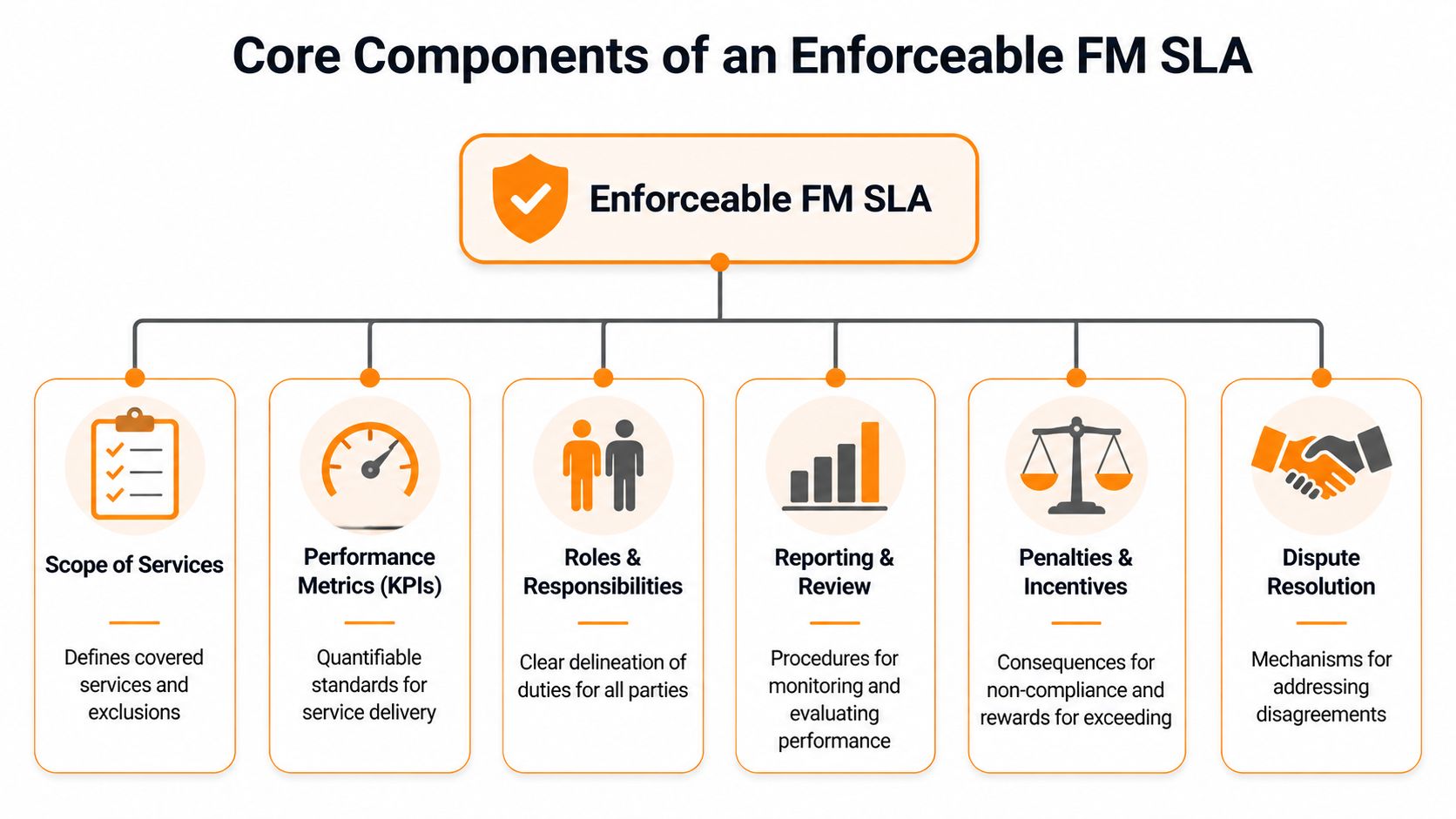
If your team is drafting from scratch, a legal template can help structure the agreement shell, but it should never replace asset-specific technical schedules. A useful starting point for clause formatting is Papersign's agreement template. The commercial form is only the beginning. The enforceability comes from the technical content attached to it.
Scope must remove interpretation gaps
The Scope of Work is where most FM disputes begin. If the scope says “HVAC maintenance included”, that still leaves unanswered questions about controls calibration, drain flushing, after-hours attendance, refrigerant handling, access coordination, temporary cooling, and fault diagnostics beyond first inspection.
A sound SLA should define scope at three levels:
Asset level
Identify equipment by type, location, and where possible by tag or asset register reference.Task level
State what preventive and corrective activities are included. Generic wording such as “inspect and service as needed” is too vague.Boundary level
State what is excluded, what requires separate approval, and what sits under specialist third-party contracts.
A practical test is simple. If a pump fails, can the property manager tell from the contract whether diagnosis, labour, consumables, temporary bypass measures, and recommissioning are included? If not, the scope is incomplete.
Metrics reporting and accountability
The second pillar is quantified performance. Response time matters, but it isn’t enough. A contractor can arrive quickly, spend hours diagnosing, leave the asset partially restored, and still claim compliance if the SLA measures attendance only.
For enforceability, use a layered metric model:
- Response metric: Time from log creation to technician attendance.
- Rectification metric: Time from attendance to restoration, or to a clearly defined temporary safe condition if full repair requires parts.
- Preventive compliance metric: Whether planned maintenance happened on schedule and with complete task evidence.
- Quality metric: Repeat faults, incomplete rectification, and defect recurrence after closure.
- Reporting metric: Whether the contractor submitted auditable records in the agreed format and timeline.
The best SLAs don’t reward busyness. They reward verifiable restoration of service.
Roles and responsibilities matter just as much. The contract should identify who logs emergencies, who authorises variation work, who approves closures, who grants roof or riser access, and who interfaces with specialist subcontractors. Many delays presented as contractor failure are contract design failures around access or approval rights.
The clauses many contracts still miss
The following items are often missing or underdeveloped:
- Escalation matrix with named responsibility by priority class.
- Definition of emergency rather than relying on opinion during an incident.
- Evidence standard for job completion, ideally including readings and site photographs.
- Asset condition baseline at mobilisation, so inherited defects aren’t confused with SLA failure.
- Review cadence for monthly operations and periodic contract recalibration.
An enforceable FM SLA doesn’t merely state expectations. It creates a recordable operational system.
Critical KPIs and Benchmark Times for Dubai FM Services
At 2:00 a.m., a chilled water failure in a hotel tower and a broken door closer in a back-of-house corridor may both enter the helpdesk as "urgent." They do not carry the same risk. One threatens revenue, guest comfort, and equipment condition within hours. The other can wait for the morning shift if the area remains safe. SLA benchmarks in Dubai need to reflect that difference from the start.
The right structure is based on consequence of failure, asset criticality, and occupancy impact. Trade category matters, but it comes second. A lift entrapment, smoke control fault, domestic water leak above occupied space, or loss of cooling in a critical area should trigger tighter attendance and restoration targets than routine MEP or soft service defects. That is how SLAs protect both OPEX and asset life.
Priority logic before response targets
A workable priority matrix is simple enough for dispatchers to apply under pressure and specific enough to prevent arguments after the event.
P1 covers life-safety exposure, major business interruption, critical asset failure, or loss of service in a high-risk occupied area.
P2 covers significant operational disruption that can continue for a short period with controls in place.
P3 covers routine defects, appearance issues, and non-critical service requests.
For high-risk assets, many Dubai portfolios set P1 attendance within 30 minutes and restoration or temporary safe condition within 4 hours. The contract should define what "restoration" means for each asset class. For a leaking pipe, it may mean isolation and making the area safe. For HVAC serving a data room, it may mean temporary cooling until permanent repair is completed. That distinction prevents false compliance and gives the owner a clearer view of actual risk.
I advise owners to avoid one generic target across the estate. A hospital, premium residential tower, logistics site, and Grade A office do not justify the same windows. The SLA should tighten or relax by building type, occupancy profile, and the cost of downtime.
For larger technical scopes, these service levels are often embedded inside integrated MEP services in Dubai and then narrowed further through equipment-specific schedules under HVAC maintenance contracts. They also need to tie back to documented compliance workflows, especially where the owner is using photo-based maintenance records to meet Dubai Municipality AMC requirements.
Benchmark SLA Response and Rectification Times by Service Priority in Dubai
| Service Type | Priority Level | Typical Trigger | Target Response Time | Target Rectification Time |
|---|---|---|---|---|
| MEP emergency systems | P1 | Power loss, critical panel alarm, major pump failure, fire-related system fault | Under 30 minutes | Within 4 hours to restore service or achieve temporary safe condition |
| HVAC critical cooling | P1 | Loss of cooling in critical occupied area, hospitality guest impact, server or control room risk | Under 30 minutes | Within 4 hours to restore cooling or deploy approved temporary measure |
| Electrical non-life-safety fault | P2 | Partial lighting failure, local DB issue, circuit trip affecting part of tenancy | 1 to 2 hours | Within 24 to 48 hours |
| Plumbing urgent defect | P2 | Active leak, blocked drainage affecting occupied area, water supply interruption to key zone | 1 to 2 hours | Within 24 to 48 hours |
| Cleaning and hygiene issue | P2 | Spill, washroom service failure, visible hygiene non-compliance in public area | 1 to 2 hours | Same operational shift or within agreed service window |
| Routine MEP defect | P3 | Minor FCU issue, non-critical fitting failure, nuisance alarm, low-impact snag | Within agreed routine window | Within agreed routine window |
| Routine soft service request | P3 | Consumable replenishment, cosmetic cleaning follow-up, non-urgent presentation issue | Within agreed routine window | Within agreed routine window |
These times are a contract design baseline, not a preset to copy line for line. Older assets with poor condition history may need a mobilisation period and separate inherited-defect register before full KPI exposure starts. Newer assets with strong OEM support can carry tighter rectification targets because the contractor has a realistic path to compliance.
KPI design that controls risk, not just vendor optics
Response time on its own is a weak control. Contractors can meet attendance targets, close the ticket, and leave the owner with repeat failures, overtime callouts, and accelerated asset wear. The stronger model measures four things separately: attendance, temporary restoration, final rectification, and recurrence.
That gives owners a clearer operating picture.
A practical KPI set for Dubai FM contracts should include:
- Emergency attendance compliance: Measured against P1 and P2 call-out windows.
- Service restoration compliance: Time to restore operation or achieve a defined safe temporary condition.
- Final rectification compliance: Time to permanent repair, with agreed exclusions for owner approvals, access restrictions, or documented parts lead times.
- Preventive maintenance completion: Completion against plan, backed by timestamps, readings, checklists, and closure photos.
- Repeat fault rate: Recurrence on the same asset or symptom within a defined period.
- Asset uptime: Applied to critical HVAC, power, pumps, lifts, and other systems where downtime has a direct cost.
- Closure evidence quality: Whether the work order contains the proof needed for audit, payment validation, and dispute control.
The trade-off is straightforward. Tighter KPIs improve response discipline and protect occupier experience, but they also increase standby cost, stockholding, and specialist coverage requirements. Owners should pay for speed where downtime creates real exposure, then avoid overspecifying the rest of the estate. That is better cost control than imposing premium response times on every work order.
What works in practice
The best SLAs split attendance from repair. They require fast mobilisation for high-risk faults, then allow a second clock for permanent rectification where OEM parts, access permits, or shutdown approvals are needed. That structure reduces disputes and keeps pressure on the contractor to stabilise the situation first.
The other factor is evidence. If a contractor claims restoration, the work order should show the meter reading, test result, photo, isolation point, and status of any temporary measure. Photo-based closure records are particularly useful in Dubai portfolios with multiple buildings and layered subcontracting because they reduce ambiguity at invoice stage and make repeat-fault reviews much easier.
If you only measure attendance, the contractor optimises dispatch. If you measure restoration, recurrence, and evidence quality, the contractor is pushed toward better diagnosis and longer asset life.
Aligning SLAs with Dubai's Regulatory and Compliance Framework
A pump trips in the middle of summer, chilled water drops, tenants escalate, and the first serious question from the owner is not whether the contractor attended fast enough. It is whether the contract required the right inspections, escalation steps, and records before the failure occurred. In Dubai, that is the compliance test. An FM SLA needs to convert statutory duties and authority expectations into work instructions, evidence standards, and decision rights that can be enforced.

Compliance clauses must be operational
Authorities and insurers do not rely on broad wording such as "maintain in accordance with applicable regulations." They look for maintenance condition, test history, permits, defect logs, and proof that the owner acted when risk was identified. If those requirements are missing from the SLA, the contractor may still be in contract while the owner remains exposed on safety, interruption, and audit findings.
For critical MEP and life-safety assets, the SLA should tie the service scope to named obligations, defined frequencies, and clear evidence requirements. That usually includes:
- inspection and testing intervals for regulated systems
- attendance and stabilisation requirements for safety-related faults
- escalation triggers to owner representatives and specialist vendors
- checklists aligned to authority and site permit requirements
- retention periods for reports, certifications, and closure records
- defect categories that require immediate temporary controls, not just a later repair
Owners using annual maintenance contracts should also check whether the preventive scope is written to support Dubai Municipality compliance requirements through AMC frameworks, rather than treating compliance as a generic contractor obligation.
The practical point is simple. Compliance needs to show up in the workflow, not only in the legal appendix.
Where owners usually leave risk uncovered
The most common drafting failure is leaving compliance at principle level. A clause that says the contractor must comply with all laws sounds protective, but it does not define the tasks, intervals, approvals, or proof needed to control the risk. That gap becomes expensive after an incident, because the argument shifts from performance to interpretation.
Three areas usually need tighter wording:
| Risk area | Weak contract wording | Stronger contract approach |
|---|---|---|
| Fire and life safety interfaces | “Maintain as required” | Define testing routines, defect classification, escalation routes, and close-out evidence |
| Electrical and power resilience | “Attend breakdowns promptly” | Set priority rules, isolation and reinstatement procedure, temporary supply protocol, and sign-off requirements |
| Authority documentation | “Submit reports monthly” | Specify forms, timestamps, photos, technician identity, supervisor approval, and document retention method |
Photo-based work orders matter here because they close a common enforcement gap. If a contractor reports a fire door adjustment, pump repair, or DB rectification, the work order should show before-and-after condition, asset tag, time of attendance, and the person who verified completion. That standard reduces payment disputes, supports audit review, and gives the owner a usable record if a regulator, insurer, or board committee later asks what was done and when.
I advise owners to draft this section of the SLA as if every material failure will need to be explained six months later to someone outside operations. That assumption changes the level of detail. It also improves asset life, because contractors are more likely to complete the right preventive tasks when the contract defines the evidence needed to prove them.
SLA Monitoring Reporting and Technology Integration
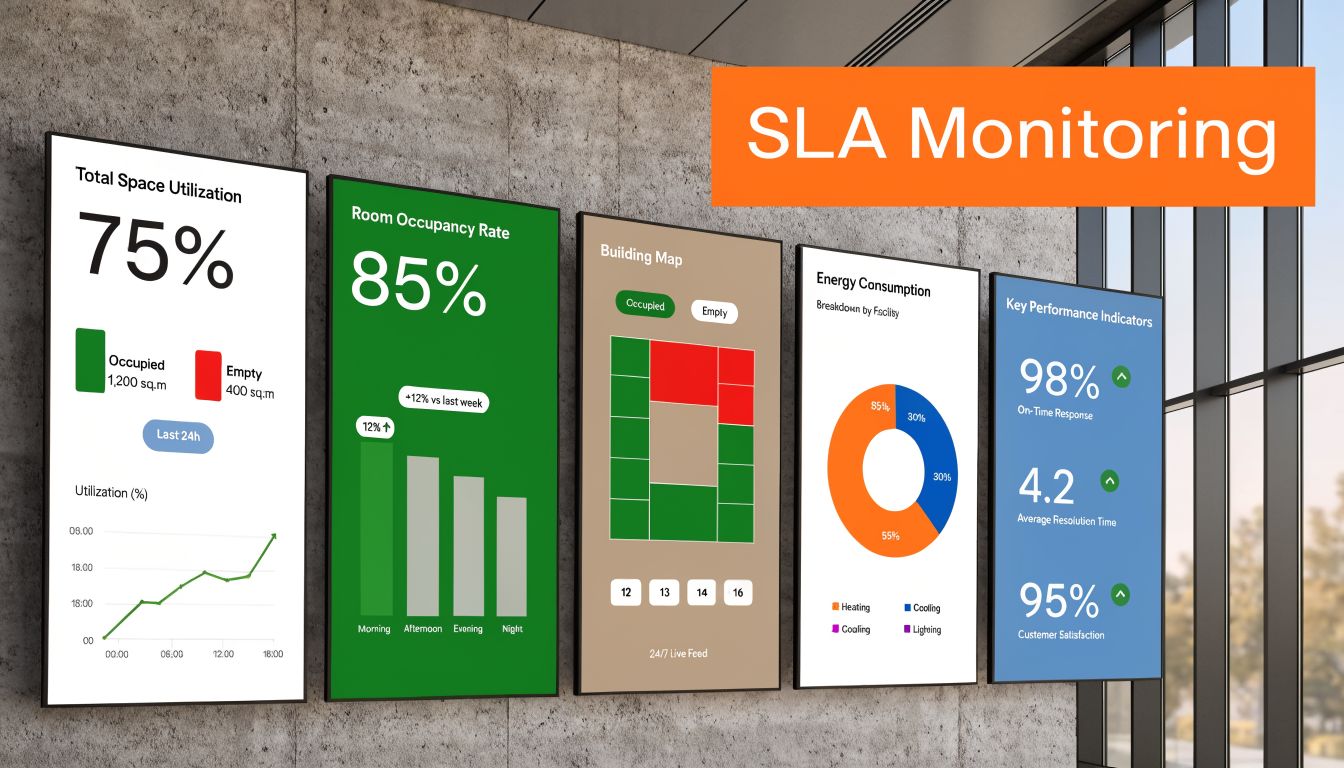
A contract only performs if the owner can see whether it’s performing. In Dubai, that means moving past emailed PDFs, handwritten service slips, and verbal updates from site teams.
Why manual reporting creates avoidable disputes
Emerging tools such as IoT sensors, mobile task verification, and digital dashboards are increasingly written into Dubai FM RFPs, yet only 30% of UAE FMCs are reported to have achieved full integration. The same source notes that weak verification often drives SLA disputes because performance can’t be objectively proven (technology adoption and FM verification challenges in the UAE).
That gap matters because an SLA breach is difficult to prove if the owner can’t verify:
- when the call was logged
- when the technician arrived
- what condition was found
- what action was taken
- whether service was restored
- whether the close-out matched the agreed standard
In reactive environments, people remember the crisis but not the timestamps. In disputes, timestamps matter more than memory.
A practical reporting stack for Dubai portfolios
For FM contracts in commercial, residential, and hospitality buildings, the most defensible monitoring model usually includes:
Digital work order logging
Every request should create a unique record with time, location, category, and priority.Photo-based verification
Before-and-after images reduce ambiguity about site condition, completion quality, and access constraints.Technician status tracking
Dispatch, arrival, work start, parts pending, temporary restoration, and closure should all be time-stamped.KPI dashboarding
Monthly reviews should show response compliance, rectification status, recurring faults, and overdue preventive tasks.Audit-ready document storage
Reports need to be retrievable by asset, date, and incident type.
Owners implementing more mature control systems often align this with wider technology-enabled maintenance and IoT monitoring workflows, especially where predictive maintenance and compliance evidence need to work together.
A photo-backed work order does more than prove attendance. It narrows the argument about whether the job was actually completed to standard.
What doesn’t work is collecting data without decision rules. Dashboards become noise if nobody defines which KPI breach triggers escalation, supplier review, commercial deduction, or revised preventive planning.
Structuring Penalties Incentives and Dispute Resolution
Financial enforcement gives the SLA its practical weight. Without it, the contract becomes a reporting exercise with no commercial consequence.
According to UAE FM best practice benchmarks, effective performance-based contracts often link 70 to 80% of payments to KPI achievement, with penalties of 5 to 10% for SLA breaches in accountability-driven maintenance arrangements (UAE FM contract and KPI payment benchmarks).
Penalty models compared
Different contract structures suit different risks.
| Model | Where it works | Limitation |
|---|---|---|
| Flat service credit | Routine service environments with frequent low-impact tasks | Can understate the seriousness of critical failures |
| Percentage deduction against invoice | Suitable where monthly KPI achievement is easy to aggregate | Can become blunt if metrics are poorly weighted |
| Priority-weighted deduction | Better for mixed-risk assets where P1 and P2 failures carry greater consequence | Needs clear metric definitions and evidence rules |
| Incentive overlay for sustained compliance | Useful where owners want long-term behaviour improvement, not only breach control | Fails if baseline metrics are weak or easy to game |
For critical systems, deductions should reflect consequence. Missing a routine cosmetic closure target isn’t commercially equivalent to failing a life-safety or core cooling obligation.
Dispute language needs operational evidence
Dispute clauses are often drafted too late and too generically. In FM, the stronger approach is to link dispute handling directly to the reporting system.
Include these items:
- Evidence hierarchy: System timestamp, approved work order, site photos, technician notes, and client closure record.
- Cure period: A short contractual window for remedy before deductions escalate.
- Escalation path: Site team, contract manager, senior management, then formal legal route if unresolved.
- Pre-agreed definitions: Emergency, temporary restoration, force majeure, access delay, excluded works.
A practical legal point under UAE conditions is that vague metrics weaken enforceability. The more measurable the service standard, the easier it is to administer deductions without turning every breach into a prolonged argument.
FAQ on Facility Management SLA Standards in Dubai
Q: What should be the first priority when reviewing an existing FM SLA in Dubai?
A: Start with the asset scope and priority matrix. If the contract doesn’t clearly state which systems are covered and how incidents are categorised into P1, P2, and routine issues, the rest of the SLA will be difficult to enforce. Most downstream disputes trace back to weak definitions at the start.
Q: Should response time and resolution time always be in the same clause?
A: They should be linked, but not merged. Response time measures attendance. Resolution time measures restoration. If you combine them loosely, the contractor may satisfy one and fail the other without any clear breach position. Separate metrics create cleaner accountability.
Q: How should owners handle parts delays in an SLA?
A: Write two standards. One for attendance and fault stabilisation, and another for final rectification where parts are needed. The contract should also define whether critical consumables or common spares must be stocked, and who approves procurement. Without that, parts delays become an easy excuse for poor planning.
Q: Are boilerplate penalty clauses enough for Annual Maintenance Contracts?
A: Usually not. In practice, Annual Maintenance Contracts (AMC) work best when the payment mechanism, KPI weighting, and deduction triggers are tied directly to service outputs and reporting evidence. That’s especially important for hard services, where preventive planning and emergency readiness need to operate together under one maintenance regime.
Q: What is the most reliable way to reduce SLA disputes in Dubai buildings?
A: Use a structured checklist before award and at mobilisation:
- Define the asset register clearly: Covered equipment, excluded systems, and specialist interfaces.
- Set measurable incident priorities: P1, P2, and routine categories with agreed triggers.
- Require objective evidence: Timestamps, site photos, readings, and closure approval records.
- Align the contract with compliance duties: Safety, authority inspections, and maintenance documentation.
- Test the commercial mechanics: Invoice deductions, cure periods, escalation path, and dispute evidence hierarchy.
For most owners, the practical implementation path is to place these controls inside structured maintenance agreements rather than relying on ad hoc call-out instructions. That’s where SLA standards become usable, not just documented.
If you're reviewing service standards, contract scope, or KPI enforcement for a Dubai asset, a practical next step is to benchmark your current maintenance model against a structured AMC and reporting workflow. SnapFixNow provides UAE-focused facility management, MEP support, and photo-based maintenance operations that can help teams compare current SLA language against operational reality.
Meta description: Facility management SLA standards Dubai explained for property owners. Learn KPIs, compliance, penalties, and reporting controls for UAE assets.