For asset owners and facility managers, the operational expenditure (OPEX) for maintaining a villa in Dubai typically ranges between 1% and 2% of the property's total value annually. This benchmark is a critical input for financial forecasting, lifecycle asset management, and ensuring sustained portfolio value. This guide provides a technical breakdown of these costs, comparing maintenance models and offering a decision framework for optimising OPEX without compromising asset integrity or regulatory compliance.
A Practical Breakdown of Villa Maintenance Costs
To accurately forecast the cost of maintaining a villa in Dubai, one must analyse the constituent parts of the total OPEX, which includes planned preventive maintenance, reactive rectification works, utilities, and mandatory community fees. Effective budgeting requires a granular understanding of each cost driver.
For property and facility managers overseeing a portfolio, financial clarity is a primary operational requirement. The table below provides an estimated annual cost breakdown for a standard 3-5 bedroom villa, serving as a high-level framework for OPEX forecasting.
Estimated Annual Maintenance OPEX for a Standard Dubai Villa
This table provides a typical cost breakdown for maintaining a standard 3-5 bedroom villa, helping asset owners and facility managers forecast operational expenditures.
| Service Category | Average Annual Cost Range (AED) | Key Operational Drivers |
|---|---|---|
| Annual Maintenance Contracts (AMC) | 1,500 – 15,000 | Scope of work (labour-only vs comprehensive), asset criticality, SLA response times. |
| Utilities (DEWA) | 40,000 – 70,000 | HVAC efficiency, irrigation system controls, occupancy patterns, DEWA tariff structure. |
| Landscaping & Pool Maintenance | 12,000 – 30,000 | Garden size, irrigation automation, plant types, pool size and equipment condition. |
| Specialised Services & Cleaning | 5,000 – 20,000 | Pest control frequency, facade cleaning, water tank cleaning, deep cleaning schedules. |
| Mandatory Community Service Charges | 15,000 – 35,000 | Community tier, common area amenities, DLD Service Charge Index, developer policies. |
This data illustrates that while an AMC is a visible cost, it often represents a smaller fraction of the total financial commitment required for compliant and effective property operation.
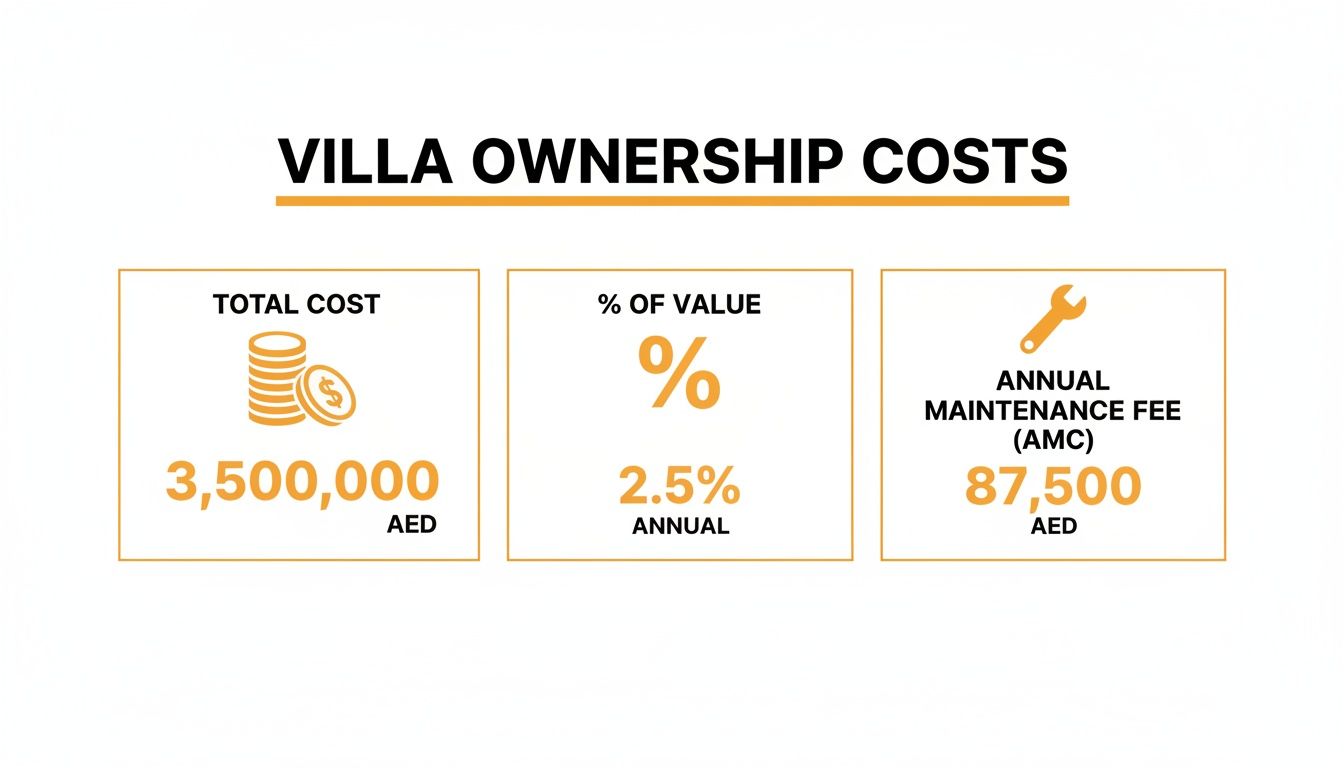
As the infographic indicates, the maintenance contract is a component of a much larger operational budget required to manage the asset effectively.
Industry data confirms this. For a standard three-bedroom villa valued between AED 3-5 million, the total annual maintenance expenditure typically falls between AED 70,000 and AED 100,000. This aligns with the 2% OPEX benchmark.
This figure is distributed across key cost centres that every facility manager must plan for. For instance, a basic Annual Maintenance Contract (AMC) may range from AED 1,500 to AED 6,000 annually, often covering emergency call-outs and baseline system checks with limited scope.
An ultimate seasonal home maintenance checklist can serve as a useful tool for mapping out the full spectrum of required tasks throughout a calendar year.
Decoding Core Hard FM Costs Like HVAC and MEP
While soft services contribute to the asset's aesthetic and habitability, it is the 'hard' facilities management (FM) services that constitute the operational core and present the most significant financial variable in the maintenance budget. These are the critical HVAC (Heating, Ventilation, and Air Conditioning) and MEP (Mechanical, Electrical, and Plumbing) systems. Mismanagement of these assets leads to escalated OPEX and premature asset failure.
In Dubai, the primary catalyst for accelerated degradation is the climate. The combination of sustained high temperatures, high humidity cycles, and significant airborne dust loading places extreme stress on mechanical and electrical systems. This environment accelerates component wear, reduces operational efficiency, and shortens the asset lifecycle unless mitigated by a structured preventive maintenance plan.
HVAC Systems: The Dominant Cost Centre
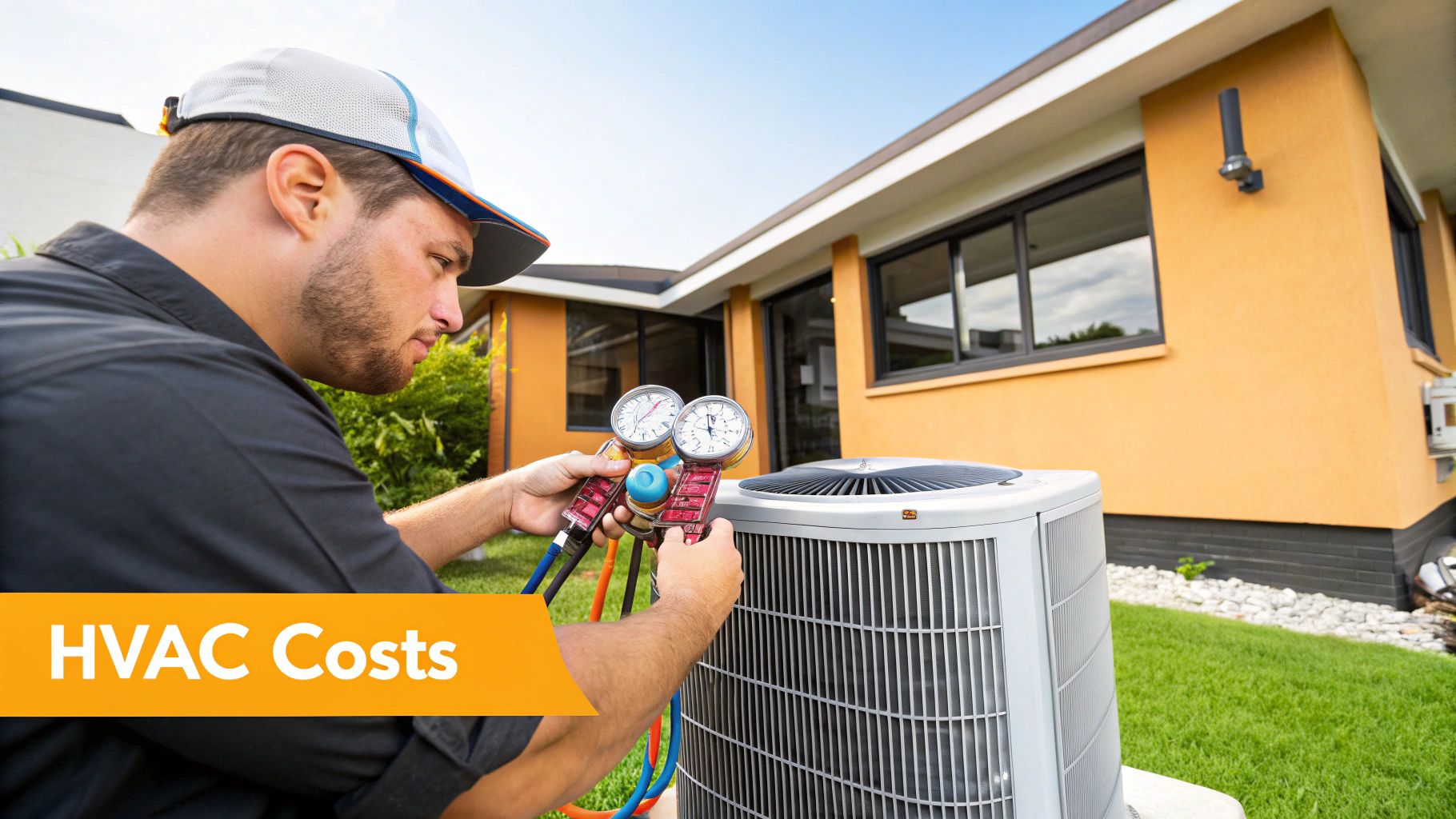
Within any Dubai villa's hard FM budget, the HVAC system is the dominant cost centre, primarily through its impact on electricity consumption. Operating almost continuously for 8-9 months of the year, it is the logical focus for both cost control and operational risk management.
A reactive "fix-on-fail" methodology is an operationally unsound and financially punitive approach. An emergency call-out for a critical AC failure during peak summer months incurs premium labour charges, introduces the risk of secondary asset damage, and guarantees significant occupant discomfort. Proactive maintenance is the only logical risk mitigation strategy.
Industry practice often shows that the cost of an emergency HVAC compressor replacement can be 5 to 10 times higher than the annual cost of a preventive maintenance plan designed to identify and rectify precursor faults.
A robust HVAC maintenance plan is based on several key preventive activities, each with direct cost implications:
- Quarterly Filter Cleaning/Replacement: Essential for maintaining required airflow and indoor air quality. Obstructed filters increase system load and can elevate energy consumption by 5-15%.
- Bi-Annual Coil and Condenser Cleaning: Dust and biofilm accumulation on coils acts as an insulator, severely impairing the system's heat exchange efficiency.
- Annual System Health Check: A comprehensive technical inspection covering refrigerant levels, electrical connections, and thermostat calibration to ensure operational parameters are within design specifications.
For a typical villa, a dedicated annual maintenance plan for the HVAC system will generally fall between AED 2,000 and AED 5,000, contingent on the number and type of units. This is not an expense but a strategic investment in OPEX control and asset lifecycle extension.
Analysing MEP and Utility Expenditures
Beyond HVAC, the remaining MEP systems and associated utility consumption represent a significant and often underestimated financial commitment. A detailed understanding of DEWA's tariff structure is essential for effective cost management.
These costs are substantial. Annual utility bills can easily reach AED 20,000-30,000, with specialised electrical or plumbing rectification works adding thousands more. DEWA’s slab tariff structure is the primary driver. For residential consumers, the electricity rate begins at AED 0.23/kWh for the first 2,000 kWh but increases to AED 0.38/kWh above 6,000 kWh (plus a fuel surcharge). This tiered system means operational inefficiency incurs costs at an accelerated rate.
A comprehensive maintenance strategy targets key points of failure before they escalate into high-cost emergencies:
- Plumbing: Regular inspections of water pumps, booster sets, and tanks are vital to prevent costly leaks and catastrophic failures in water pressure.
- Electrical: An annual inspection of distribution boards (DBs), circuit breakers, and wiring is a fundamental safety and compliance requirement.
- Utilities: Implementation of water-efficient irrigation systems and prompt rectification of minor leaks can yield significant aggregate savings on utility bills.
Ultimately, hard FM services should be viewed as an investment in asset preservation. The expenditure on preventive planning directly mitigates higher reactive costs, impacting both monthly OPEX and the long-term capital value of the property.
Budgeting for Soft Services Like Landscaping and Cleaning
While hard FM services ensure the operational functionality of a villa, soft services preserve its aesthetic value, hygiene, and overall market appeal. This category includes landscaping, professional cleaning, and security services.
For procurement teams and asset managers, budgeting for these services requires an evaluation of scope, frequency, and the unique environmental demands of Dubai. Cost drivers for soft services are primarily labour and consumables, planned to maintain a consistent standard of presentation rather than mitigate catastrophic component failure. A neglected garden or an inadequate cleaning contract can negatively impact a premium property's value as significantly as a malfunctioning mechanical system.
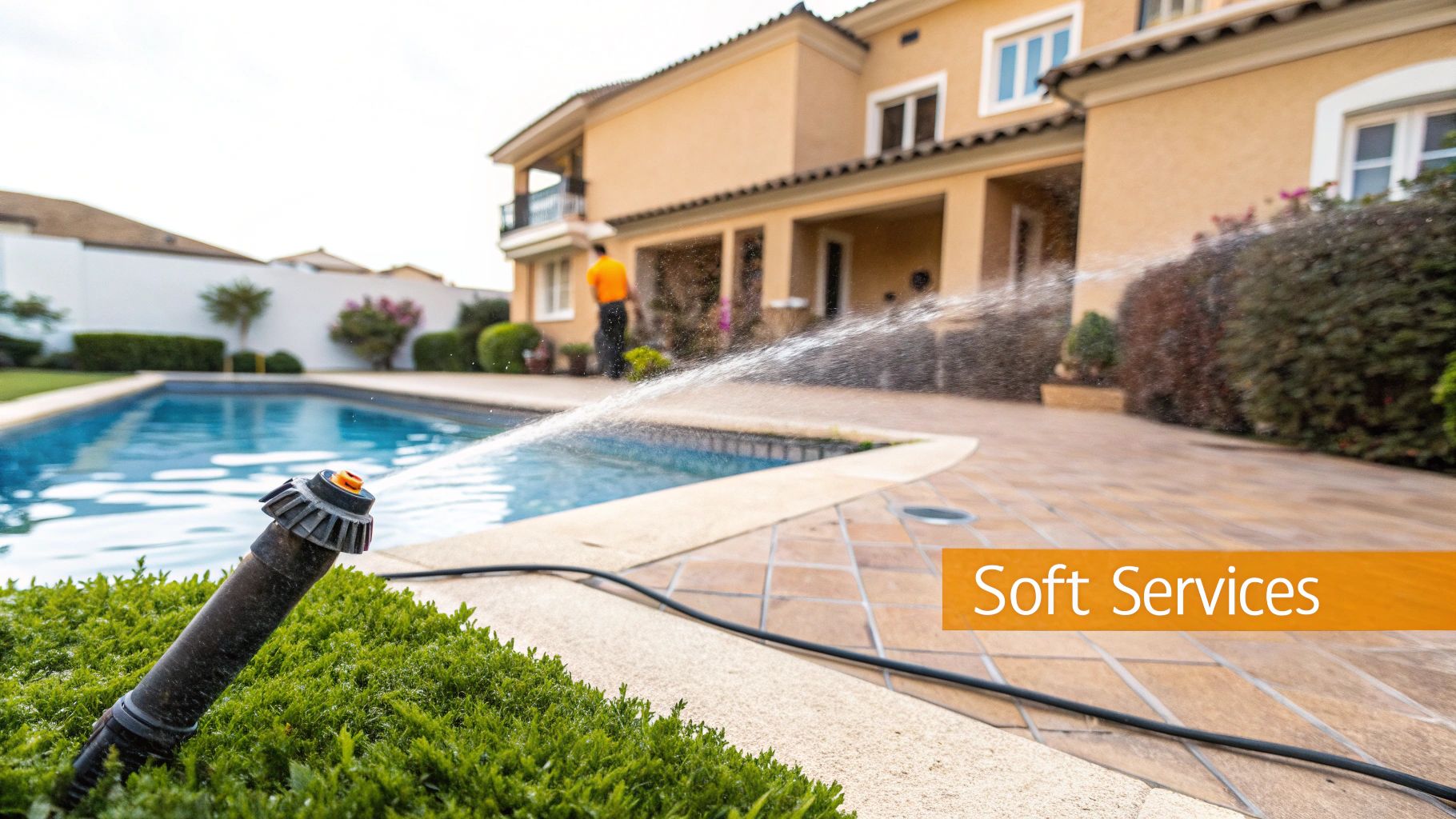
Financial and Operational Planning for Landscaping
In the UAE climate, landscaping is a technical discipline requiring expertise in irrigation management, soil science, and horticulture to ensure plant survival. The intense summer heat and high water salinity place significant stress on both flora and equipment, making professional management essential.
For a standard villa, annual costs for garden maintenance typically range between AED 8,000 and AED 18,000. This figure is sensitive to garden size, the complexity of plantings, and the sophistication of the irrigation system.
Key cost components within a service contract include:
- Irrigation System Maintenance: This involves regular inspection of pumps, nozzles, and lines for leaks or blockages. A malfunctioning irrigation system is a common cause of excessive DEWA charges.
- Pest and Disease Control: The climate necessitates a structured pest management program. Contracts must specify treatment frequency and confirm compliance with Dubai Municipality regulations on pesticide application.
- Garden Upkeep: This covers routine tasks such as lawn mowing, pruning, fertilisation, and waste removal. The scope must clearly define the number of site visits per week or month.
A critical, often overlooked cost is the seasonal replacement of plants that fail to survive the summer. A well-structured contract will include provisions or a separate allowance for this replanting, preventing unexpected expenditures in the autumn.
Quantifying Professional Cleaning Service Costs
Professional cleaning services are crucial for maintaining hygiene standards and preserving interior finishes. Costs vary widely, necessitating a clear distinction between routine housekeeping and specialised, intensive cleaning tasks.
A contract for regular housekeeping (e.g., two visits per week) for a standard villa can range from AED 12,000 to AED 25,000 annually. A comprehensive cleaning budget, however, must also account for periodic deep cleaning and other specialised services.
When planning OPEX, consider these distinct service lines:
- Routine Housekeeping: Daily or weekly cleaning, with cost driven by required man-hours per visit.
- Periodic Deep Cleaning: Typically conducted quarterly or bi-annually, this is an intensive clean of all areas. A single deep clean can cost between AED 800 and AED 2,000.
- Specialised Services: Includes facade/window washing, water tank cleaning (a mandatory compliance item in Dubai), and upholstery/curtain cleaning. These are typically priced per job or under a separate annual contract.
Evaluating Security System and Personnel Costs
Security costs for a villa are divided between technology (a capital or rental expense) and manpower (an operational expense). For most individual villas, technology-based solutions are the primary focus due to their cost-effectiveness.
Initial installation of a CCTV and alarm system can range from AED 5,000 to AED 15,000+. Ongoing operational costs are modest, typically AED 1,000 to AED 3,000 per year for maintenance and monitoring services. While manned guarding is less common for standalone villas, it becomes a significant OPEX component when budgeting at the community level.
Making Sense of Mandatory Service Charges
For villas located within master-planned communities, the maintenance budget comprises two distinct components: directly controlled costs (e.g., internal MEP maintenance) and non-discretionary costs—the mandatory community service charges.
These fees are a legal requirement for property ownership in such developments and fund the collective operation and maintenance of the entire community, from common area landscaping and security to shared amenities. For asset owners and facility managers, accurately forecasting this line item is essential for budget integrity.
The DLD Service Charge Index: Your Guide to Fair Pricing
To ensure transparency and regulate these fees, the Dubai Land Department (DLD) and its regulatory arm, RERA, publish a Service Charge Index. This tool provides approved per-square-foot rates for communities across Dubai.
This index is an invaluable resource for due diligence during property acquisition or for annual OPEX forecasting, allowing for data-driven comparisons between different developments.
The regulated fees fund essential community-wide services:
- Common Area Maintenance: Upkeep of parks, internal roads, and public landscaping.
- Shared Amenities: Operational costs for community pools, gyms, and sports facilities.
- Infrastructure Management: Maintenance of street lighting, access control systems, and shared utility networks.
- Security Services: Funding for 24/7 security teams and community-wide surveillance.
- Management and Administration: The operational cost of the owner's association management company.
What to Expect: Typical Costs and What They Cover
The cost per square foot varies based on the community's positioning, amenity provision, and scale. According to the DLD Service Charge Index, service charges for villa communities in Dubai generally range between AED 3 to AED 7 per square foot annually.
For example, a premium community like Al Barari has a flat charge of AED 7.57 per sq ft. In contrast, villas in a large-scale development like Dubai Hills Estate typically range from AED 3 to AED 4 per sq ft. Established communities such as Jumeirah Islands and Victory Heights often fall within the AED 3-7 per sq ft bracket.
It is critical to note that service charges are calculated based on the property's total built-up area (BUA), not the plot size. This distinction is crucial for accurate cost analysis when comparing properties.
These fees are a fundamental component of the total cost of ownership. For a complete financial overview, it is also important to understand the various DEWA housing charges, which constitute another significant portion of monthly expenditures. Accounting for these fixed costs is the first step toward building a realistic and predictable maintenance budget.
Comparing AMC and Ad-Hoc Maintenance Models
Decision-makers have two primary models for villa maintenance: a structured Annual Maintenance Contract (AMC) or a reactive, ad-hoc (pay-as-you-go) model. The choice is a strategic one that dictates budget predictability, asset lifecycle, and operational risk. The core trade-off is between short-term cost flexibility and long-term asset health.
The ad-hoc model is reactive by definition: a fault occurs, a service provider is engaged for a single transaction, and an invoice is paid. This offers maximum flexibility but introduces significant budget volatility and operational risk, particularly for critical system failures.
Conversely, an AMC is a proactive service agreement. A fixed annual fee covers a predefined scope of maintenance services, converting maintenance from an unpredictable event into a planned OPEX line item. The primary objective is to mitigate failures through scheduled preventive interventions.
A Risk-Based Operational Comparison
For property managers and asset owners, the selection between these models must be driven by operational and financial analysis. The appropriate model depends on asset criticality and the organisation's tolerance for unplanned expenditure and operational disruption.
The fundamental difference lies in risk allocation. The ad-hoc model accepts the risk of failure, forcing a reactive response. An AMC is designed to systematically reduce the probability of failure, thereby lowering the total cost of ownership over the asset's lifecycle. To review typical contract structures, see this guide on the difference between one-time repairs and annual AMC packages.
Financial Implications and Total Cost of Ownership
From a purely financial standpoint, the ad-hoc model can appear more cost-effective for non-critical, low-impact issues. Engaging a provider for minor cosmetic rectification does not warrant a comprehensive contract.
However, for critical systems—HVAC, water pumps, main electrical panels—this logic is inverted. An emergency HVAC failure during Dubai's summer can result in costs exponentially higher than a planned service. The total cost includes not only the repair itself but also premium rates for emergency labour, the potential for secondary damage (e.g., water leaks), and the high indirect costs associated with occupant dissatisfaction. An AMC transfers this risk to the service provider for a fixed annual fee, providing budget certainty.
A key metric to consider is the cost of downtime. For a high-value tenanted villa, a single day without air conditioning can result in financial penalties or reputational damage far exceeding the annual cost of a comprehensive AMC. The contract effectively functions as an insurance policy against operational failure.
To facilitate an objective evaluation, the following table provides a direct operational comparison.
Operational Comparison: Annual Maintenance Contract vs Ad-Hoc Model
This table contrasts the structured AMC with a reactive model, highlighting the trade-offs in cost control, risk management, and administrative efficiency.
| Evaluation Metric | Annual Maintenance Contract (AMC) | Ad-Hoc (Reactive) Model |
|---|---|---|
| Cost Predictability | High. Fixed annual cost provides OPEX certainty, simplifying budget forecasting. | Low. Costs are unpredictable and can lead to significant budget overruns. |
| SLA & Response Times | Guaranteed. Contractually defined response times for critical and non-critical issues. | Variable. Dependent on provider availability at the time of failure; no guaranteed response. |
| Preventive Planning | Core component. Includes scheduled inspections and servicing to prevent failures. | None. Service is initiated only after a fault has occurred. |
| Asset Lifecycle Impact | Positive. Proactive maintenance extends the operational life of equipment and reduces capital replacement frequency. | Negative. Repeated failures and unmanaged wear accelerate asset degradation, increasing total cost of ownership. |
| Administrative Overhead | Low. Single contract and vendor relationship simplifies procurement and payment processes. | High. Requires sourcing, vetting, and managing multiple vendors for different jobs, increasing administrative burden. |
| Compliance & Reporting | Structured. Provides service reports and documentation for compliance and asset history tracking. | Inconsistent. Lacks formalised reporting, making it difficult to track asset performance and compliance history. |
In conclusion, while the ad-hoc model offers flexibility for minor, non-critical tasks, an AMC provides the structure, predictability, and risk mitigation essential for protecting the high-value systems that ensure a villa's operational integrity.
A Framework for Fine-Tuning Your Maintenance OPEX
A structured framework is required to optimise maintenance OPEX without compromising asset integrity or compliance. This engineering-based approach enables owners and facility managers to define service requirements, establish performance metrics, and implement a strategy that protects the long-term asset value. The objective is to transition from reactive expenditure to controlled, planned operational costs.
A sound strategy begins with a technical understanding of the managed assets, which requires a formal condition-based assessment.
Start with a Comprehensive Asset Condition Audit
Prior to defining a maintenance budget or scope, a detailed audit of all critical systems is necessary. This audit must document the age, condition, and service history of all major HVAC, MEP, and specialised equipment. The findings directly inform maintenance priorities and identify key areas of operational risk.
For example, a 10-year-old HVAC system exposed to the Dubai climate requires a more intensive preventive maintenance regimen than a 2-year-old unit. The audit identifies assets nearing their end-of-life, enabling proactive capital expenditure (CAPEX) planning and avoiding the high costs of emergency replacement.
An asset audit is not an expense; it is a critical risk mitigation tool. It provides the empirical data needed to justify preventive maintenance expenditure and moves budget discussions from subjective opinion to objective, fact-based analysis.
Define and Enforce Clear Service Level Agreements
With a clear understanding of asset conditions, the next step is to establish precise Service Level Agreements (SLAs) with the maintenance provider. Ambiguous scopes of work are a primary cause of cost disputes and operational failure. Effective SLAs must be specific, measurable, and directly linked to operational priorities.
Key components of a robust SLA include:
- Response Time Thresholds: Define clear arrival times based on fault severity. For a Critical Failure (e.g., total AC outage), a response within 60-120 minutes is standard. An Urgent issue (e.g., partial failure) may be 4-6 hours, while a Routine job can be scheduled within 24 hours.
- Rectification Timelines: Specify the maximum time allowed for fault resolution. This holds the provider accountable for performance, not merely attendance.
- Preventive Maintenance Schedule: Explicitly list the frequency and scope of all preventive tasks, from quarterly filter changes to annual electrical panel inspections, leaving no room for ambiguity.
- Reporting Requirements: Mandate detailed service reports after every visit. This creates an auditable record of asset performance and demonstrates compliance history.
This structured approach transforms maintenance from a reactive cost centre into a managed, predictable operational function. By applying this framework—auditing assets, defining stringent SLAs, and focusing preventive resources on high-value systems—one can build a maintenance strategy that is both cost-effective and operationally resilient, ensuring regulatory compliance while protecting asset lifecycle value.
Got Questions About Villa Maintenance? We’ve Got Answers.
When managing villa upkeep in Dubai, property managers and asset owners frequently encounter similar operational questions. Below are concise, technical answers to common queries.
What Are the Most Common Hidden Maintenance Costs for a Villa in Dubai?
Beyond predictable service charges, the most significant unforeseen costs typically arise from the impact of Dubai’s climate on MEP systems. Premature failure of HVAC components (compressors, coils) due to constant heat stress is common. High water salinity accelerates the degradation of water pumps and heaters. Furthermore, outdoor electrical enclosures are susceptible to failures caused by humidity and dust ingress.
Another notable cost is specialised pest control; standard treatments are often insufficient, necessitating a formal quarterly or annual contract. Finally, water ingress following rare heavy rainfall events can lead to substantial, unplanned expenditure on waterproofing, roofing, and other civil rectification works.
How Does an AMC Scope Impact Its Price and Value?
The price of an Annual Maintenance Contract (AMC) is a direct function of its scope. A basic, labour-only contract offers the lowest initial price but provides limited value, as all spare parts and consumables are billed separately. This model creates an unpredictable operating budget (OPEX).
In contrast, a comprehensive contract has a higher fixed cost but is structured to provide budget certainty. It typically includes scheduled preventive maintenance, consumables up to a specified value, and guaranteed Service Level Agreements (SLAs). The value is realised by including critical, high-failure-risk assets such as HVAC systems, pool equipment, and main water pumps. For a facility manager, a comprehensive AMC is a strategic tool for mitigating the financial shock of large, unexpected repair costs.
What Is a Reasonable SLA for Emergency Maintenance Call-Outs in Dubai?
In the UAE, industry practice for emergency call-outs within a professional AMC is tiered by fault severity:
- Critical Failure: Total loss of air conditioning, power, or water; a major plumbing leak causing asset damage. Expected on-site response time is 60 to 120 minutes, 24/7.
- Urgent Issue: A significant but non-catastrophic fault, such as a partial AC failure or a minor, containable leak. A 4-6 hour response time is the standard.
- Routine Repair: Non-urgent issues like a faulty light fixture or a dripping tap. A 24-48 hour response window is acceptable.
These SLAs are the core of a functional maintenance agreement and must be clearly defined within the contract to ensure adequate protection of the asset's operational continuity.