The annual maintenance contract (AMC) cost for commercial and high-end residential assets in Dubai typically ranges between 1% and 3% of the asset's total replacement value. The final figure within this range is a function of system complexity, operational intensity, and the level of risk transferred to the service provider.
An Executive Summary for Decision-Makers
An Annual Maintenance Contract (AMC) is a strategic operational expenditure (OPEX) designed to preserve asset value and ensure operational continuity. The cost is a direct reflection of the technical sophistication of building systems, specified Service Level Agreements (SLAs), and the demanding local operating environment. For facility managers, asset owners, and procurement teams, understanding these cost drivers is the foundational step in conducting a meaningful, like-for-like comparison of proposals.

Ultimately, AMC pricing is dictated by the scope of work and asset type. A high-rise commercial tower with integrated chiller plants, a complex building management system (BMS), and critical life safety systems will command a higher cost than a low-rise residential building with standard split AC units due to the disparity in technical risk and maintenance requirements.
Key Financial Benchmarks for Budgeting
To provide a clear financial orientation, the following benchmarks are presented. These figures serve as a starting point for budget forecasting and illustrate typical costs for an annual maintenance contract in Dubai under normal operating conditions.
Estimated Annual Maintenance Contract Cost Benchmarks in Dubai
This table outlines typical AMC cost ranges by property type and scope. It is designed to provide a financial baseline before soliciting detailed proposals.
| Property Type | Typical Scope | Estimated Annual Cost Per Sq Ft | Key Cost Drivers |
|---|---|---|---|
| Grade A Commercial Office Tower | Comprehensive MEP, HVAC (Chillers), Fire & Life Safety | AED 7 – AED 15+ | BMS complexity, vertical transport, 24/7 SLA requirements |
| High-End Residential Tower | MEP, HVAC (VRF/Splits), Common Area Civil Works | AED 5 – AED 10 | Number of units, swimming pool/gym facilities, tenant SLAs |
| Retail Mall / Large Venue | Comprehensive MEP, Specialist Systems, High Footfall Areas | AED 8 – AED 18+ | 24/7 operation, public safety compliance, specialist lighting |
| Industrial Warehouse / Facility | MEP, Industrial HVAC, Loading Bay Equipment | AED 4 – AED 9 | Asset specialisation, regulatory compliance, operational hours |
These ranges account for the environmental stress factors unique to Dubai's climate, including high dust loading on filtration systems and heat stress on HVAC components. When planning annual operational costs, this AMC budget must be considered alongside other regulatory overheads, such as the yearly Dubai Economic Department license renewal.
An AMC functions as a financial instrument against unplanned downtime and excessive rectification costs. The premium is a calculated investment to extend asset lifecycle and ensure operational stability.
The objective is to align contract cost with the asset's operational risk profile. A lower-cost contract often signifies risk transference back to the asset owner, typically through service exclusions, extended response times, or a reactive maintenance model instead of a preventive one.
Core Drivers of AMC Pricing in Dubai
When evaluating proposals for an annual maintenance contract in Dubai, significant price variances are seldom arbitrary. They are a calculated reflection of operational risk, technical complexity, and specified service levels.
To conduct a true like-for-like comparison, the focus must shift from 'how much' to 'why'. The cost of any AMC is built upon the scope of work, asset condition, SLA stringency, and the local climate. Each factor directly impacts the manpower, materials, and risk that the provider must price into the contract.
The Scope of Services
The breadth and depth of the services covered form the baseline for any quotation. A contract limited to basic preventive maintenance on Mechanical, Electrical, and Plumbing (MEP) systems will cost substantially less than a comprehensive agreement.
A typical scope breakdown includes:
- Core MEP Systems: Electrical distribution boards, plumbing networks, and drainage systems.
- HVAC Systems: This is a major cost centre, particularly in the UAE. The system type—from split units to Variable Refrigerant Flow (VRF) or centralised chillers—dictates maintenance complexity and cost.
- Fire and Life Safety Systems: Maintenance of fire alarms, sprinklers, and emergency lighting is a non-negotiable requirement for compliance with Dubai Civil Defence regulations.
- Specialised Systems: Building management systems (BMS), access control, swimming pools, and vertical transport require specialist technicians, adding to the cost.
- Civil Works: This typically covers minor rectifications to the building's fabric, such as masonry, painting, or carpentry repairs.
The inclusion of more systems directly increases the required technical expertise and man-hours, escalating the contract price.
Asset Age and Condition
The physical state of the equipment is a significant risk factor that a service provider must price into the contract. An older building with aging infrastructure presents a higher probability of component failure, necessitating more intensive preventive planning.
From a technical standpoint, a 15-year-old chiller plant has a fundamentally different risk profile than a 2-year-old unit. The maintenance plan for the older asset must account for a higher likelihood of component failure, potential parts obsolescence, and increased energy inefficiency, all of which translate to a higher AMC premium.
This reality is reflected in property service charges across Dubai, which are managed by the Dubai Land Department (DLD) and vary significantly based on the maintenance demands of different buildings. An older tower requires a larger budget allocation for repairs and system upgrades than a new development.
Service Level Agreement Parameters
The Service Level Agreement (SLA) codifies performance expectations and directly impacts price. More stringent SLAs require the provider to maintain a larger, more responsive technical team, often on a 24/7 basis, which increases overheads and contract cost.
Key SLA metrics that drive cost include:
- Response Time: The mandated time for a technician to be on-site. A 1-hour response for a critical failure is more costly than a 4-hour response.
- Rectification Time: The maximum time allowed to resolve the issue. Guaranteeing short rectification times for critical systems often requires the provider to hold expensive spare parts in inventory, a cost that is passed on to the client.
- Service Hours: A 24/7/365 coverage model is inherently more expensive than one limited to standard business hours.
The Dubai Climate Factor
The region's unique environmental stressors act as a cost multiplier. The combination of extreme heat, high humidity, and airborne dust accelerates asset degradation.
- HVAC Strain: Prolonged operation under high ambient temperatures increases wear and tear on compressors, fans, and coils.
- Dust and Sand: High dust loading necessitates more frequent cleaning of filters, coils, and air handling units to maintain efficiency and prevent failures.
- Corrosion: High humidity and saline coastal air accelerate the corrosion of metallic components, from condenser units to structural fixtures.
A correctly priced AMC for a Dubai property must account for this accelerated degradation with a more intensive preventive maintenance schedule, which translates to a higher cost. For a deeper understanding of these factors, learn more about facility management services in the UAE.
Comparing Comprehensive Versus Labour-Only AMC Models
A critical decision in procuring an Annual Maintenance Contract (AMC) in Dubai is the selection of the contract structure. This choice directly impacts budget predictability and operational risk. The two primary models are the Comprehensive AMC and the Labour-Only AMC.
Understanding their differences in scope, risk allocation, and cost is essential for making a sound financial and operational decision.
This diagram breaks down the core elements that drive the price of an annual maintenance contract in Dubai, focusing on scope, asset age, and the demanding local climate.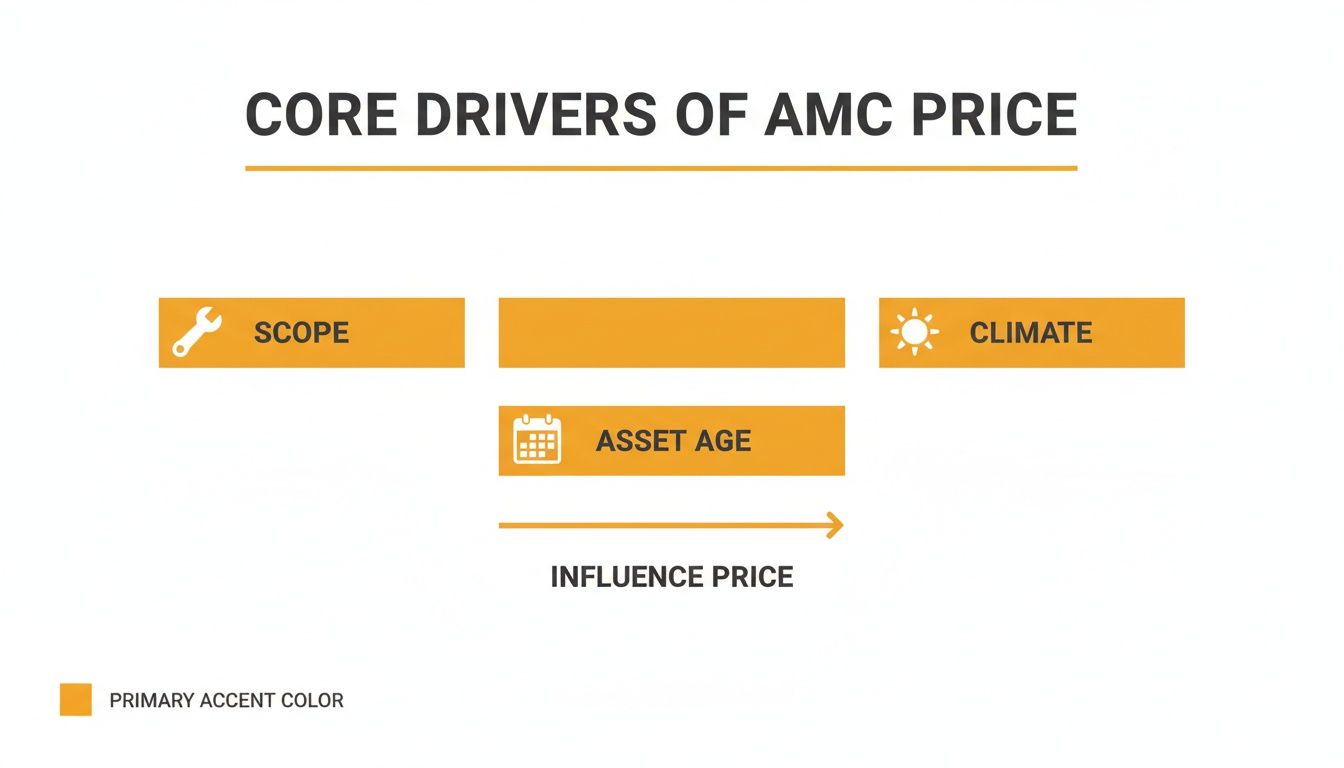
Each factor represents a specific operational risk that a service provider must calculate and incorporate into the final contract price.
Risk Allocation: The Fundamental Difference
The primary distinction between these models is the allocation of financial risk for component failure.
A Comprehensive AMC is structured to transfer the majority of this risk from the asset owner to the service provider. For a fixed, higher annual fee, the provider covers both labour and the cost of spare parts and consumables for both preventive maintenance and breakdowns. This model provides maximum budget predictability, converting variable maintenance costs into a fixed operational expenditure (OPEX).
Conversely, a Labour-Only AMC (or non-comprehensive contract) retains the risk and cost of materials with the asset owner. The contract covers technician labour for scheduled maintenance and call-outs. All spare parts, components, and consumables are billed separately. While this results in a lower initial contract price, it exposes the budget to significant, unplanned costs in the event of major component failure.
A Comprehensive AMC functions as an insurance policy against unforeseen failures, ensuring budget certainty. A Labour-Only AMC offers a lower upfront cost but exposes the budget to the volatility of equipment performance and market prices for spare parts.
A Decision Matrix: Comprehensive vs. Labour-Only
To clarify the trade-offs, a direct comparison across key operational and financial parameters is necessary. The differences reflect two distinct strategies for managing asset lifecycle and financial risk.
Operational and Financial Comparison of AMC Contract Models
| Parameter | Comprehensive AMC | Labour-Only or Non-Comprehensive AMC |
|---|---|---|
| Scope of Supply | Includes technician labour, all standard spare parts, and consumables for PPM and breakdowns. | Covers only technician labour for scheduled maintenance and call-outs. |
| Cost Structure | Higher fixed annual premium, providing predictable OPEX. | Lower fixed annual fee with variable, additional costs for all parts and materials. |
| Financial Risk | Risk of parts failure and price volatility is transferred to the service provider. | Asset owner retains all financial risk for component failures and parts procurement. |
| Budgeting Impact | Simplifies financial planning with a single, predictable maintenance cost. | Complicates budgeting; requires a separate contingency fund for unforeseen repairs. |
| Operational Incentive | The provider is motivated to perform high-quality preventive maintenance to minimise their own costs on future repairs. | The provider's primary incentive is to fulfill labour hours; no financial stake in preventing parts failure. |
| Ideal Use Case | Best for critical assets where downtime is costly and budget predictability is paramount (e.g., commercial towers, hospitality). | Suitable for non-critical assets, newer buildings under warranty, or where owners have in-house parts procurement capabilities. |
The optimal choice depends on the organisation's risk tolerance and internal capabilities. A comprehensive model offers strategic risk mitigation and simplified financial management. A labour-only model provides a lower entry cost but requires more active financial oversight and the capacity to absorb unpredictable repair expenditures.
The Strategic Shift in UAE Facility Management
Facility management in Dubai has evolved from a reactive, break-fix service to a proactive, data-driven discipline. Asset owners and facility managers now leverage the Annual Maintenance Contract (AMC) as a strategic tool for optimising operating costs (OPEX) and preserving long-term asset value.
This evolution is driven by the increasing technical complexity of modern buildings and a greater focus on lifecycle cost management. Clients now demand transparent pricing, scalable service levels, and a clear return on maintenance investment. The modern AMC is a strategic partnership designed to minimise asset downtime and extend the operational life of critical equipment.
From Reactive Repairs to Proactive Performance Management
The strategic shift is fundamentally about moving from a reactive to a preventive posture. A reactive model waits for a failure—such as an HVAC system outage in August—and then initiates an emergency response. This approach leads to unpredictable costs, significant operational disruptions, and premium charges for emergency rectification.
A proactive model, by contrast, utilises scheduled, preventive maintenance to identify and address potential issues before they escalate into failures. This is built on several core principles:
- Predictable OPEX: Planned maintenance transforms costs into a predictable budget item rather than a series of unplanned financial events.
- Asset Lifecycle Extension: Regular, manufacturer-compliant servicing reduces wear and tear, directly extending the operational life of high-value equipment like chillers, pumps, and electrical switchgear.
- Reduced Downtime: The primary objective is to prevent failures, ensuring operational continuity for tenants and users, which is critical in commercial and hospitality environments.
An effective AMC transforms maintenance from a cost centre that fixes problems into a value-generating function that prevents them. This pivot requires a deeper level of technical planning and a solid commitment to data-driven decision-making.
The Growing Importance of Regulatory Compliance
Dubai's stringent regulatory environment is another major force driving this evolution. A structured AMC is essential for ensuring a building's systems remain compliant with standards set by key authorities.
This includes adherence to regulations from:
- Dubai Municipality: Governing building codes, public health, and general safety standards.
- Dubai Civil Defence (DCD): Regulating all fire and life safety systems with strict mandates for periodic testing and maintenance.
- Real Estate Regulatory Agency (RERA): Influencing standards for common area maintenance in jointly owned properties.
A well-designed AMC integrates these compliance checks into the preventive maintenance schedule, providing asset owners with a documented record of adherence. This documentation is invaluable during audits and helps mitigate liability. This focus on compliance is one area where technology-enabled maintenance solutions are reshaping the industry.
Scalability and Access to Specialised Expertise
Modern business operations demand agility, and maintenance contracts are adapting. AMCs in Dubai are increasingly flexible, moving away from rigid agreements. Providers now offer varied contract terms, scalable service scopes, and adaptable payment structures. Crucially, this model provides access to specialised expertise without the overhead of hiring full-time specialists, offering a cost-effective method for maintaining complex building systems. This adaptability allows organisations to align maintenance expenditure directly with their operational requirements.
A Framework for Evaluating AMC Proposals
Receiving quotations for an annual maintenance contract in Dubai is the beginning of the evaluation process, not the end. A structured framework is required to perform a like-for-like comparison that assesses value, operational risk, and total cost of ownership beyond the headline price.
This process is a technical and commercial audit of each proposal, designed to identify hidden costs, clarify ambiguous service commitments, and ensure the offering aligns with facility requirements. A low price often signifies risk being transferred back to the asset owner through scope gaps or imprecise contract language.
Step 1: Verify the Scope of Work and Asset Inventory
First, meticulously validate the proposed scope. A term like “MEP Maintenance” must be explicitly defined. Create a master checklist of all assets and systems requiring maintenance within the facility.
Compare each proposal against this master list, identifying all discrepancies.
- Asset Inventory Alignment: Does the provider's asset list match yours? Are all critical pumps, AHUs, electrical panels, and fire safety systems specifically itemised?
- System Boundaries: Define the limits of responsibility. For plumbing, does the scope cover main lines only, or does it extend to fixtures within tenant spaces?
- Specialised Systems: Are systems like swimming pool equipment, BMS, or access control included, or are they designated as separate, extra-cost items?
Any ambiguity here is a significant red flag. A proposal that omits critical equipment is not cheaper; it is incomplete.
Step 2: Scrutinise Inclusions and Exclusions
The "Exclusions" clause is where unforeseen costs often reside. A thorough review of this section is non-negotiable.
From a risk management perspective, the exclusions list is more important than the inclusions list. It defines the operational and financial risks that remain entirely with the asset owner. A lengthy or vague exclusions list directly translates to a higher potential for unbudgeted OPEX.
Pay close attention to these common areas:
- Major Component Failures: Most contracts exclude the replacement of "major components" like chiller compressors or main transformers. Demand a precise definition and an itemised list of what constitutes a major component.
- Consumables and Spare Parts: In a comprehensive contract, check for value caps on parts or exclusions for specific types of spares. In a labour-only contract, confirm the process for parts approval and procurement.
- Negligence and Misuse: The contract's definition of damage resulting from user error or negligence must be precise to avoid future disputes.
- Civil Works: Clarify the extent of civil work included. Is it limited to minor touch-ups, or does it cover more substantial repairs like tile replacement or waterproofing?
Step 3: Assess Technical Capabilities and Manpower Allocation
A contract's value is determined by the competency of the team executing it. The proposal must provide clear evidence of technical capability and a viable deployment plan.
Your evaluation should address:
- Technician Certifications: Are technicians certified and trained on the specific systems within your facility (e.g., specific chiller brands or fire alarm systems)?
- Manpower Allocation: Does the proposal outline a clear staffing plan? Will dedicated technicians be on-site, or will a mobile team handle call-outs? The latter can impact rectification times.
- Subcontractor Reliance: To what extent does the provider rely on third-party subcontractors? Excessive reliance can introduce delays and inconsistencies in service quality.
Step 4: Analyse the Proposed Service Level Agreement (SLA)
The Service Level Agreement (SLA) is the core of the contract. It must be specific, measurable, and aligned with your facility's operational needs. A generic SLA indicates a lack of tailored planning.
Focus on these critical SLA metrics:
- Response vs. Rectification Time: The proposal must clearly differentiate between response time (time to arrive on-site) and rectification time (time to resolve the issue). A rapid response is of little value if the problem persists for days.
- Criticality Levels: A robust SLA will define different response times based on severity levels (e.g., critical, urgent, routine). A water leak in a data centre requires a faster response than a non-critical lighting failure.
- Reporting and KPIs: What key performance indicators (KPIs) will be reported, and at what frequency? Look for a commitment to provide monthly reports on asset uptime, call-out volume, and SLA adherence. This data is essential for contract management and accountability.
By applying this structured framework, you can move beyond price to evaluate each proposal on its ability to mitigate risk, ensure operational continuity, and preserve asset value—the true metrics of a successful annual maintenance contract in Dubai.
Frequently Asked Questions for Asset Managers
When evaluating an Annual Maintenance Contract (AMC) in Dubai, several key questions consistently arise among facility managers, asset owners, and procurement teams. This section provides direct, operationally-focused answers.
What Is Typically Excluded From a Standard AMC in Dubai?
A standard AMC is designed to manage predictable maintenance and routine repairs within an operational expenditure (OPEX) framework. It is not a comprehensive insurance policy against all possible failures. Understanding exclusions is critical for managing unbudgeted costs.
Common exclusions include:
- Major Component Replacement: High-cost, long-lifecycle items such as chiller compressors, main electrical transformers, or complete elevator cars. The replacement of these assets is considered capital expenditure (CAPEX), not routine maintenance.
- System Upgrades or Enhancements: An AMC maintains systems to their original design specifications. Work intended to improve performance, such as a Building Management System (BMS) software upgrade or an energy-efficiency retrofit, is outside the scope and treated as a separate project.
- Damage from External Factors: The provider is not responsible for events beyond their control. This includes damage from force majeure events (e.g., storms, floods), utility power surges, civil disturbances, or third-party negligence.
- User Negligence or Misuse: Equipment failure resulting from improper operation by tenants or staff is typically not covered. This underscores the importance of clear standard operating procedures (SOPs) and user training.
- Specialised Third-Party Systems: Highly specialised equipment like elevators, escalators, or complex security systems often require their own dedicated maintenance contracts, frequently with the Original Equipment Manufacturer (OEM). Unless explicitly included, assume they are excluded.
How Does Building Age Impact The Cost of An Annual Maintenance Contract?
Building age is a primary risk variable in AMC pricing. From an engineering perspective, an older building presents a significantly different risk profile than a new one, and this elevated risk is priced into the contract.
Older buildings have a higher statistical probability of component failure. The MEP systems in a 15-year-old tower are more prone to breakdowns than those in a new facility. This increased failure rate requires the service provider to budget for more frequent emergency call-outs and maintain a larger inventory of spare parts, particularly under a comprehensive contract.
Furthermore, parts obsolescence becomes a factor. Sourcing components for older systems can be difficult and costly. These systems are also typically less energy-efficient and require more intensive preventive maintenance to sustain performance. This translates to higher labour costs and a higher overall AMC fee.
An AMC for an older asset isn't just priced on the checklist of scheduled tasks. It's priced on the statistical probability of failure. The premium you pay reflects the provider taking on a greater share of the financial and operational risk that comes with aging equipment.
Are Spare Parts Included in A Comprehensive AMC?
Yes, in principle. The core value proposition of a comprehensive AMC is the inclusion of spare parts for both scheduled preventive maintenance (PPM) and breakdown repairs. The model is designed to provide predictable OPEX by transferring the financial risk of parts failure to the service provider.
However, the term "comprehensive" requires careful scrutiny, as the scope of included parts can vary significantly. Before signing, it is imperative to verify:
- Value Caps: Is there an annual monetary limit on the total value of spare parts covered?
- Major Component Exclusions: Does the contract's fine print specifically exclude certain high-cost components, even if they are not major CAPEX items?
- Consumables vs. Spares: How is the line defined between routine consumables (e.g., filters, lubricants) and actual replacement parts?
This area is a common source of contractual disputes. Obtaining written clarification is essential to prevent unforeseen expenditures.
What SLA Response Times Are Standard for Critical Assets in Dubai?
The Service Level Agreement (SLA) must be directly proportional to the criticality of the asset to the facility's operations. For systems in commercial or hospitality settings where downtime translates to revenue loss or safety risks, industry practice in Dubai dictates stringent response times.
A well-structured AMC will clearly define response tiers:
- Emergency Response (Critical Systems): For assets such as primary HVAC chillers, main electrical panels, or fire safety systems, an on-site technician response time of 30 to 60 minutes is a typical industry benchmark.
- Urgent Response (Non-Critical): For significant but non-emergency issues, such as a localized AC unit failure in a common area or a minor plumbing leak, a 2 to 4-hour response time is standard.
Crucially, a fast response time is insufficient without a corresponding rectification time—the maximum time allowed to resolve the issue. These timelines must be clearly documented in the SLA and linked to performance penalties to ensure accountability.