Filing an insurance claim in Dubai has become much more than a paperwork exercise. These days, it demands irrefutable technical proof to get past the increasingly tough underwriting standards. Insurers now expect a complete file of evidence—we're talking timestamped photos, reports from certified technicians, and detailed, itemised repair estimates.
If you don't have this kind of airtight documentation, even the most legitimate claims can get stuck in delays or, worse, rejected outright.
Why Dubai Insurers Demand Airtight Technical Proof
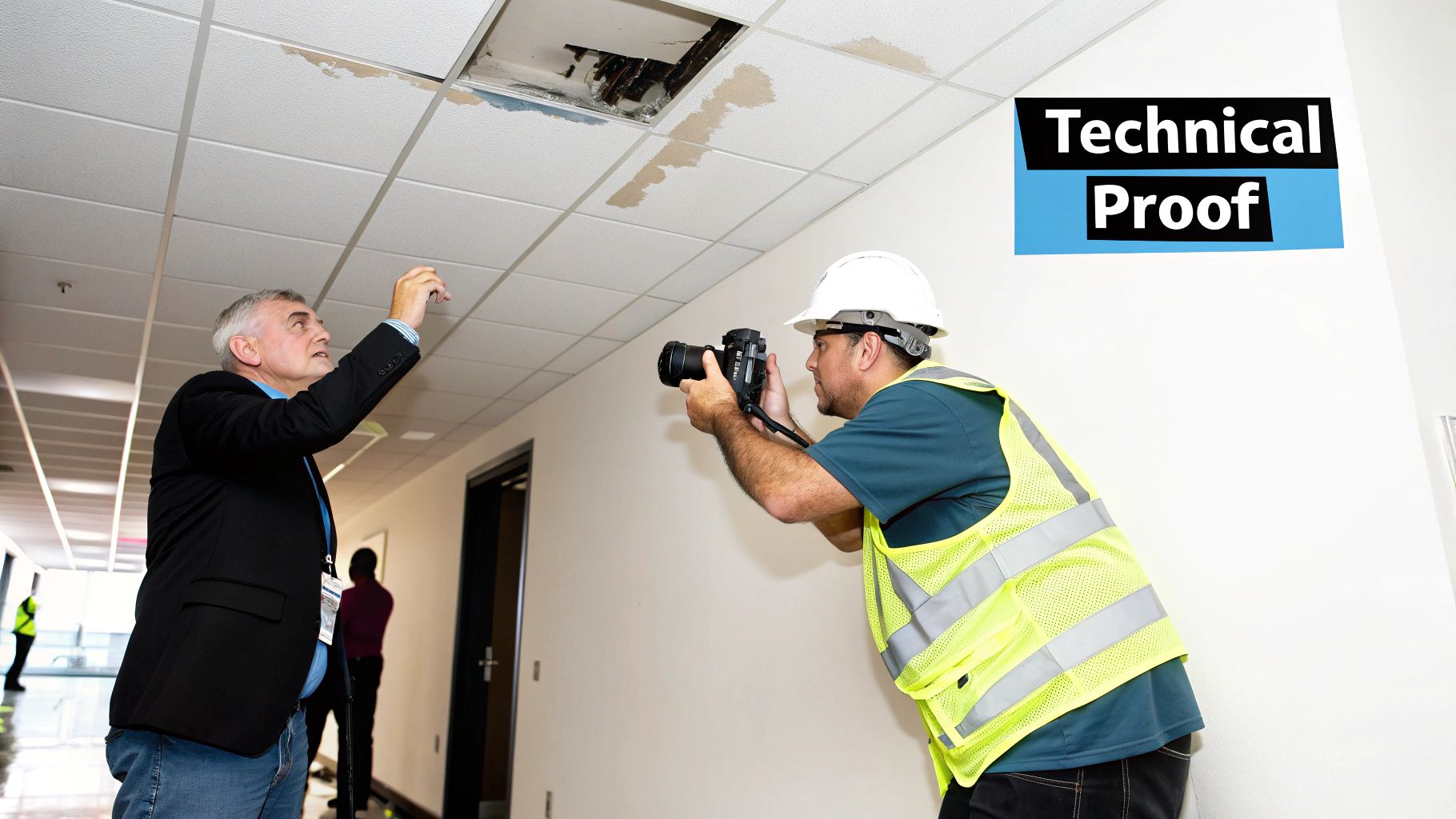
Navigating an insurance claim in Dubai can often feel like an uphill battle. It's not just you. Over the last few years, a spike in claim volumes, especially after major weather events, has forced a major shift in how the industry operates. Insurers aren't just processing claims anymore; they're meticulously auditing them.
This isn't about creating more red tape for the sake of it. It’s a fundamental change driven by risk mitigation and financial pressures. For facility and property managers, this new reality is a serious challenge. The days of sending in a simple incident report with a couple of blurry phone pictures are long gone.
The Real-World Pressure on Property Managers
Let’s paint a picture. You manage a high-rise commercial tower in JLT. A pipe gives way on the 30th floor over a long weekend, leading to severe water damage in three premium office spaces below. You follow the old routine: call your maintenance crew, snap a few photos on your phone, and submit a claim with a one-page report.
Weeks later, a rejection letter lands on your desk. The insurer points to "insufficient proof of loss" and "lack of evidence for the cause of failure." Your photos don't have timestamps, there's no technical report from a certified plumber explaining why the pipe failed, and the repair estimate is just a single number from a general contractor. Your claim is now in limbo, repair costs are piling up, and your tenants are justifiably furious.
This exact scenario is happening more and more. Insurers are pushing back hard on any claim that doesn't have a clear, technically sound story. They need to see a professional, evidence-based case that fully justifies the payout.
Shifting from Reactive to Proactive Documentation
This is where a modern, evidence-first approach becomes absolutely vital for insurance claim support in Dubai. It's all about building your case from the very moment an incident happens, not scrambling to find documents after the fact.
You need a system that guarantees:
- An Immediate Visual Record: Every single incident must be documented with high-resolution, timestamped, and geotagged photos and videos. No exceptions.
- A Certified Technical Assessment: A qualified technician has to provide a detailed report on the root cause—not just a description of the visible damage.
- Transparent Costing: Repair estimates need to be fully itemised, breaking down every dirham for labour, materials, and any other associated costs.
- Compliance and Standards: All your documentation and subsequent repairs must meet local regulations. You can learn more in our guide to meeting Dubai Municipality requirements through an AMC.
By bringing a photo-centric platform like SnapFixNow into your workflow, you automatically turn every maintenance call and emergency response into a piece of verifiable evidence. This transforms a high-stakes, stressful problem into a solved one, protecting your property investment and making sure your claims get the fast approval they deserve.
Building an Insurer-Ready Evidence Dossier
When something goes wrong in your building, compiling the right evidence for an insurance claim can feel like a frantic scramble. But it shouldn't be. Think of your claim as a legal case: you're making an argument, and your evidence is what will win it for you. A messy pile of notes and blurry phone pictures just won’t do the job. You need to build a structured, comprehensive claim package that speaks the insurer's language right from the start.
This is about more than just snapping a few photos of the damage. It’s about creating a compelling, chronological story backed by solid, technical proof. We'll get into why a formal report from a certified technician carries so much weight, how to draft itemised repair estimates that leave no room for argument, and why maintaining an unbroken 'chain of custody' for your evidence is so important.
In Dubai's increasingly sophisticated insurance market, this methodical approach is becoming the standard.
The Power of a Certified Technician's Report
When damage happens, your first instinct is probably to document it yourself or have an internal team member write up a quick summary. That’s a good first move, but honestly, it doesn't hold much sway with a claims adjuster. Insurers are looking for an objective, expert assessment that explains not just what happened, but why.
A detailed report from a certified technician—whether a plumber, an HVAC specialist, or an electrical engineer—is the absolute cornerstone of your claim. It takes a simple incident report and turns it into a professional diagnosis.
A proper report should always include:
- Root Cause Analysis: A technical breakdown of what failed and why. Don't just say "a pipe burst." It needs to be something like, "A galvanised iron supply line failed due to advanced corrosion at a threaded joint, which is consistent with its age and the local water's mineral content."
- Scope of Damage: A clear outline of every affected area. This includes the primary damage (the initial water leak) and all the secondary damage that followed (like mould growth or damaged flooring in the unit next door).
- Immediate Mitigation Steps: Proof of the actions you took to stop things from getting worse, like shutting off the water main or bringing in industrial dehumidifiers. This shows you acted responsibly.
An insurer sees a report from an ISO-certified company like SnapFixNow as credible, third-party validation. It strips away the subjectivity and proves you took the incident seriously by calling in qualified professionals right away.
This level of detail gives your insurer the technical proof they need, making it much tougher for them to dispute the legitimacy of the damage.
Creating Ironclad Itemised Repair Estimates
Submitting a single, lump-sum quote for repairs is a huge red flag for insurance adjusters. It lacks transparency and gives them an easy reason to question the costs, often leading them to simply substitute it with their own, much lower estimate. Your aim is to create an estimate so detailed that it leaves no room for doubt or negotiation on the scope of the work.
An insurer-ready estimate has to be itemised, breaking down every single part of the restoration. This detailed approach provides clarity and justifies the total cost.
Your itemised estimate should clearly outline:
- Labour Costs: Be specific. Note the number of hours and the hourly rate for each type of tradesperson involved (plumber, electrician, painter, tiler, etc.).
- Material Costs: List every single material needed, from pipes and fittings to paint, grout, and plasterboard. Include the quantities and unit prices for each.
- Equipment Hire: If you need specialised equipment like water extractors or thermal imaging cameras, list the daily or weekly hire cost.
- Timelines: Provide a realistic project timeline that shows how long each phase of the repair is expected to take.
This level of detail shows the insurer you've done your homework. It presents the repair not as some arbitrary number, but as a calculated, logical process based on real-world costs. You can learn more about the meticulous approach property managers take by reading our guide on what to look for when inspecting commercial buildings.
Maintaining a Defensible Chain of Custody
"Chain of custody" might sound like a term from a crime show, but it's incredibly relevant here. It refers to the chronological paper trail that shows the seizure, custody, control, and analysis of evidence. For an insurance claim, it means creating an irrefutable log of every piece of evidence from the moment you collect it.
This systematic process stops an insurer from questioning the timeline or the authenticity of your documentation. The goal is to build a seamless, time-stamped record of the entire event, from the initial incident right through to the final repair.
Dubai's role as a global insurance hub is growing fast. Just look at the Dubai International Financial Centre (DIFC), which recently saw a 35% jump in insurance premiums, hitting USD 3.5 billion. This growth is attracting sophisticated insurers who demand flawless technical proof, making a solid chain of custody more critical than ever. You can read more about Dubai's evolving insurance landscape on DIFC.com.
A photo-based platform like SnapFixNow completely automates this. The moment a technician is dispatched, every photo, note, and report is automatically timestamped, geotagged, and logged against that specific job. This creates an unbroken, digital chain of custody that is virtually impossible for an insurer to argue with. It's no longer just about collecting documents; it’s about building a fortress of proof from day one.
Mastering Visual Proof With Photo and Video Protocols
When it comes to insurance claims, a picture really is worth a thousand words. In fact, solid visual evidence is often the single most powerful tool you have. But here in Dubai, insurers aren't just looking for a few quick snaps from your phone anymore. They expect professional, methodical documentation that tells the whole story, leaving zero room for doubt.
The line between a claim that sails through and one that gets bogged down in questions often comes down to the quality of your visual proof. It's about shifting your mindset from just taking pictures to creating a visual record. This means capturing every angle, proving when and where each photo was taken, and building a clear, chronological narrative of what happened.
From Simple Snapshots to Verifiable Evidence
Insurers are trained to scrutinise photos for authenticity. A random shot of a water stain on a ceiling is just a picture. But a photo of that same stain—with a timestamp, GPS coordinates, and notes from a certified technician embedded in the file—is hard evidence. This is where modern, photo-based platforms providing insurance claim support in Dubai become absolutely essential.
The goal is to provide data the insurer can trust implicitly. This includes:
- Embedded Metadata: Every single photo and video needs a verifiable timestamp and geolocation baked right into the file's data. It’s non-negotiable. This proves exactly when and where the evidence was captured and shuts down any argument about tampering.
- Contextual and Detailed Shots: You need the full picture. Start with wide shots to show the overall scene and the scale of the damage. Then, zoom in. Get detailed close-ups of the specific failure point—the burst pipe, the frayed wire, the cracked fitting—and every single area affected by it.
- Narrated Video Walkthroughs: A video where your technician walks through the damaged site, explaining what they're seeing as they go, is incredibly persuasive. It’s like giving the claims adjuster a guided tour, connecting the dots for them and explaining the cause and effect in real-time.
A classic mistake I see all the time is only documenting the damage itself. Insurers also need proof of the immediate steps you took to mitigate the problem. Photos of industrial fans drying a room or a temporary patch on a leaky roof show you acted responsibly to prevent further loss.
The process doesn't have to be complicated. When done right, it's a simple, three-step flow that builds an iron-clad case for your claim.
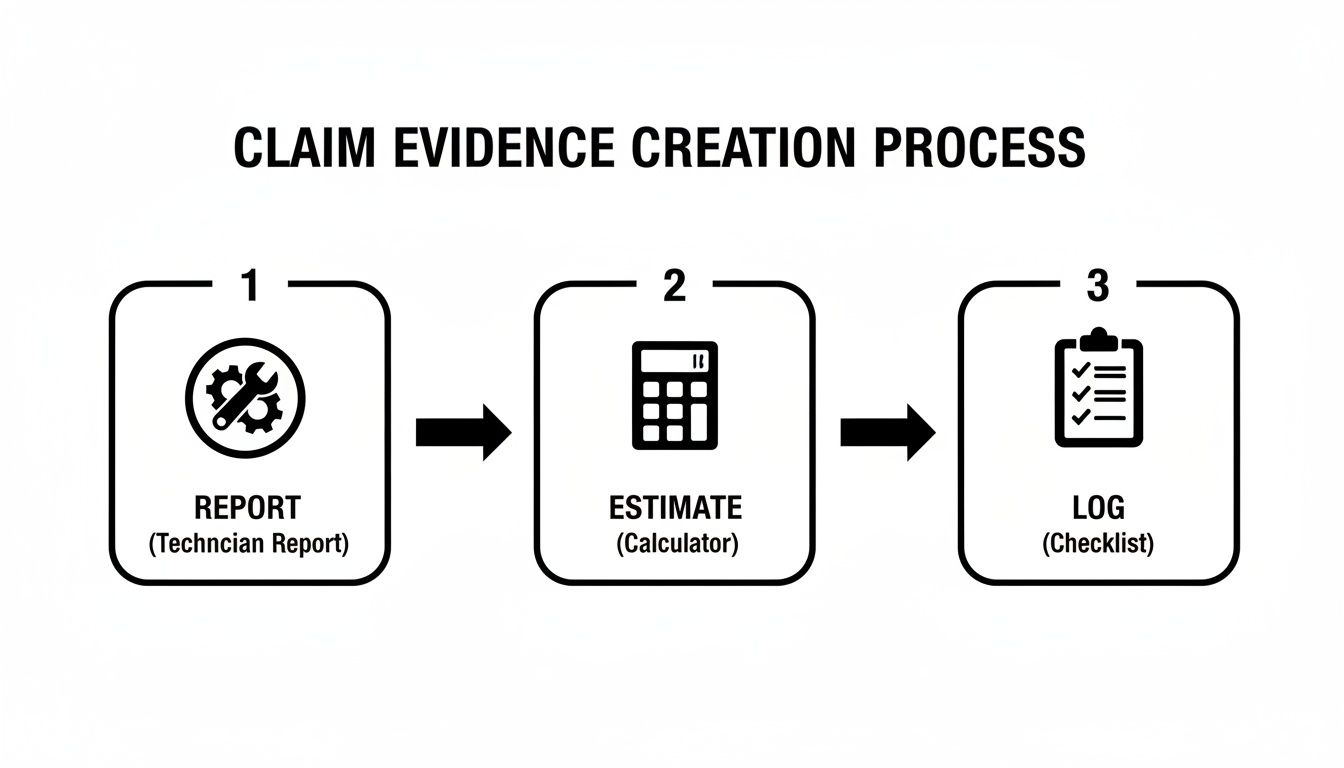
As you can see, a professional report, a detailed estimate, and a comprehensive evidence log are the three pillars of a successful claim.
To see the difference in action, let's compare the old way of gathering photos with the structured, platform-based approach that insurers now expect.
Visual Evidence Checklist for Insurance Claims
| Evidence Type | Standard Approach (High Risk of Rejection) | Best Practice Approach (Insurer-Approved) |
|---|---|---|
| Timestamps & Geotags | None, or relies on phone's camera roll (easily edited). | Automatically embedded, verifiable metadata in every file. |
| Context | Random shots of damage with no sense of scale or location. | Wide shots, medium shots, and detailed close-ups. |
| "Before & After" | Usually just "after" shots of the damage. | Timestamped "before" and "after" photos for every task. |
| Asset History | No prior records; impossible to prove pre-existing condition. | Full visual history of the asset from previous maintenance jobs. |
| Chain of Custody | Photos sent via WhatsApp/email; unclear who took them. | Photos logged by a specific technician against a specific job. |
| Mitigation Proof | No documentation of steps taken to prevent further damage. | Photos of temporary repairs, drying equipment, etc. |
This checklist makes it clear: a systematic approach isn't just better, it's the only way to guarantee your visual evidence will stand up to scrutiny.
The Power of Proving Prior Condition
One of the most frequent reasons for claim rejection in Dubai is the dreaded "pre-existing condition" argument. An insurer might claim the damage wasn't from a single event but was due to wear and tear you should have dealt with. How do you counter that? With a robust, visual history of your assets.
This is where your Annual Maintenance Contract (AMC) becomes your secret weapon. When managed through a photo-based system like SnapFixNow, your AMC creates an invaluable archive. Every routine service—from a quarterly AC filter change to an annual plumbing check—generates a photographic record of that asset's condition at a specific moment in time.
Let's say a pipe bursts in an apartment. The insurer suggests it might be due to long-term corrosion. No problem. You pull up a plumbing inspection report from three months ago, complete with timestamped photos showing that exact pipe in perfect condition. Argument over. You've just proven the failure was sudden and unforeseen.
Automating Evidence Collection for Every Job
Trying to manually organise photos, label files, and piece together a timeline after an emergency is a recipe for disaster. It's inefficient and full of holes. The smart move is to use a system where collecting evidence is simply an automatic part of your daily workflow.
With a photo-based work order platform, every single maintenance task becomes an evidence-gathering opportunity.
- A technician gets a job on their device.
- They take "before" photos of the area the moment they arrive.
- They do the work, taking photos of the process and any parts they use.
- They finish with "after" photos showing the job is complete and the site is clean.
This entire visual story is automatically timestamped, geotagged, and logged against that specific asset in your system. When an incident does happen, you don’t have to scramble for proof. You have an instant, irrefutable visual history ready to go, forming the core of the technical proof your insurer expects. This simple process turns your routine maintenance records into one of your most powerful insurance assets.
Sidestepping the Common Claim Rejection Traps
Knowing what makes an insurer say "no" is your best tool for getting them to say "yes." Too many valid claims in Dubai get bogged down or flat-out denied, not because the damage isn't real, but because the submitted proof doesn't meet the strict technical standards insurers now live by.
If you can understand these common failure points, you can build a claim file that anticipates and neutralises objections right from the start. This isn't about finding loopholes; it's about giving adjusters the clear, structured, and verifiable evidence they need to approve your claim without a fuss.
Let's walk through the most frequent rejection pitfalls we see in Dubai's property sector and, more importantly, how to avoid them.
Pitfall One: The Vague 'Proof of Loss'
By far the most common reason for an initial rejection is a vague or incomplete 'Proof of Loss' statement. Handing over a generic description like "water damage in apartment 1201" with a single, lump-sum repair quote is practically an invitation for denial. Insurers need a granular level of detail to see what happened and justify the costs.
A wishy-washy submission forces the adjuster to make assumptions, and trust me, they rarely assume in your favour. They need to see a crystal-clear line connecting the incident, the specific damages, and the itemised cost to fix each little thing. Without that, they have no choice but to push back for more information, and that means delays.
To dodge this, your documentation has to be obsessively detailed. The technical proof your insurer expects should tell a story, breaking down the incident with evidence backing up every chapter.
- Be specific about every single damaged item. Don't just say "damaged flooring." Write, "15 square metres of warped engineered oak flooring in the main living area."
- Itemise every single cost. Your repair estimate needs to break down labour by hours and rate, materials by unit and cost, and any equipment rental fees.
- Connect the damage to the cause. A technician's report is perfect for this. It should explicitly link each damaged component back to the root cause of the incident.
Your goal is to hand over a file so complete and logical that the adjuster can follow the story from the initial incident to the final repair without having to ask a single question. That’s the sign of a claim built for a quick approval.
Pitfall Two: Forgetting to Document Mitigation
After something goes wrong, your first instinct is to stop the damage from getting worse. That's the right move. What many managers don't realise is that documenting these mitigation efforts is just as critical as documenting the damage itself. Insurers need to see that you acted like a responsible partner and took immediate, reasonable steps to minimise their liability.
If you can't prove you acted fast, an insurer could argue that a chunk of the damage was preventable and, therefore, not covered. They might claim your inaction made the repair bill bigger, and they could slash the payout to match.
For example, after a pipe bursts, you need to show hard evidence that you:
- Immediately shut off the main water supply.
- Brought in industrial dehumidifiers and fans to start drying the area.
- Got a temporary patch or repair done to stop any further leakage.
Timestamped photos and videos of your team or a certified service like SnapFixNow on-site with drying equipment are non-negotiable. This kind of documentation is powerful insurance claim support in Dubai because it proves you did your part.
Pitfall Three: The Dreaded "Pre-Existing Condition" Argument
This is one of the most frustrating reasons for a rejection: the "pre-existing condition" or "wear and tear" argument. An insurer might claim the burst pipe wasn't a sudden, accidental event but the result of slow corrosion and poor maintenance—something most policies exclude. It's an incredibly tough argument to fight without a solid history of proactive care.
And the pressure is mounting. Recently, UAE insurers paid out a staggering Dh11 billion in gross claims in a single quarter, with property claims alone hitting Dh4.5 billion. This financial squeeze, made worse by major weather events, means insurers are digging into maintenance histories more deeply than ever. You can read more about the rise in UAE insurance claims on KhaleejTimes.com.
Your only real defence here is a robust and visually documented maintenance history. Those consistent records from your Annual Maintenance Contract (AMC) are your best weapon. When you can pull up a service report from three months ago showing the asset was in good working order—complete with timestamped photos—the insurer's argument about neglect simply falls apart. This proactive paperwork turns your routine maintenance into an invaluable insurance shield.
How The Right Tech Makes Your Claims Process Easier

Let's be honest, manually pulling together evidence, chasing technicians for reports, and juggling repair quotes is a nightmare. It’s stressful, incredibly inefficient, and leaves far too much room for mistakes or missed details—the very things that can get a claim delayed or denied.
Partnering with the right tech-driven maintenance company changes this completely. It shifts you from a reactive scramble to a proactive, organised workflow.
An integrated solution—one that brings together a photo-based platform, ISO-certified processes, and a team of certified technicians—is designed to tackle these documentation headaches head-on. It helps collect evidence automatically and ensures every bit of data is compliant from the get-go. This is the kind of comprehensive insurance claim support in Dubai that insurers now see as the standard.
Cut Down on Paperwork by Automating Evidence Collection
Imagine a pipe bursts at 2 AM. Instead of frantically making calls and sending emails, your entire response is logged and tracked through one central platform. A certified technician is sent out, and from the second they arrive, every action is being documented for you.
This is exactly what a photo-based work order system does. It makes every maintenance call an opportunity to gather evidence without creating more work for you or your team.
- Instant Visual Proof: Technicians take timestamped and geotagged photos and videos right in the job ticket. This creates an undeniable record of the damage and the steps taken to fix it.
- One Place for Everything: All notes, reports, and approvals are stored in one spot. No more digging through emails or trying to find lost paperwork.
- Real-Time Tracking: You can see how the job is progressing right from your desk, giving you total visibility without having to physically be there.
This kind of automation doesn't just save you hours of admin work. More importantly, it ensures no critical detail gets overlooked, building the solid technical proof your insurer expects.
By weaving your routine maintenance and emergency responses into a single system, you're building an unbreakable chain of evidence. It gives insurers the confidence they need to approve claims quickly, often cutting out the frustrating back-and-forth that causes so many delays.
Get More Claims Approved with Compliant Reports
Insurers in Dubai are sharp; they can spot inconsistencies a mile away. A vague report or a poorly justified estimate is an instant red flag that will invite extra scrutiny. A tech-driven approach makes sure every document you submit is professional, compliant, and easy to defend.
When your maintenance partner uses a unified system, data flows smoothly from the field technician to the final report. Certified technicians log their findings on-site, and that information is used to generate detailed, itemised repair estimates and root cause analysis reports.
This methodical process means every claim package is:
- Technically Sound: Reports are written by certified professionals who know exactly what kind of information insurers need to see.
- Crystal-Clear Costs: Estimates break down everything by labour, materials, and equipment, leaving no room for questions.
- Backed by History: The system can pull up past maintenance records for an asset in seconds, which is a powerful way to counter any "pre-existing condition" arguments from the insurer.
Reduce Downtime by Being More Proactive
Finally, the best technology doesn't just help you with claims—it helps you avoid them in the first place. When you use an integrated platform for both your Annual Maintenance Contract (AMC) and emergency repairs, you start seeing powerful insights into your property's health. You can find out more about how this works with our guide on technology-enabled and predictive maintenance solutions.
This proactive mindset is a game-changer. It moves your facility management from just reacting to problems to actively predicting and preventing them. This not only cuts down on the number and severity of claims but also keeps your property running like a well-oiled machine.
Frequently Asked Questions
What Is The Single Most Important Piece of Technical Proof?
While you absolutely need a complete dossier, the one thing that can make or break your claim is immediate, high-quality visual evidence. I’m talking about timestamped photos and videos taken the moment you discover the incident. This is your irrefutable proof of the damage before anyone touches anything.
Think of this initial visual record as the foundation. Everything else—engineering reports, detailed repair quotes, technical assessments—gets built on top of it. A platform like SnapFixNow is built for this, integrating photo documentation into every single service call so it's done automatically.
How Can An Annual Maintenance Contract Help My Claim?
An Annual Maintenance Contract (AMC) is an incredibly powerful tool when it comes to insurance claims. Why? Because it gives you a clear, documented baseline of your property's condition over time. When a certified provider performs regular, documented maintenance, you build a historical record that torpedoes an insurer's favourite arguments: 'pre-existing conditions' or general neglect.
When an incident happens, you can simply pull up detailed service reports—complete with photos—proving the asset was in good working order. This simple step massively strengthens your position and provides the exact technical proof your insurer expects.
Think of your AMC records as your property's health history. A clean bill of health right before an incident makes it much, much harder for an insurer to argue that the problem was caused by some chronic, pre-existing issue instead of a sudden, covered event.
My Insurer Is Delaying My Claim. What Should I Do?
This is a common frustration. If your insurer is dragging their feet, the first step is to follow up professionally but persistently. Always ask for the specific reason for the delay in writing.
Next, take a hard look at the evidence package you submitted. Compare it against the best practices we've outlined here. Is a technical report missing a key detail? Are the cost estimates not fully itemised down to the last fil?
If you spot a gap, don't wait. Engage a certified third-party service to provide a supplementary assessment or report that directly addresses what you suspect their concern might be. Providing clear, organised, and technically solid insurance claim support in Dubai is your best strategy to get things moving again.
Stop chasing paperwork and start building airtight claims. SnapFixNow provides the certified technicians and photo-based documentation you need to get your claims approved faster. Learn more at https://www.SnapFixNow.com.