In Dubai's high-stakes real estate market, a building's Mechanical, Electrical, and Plumbing (MEP) systems are its operational core. These systems are the unseen infrastructure ensuring climate control, power, and safety. Consequently, selecting the right mep contractors in dubai is not a simple procurement task—it is a critical business decision that directly impacts operational success, regulatory compliance, and long-term asset value.
Why Strategic Vetting of MEP Contractors Is Non-Negotiable

For facility managers and asset owners in Dubai, the traditional "break-fix" approach to MEP maintenance is no longer viable. An MEP service provider must function as a strategic partner, not merely a reactive service. They are on the front line of managing operational expenditure (OPEX) and ensuring asset integrity in a climate where high-performance systems, particularly Heating, Ventilation, and Air Conditioning (HVAC), are essential.
The city's rapid development has cultivated a crowded and competitive market. The real estate expansion between 2010 and 2020 directly fueled a significant increase in MEP services. To provide context, the broader U.A.E. MEP sector was valued at approximately USD 3.03 billion in 2020 with projections for continued growth. A substantial portion of this expenditure is concentrated in Dubai, where air conditioning can account for 40–60% of a building’s total energy consumption. This places immense pressure on contractors to deliver systems that are both reliable and highly efficient. You can review this market forecast on psmarketresearch.com.
The Shift from Reactive to Proactive Maintenance
A purely reactive maintenance strategy—waiting for equipment failure before initiating a service call—exposes an asset to significant risks:
- Unplanned Downtime: System failures can disrupt business operations, negatively impact tenant satisfaction, and lead to direct revenue loss.
- Higher Lifecycle Costs: Emergency repairs are invariably more expensive than planned maintenance and often accelerate equipment degradation, leading to premature capital replacement.
- Compliance Breaches: Neglected systems can fail to meet the stringent standards set by regulatory bodies such as the Dubai Municipality or Dubai Civil Defence.
A structured vetting process is the foundation for a successful partnership. It ensures your chosen contractor has the verified technical expertise, financial stability, and quality management systems required to protect and enhance your facility's core infrastructure.
This guide provides a clear framework for evaluating MEP contractors in Dubai, focusing on building resilient, compliant, and cost-effective operations through informed, evidence-based decision-making.
Mastering Dubai's MEP Regulatory Framework
Engaging MEP contractors in Dubai requires more than an assessment of technical skill; it necessitates partnering with a provider proficient in navigating the complex local regulatory landscape where compliance is the absolute foundation of any project.
Failure to adhere to these regulations can result in significant project delays, failed inspections, financial penalties, and serious legal liabilities. A competent partner must possess an in-depth, operational understanding of this framework.
The process involves managing approvals and documentation across several governing bodies. A contractor's inability to do so exposes the asset and its owner to immediate and substantial risk.
Key Authorities and Their Mandates
Three primary authorities regulate MEP work in Dubai, each with a distinct jurisdiction. Understanding their respective roles is the first step in ensuring your contractor is qualified for the task.
-
Dubai Electricity and Water Authority (DEWA): DEWA governs all matters related to electricity and water infrastructure. It enforces strict standards for electrical load calculations, wiring specifications, and water connections to ensure the safety, efficiency, and stability of the city's grid. Any new electrical fit-out or significant plumbing modification requires DEWA approval.
-
Dubai Municipality (DM): The DM is the authority for building codes, covering aspects from structural integrity to public health and safety. Its regulations directly influence MEP design, particularly for drainage, sanitation, and ventilation systems.
-
Dubai Civil Defense (DCD): The DCD's mandate is focused on fire and life safety. It enforces codes and standards for fire alarms, smoke control systems, sprinkler installations, and emergency lighting. Compliance with DCD regulations is a non-negotiable component of any MEP project.
Engaging a contractor without verified approvals from these bodies constitutes a significant liability. The choice is not merely a procurement decision but an assumption of risk. Non-compliant work may require complete removal and re-installation at the asset owner's expense.
The Importance of Certified Compliance
Regulatory standards are subject to continuous updates. Authorities like DEWA scrutinise electrical drawings meticulously, while the DCD enforces its fire safety codes with zero tolerance. This environment necessitates the engagement of certified, locally-approved mep contractors in dubai to avoid project stalls or the withholding of a building completion certificate.
A contractor's value is demonstrated by their ability to navigate this system efficiently. Their expertise in securing permits, scheduling inspections, and delivering compliant work is as critical as the physical installation itself. For facility and property managers, securing this compliance through a structured Annual Maintenance Contract (AMC) is a fundamental risk-management strategy.
An Essential MEP Contractor Vetting Checklist
Selecting an MEP contractor in Dubai is a high-stakes decision that directly influences a building's performance, safety, and operational budget for years. A thorough vetting process must extend beyond proposals and presentations to an examination of verifiable evidence of capability, compliance, and commitment to quality.
This structured evaluation protects an asset from the significant risks associated with underqualified or non-compliant providers and ensures the selected partner can meet Dubai's demanding operational standards.
Foundational Compliance and Licensing
The initial step in the vetting process involves confirming the contractor's legal and regulatory standing. These foundational requirements are non-negotiable and serve as a critical gatekeeping exercise.
Before proceeding, verify the following documentation:
- Valid Trade Licence: The contractor must possess a current trade licence from the Dubai Department of Economy and Tourism (DET) that specifically covers MEP contracting activities.
- Authority Approvals: Confirm that the contractor holds necessary certifications from key regulatory bodies, including being a DEWA-approved contractor for electrical works and holding current certifications from Dubai Civil Defence (DCD) for all fire and life safety systems.
- Adequate Insurance Coverage: Request and review certificates of insurance, particularly for Public Liability and Workmen’s Compensation, to mitigate your organization's risk exposure.
This diagram illustrates the hierarchy of regulatory bodies that compliant mep contractors in dubai must navigate.
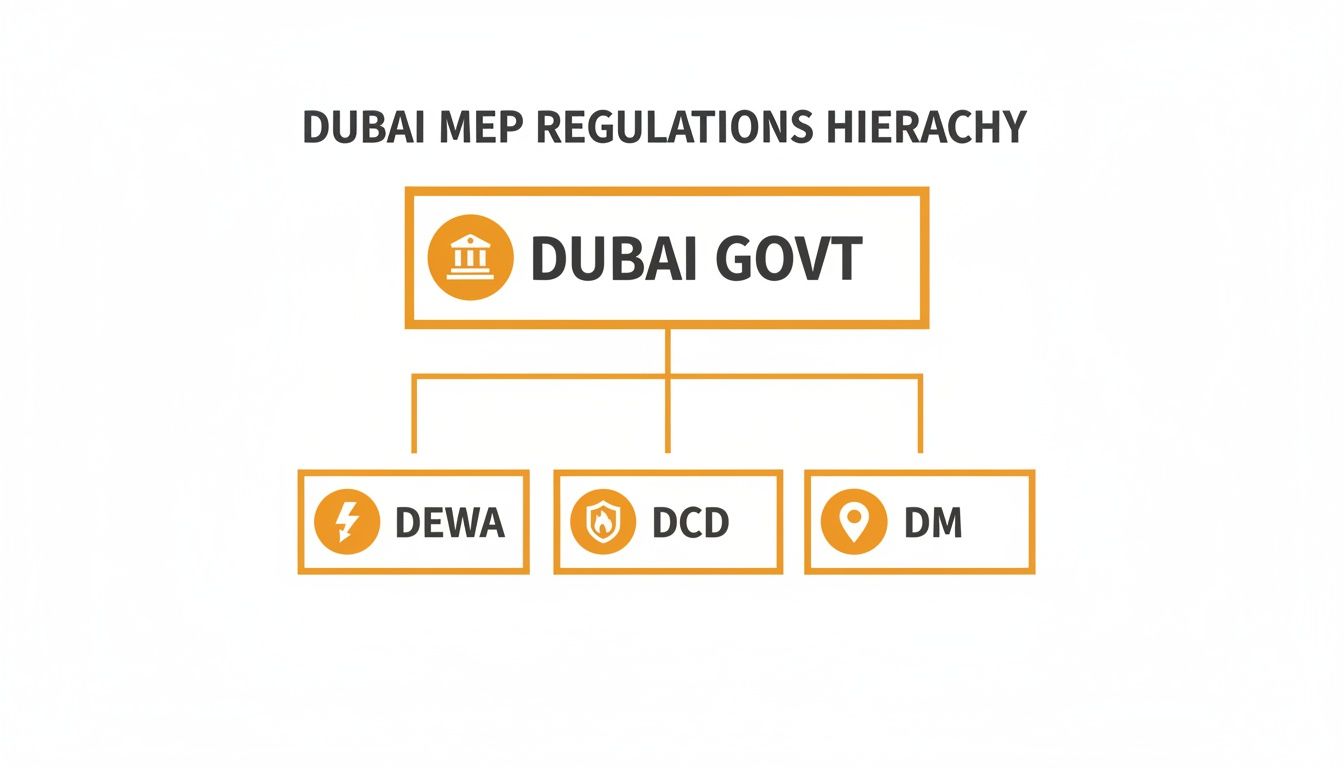
As shown, contractors are accountable to multiple authorities, each with a specific focus, operating under the overarching framework of the Dubai Government. A proficient partner must understand this system intimately.
Operational Capability and Quality Assurance
After confirming legal compliance, the evaluation should shift to the contractor's operational capability and ability to deliver consistent, high-quality service. This involves assessing their internal processes, technical resources, and commitment to recognized quality standards.
An ISO 9001:2015 certification is a strong indicator of a mature Quality Management System (QMS). It provides third-party verification that the contractor has formalized processes for service delivery, customer satisfaction, and continuous improvement, significantly reducing performance-related risks for facility managers.
Key areas for investigation include:
- In-House vs. Subcontracted Labour: Clarify the ratio of directly employed technicians to subcontractors. A substantial in-house team generally facilitates better quality control, faster response times, and more consistent service delivery.
- Technical Certifications: Verify the qualifications and certifications of the technical staff, particularly for specialized systems such as chillers, fire alarms, and Building Management Systems (BMS).
- Safety Policies and Records: A professional and responsible operator will maintain a robust safety culture. Request documentation of their Health, Safety, and Environment (HSE) policies and their historical safety record.
This framework provides a structured methodology for making an evidence-based decision.
MEP Contractor Vetting Framework
This checklist offers a systematic approach to evaluating potential MEP service providers in Dubai, ensuring all critical areas are covered before entering into a contract.
| Evaluation Category | Key Criteria to Verify | Importance for Facility Managers |
|---|---|---|
| Legal & Regulatory Compliance | Valid DET Trade Licence, DEWA/DCD Approvals | Critical: Non-negotiable. Ensures the contractor can legally operate and obtain necessary permits. |
| Risk Management | Public Liability & Workmen’s Compensation Insurance | High: Protects your organisation from financial and legal exposure in case of accidents or incidents. |
| Quality Management System | ISO 9001:2015 Certification | High: Indicates formalised processes for quality, consistency, and customer satisfaction. |
| Technical Manpower | Ratio of in-house vs. subcontracted staff | High: A strong in-house team often correlates with superior quality control and reliability. |
| Technical Expertise | Staff certifications for specialised systems (BMS, chillers) | Medium-High: Ensures they possess the proven skills to manage your specific asset requirements. |
| Health & Safety | Documented HSE policies and safety records | High: A strong safety culture reflects professionalism and mitigates on-site risks. |
By systematically assessing each potential provider against these criteria, decision-makers can develop a clear understanding of their operational maturity. This process is not about finding the lowest-cost provider, but about identifying a qualified partner with the verified credentials to protect and maintain high-value assets.
Crafting Performance-Based MEP Service Contracts

For property managers and asset owners, the service contract is the single most important tool for managing the relationship with mep contractors in dubai. A well-structured agreement transforms a simple transaction into a strategic partnership based on accountability and measurable outcomes, serving as a primary defense for controlling operational costs and preserving long-term asset value.
Relying on reactive, ad-hoc service calls is an inefficient and costly operational model. This "run-to-failure" approach exposes valuable assets to unplanned downtime and inflates budgets with unpredictable emergency repair costs, which are consistently higher than planned maintenance expenditures. A proactive approach is essential.
Moving from Reactive to Proactive with Annual Maintenance Contracts
The foundation of a performance-driven relationship is the Annual Maintenance Contract (AMC). A well-defined AMC establishes a framework for proactive care, shifting the focus from fixing failures to preventing them. This transition results in predictable budgets and extended equipment lifecycles.
A robust AMC is built on several key pillars:
- A Detailed PPM Schedule: This is a calendar-based schedule outlining all required planned preventative maintenance (PPM) tasks for every covered asset, from air handling unit filter changes to fire pump testing.
- Guaranteed Response Times: The contract must explicitly define response times for different service call categories based on urgency (e.g., critical, urgent, routine).
- A Crystal-Clear Scope of Work: The agreement must eliminate ambiguity by clearly listing all included assets, services, and any specific exclusions to ensure mutual understanding.
Defining Success with SLAs and KPIs
To elevate an AMC from a basic agreement to a performance management tool, it is essential to incorporate clear Service Level Agreements (SLAs) and measurable Key Performance Indicators (KPIs). These metrics convert general service promises into binding contractual obligations, creating a transparent system for evaluating service quality.
An SLA is the contractor's commitment; a KPI is the evidence that the commitment has been met. Well-defined KPIs provide the quantitative data needed to hold a service provider accountable to the SLA, ensuring the contract delivers tangible value.
Effective KPIs for MEP contracts are specific, measurable, and directly tied to operational objectives. They move beyond simple task completion to measure the actual impact on facility performance.
Key Performance Indicators for MEP Contracts
Consider integrating these KPIs into your service agreements to drive performance:
| KPI Category | Example Metric | Target for High-Performing Facilities |
|---|---|---|
| Asset Uptime | Percentage of operational availability for critical systems (e.g., chillers, elevators). | 99.5% or higher |
| Emergency Response | Time from critical fault report to technician arrival on-site. | Within 60 minutes |
| PPM Adherence | Percentage of scheduled PPM tasks completed within the designated timeframe. | 100% |
| First-Time Fix Rate | Percentage of reactive calls resolved on the first technician visit without requiring a follow-up. | 90% or higher |
By incorporating these elements into service agreements, you create a contract that actively protects assets and aligns the contractor's success directly with your own. This establishes a partnership where high-level performance is not merely an expectation but a contractually mandated and continuously measured requirement.
Connecting MEP Services to Broader Business Objectives

In a sophisticated real estate market like Dubai, MEP management has evolved beyond routine maintenance. It is now a core component of achieving strategic business goals, from enhancing property value to meeting corporate sustainability targets.
This requires viewing an MEP provider not just as a maintenance team, but as an engineering-led advisor capable of translating high-level objectives—such as reducing a building's carbon footprint—into practical, on-the-ground actions. This strategic alignment transforms MEP from a necessary cost center into a significant value driver.
Driving Efficiency and Sustainability
Forward-thinking mep contractors in dubai are actively assisting clients in achieving their sustainability objectives. These initiatives yield tangible reductions in operational expenditure (OPEX) and ensure compliance with Dubai's stringent green building regulations.
Key contributions in this area include:
- Energy Audits: Conducting detailed assessments of HVAC, lighting, and electrical systems to identify sources of energy waste.
- High-Efficiency Retrofits: Replacing outdated, energy-intensive equipment with modern, efficient alternatives, such as chiller upgrades or the installation of variable frequency drives (VFDs) on pumps and fans.
- Building Management System (BMS) Integration: Ensuring seamless communication between all MEP systems via a central BMS for intelligent, automated climate control and real-time energy consumption monitoring.
The most valuable MEP partnerships are those where the contractor actively contributes to achieving Environmental, Social, and Governance (ESG) targets. Their technical expertise is crucial for validating energy savings and providing the hard data required for sustainability reporting.
Aligning with Regional Agendas
The drive for greater efficiency is a region-wide priority. The Middle East and Africa is the world's fastest-growing MEP market, fueled by smart city initiatives and sustainability mandates. In Dubai, stringent energy conservation laws have made high-efficiency systems a standard requirement.
This market shift requires facility managers to seek more than basic repair services. An ideal MEP partner must be capable of delivering technology-enabled maintenance and predictive solutions that leverage data to pre-empt equipment failures.
Ultimately, selecting the right contractor is about finding a partner who can future-proof a building—ensuring it remains compliant, efficient, and valuable for the long term.
Frequently Asked Questions About Selecting an MEP Contractor in Dubai
For facility managers and asset owners, navigating the selection process for an MEP partner in Dubai raises several critical questions. Securing clear, practical answers is essential for making an informed decision that protects property value and ensures operational continuity.
This section addresses the most common queries with guidance grounded in compliance and performance, helping decision-makers move beyond abstract promises to select an MEP contractor based on verifiable credentials and clearly defined expectations.
What are the essential licenses for an MEP contractor?
In Dubai, a legitimate MEP contractor requires a specific set of licenses to operate legally. The non-negotiable requirement is a valid trade licence from the Dubai Department of Economy and Tourism (DET) that explicitly lists MEP contracting activities.
Furthermore, for any electrical work, the contractor must hold technical approvals from the Dubai Electricity and Water Authority (DEWA). For fire and life safety systems, certification from Dubai Civil Defence (DCD) is mandatory. Verifying these documents should be the first step in any vetting process, as it confirms the contractor's legal authority to perform the work and secure necessary permits.
How should KPIs be structured in an MEP maintenance contract?
Vague service promises in a maintenance contract are ineffective. To ensure accountability, Key Performance Indicators (KPIs) must be specific, measurable, and directly linked to critical facility outcomes. The focus should be on quantifiable data, not subjective assessments.
Consider incorporating these performance-driven metrics:
- Asset Uptime: For critical systems like chillers or fire pumps, specify 99%+ operational availability.
- Emergency Response Time: Define precise targets. A guaranteed on-site arrival within 60 minutes for critical failures is a common benchmark for high-performance facilities.
- First-Time Fix Rate: To avoid repeat service calls for the same issue, aim for over 90% of issues to be correctly diagnosed and resolved on the first visit.
- PPM Schedule Adherence: To ensure the value of planned preventive maintenance is realized, require 100% completion of all scheduled tasks within the specified timeframe.
These types of KPIs transform a standard agreement into a performance-based contract that holds the provider accountable for tangible results.
An ISO 9001:2015 certification is more than a credential. It provides third-party validation of an MEP contractor's audited Quality Management System (QMS). For a facility manager, this signifies a commitment to consistent processes and meticulous record-keeping—essential for compliance and risk mitigation.
What common mistakes should be avoided when outsourcing MEP services?
When engaging an MEP contractor in Dubai, several common pitfalls can lead to substandard work, unforeseen costs, and contractual disputes. Awareness of these risks is the first step toward mitigation.
The most prevalent mistake is selecting a contractor based solely on the lowest price, which often results in compromised quality and a high volume of "out-of-scope" charges. Another significant risk is signing a contract with an ambiguous scope of work, leaving the organization vulnerable to disputes over service inclusions.
Finally, it is crucial to verify the contractor's reliance on in-house technicians versus subcontractors. An over-reliance on third parties can negatively impact quality control and response times. To avoid these issues, decision-makers should employ a disciplined vetting process, use a detailed evaluation checklist, and insist on a contract with a clearly defined scope, firm SLAs, and the measurable KPIs previously discussed.
For organisations seeking an engineering-led facilities management partner, SnapFixNow delivers ISO-certified MEP services and comprehensive Annual Maintenance Contracts designed to protect asset value and ensure operational excellence across Dubai. Learn more about our SLA-driven solutions at https://www.SnapFixNow.com.