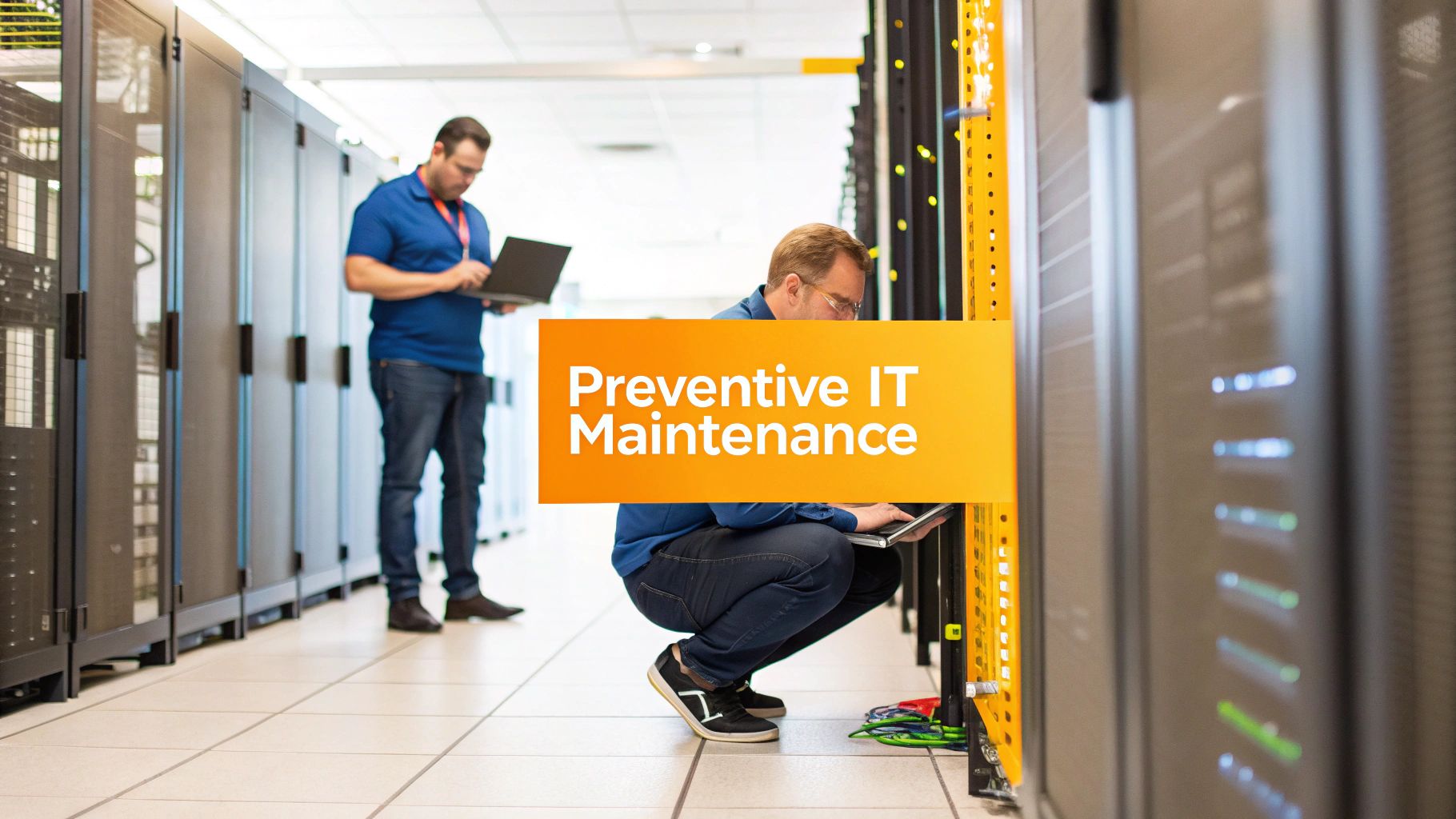
Preventive IT maintenance is not merely about scheduled checks; it is a strategic shift from reactive firefighting to proactive future-proofing. For any facility in Dubai or the UAE, this means moving away from the costly chaos of unexpected failures towards a structured program of planned services on your IT infrastructure to maintain its health and reliability. This proactive approach is essential for controlling costs, extending asset lifecycles, and ensuring business continuity.
Shifting From Reactive Fixes to Proactive IT Health
For many years, the "break-fix" model was the operational default: a system fails, an emergency repair is requested, and a premium is paid for the urgent fix. For modern facilities across Dubai and the UAE, this is no longer a viable strategy. It creates a cycle of unpredictable downtime and even more unpredictable costs.
A structured preventive IT maintenance program reframes upkeep not as an expense, but as an investment in operational stability. For property managers, procurement teams, and engineering leaders, the logic is clear. It replaces sudden, high capital expenditures (CAPEX) for emergency equipment replacement with a steady, predictable operational expenditure (OPEX). This financial control is critical for budgeting and resource allocation in the competitive UAE market.
To fully grasp the financial implications, it is useful to compare the two models side-by-side. While a reactive approach may appear less expensive on a monthly basis, the long-term total cost of ownership tells a different story.
Preventive vs. Reactive IT Maintenance: A Cost-Benefit Analysis for UAE Facilities
This table provides a direct comparison between the two maintenance models, focusing on key decision-making criteria for facility and asset managers in the UAE.
| Decision Factor | Reactive Maintenance (Break-Fix Model) | Preventive Maintenance (Scheduled Model) |
|---|---|---|
| Budgeting | Unpredictable. Costs are variable and spike during emergencies, creating CAPEX shocks. | Predictable. Fixed monthly or annual costs (OPEX) for simplified budgeting. |
| Downtime | High and unplanned. Failures occur at peak operational times, halting business. | Minimal and planned. Maintenance is scheduled during off-peak hours (e.g., 2 AM – 5 AM) to avoid disruption. |
| Asset Lifespan | Shorter. Constant stress and emergency fixes lead to premature hardware failure (typically 20-30% shorter). | Longer. Regular care extends the life of servers, network gear, and UPS systems, maximizing the initial investment. |
| Total Cost | Higher over the long term due to premium emergency rates, replacement costs, and operational losses. | Lower over the long term (often by 12-18%) by avoiding major failures and extending asset life. |
| Operational Risk | High. Constant risk of data loss, security breaches, and business interruption. | Low. Proactive patching, backups, and monitoring mitigate risks before they escalate. |
| Tenant/Guest Impact | Negative. Unreliable WiFi, BMS failures, and system outages lead to complaints and potential contract terminations. | Positive. Consistent uptime and reliable services enhance satisfaction and retention. |
Ultimately, the break-fix model is a gamble on asset reliability. A preventive model is a calculated strategy that delivers returns through enhanced reliability, efficiency, and financial predictability.
Mitigating UAE-Specific Operational Risks
The unique environmental conditions in the UAE pose specific threats to IT equipment, which a robust preventive plan must address. These are not minor inconveniences; they can cause catastrophic hardware failure.
-
Extreme Heat: High ambient temperatures place immense stress on cooling systems in server rooms and data closets. If HVAC units, server fans, and ventilation are not performing at 100% capacity, heat-related hardware failure is imminent. Regular maintenance ensures cooling systems are calibrated for Dubai's climate.
-
Dust and Sand: Fine airborne dust infiltrates sensitive equipment, clogging fans, coating components in an insulating layer, and leading directly to overheating. Scheduled, professional cleaning of IT environments and hardware is a non-negotiable risk mitigation task.
-
Humidity Fluctuations: High humidity, particularly in coastal areas, can cause condensation and corrosion on delicate electronic components. Preventive checks verify that environmental controls and dehumidifiers are functioning within specified tolerances (e.g., 40-60% Relative Humidity) before corrosion occurs.
A proactive maintenance strategy directly confronts these regional challenges. It transforms environmental vulnerabilities from potential crises into manageable operational tasks, safeguarding critical infrastructure against conditions that can silently degrade performance and shorten asset lifespan.
The market is reflecting this shift. The UAE's predictive maintenance market, which encompasses advanced IT solutions, was valued at USD 230.3 million in 2023 and is projected to reach USD 1,435.6 million by 2030. This growth indicates a widespread move away from reactive chaos toward proactive control. To understand the specifics, you can discover more insights about these UAE market trends and their drivers.
Embracing preventive IT maintenance is about ensuring operational uptime. For a hotel, it means guest WiFi, booking systems, and access controls are always functional. For a commercial tower, it ensures building management systems (BMS), security cameras, and tenant internet are stable. This proactive stance protects revenue, enhances tenant satisfaction, and solidifies a property's reputation for reliability.
Building Your Preventive IT Maintenance Framework
A robust preventive IT maintenance program must be built upon a detailed, comprehensive inventory of every critical IT asset within a facility. This is the foundational step; without it, any maintenance plan is based on guesswork.
For a commercial tower in Dubai, this involves mapping everything from the servers running the Building Management System (BMS) to the core network switches in the main distribution frame (MDF) room. It includes uninterruptible power supply (UPS) units and the entire CCTV server and storage array. For a hotel, the inventory must include point-of-sale (POS) servers, guest Wi-Fi controllers, and digital signage players. An unlisted asset is a blind spot and a potential point of failure.
This process is not merely list-making. True asset management involves creating a single source of truth for the entire IT infrastructure through systematic tagging and documentation.
The Importance of Asset Tagging and Documentation
Proper asset tagging enables the tracking of each piece of equipment's entire lifecycle. An effective asset tag includes a unique ID, purchase date, and a QR code linking to its digital record.
The digital record should contain:
- Asset Details: Make, model, serial number, and specific configurations.
- Location: Precise physical location (e.g., "Server Rack 12U, B2 Data Centre").
- Maintenance History: A full log of every check, repair, and component replacement.
- Warranty Information: Expiry dates and service contact details.
This level of detail transforms maintenance from a series of disconnected tasks into a data-driven operation. It enables the identification of recurring issues, prediction of hardware failure, and justification for upgrade budgets with factual data.
This flowchart illustrates the strategic shift from reactive repairs to a structured, proactive approach.
Moving from chaotic emergency repairs to scheduled care provides the stability and control essential for modern facility management.
Developing Tailored Maintenance Checklists
With a complete inventory, specific, actionable checklists can be developed for different equipment types. A one-size-fits-all approach is inefficient and risky. The unique operational demands and environmental pressures in the UAE require customized maintenance schedules. A standard commercial office operating from 9 AM to 6 PM has vastly different requirements than a 24/7 luxury hotel, where critical systems like booking and room access servers are under constant load and failure costs are exceptionally high.
A well-structured checklist is more than just a to-do list; it’s a risk mitigation tool. It turns broad goals into specific, verifiable actions that ensure nothing gets missed. This is absolutely essential for proving compliance and performance.
The following are property-specific examples for consideration:
- Hospitality (Hotels/Resorts): Weekly backup verification for property management system (PMS) and POS data is non-negotiable. Monthly load tests for UPS units backing guest services are critical to prevent operational disruption during power fluctuations.
- Commercial Towers: Given Dubai's climate, quarterly deep cleaning of server rooms and communication closets is vital to prevent overheating. Biannual thermal imaging scans of server racks can identify hotspots before they lead to component failure.
- Retail Malls: Monthly checks on network switches supporting tenant POS systems and public Wi-Fi are necessary to maintain transactional integrity. Verification of CCTV recording integrity and storage capacity is another high-priority task.
- Industrial Facilities: These harsh environments demand monthly physical inspections of network cabinets for dust ingress and quarterly calibration of environmental sensors for temperature and humidity.
Aligning Schedules with Operational Realities
The final element of this framework is scheduling maintenance tasks to avoid business disruption. This requires constant communication between the IT maintenance team and facility operations. For a busy mall, network maintenance should be scheduled overnight, outside of peak shopping hours. In a residential tower, major system updates must be communicated to residents well in advance.
This alignment distinguishes a disruptive maintenance plan from a seamless one. The objective of preventive IT maintenance is to enhance business continuity. By building a framework on a detailed inventory, tailored checklists, and operationally-aware scheduling, you create a program that is both effective and practical for the unique demands of properties in the UAE.
Defining Service Levels and Performance Metrics
A preventive IT maintenance plan is ineffective without a robust contract to enforce it. For procurement teams and facility managers in Dubai, the Service Level Agreement (SLA) is the most critical document. It transforms maintenance goals into measurable commitments that protect assets and budgets.
A well-defined SLA does more than list tasks; it establishes clear performance targets and specifies remedies for non-compliance. This is essential for managing expectations, justifying contract costs, and ensuring the service provider is aligned with your objectives. Without a strong SLA, you are paying for activity, not for results.
Key Performance Indicators to Track
To measure program effectiveness, focus on specific Key Performance Indicators (KPIs). These metrics provide an objective assessment of your IT infrastructure's health and your maintenance partner's performance.
For most UAE properties, the following KPIs are critical:
- Asset Uptime Percentage: This is the primary metric. For critical systems like building management servers or guest Wi-Fi controllers, the target should be 99.9% uptime or higher.
- Mean Time Between Failures (MTBF): This metric tracks the average time a component operates before failing. A rising MTBF indicates that preventive actions are successfully extending equipment life and reliability.
- Scheduled Maintenance Completion Rate: This measures adherence to the agreed-upon schedule. A rate of 98-100% for planned tasks is a reasonable expectation.
- Emergency Call-Out Frequency: A successful preventive plan should lead to a measurable reduction in emergency calls, providing direct evidence that problems are being preempted.
Differentiating Between Contract Models
In the UAE market, IT maintenance contracts generally fall into two categories, each with distinct risk and cost profiles. A labour-only contract covers the technician’s time for scheduled visits and call-outs. All replacement parts, components, and supplies are billed separately. This model appears less expensive initially but carries significant financial risk, as a single major failure can result in a large, unbudgeted invoice.
Conversely, a comprehensive Annual Maintenance Contract (AMC) includes both labour and the cost of most replacement parts. While the upfront investment is higher, it provides complete cost predictability. For facilities with aging IT assets or zero tolerance for downtime, a comprehensive AMC is often the more prudent choice as it transfers the financial risk of parts failure to the service provider.
The choice between labour-only and comprehensive models is a strategic decision about risk allocation. A labour-only contract lowers fixed operating expenses but exposes the organization to unpredictable capital expense spikes. A comprehensive AMC stabilizes the budget by absorbing these variable costs into a fixed fee.
Setting Realistic Response Times in Your SLA
Response time guarantees are a cornerstone of a strong SLA, but they must be realistic and tiered based on issue severity and property type. The UAE's regulatory environment is increasingly emphasizing proactive maintenance and documented performance, making clearly defined SLAs critical for compliance.
The table below provides practical benchmarks for IT maintenance contracts, categorized by common property types in the UAE.
Indicative SLA Benchmarks for IT Maintenance Contracts in the UAE
This framework offers a starting point for evaluating service levels in an IT maintenance contract, ensuring a provider's commitments align with operational needs.
| Performance Metric (KPI) | Commercial Office Buildings | Hospitality & Retail (24/7 Operations) | Industrial & Data Centres |
|---|---|---|---|
| Emergency Response Time | 2-4 hours | < 1 hour | < 30-60 minutes |
| Critical Asset Uptime | 99.5% | 99.9% | 99.99% |
| Scheduled Task Window | Business hours / after hours | Overnight (1 AM – 5 AM) | Defined maintenance windows (24/7) |
| Non-Critical Issue Resolution | Next business day | Within 4-6 hours | Within 2-4 hours |
These benchmarks are a guide. The appropriate SLA metrics for your facility will depend on your specific equipment, business risk tolerance, and budget. These details must be negotiated before the contract is signed, not after a critical system has failed.
Quantifying the Financial Impact and ROI

To secure stakeholder buy-in for a preventive IT maintenance program, the discussion must be framed in financial terms. The strategy involves converting unpredictable, high-cost reactive repairs into a predictable operational expense (OPEX).
The financial analysis must extend beyond the price of an Annual Maintenance Contract (AMC). It must quantify the hidden costs of inaction: unplanned downtime, premium emergency call-out fees, lost productivity, and the premature replacement of expensive hardware.
What Drives the Cost of a Preventive IT Maintenance Contract?
The pricing of an AMC is a calculated figure based on risk, complexity, and service level requirements. Understanding these cost drivers helps in evaluating quotes and ensuring the scope aligns with your facility's needs.
Key cost drivers include:
- Age and Complexity of IT Infrastructure: Older equipment carries a higher failure risk. An AMC for a facility with five-year-old servers will be priced higher than one for a new facility with assets under manufacturer warranty.
- Required Engineer Skill Level: Servicing basic hardware differs from diagnosing complex network switch failures. Contracts covering mission-critical infrastructure require certified, experienced engineers, which commands a higher price.
- Scope of Covered Assets: A contract limited to a main server room is less costly than one that includes every network closet, UPS unit, and public Wi-Fi access point across a large property.
- SLA Response Times: Guaranteed rapid response is a premium service. A standard four-hour response time for commercial properties is priced differently from a sub-one-hour or 30-minute requirement for a hotel or data center.
The core value proposition of a preventive maintenance plan lies in its ability to convert unpredictable capital expenditures into manageable operational costs. By investing in scheduled upkeep, you are essentially purchasing budget stability and operational resilience.
Scenario: Preventive vs. Reactive Costs in Action
A five-year Total Cost of Ownership (TCO) analysis for a critical server in a commercial tower running access control and security cameras illustrates the financial difference.
The Reactive (Break-Fix) Model:
No action is taken until failure. In year three, the server's power supply fails due to dust and overheating, resulting in an eight-hour outage and an emergency repair bill of AED 7,500. In year five, a motherboard failure necessitates a full emergency server replacement at a cost of AED 45,000. The total cost over five years is AED 52,500, excluding the cost of security risks and operational disruption.
The Preventive (Comprehensive AMC) Model:
An AMC is in place at a cost of AED 6,000 per year. The contract includes quarterly cleaning, component checks, and firmware updates, with all parts and labor covered. The total investment over five years is a predictable AED 30,000. Proactive maintenance prevents the failures seen in the reactive model, and the server's operational life is extended.
The analysis demonstrates a clear financial benefit to the proactive approach. For more examples, see this preventive vs. reactive maintenance cost analysis for different property types.
The Payoff Goes Beyond Direct Savings
The business case is further strengthened by considering indirect benefits. In the UAE's service-driven economy, operational reliability translates directly into financial gains. Regional telecom providers using AI-driven predictive maintenance have reported reducing operational costs by approximately AED 250 million annually. While the scale is different, the principle applies to facility management. You can read the full research about these predictive maintenance findings to see how this is shaping the market.
A proactive approach guarantees system uptime, which supports revenue generation in hotels and retail malls and protects asset value for property owners. It is a strategic investment in long-term financial health.
Using Technology to Enhance Program Efficiency
Static checklists and paper-based work orders are inadequate for managing complex IT infrastructure in Dubai and the UAE. Technology transforms a preventive IT maintenance program into a dynamic, transparent, and data-driven operation, reducing administrative overhead and increasing accountability.
Modern work order management systems provide real-time tracking, communication logs, and performance analytics. For managers overseeing multiple sites, this centralized view offers an immediate snapshot of job status, enabling efficient resource management.

The Power of Photo-Based Documentation
A significant advancement in maintenance management is the adoption of photo-based reporting. Technicians are required to upload time-stamped, geotagged photos as proof of completion, providing undeniable evidence that a task was performed correctly and at the specified location.
This visual verification is crucial for several reasons:
- SLA Verification: For procurement teams and asset owners, photo reports offer a straightforward method to audit service delivery and confirm that Annual Maintenance Contract (AMC) terms are being met.
- Compliance and Auditing: In the event of an incident or insurance claim, a detailed visual history of maintenance serves as a factual record of due diligence.
- Quality Control: Managers can remotely inspect the quality of work, such as the cleanliness of a server room or the proper labeling of network cables.
Photo-based documentation closes the gap between what's reported and what actually got done. It creates a transparent, verifiable record that builds trust between property managers and their service providers, ensuring every single action is accounted for.
Integrating Monitoring Tools and Sensors
Technology can also serve as an early warning system. Integrating alerts from monitoring tools and IoT sensors into the maintenance workflow enables a shift from preventive to predictive action. More information on how technology-enabled maintenance and IoT monitoring are shaping the future of facility management is available.
Consider these real-world applications in the UAE:
- Environmental Monitoring: A temperature sensor in a server room detecting a gradual increase in heat can automatically trigger a work order to inspect the HVAC unit, preventing a shutdown from overheating—a significant risk during Dubai's summer.
- UPS Alerts: Modern Uninterruptible Power Supply (UPS) systems can issue an alert when battery health degrades or a self-test fails. Integrating these notifications ensures timely battery replacement before a power outage.
- Network Performance: Network monitoring software flagging a switch that is dropping an unusual number of packets can generate an instant alert for a technician to investigate a potential hardware fault before it impacts tenant connectivity.
By channeling these real-time data points into an actionable platform, the maintenance program evolves from being purely schedule-based to also being condition-based. This intelligent approach directs resources precisely where they are needed most, representing the hallmark of a modern IT maintenance strategy.
Got Questions About IT Maintenance in the UAE? We've Got Answers
For facility managers and asset owners in the UAE, implementing a preventive IT maintenance program often raises practical questions shaped by the local climate, business pace, and contracting norms.
Here are common queries with direct, practical answers.
How Often Should We Really Be Doing This Stuff?
There is no single correct frequency. The optimal schedule depends on asset criticality and the operating environment. A tiered approach is most effective.
A practical starting point is:
- Monthly Checks: For the most critical, high-utilization systems, such as Wi-Fi controllers in a hotel or BMS servers. This frequency is also vital for physical tasks in dusty environments, like cleaning air filters on server room AC units.
- Quarterly Tasks: The ideal frequency for important but less-stressed infrastructure. This includes deep cleaning of server rooms, UPS load testing, and firmware reviews for network switches.
- Bi-Annual or Annual Reviews: Reserved for strategic tasks like full system diagnostics, service log analysis to identify trends, and hardware lifecycle planning discussions.
Is a Comprehensive AMC Always Better Than a Labour-Only Contract?
Not necessarily. The decision depends on an organization's risk tolerance and the age of its IT assets.
A comprehensive Annual Maintenance Contract (AMC), covering parts and labour, is designed for predictable budgeting. It is generally the prudent choice for equipment over 5 years old, where component failure is a significant risk. The higher fixed cost acts as an insurance policy against large, unforeseen repair bills.
A labour-only contract offers a lower upfront cost but exposes the budget to variable parts expenses. This model can be viable for facilities with newer equipment still under manufacturer warranty, where the primary need is for routine checks and scheduled service.
Don't just look at the upfront contract price; consider the total cost of ownership. A "cheaper" labour-only contract can become a financial nightmare after just one major hardware failure.
What's a Realistic Budget for a Preventive IT Maintenance Program?
Budgeting for an AMC should be data-driven, typically calculated as a percentage of the total asset replacement value (ARV) of the covered IT equipment. In the UAE market, a benchmark for a comprehensive AMC is between 10% and 18% of the ARV annually.
For example, if the critical IT infrastructure has a replacement value of AED 500,000, the annual maintenance budget should be in the range of AED 50,000 to AED 90,000.
Factors influencing the position within this range include:
- Age of Equipment: Older assets increase maintenance costs and push the percentage higher.
- SLA Requirements: A rapid response time (e.g., under one hour) increases the cost.
- System Complexity: A complex, integrated system is more expensive to maintain than a simple network.
This methodology provides a structured approach to financial planning, grounding the budget conversation in the actual value of the assets being protected.
A solid preventive maintenance strategy is the foundation for operational stability and predictable costs. At SnapFixNow, we specialize in engineering-led facility management that’s built on transparent, SLA-driven performance. Our unique photo-based reporting platform means every single task is documented, giving you total confidence in your maintenance program. Protect your assets and get control of your costs—explore our comprehensive Annual Maintenance Contracts at https://www.SnapFixNow.com.