This guide provides a structured methodology for evaluating facility management (FM) service providers in Dubai, designed for procurement teams, asset managers, and engineering leaders. Instead of a subjective ranking of providers, it presents an operational framework. The focus is on assessing the risk, cost, and performance trade-offs inherent in different FM models available within the UAE market.
We will analyse key service delivery structures, from comprehensive integrated facility management (IFM) to specialised hard FM contracts, examining their direct impact on operational expenditure (OPEX), asset lifecycle, and regulatory compliance. The objective is to equip decision-makers with the technical criteria needed to compare service models and select a partner aligned with specific asset performance goals. This moves the evaluation beyond marketing claims to focus on quantifiable operational value and technical capability.
Key considerations addressed include the harsh Dubai climate, specifically high humidity cycles and extreme heat stress on HVAC systems, and the critical importance of adherence to Dubai Municipality and Civil Defence standards. Understanding how potential partners address these regional challenges is fundamental to mitigating operational risk. The structure of this guide is designed to be easily found by its target audience; understanding how to keyword research is a foundational step in connecting specialised professional content with the decision-makers who need it most. Each company profile that follows includes direct links and a summary of their operational focus to streamline your evaluation process.
1. SnapFixNow
SnapFixNow operates as an engineering-led facility management specialist, focusing on hard FM, preventive maintenance through Annual Maintenance Contracts (AMCs), and 24/7 ad-hoc support. Operating across Dubai and the Northern Emirates, its service model is built on a foundation of structured processes, in-house technical expertise, and technology-driven operational transparency. This approach is designed to shift clients from a reactive, unpredictable maintenance cycle to a proactive, data-informed strategy that controls operational expenditure (OPEX) and protects asset longevity.
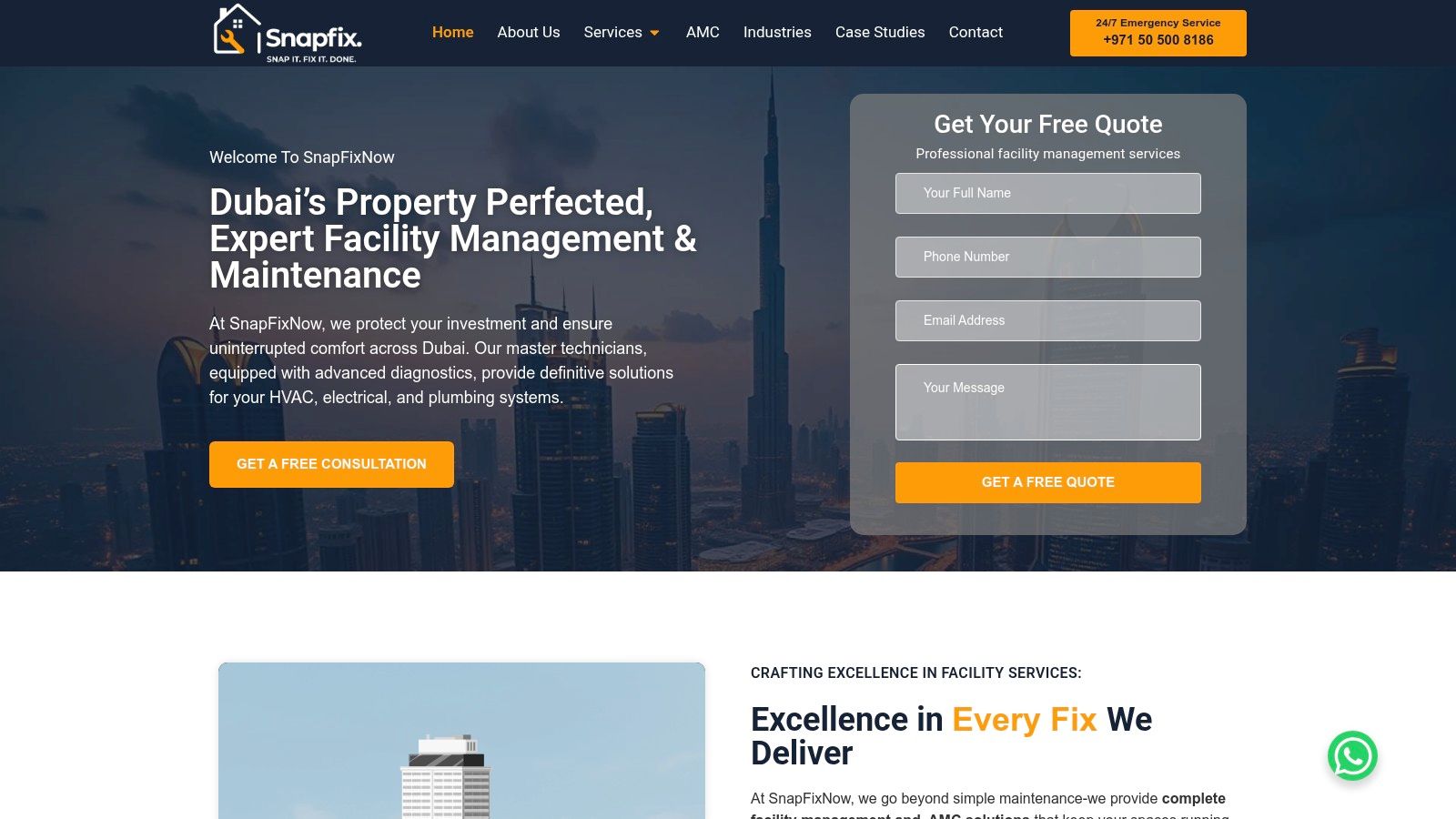
The company’s core proposition centres on delivering predictable outcomes. By embedding ISO 9001:2015 certified processes and backing its work with warranties, SnapFixNow aims to reduce the operational risk and financial uncertainty often associated with property maintenance. Its in-house team of over 50 certified technicians across MEP, HVAC, and civil works mitigates reliance on third-party contractors, ensuring greater control over response times and quality of execution.
Key Service Offerings & Operational Model
SnapFixNow’s portfolio is geared towards comprehensive asset lifecycle management, particularly for commercial, hospitality, and high-end residential properties.
Preventive Maintenance (Customised AMCs): The primary offering involves creating tailored AMCs based on asset condition, usage, and client-defined Service Level Agreements (SLAs). This moves maintenance from a cost centre to a strategic function aimed at maximising uptime.
24/7 Emergency Response: SLA-backed rapid deployment for critical failures in MEP, HVAC, and plumbing systems is a key feature, designed to minimise business disruption and protect tenant satisfaction.
Specialist Technical Services: Expertise in HVAC systems optimisation, electrical load management, and complex plumbing solutions is a stated capability.
Technology-Enabled Workflow: A photo-based work order and real-time tracking platform streamlines communication between facility managers and technicians. This system provides auditable records, speeds up approvals, and reduces administrative overhead, with the company claiming it can save teams up to five hours per week.
Operational Insight: SnapFixNow's model demonstrates a clear preference for a preventive maintenance framework over a purely reactive one. This strategy aligns with industry practice for asset management, where scheduled servicing and data analysis help pre-empt failures, thereby reducing costlier emergency repairs and extending the operational life of critical equipment.
Performance & Credibility
The company provides quantifiable evidence of its impact through case studies and client testimonials. For example, a documented 22% energy reduction on an HVAC optimisation project provides a tangible ROI metric for potential clients. Endorsements from entities like InterContinental, Jumeirah, and Dubai British School lend credibility, particularly for decision-makers in the hospitality and education sectors. The stated 99% client satisfaction metric, combined with ISO 9001:2015 certification, reinforces a commitment to quality-controlled service delivery.
Ideal Client Profile & Pricing Structure
SnapFixNow is suited for facility managers, property owners, and operations leaders who prioritise reliability, technical competence, and data-driven performance. The model is particularly effective for those seeking to transition from an unpredictable, break-fix maintenance approach to a structured, preventive plan backed by clear SLAs. While not publishing a fixed price list, the company provides indicative benchmarks for its AMC services:
Grade A Offices: Typically ranges between AED 7–15+ per sqft
High-End Residential: Typically ranges between AED 5–10 per sqft
Retail Spaces: Typically ranges between AED 8–18+ per sqft
Final pricing is determined after a detailed site survey and the definition of specific SLA requirements, ensuring the contract is precisely aligned with the asset's needs. This customised approach is a strong fit for clients who require more than a generic service package. You can explore a more detailed breakdown of how facility management companies in the UAE structure their contracts and services.
Pros:
SLA-backed 24/7 service with a focus on predictable performance and rapid response.
Technology platform that enhances transparency and operational efficiency.
Certified, in-house technical teams reduce subcontractor risk.
Demonstrable results through case studies and client testimonials.
Cons:
Service area is limited to Dubai and the Northern Emirates.
Customised pricing requires a site survey, which is not suitable for those seeking immediate, fixed-cost quotes.
Website: https://www.SnapFixNow.com
2. Emrill Services
Emrill Services has established a significant presence in the UAE as an integrated facilities management provider, offering a comprehensive suite of services under a single contractual framework. The company’s website serves as a detailed portal for procurement managers and asset owners evaluating large-scale or technically complex FM partnerships. It clearly outlines their capabilities across hard, soft, and security services, demonstrating their capacity to manage diverse and high-profile portfolios.
, it's clear that integrated models like Emrill's are designed to streamline accountability and reduce the operational burden on property owners by consolidating multiple vendor relationships into one.
Scope of Services and Sector Expertise
Emrill's website provides a structured overview of its service delivery model, which is a key differentiator for decision-makers. The site is organised to help users quickly identify relevant capabilities based on their specific asset type.
Hard FM: This includes MEP (Mechanical, Electrical, and Plumbing), HVAC systems, building fabric maintenance, and specialised asset lifecycle management. Their approach is geared towards preventive and predictive maintenance to optimise OPEX.
Soft FM: The platform details services like housekeeping, cleaning, waste management, concierge services, and landscaping, which are critical for maintaining asset value and tenant satisfaction.
Security Services: Emrill provides manned guarding and security solutions, integrated directly into the overall FM contract.
Sector Focus: The website features detailed case studies and sector-specific pages for residential, commercial, retail, hospitality, and major infrastructure projects. This allows a potential client, such as a hotel chief engineer, to see direct evidence of Emrill’s experience with similar assets, like their work with Dubai Opera.
Website Usability and Procurement Process
The Emrill website is designed for a professional B2B audience. It avoids generic marketing language in favour of showcasing certifications, awards, and documented performance metrics.
Pros:
Well-documented operational excellence: The site prominently displays safety programmes, KPIs, and case studies, offering tangible evidence of their performance standards.
Clear sector specialisation: It’s easy for users from different industries to find relevant project references and understand Emrill’s experience in their specific domain.
Direct engagement channels: A central enquiry form and the 800-EMRILL toll-free hotline provide immediate, direct access for requesting proposals or discussing Annual Maintenance Contracts (AMCs).
Cons:
No transparent pricing: All pricing is customised via a formal Request for Quotation (RFQ) process. This is standard for large-scale FM but not suitable for users seeking quick price benchmarks for smaller jobs.
Oriented towards large portfolios: The procurement workflow and information architecture are clearly aimed at medium-to-large asset owners, which may be less accessible for single-building owners or small businesses.
Website: https://www.emrill.com/
3. Imdaad
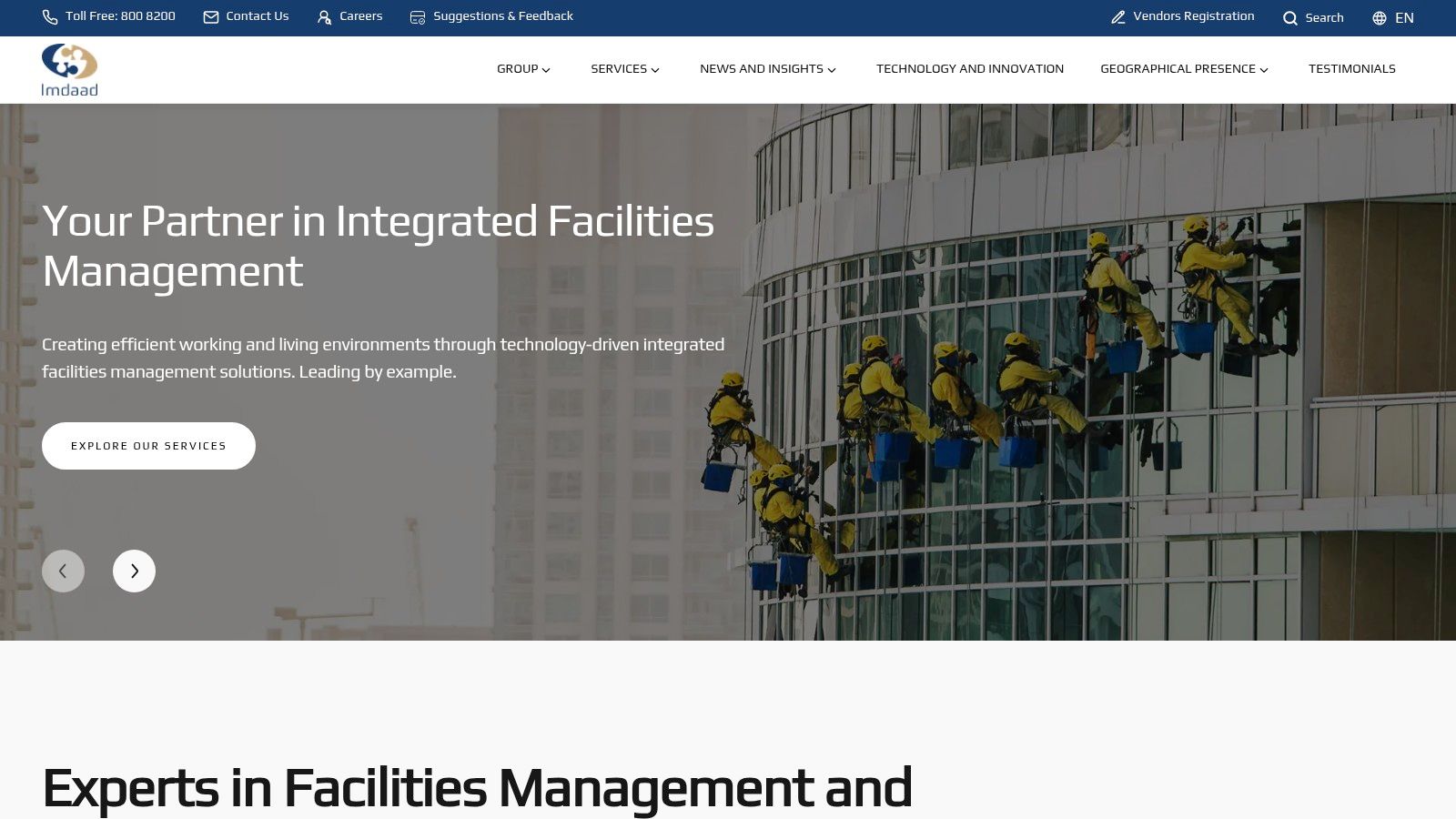
Imdaad is a Dubai-headquartered group that offers an integrated model, combining facilities management with comprehensive environmental services. Their website is structured as a corporate gateway, providing procurement managers and asset owners with a clear view of their extensive service portfolio, which is delivered through specialised group subsidiaries. This structure allows clients to bundle traditional FM services with environmental solutions like waste and wastewater management under a single, streamlined agreement.
This bundled approach is a key differentiator, as it helps consolidate vendor management and align operational objectives across multiple critical services. Managing waste and maintenance compliance under one provider can also simplify reporting and mitigate risks associated with common maintenance compliance failures in Dubai buildings, ensuring a more cohesive approach to asset integrity.
Scope of Services and Sector Expertise
Imdaad’s website effectively organises its offerings around its group structure, allowing potential clients to understand the depth of their specialist capabilities. This model provides a single source for a wide array of property needs.
Integrated FM (IFM): The core offering combines hard and soft services, managed through a central contract to optimise efficiency and accountability.
Environmental Services: This is Imdaad’s unique value proposition, covering solid waste management, wastewater treatment, and pest control services. These are often managed as separate contracts, so bundling them can significantly reduce administrative overhead.
Specialist Subsidiaries: The website details the roles of its in-house companies like Isnaad (soft services), FARZ (material recovery), HomePro (residential maintenance), Vision Safety (fire protection), and Nigma (automation), showcasing a deep technical bench.
Sector Focus: Imdaad highlights its experience across major sectors including residential communities, commercial towers, industrial facilities, and large-scale government projects, reinforcing its strong local presence.
Website Usability and Procurement Process
The website is designed for a B2B audience focused on large-scale, long-term partnerships. It functions as an informational hub that directs users toward a formal enquiry and tender process rather than transactional engagement.
Pros:
Bundled environmental services: The ability to consolidate FM with waste, wastewater, and pest control under one Service Level Agreement (SLA) is a significant advantage for large asset owners.
Strong government and blue-chip references: The company’s established portfolio in Dubai provides confidence for clients managing critical infrastructure or high-profile assets.
Clear service segregation: The subsidiary model makes it easy to identify and evaluate specific technical capabilities, from fire safety to waste recycling.
Cons:
No transparent pricing: All engagements are customised and tender-driven, which is unsuitable for users needing immediate cost estimates or smaller, ad-hoc services.
Complex group navigation: For niche add-on services, a client may need to engage with multiple contacts within the different subsidiaries, which could complicate initial communications.
Website: https://imdaad.ae/
4. Farnek
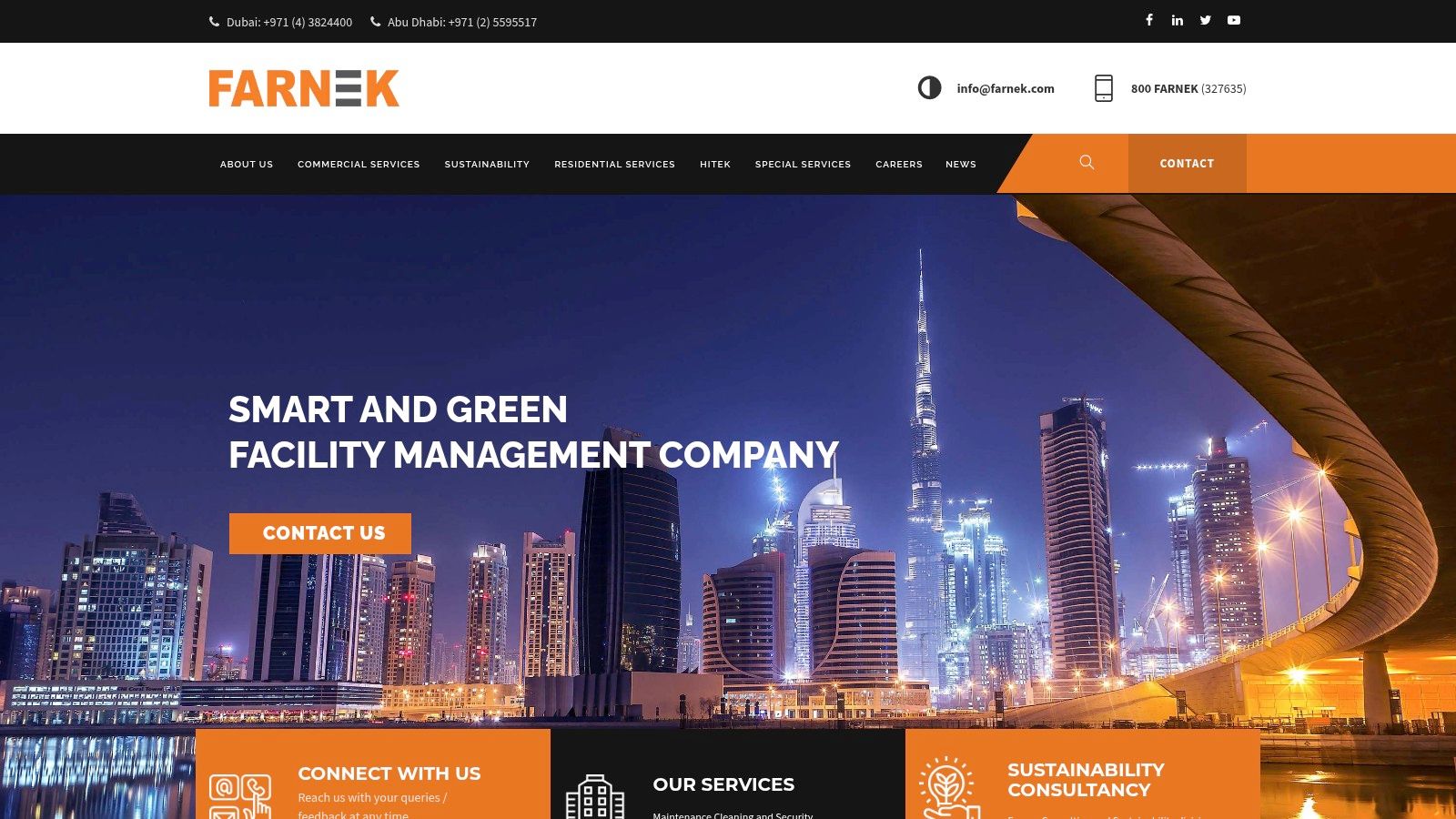
Farnek positions itself at the intersection of technology and sustainability, operating as a 'smart and green' facilities management company in Dubai. Its website is structured for decision-makers who prioritise data-driven operations and measurable reductions in operational expenditure (OPEX) through sustainable practices. The platform clearly articulates Farnek's commitment to technology, showcasing IoT-enabled solutions, smart dashboards, and AI-driven analytics as core components of its service delivery model.
The company’s approach aligns with a growing trend where asset owners seek FM partners that can not only maintain a property but also enhance its efficiency and reduce its environmental footprint. By integrating energy management directly into its core FM offering, Farnek provides a holistic solution designed to optimise building performance and achieve sustainability targets. This integrated model is particularly compelling for owners of large, energy-intensive assets like commercial towers, malls, and hotels.
Scope of Services and Sector Expertise
Farnek’s website organises its services around its core 'smart and green' philosophy, making it easy for users to understand how technology underpins each operational area. The platform provides detailed insights into its tech stack and its application across different asset types.
Hard FM (MEP): The site details its capabilities in maintaining mechanical, electrical, and plumbing systems, with a strong emphasis on leveraging IoT sensors and predictive analytics to pre-empt equipment failure and optimise energy consumption.
Soft FM: This includes a full suite of services like cleaning, security, and support staff, enhanced by smart workforce management tools for efficient deployment and real-time performance tracking.
Energy & Sustainability Consulting: A key differentiator is the in-house consultancy that works alongside the FM teams. The website features case studies highlighting tangible energy savings and carbon footprint reductions achieved for clients.
Sector Focus: Farnek showcases its experience across aviation, hospitality, banking, retail, and large-scale residential communities. The inclusion of high-profile client logos and projects provides social proof of their capability to manage complex and high-security environments.
Website Usability and Procurement Process
The website is designed for a technically proficient B2B audience, focusing on solutions, technology, and measurable outcomes rather than generic marketing. It serves as a resource for procurement managers and chief engineers looking to understand how 'smart FM' translates into operational and financial benefits.
Pros:
Clear technology-led value proposition: The site effectively communicates how its IoT and AI tools deliver OPEX reductions and enhance building efficiency, a key factor for asset managers.
Strong emphasis on sustainability: Farnek’s documented expertise in green initiatives and energy management is a significant advantage for clients with corporate sustainability goals.
Large, established workforce: The company’s scale (over 10,000 employees) gives potential clients confidence in its ability to mobilise and manage large, complex sites effectively.
Cons:
Requires client-side change management: Adopting Farnek’s advanced tech stack may necessitate new processes and training on the client's side to fully leverage the data and dashboards provided.
Customised pricing only: Like other major FM providers, pricing is not available online. A formal scoping and quotation process is required to determine costs, which is unsuitable for those needing quick budgetary estimates.
Website: https://www.farnek.com/
5. Transguard Group – Facilities Management
Transguard Group is a major business solutions provider in the UAE, and its Facilities Management division is known for its extensive manpower and large-scale operational capacity. The company’s website presents a portfolio geared towards clients requiring a comprehensive, integrated service model that often combines FM with security and staffing. For procurement managers overseeing large commercial, aviation, or multi-site portfolios, the website acts as a high-level overview of their broad capabilities, emphasising compliance, scale, and a single-provider approach.
 or tender process, with no online estimates.
Website: https://transguardgroup.com/services/integrated-facility-services/
6. EFS Facilities Services Group
EFS Facilities Services Group is a regional integrated facilities management provider with a strong operational base in Dubai and across the wider Middle East. The company's website is positioned as a resource for asset owners and procurement managers, particularly those managing cross-border portfolios who require standardised service delivery and consistent governance. It communicates a focus on process maturity and delivering integrated hard and soft services under a unified operational model.
The platform is particularly relevant for decision-makers managing assets across multiple GCC markets. EFS's emphasis on a standardised operating model means a client with properties in Dubai, Riyadh, and Doha can expect consistent service level agreements (SLAs), reporting structures, and compliance frameworks, simplifying regional oversight and performance management.
Scope of Services and Sector Expertise
EFS's website organises its offerings to demonstrate its capacity for full-scope, integrated FM contracts. The structure helps users understand how services are bundled to create efficiencies for large-scale operations and diverse asset types.
Integrated Hard & Soft FM: The site details a comprehensive suite of technical services, including MEP, civil works, and HVAC system maintenance, alongside soft services such as cleaning, security, and support services. This integrated approach is designed to provide a single point of accountability.
Sector Verticals: EFS clearly outlines its experience in key sectors like banking, retail, commercial real estate, and industrial facilities. This allows a user, such as a procurement lead for a regional bank, to quickly assess EFS's relevant experience and process knowledge for their specific operational environment.
Process and Governance: A key differentiator showcased is the emphasis on governance, compliance, and transparent operational processes. This is crucial for clients who need to ensure consistent standards and risk management across multiple locations.
Website Usability and Procurement Process
The EFS website is designed for B2B engagement, focusing on corporate capabilities and the procurement process rather than direct-to-consumer services. It serves as an introductory portal leading to a formal Request for Quotation (RFQ) and tendering process.
Pros:
Regional consistency: The site's primary strength is communicating its ability to deliver a uniform service standard across different countries, which is a major advantage for pan-GCC portfolio owners.
Clear engagement pathways: It provides centralised contact forms and key account engagement channels, streamlining the process for initiating formal procurement discussions for large contracts.
Strong industry presence: The platform highlights industry awards and certifications, offering third-party validation of its operational maturity.
Cons:
Limited Dubai-specific case detail: While the regional strength is clear, the website offers less granular, publicly visible detail on specific Dubai-based projects compared to some local competitors.
Pricing via formal tender: Consistent with the B2B FM model, all pricing is bespoke and provided through a formal RFQ. The site does not offer online price estimation tools for smaller-scale asset needs.
Website: https://efsme.com/
7. MEFMA (Middle East Facility Management Association) – Member Directory
The Middle East Facility Management Association (MEFMA) is a non-profit professional body that serves as a central hub for the region's FM industry. For procurement managers and asset owners, its website, specifically the member directory, acts as a crucial first step in the vendor qualification process. It provides a neutral, association-vetted list of facility management companies in Dubai and the wider GCC, offering a reliable starting point for building a tender list or validating a potential partner’s industry standing.
Unlike direct company websites, MEFMA's platform is not a sales tool; it's a resource for due diligence. Utilising this directory allows decision-makers to identify providers who are actively engaged in the industry, committed to professional development, and aligned with regional best practices. This initial screening step helps de-risk the procurement process by filtering for organisations with a demonstrated commitment to the FM sector.
Scope of Services and Sector Expertise
The MEFMA directory is not a service catalogue but a tool for discovering and validating providers across the entire FM spectrum. Its primary function is to help users build a qualified list of potential vendors for their specific needs, whether for an integrated contract or a specialised service.
Vendor Discovery: The directory lists a wide range of companies, from large integrated FM providers (like Emrill, Farnek, and Imdaad) to more specialised firms focused on niche areas like energy management, waste recycling, or security solutions.
Credential Validation: A key use for procurement teams is to verify if a potential vendor is a member in good standing. This signals a level of professionalism and industry involvement that goes beyond basic commercial licensing.
Industry Benchmarking: The website also hosts reports, event proceedings, and industry insights. This allows managers to benchmark their own operational needs and RFP requirements against current market trends and standards discussed within the association.
Direct Sourcing: Each member listing typically includes a direct link to the company's official website, creating a seamless pathway from validation to direct engagement for a Request for Proposal (RFP) or an AMC enquiry.
Website Usability and Procurement Process
The MEFMA directory is a straightforward, functional tool designed for B2B research. Its value lies in its neutrality and the credibility of its listings.
Pros:
Neutral, association-backed list: The directory provides an unbiased starting point for vendor shortlisting, free from marketing claims.
Aids due diligence: Quickly confirms a company's affiliation with the primary professional body for FM in the Middle East.
Discover specialist providers: Useful for finding niche experts beyond the well-known integrated FM giants for specific, technical projects.
Cons:
No direct service comparison: The site does not provide pricing, service matrices, or side-by-side comparisons; users must click through to each individual member's website.
Requires further investigation: It is a starting point, not an end-point. Procurement managers must still conduct their own detailed vetting, RFP process, and reference checks for each shortlisted company.
Website: https://mefma.org/membership/meet-our-members/
A Decision Framework for FM Partner Selection in Dubai
Navigating the landscape of facility management companies in Dubai requires a structured approach that moves beyond brand recognition to a granular analysis of operational models and risk allocation. The preceding profiles highlight the diverse capabilities available in the market. However, the optimal choice for your asset depends less on a provider's name and more on the alignment of their service delivery framework with your specific operational, financial, and compliance objectives. A methodical evaluation process is critical to transitioning from a cost-centric procurement exercise to a value-driven, long-term partnership that protects asset integrity.
Comparison of FM Contract Models
| Contract Model | Typical Cost Structure | Risk Allocation (Client) | Ideal Use Case | Operational Implications |
|---|---|---|---|---|
| Comprehensive AMC | Higher fixed annual fee, includes parts & labour | Low | High-value assets, mission-critical facilities (e.g., data centres, hospitals) | Predictable OPEX, incentivises provider to perform preventive maintenance to reduce their own costs. |
| Labour-Only AMC | Lower fixed annual fee + variable cost of parts | High | Non-critical assets, clients with in-house parts procurement capabilities | Unpredictable OPEX, risk of inflated parts pricing, potential delays awaiting parts approval/delivery. |
| Reactive / Call-Out | Pay-per-use, no fixed fee | Very High | Small businesses, low-complexity assets, supplementary to an in-house team. | Highest potential OPEX, no preventive planning, significant downtime risk. |
| Integrated FM (IFM) | Single, comprehensive contract fee for all services | Varies (Low to Medium) | Large portfolios, multi-site operations, clients seeking vendor consolidation. | Streamlined contract management, single point of accountability, potential for cost efficiencies at scale. |
Core Evaluation Criteria for Your FM Partner Shortlist
Before engaging with potential providers, your internal team should establish clear benchmarks for what constitutes an acceptable service level. Use the following criteria as a robust checklist to evaluate proposals and conduct due diligence, ensuring a like-for-like comparison that reveals true value.
1. Contractual and Commercial Rigour
The structure of the FM contract is the foundation of the partnership. Scrutinise the proposed model for risk allocation and cost predictability.
Comprehensive vs. Labour-Only Models: A fully comprehensive contract, while having a higher initial cost, shifts the risk of component failure and emergency call-outs to the provider. This model offers predictable OPEX, which is crucial for budgeting. In contrast, a labour-only or "plus parts" model may present a lower initial figure but introduces significant financial volatility. For critical assets, the risk of unpredictable expenditure often outweighs the perceived savings of a labour-only approach.
SLA and Penalty Clauses: A Service Level Agreement (SLA) without financial penalties for non-performance is a statement of intent, not a guarantee. For a Grade A commercial tower in Dubai, an emergency response time for a critical HVAC failure should be contractually defined. Industry practice often shows this threshold between 60-90 minutes. Rectification times for such issues should be clearly stipulated, with escalating penalties for delays. Verify that the SLA covers all critical assets and includes clear definitions for response, rectification, and incident categorisation.
2. Verifying Technical and Operational Depth
A provider's ability to execute depends entirely on its technical resources and operational processes.
In-House vs. Subcontracted Labour: Request a clear breakdown of the proposed team structure, specifically the ratio of directly employed, multi-skilled technicians to subcontracted specialists. A high reliance on subcontractors can introduce delays in mobilisation, inconsistent quality standards, and fragmented communication. Providers with strong in-house technical teams for core MEP (Mechanical, Electrical, and Plumbing) services typically demonstrate higher first-time fix rates and greater control over service quality.
Technology Stack and Data Transparency: Modern facility management is data-driven. Evaluate the provider's Computerised Maintenance Management System (CMMS) or field service management platform. Can it provide real-time dashboards on work order status, asset performance, and SLA compliance? For organisations like property management companies, this data is invaluable for tenant communication and owner reporting. Insist on a system that offers transparent, auditable records for compliance with Dubai Municipality and Civil Defense regulations. Platforms that leverage photo and video-based reporting, like that used by some modern providers, offer an unparalleled level of transparency and verification.
Evaluating Facility Management Service Providers in Dubai
This guide offers a detailed approach for evaluating facility management (FM) service providers in Dubai, targeting procurement teams, asset managers, and engineering leaders. It includes a framework for assessing risk, cost, and performance in various FM models within the UAE market, emphasizing quantifiable operational value over subjective rankings.
Key Service Delivery Structures
The guide examines service delivery structures, from integrated facility management (IFM) to specialized hard FM contracts, and their impact on operational expenditure (OPEX), asset lifecycle, and compliance. This helps decision-makers compare service models and select a partner that meets specific asset performance objectives.
Considerations for the Dubai Market
Important factors include Dubai's harsh climate, with high humidity and extreme heat affecting HVAC systems, and the necessity of adhering to local standards. Assessing how potential partners manage these challenges is crucial for reducing operational risks.
Company Profiles
SnapFixNow
Best for: Large Communities
Service Model: Engineering-led, focusing on hard FM, preventive maintenance, and 24/7 support.
Cost Insight: Grade A Offices: AED 7–15+ per sqft; High-End Residential: AED 5–10 per sqft.
Core Strength: Predictable outcomes with ISO 9001:2015 certified processes and in-house expertise.
Emrill Services
Best for: Large Portfolios
Service Model: Integrated FM with hard, soft, and security services.
Core Strength: Consolidates vendor relationships into a single contract.
Imdaad
Best for: Environmental Integration
Service Model: Combines FM with environmental services.
Core Strength: Single agreement for FM and environmental solutions.
Farnek
Best for: Quick Tech Integration
Service Model: 'Smart and green' FM with IoT and AI-driven solutions.
Core Strength: Focus on technology and sustainability.
Transguard Group
Best for: Commercial Offices
Service Model: Comprehensive FM with security and staffing.
Core Strength: Large-scale operational capacity.
Comparison Matrix
| Company | Best For | Key Strengths | Core Services |
|---|---|---|---|
| SnapFixNow | Large Communities | Predictable outcomes, in-house expertise | Hard FM, preventive maintenance, 24/7 support |
| Emrill Services | Large Portfolios | Vendor consolidation | Integrated FM |
| Imdaad | Environmental Integration | FM with environmental services | Integrated FM, waste management |
| Farnek | Quick Tech Integration | Technology and sustainability focus | IoT and AI-driven solutions |
| Transguard Group | Commercial Offices | Large-scale capacity | FM, security, staffing |
Red Flags: 3 Signs Your Current FM Company is Failing You
Inconsistent Service Quality: Frequent service disruptions or tenant complaints.
Lack of Transparency: No clear reporting on service delivery and compliance.
Delayed Response Times: Slow reaction to emergencies or maintenance requests.
Cost per Square Foot Insight
JLT Offices: AED 8–14 per sqft
Palm Jumeirah Villas: AED 10–18 per sqft
Client Testimonial Integration
Visit company websites to view Google Review Snapshots and Ratings for an in-depth understanding of client satisfaction.
Interactive Quiz
Take the "Which FM Company fits your building?" quiz to receive a personalized recommendation and connect directly with potential providers.
By systematically applying this framework, you empower your organisation to make an informed, defensible decision. The goal is to forge a strategic alliance that not only maintains your facility but actively contributes to its operational efficiency and long-term asset value.