This guide provides a technical framework for asset owners, facility managers, and procurement teams responsible for managing high-value HVAC systems in the UAE. The content is structured to reduce decision ambiguity by using quantified, risk-based analysis for VRF, chiller, and AC systems, focusing on operational expenditure (OPEX), asset lifecycle, and regulatory compliance.
Decision Navigation:
- For Existing Assets: Jump to Section 1: Cooling Optimization
- For New Buildings: Jump to Section 2: Lifecycle Selection
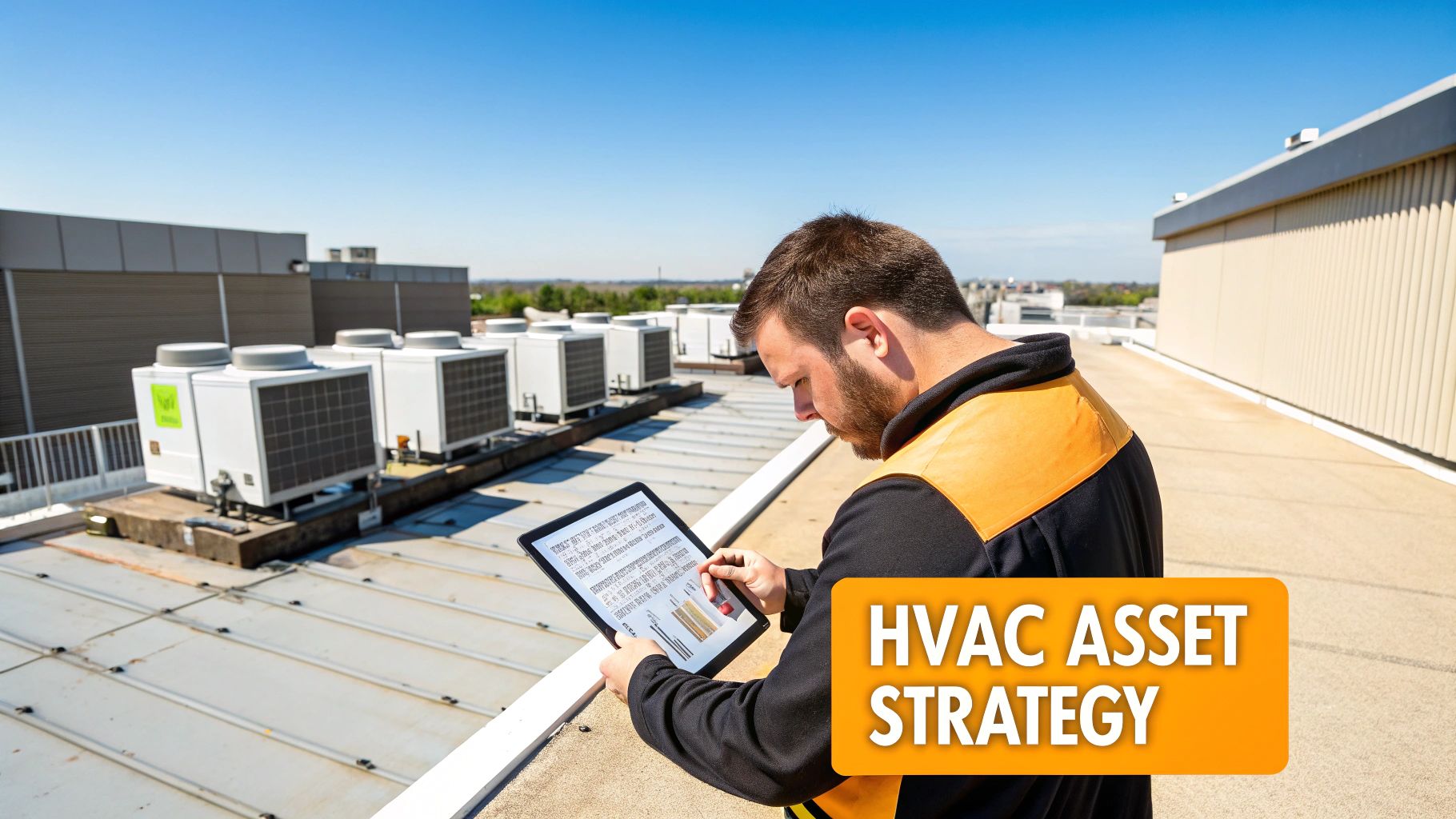
- For Failing Systems: Jump to Section 3: Asset Strategy
- For Occupant Health: Jump to Section 4: Indoor Air Quality & Health
- For Future Compliance: Jump to Section 5: 2026 Regulatory & Future Compliance
Section 1: Cooling Optimization (Performance Engineering)
Focus: Mitigating the "Efficiency Tax" in the UAE Climate
The primary operational challenge for any HVAC system in the UAE is the "efficiency tax"—a performance degradation caused by two persistent environmental factors: high ambient temperatures causing derating and airborne dust insulating condenser coils. This phenomenon, if unmanaged, can inflate energy-related OPEX by 15-25% annually and accelerate component failure. Effective management requires an engineering-led approach to quantify performance loss, execute precise rectification, and validate the return on investment.
The Evidence Framework: Quantifying Performance Loss
Performance cannot be managed without being measured. The core metric is the Energy Efficiency Ratio (EER), which degrades under UAE operational conditions. The quantification of this degradation is calculated as follows:
Formula: Efficiency Loss (%) = 1 – (Measured EER / Design EER)
Decision Trigger: If the measured efficiency loss exceeds 12% against the manufacturer's design specifications, an immediate chemical coil restoration is triggered. Industry data indicates a typical Return on Investment (ROI) of approximately 4.2 months for this action, based on current DEWA commercial electricity tariffs.
The Rectification Protocol
Standard pressure washing is insufficient to remove the baked-on combination of dust, salt, and pollutants common in the UAE. A systematic, multi-step process is required for effective performance restoration.
- Step 1 (Diagnosis): Establish a baseline by measuring the current EER and airflow.
- Step 2 (Chemical Restoration): Apply a non-corrosive, foaming chemical cleaner formulated to penetrate deep into coil fins and dissolve contaminants without causing material damage.
- Step 3 (Low-Pressure Rinse): Thoroughly rinse coils to remove chemical residue and dislodged debris. High pressure must be avoided to prevent damage to delicate fins, which would further impede performance.
- Step 4 (Validation): Re-measure EER and airflow to confirm performance has been restored to within 5% of the original design specifications.
This structured protocol transitions maintenance from a routine cost into a quantifiable investment with a direct impact on OPEX reduction. For further optimization, a commercial HVAC maintenance checklist provides a foundational layer for preventive planning, which can be enhanced with technologies like variable frequency drives for additional VFD energy savings. You can read more about energy efficiency through strategic AMC planning.
Section 2: Lifecycle Selection (Financial Modeling)
Focus: High-Stakes Procurement—VRF vs. Chillers
The selection between a Variable Refrigerant Flow (VRF) system and a central water-cooled chiller plant is a high-impact procurement decision with long-term financial consequences. The optimal choice is determined by the financial crossover point where the modularity and part-load efficiency of VRF are weighed against the scale and peak-load efficiency of chillers. This decision must be based on a comprehensive 10-Year Total Cost of Ownership (TCO) analysis, not solely on initial capital expenditure (CAPEX).
The Evidence Framework: 10-Year TCO Predictor
A TCO model provides a financial forecast that accounts for all costs over a decade of operation under UAE conditions. This prevents the common procurement error of selecting a low-CAPEX system that results in excessive OPEX.
Key TCO Variables:
- Initial CAPEX: Equipment, installation, and commissioning costs.
- Energy Consumption (OPEX): Modeled against specific building occupancy profiles and current DEWA commercial tariffs.
- Preventive Maintenance Costs: Reflecting the different cost structures of distributed VRF units versus a centralized chiller plant.
- Projected Corrective Repair Costs: Budgeted based on component failure probabilities over a 10-year lifespan.
- End-of-Life Decommissioning Costs.
TCO Decision Matrix: VRF vs. Water-Cooled Chillers
| Decision Factor | VRF System Profile | Water-Cooled Chiller Profile |
|---|---|---|
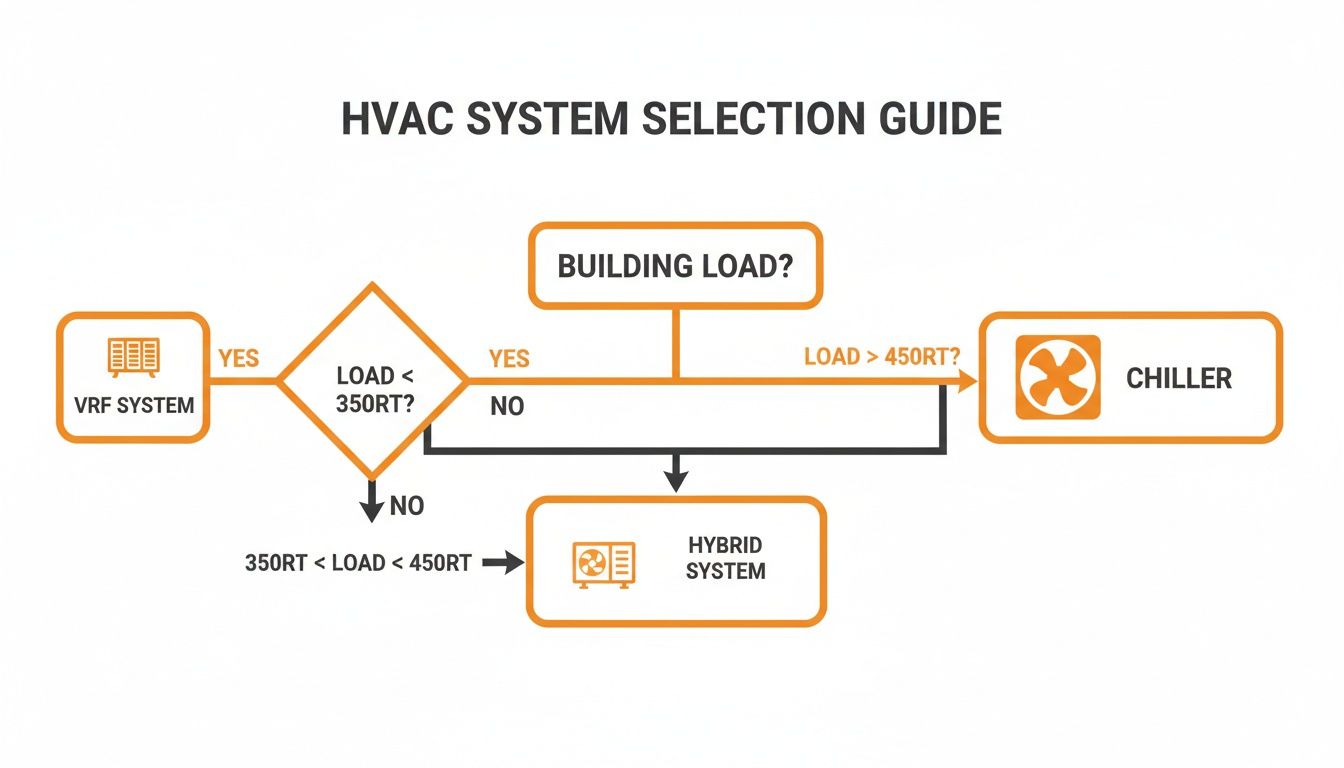
| Ideal Cooling Load | Optimal for loads under 350 RT. | Most efficient for loads over 450 RT. |
| Occupancy Profile | High variability (e.g., hotels, boutique offices). | Consistent, high base-load (e.g., malls, large towers). |
| Initial CAPEX | Generally lower upfront investment. | Higher initial investment for plant and equipment. |
| 10-Year OPEX | Lower energy costs at part-load (40-70% capacity). | Can deliver up to 22% lower OPEX at peak load. |
| Maintenance | Distributed maintenance across multiple smaller units. | Centralised maintenance on a single large plant. |
| Installation Footprint | Smaller, modular outdoor units; less plant room space. | Requires a significant dedicated central plant room. |
| Scalability | Excellent; can be expanded in modular phases. | Limited; designed for a specific peak capacity. |
Decision Output: Based on 2026 UAE cooling market data, if the total cooling load is less than 350 RT with highly variable occupancy, VRF typically emerges as the winner on a 10-year TCO. Conversely, if the load is greater than 450 RT with 24/7 base-load requirements, a water-cooled chiller system is projected to reduce long-term OPEX by as much as 22%.
Case Study Logic:
- Dubai Marina Tower (High Base-Load >450 RT): The peak-load efficiency of a water-cooled chiller system provides superior OPEX savings over ten years, justifying the higher initial CAPEX.
- JLT Boutique Hotel (Variable Load <350 RT): A VRF system's ability to operate efficiently at 40-60% capacity during periods of low occupancy significantly reduces energy waste, making it the more prudent long-term investment.
This TCO model provides procurement teams with a risk-based framework to align HVAC system selection with the building's specific operational and financial strategy. The implementation of such systems is typically handled by a qualified MEP contracting company in Dubai.
Section 3: Asset Strategy (Replacement Logic)
Focus: Eliminating "Zombie Assets" from Maintenance Budgets
"Zombie assets" are legacy HVAC systems that remain technically operational but are practically obsolete, consuming disproportionate maintenance budgets due to repeat failures and poor energy efficiency. Their continued operation is often justified by the sunk-cost fallacy, leading to unpredictable OPEX and an elevated risk of catastrophic failure during peak cooling demand. A structured decommissioning strategy is a fiscal necessity to mitigate these risks.

The Evidence Framework: The 1/3 Life-Cost Rule
To provide a quantitative basis for the repair-versus-replace decision, the "1/3 Life-Cost Rule" serves as a mandatory trigger for a formal replacement evaluation. This rule removes subjective bias from the decision-making process.
Rule: If cumulative repair costs for a single asset exceed 35% of its replacement value within a rolling 24-month period, decommissioning becomes mandatory.
This trigger forces a strategic review based on future financial viability. Investing capital beyond this threshold into an aging asset represents a misallocation that should be redirected toward a new, more efficient unit.
Field Data: Failure Rates in Legacy UAE Systems
Field data from the UAE confirms a non-linear increase in failure probability for HVAC systems older than 12 years. The unique environmental stressors—heat and dust loading—accelerate component fatigue in compressors, fan motors, and control boards.
- Years 8-12: A noticeable increase in component wear and corrective maintenance frequency.
- Years 12+: The high-risk phase. Logged data shows that return-visit rates for the same or related faults can increase by as much as 200% compared to mid-life assets.
Decision Output: Proactive replacement, triggered by the 1/3 Life-Cost Rule, results in a projected 28% reduction in 5-year lifecycle costs. This is driven by lower energy consumption, near-zero corrective maintenance, and new warranty coverage. The substantial size of the UAE commercial HVAC market underscores the financial importance of managing these capital-intensive assets effectively.
Section 4: Indoor Air Quality & Health (The ESG Layer)
Focus: Aligning IAQ with Productivity, Tenant Retention, and 2026 Standards
In Dubai's sealed building environments, Indoor Air Quality (IAQ) has evolved into a critical Environmental, Social, and Governance (ESG) metric. Poor IAQ, a primary contributor to "Sick Building Syndrome," directly impacts occupant cognitive performance and tenant retention. Proactive IAQ management is now a strategic imperative to preserve asset value. Aligning HVAC operations with standards like ASHRAE 62.1-2026 and ISO 16890 is essential for creating healthy and productive indoor environments.

The Evidence Framework: Filtration and Ventilation Strategy
Effective IAQ management hinges on two levers: filtration and ventilation. The strategy should be dictated by occupancy density to control both particulate matter and bio-effluents like CO₂.
Filter Grade Recommendations:
- Low-Density (<4 persons/1,000 sq ft): MERV 8 filtration is typically sufficient to protect HVAC equipment from large dust particles.
- Medium-Density (4-7 persons/1,000 sq ft): An upgrade to MERV 11 is recommended to capture smaller particles like pollen and mold spores, improving occupant air quality.
- High-Density (>7 persons/1,000 sq ft): MERV 13 filters are the minimum requirement. They are effective at trapping fine particles, including some bacteria and virus carriers.
Ventilation Formula (ASHRAE 62.1): The required ventilation rate ($V_z$) is a function of occupancy density ($P_z$) and floor area ($A_z$). In high-density spaces, this often necessitates advanced ventilation strategies.
Decision Output: For occupancy densities exceeding 7 persons per 1,000 sq ft, an upgrade to MERV 13 filtration combined with CO₂-led Demand Controlled Ventilation (DCV) is advised. Studies show this combination can lead to an 11% increase in cognitive performance metrics.
Demand Controlled Ventilation (DCV) for OPEX Control
Constantly ventilating with hot, humid outdoor air places a significant load on cooling systems and increases OPEX. DCV offers an intelligent solution by using CO₂ sensors to modulate fresh air intake based on real-time occupancy.
- Low Occupancy: The system reduces fresh air intake to the minimum required, saving energy.
- High Occupancy: The system increases fresh air supply to dilute CO₂ and maintain healthy IAQ.
This approach optimizes the trade-off between energy efficiency and occupant health, ensuring the building is neither over-ventilating (wasting energy) nor under-ventilating (compromising health).
Section 5: 2026 Regulatory & Future Compliance
Focus: Legal De-risking and Mandatory "Green" Mandates
The UAE's regulatory landscape for building management is evolving, with a clear trajectory toward mandatory energy efficiency and environmental standards. Proactive compliance is a core risk mitigation strategy for asset owners, as non-compliance can result in financial penalties, permit renewal complications, and diminished asset value. Future-proofing operations against these changes is a strategic priority.
Key Regulatory Shifts
- Cabinet Resolution No. 157 (2025): Mandatory 2026 Energy Labels. This resolution will enforce a Minimum Energy Performance Standard (MEPS) for all new HVAC equipment and major retrofits. Procurement decisions must now weigh these energy labels alongside cost and capacity.
- GWP Refrigerant Limits: A mandatory shift to refrigerants with a Global Warming Potential (GWP) of less than 700 is mandated for most new systems by January 2026. This effectively phases out common refrigerants like R-410A in new equipment and will lead to increased service costs for legacy systems as supply dwindles.
- BMS Integration & Smart Operational Logs: Dubai Municipality mandates that all HVAC systems be integrated with a central Building Management System (BMS) for automated logging of key performance data. This data must be available for regulatory audits.
Decision Output: Assets that fail to meet these new standards, including the Estidama 3-Star minimum for major retrofits, will face non-compliance penalties during building permit renewals. This accelerates the need for a strategic asset replacement plan, moving away from systems that are becoming operational and legal liabilities. The high value of the UAE commercial HVAC market reinforces the importance of aligning capital planning with these impending regulations.
Decision Considerations for HVAC Service Contract Procurement
Procuring an HVAC service contract based solely on the lowest price often results in higher long-term OPEX due to repeat failures, extended downtime, and inefficient system performance. A structured evaluation framework allows procurement teams to assess providers based on their ability to deliver operational reliability and mitigate risk.
Contractual and Operational Evaluation
- Service Model Comparison: A comprehensive, SLA-driven contract typically costs 15-20% more upfront than a reactive, labour-only model but reduces long-term costs by preventing failures.
- Response Time SLAs: For critical system failures in the UAE, an on-site technician response time of 2-4 hours should be a non-negotiable term in the Service Level Agreement (SLA).
- Technician Certification: Verify that technicians hold OEM or industry-recognized certifications for VRF, chillers, and AC repair to reduce the risk of improper servicing and repeat failures. The significant value of the HVAC rental market, as detailed in research you can read the full research on the HVAC rental market, highlights the high cost of downtime and validates the need for stringent SLAs.
Technical and Reporting Evaluation
- Reporting Platform: The provider should use a photo-based digital platform for work orders. This provides objective, time-stamped proof of work performed, simplifying compliance audits and performance verification.
- Technical Capabilities: The provider must demonstrate in-house technical teams with proven expertise in diagnostics, rectification, and preventive planning for complex systems. Subcontract-based models often introduce delays and inconsistent service quality.
By applying this evaluation logic, procurement shifts from a cost-focused transaction to a strategic partnership decision that directly enhances asset uptime and optimizes lifecycle costs.
To apply these principles, begin with a professional site audit and load recalculation. Contact us to schedule an evaluation.