An Annual Maintenance Contract (AMC) is a strategic operational tool for safeguarding critical building systems. In Dubai, where high ambient temperatures, humidity, and airborne dust place extreme stress on infrastructure, an AMC shifts facility management from a reactive, high-cost breakdown model to a planned, preventive framework. The objective is to manage operational expenditure (OPEX), mitigate failure risk, and extend the lifecycle of key assets, including HVAC, MEP (Mechanical, Electrical, and Plumbing), and life safety systems.
This guide provides a technical breakdown of AMC structures, scope inclusions/exclusions, and Service Level Agreement (SLA) metrics to support informed decision-making for property managers, facility engineers, and asset owners in the UAE.
Core Scope of an AMC in Dubai: What's Covered
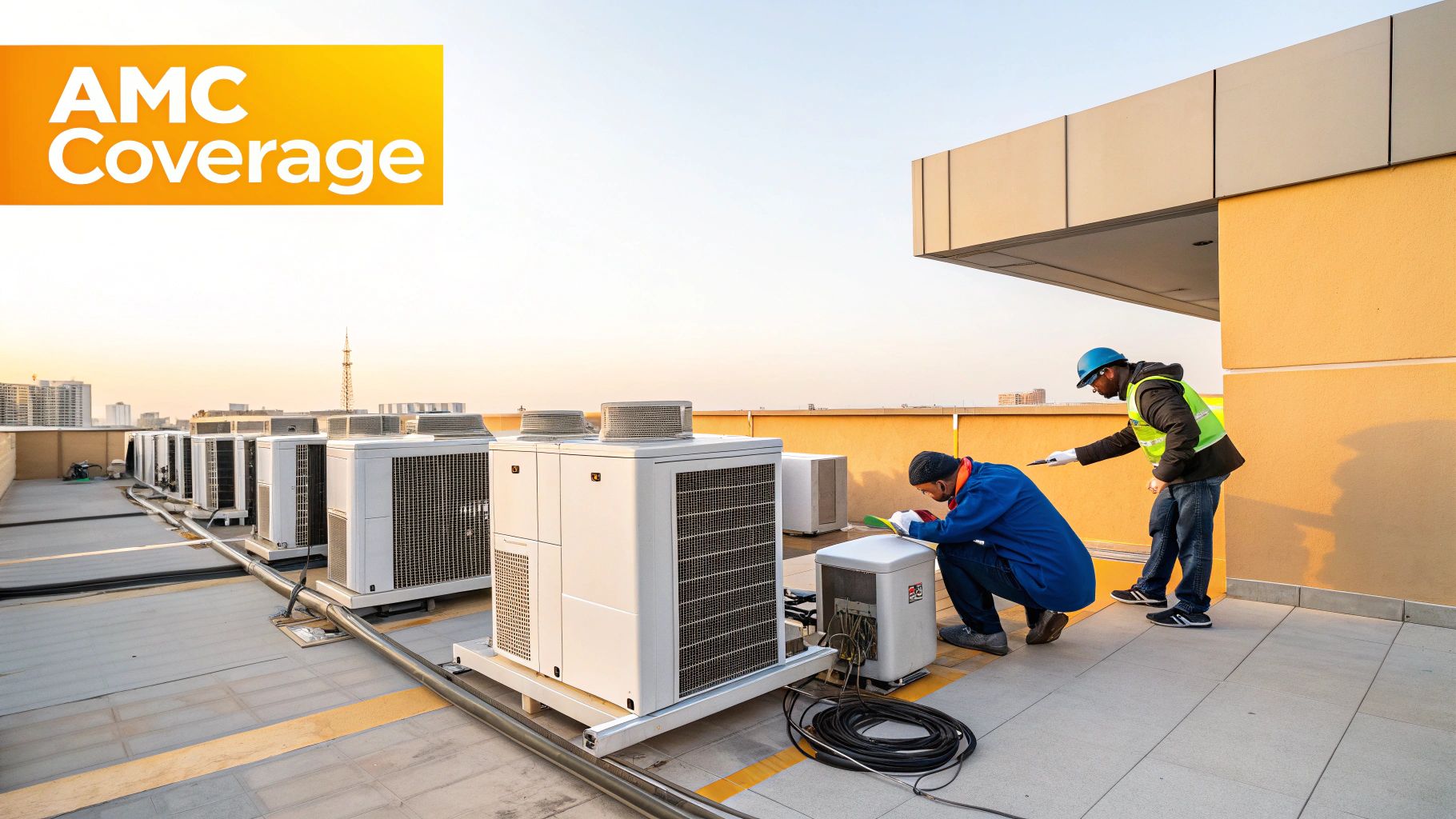
An AMC is a service agreement that converts unpredictable maintenance costs into a forecasted budget line item. This is critical for asset management in Dubai, where environmental factors accelerate asset degradation. A well-structured AMC is a primary risk mitigation instrument, ensuring operational continuity and compliance with local regulatory bodies like Dubai Municipality and Civil Defence. The agreement is founded on three maintenance pillars.
Core Maintenance Pillars
- Preventive Maintenance: Scheduled, proactive interventions based on a predefined scope and frequency. Activities include inspections, filter cleaning, lubrication of moving parts, and system calibration to identify and rectify minor issues before they escalate into major failures.
- Corrective Maintenance: Labour allocated for unscheduled repairs when an asset malfunctions between preventive visits. This covers the rectification of unforeseen breakdowns to restore system functionality.
- Emergency Response: A contractually guaranteed response to critical failures that pose a safety risk or threaten operational continuity (e.g., total HVAC failure, major power outage). Response times are defined within the Service Level Agreement (SLA), often with 24/7 availability.
Understanding contract models is essential. For more detail, you can explore the various types of annual maintenance contracts for different property needs in Dubai. The primary objectives are to sustain asset performance, ensure safety, and achieve OPEX predictability. A professionally managed AMC also generates an auditable record of all maintenance activities, which is vital for compliance reporting and demonstrating due diligence in asset management.
AMC Inclusions vs. Exclusions Matrix
This matrix provides a clear operational distinction between what is typically included within a standard AMC scope and what constitutes a separate, chargeable work order. Understanding these boundaries is fundamental to accurate budgeting and avoiding scope creep.
| Asset / Service Category | Typically Included in AMC Scope | Typically Excluded (Requires Separate Quotation) | Key Consideration in Dubai's Climate |
|---|---|---|---|
| HVAC Systems | Scheduled Preventive Maintenance (PPM) including filter/coil cleaning, labour for repairs, refrigerant leak checks. | Full refrigerant gas charging post-major leak, major component replacement (compressors, chillers). | High thermal load and dust loading necessitate quarterly PPM at a minimum to maintain operational efficiency and prevent premature failure. |
| Electrical Systems | Distribution Board (DB) panel inspection, tightening of connections, functional testing of circuit breakers (MCB/ELCB). | Replacement of major components (transformers, switchgear), thermographic scanning, comprehensive energy audits. | High humidity accelerates corrosion on electrical contacts; regular inspection is critical for fire prevention. |
| Plumbing & Drainage | Water pump functional checks, clearing minor blockages, inspection of water heaters. | Major re-piping projects, replacement of water heaters/pumps, sewage system overhauls. | High water salinity and TDS levels can lead to accelerated corrosion and calcification in pipes and pumps. |
| Specialised Systems | Almost always excluded unless specified as a separate contract. | Fire alarm/fighting systems, elevators, Building Management Systems (BMS), access control, CCTV. | These systems require specialist third-party certification and dedicated maintenance contracts to comply with Dubai Civil Defence regulations. |
| Consumable Parts vs. Spare Parts | Consumables (filters, belts, lubricants) used during PPM. Note: this varies by contract type. | Any spare parts required for corrective repairs (unless under a Comprehensive AMC). | The contract must explicitly define "consumable" versus "spare part" to avoid disputes. |
| Civil & Masonry Works | Universally excluded. | Painting, tiling, waterproofing, structural repairs. | These are classified as project-based works, falling outside the scope of routine MEP maintenance. |
This matrix underscores the necessity of scrutinising the detailed scope of work. A clear understanding of these delineations ensures the AMC aligns with the property's operational requirements and prevents unforeseen expenditure.
Distinguishing Between Included and Excluded Scope
Defining the boundaries of an Annual Maintenance Contract is the most critical factor in preventing contractual disputes and unbudgeted expenditure. For facility and procurement teams in Dubai, ambiguity in the scope of work is a direct risk to OPEX control. A contract's value is determined not by assumptions, but by explicit, documented inclusions and exclusions.
The fundamental purpose of an AMC is to manage the planned preventive and corrective maintenance required for operational continuity. The critical dividing line is between maintenance (an operational expense, or OPEX) and replacement or major overhaul (a capital expense, or CAPEX). This distinction must be unambiguous.
What's Typically Included in the Scope
A standard AMC in the UAE is structured around maintaining the operational integrity of MEP (Mechanical, Electrical, and Plumbing) and HVAC systems—the core life-support infrastructure of any building in this climate.
HVAC Systems Coverage:
Given the extreme ambient heat and airborne particulates, HVAC systems are a primary focus. A robust contract typically includes:
- Scheduled Preventive Maintenance (PPM): Routine, planned service visits. This encompasses filter cleaning, coil washing, refrigerant level checks, motor lubrication, and inspection of electrical connections. For commercial properties in Dubai, quarterly PPM is considered the operational minimum.
- Labour for Corrective Repairs: When a system fails between scheduled visits, the technician's time and expertise for diagnostics and rectification are covered.
- Functional Testing: Verification that system controls, including thermostats, sensors, and actuators, are calibrated and responding correctly.
MEP Systems Coverage:
The scope for electrical and plumbing systems is similarly defined:
- Electrical: Periodic inspection of Distribution Boards (DBs), tightening of terminals to prevent overheating, and functional testing of Miniature Circuit Breakers (MCBs) and Earth Leakage Circuit Breakers (ELCBs) to ensure correct tripping characteristics.
- Plumbing: Inspection of water pumps (booster and transfer), identification of minor leaks, cleaning of water tank filters, and functional checks of water heaters.
- Drainage: Scheduled clearing of floor traps and roof drains to prevent blockages, particularly in preparation for seasonal rainfall.
A common misconception is that an AMC is merely a reactive repair service. In reality, the scope of coverage delivered through comprehensive Annual Maintenance Contracts in Dubai extends far beyond basic reactive repairs, encompassing preventive maintenance frameworks that directly address the operational demands of Dubai's diverse facility landscape. For commercial buildings and mixed-use developments, modern AMCs include regular health checks of mechanical, electrical, and plumbing (MEP) systems, HVAC maintenance, network infrastructure monitoring, and spare parts provisioning as needed, with standardized response protocols ensuring rapid resolution if breakdowns occur. Discover more insights about IT and facility AMC coverage on bluechipgulf.ae.
Common Exclusions and Grey Areas
Understanding what is not covered is as important as knowing what is. Exclusions protect both the asset owner from assuming unlimited coverage and the service provider from unquantifiable financial risk. These items almost universally fall outside a standard AMC and require a separate quotation.
Capital Equipment and Major Component Failure:
This is the primary exclusion. An AMC is designed to maintain an asset through its operational lifecycle, not to fund its replacement at end-of-life.
- Examples: Complete replacement of an HVAC chiller, a main electrical transformer, a water heater, or a primary water pump. The failure and subsequent replacement of a major compressor within an AC unit is a capital expense.
Significant Civil and Structural Works:
AMCs address MEP and HVAC systems, not the building fabric.
- Examples: Rectification of major water leaks requiring intrusive works (breaking walls/floors), repainting, masonry repairs, or any structural modifications.
Tenant-Induced Damage or Misuse:
The contract assumes equipment is operated within manufacturer-specified parameters. Damage resulting from negligence, misuse, or unauthorised modifications by tenants is excluded. For example, drilling into a concealed water pipe or overloading an electrical circuit.
Specialised Systems:
Certain critical systems require technicians with specific certifications, often mandated by authorities like Dubai Civil Defence.
- Examples: Fire alarm and firefighting systems, elevators and escalators, Building Management Systems (BMS), and CCTV or access control systems. These invariably require their own dedicated, specialist AMCs.
By clearly defining these boundaries at the procurement stage, facility managers can accurately forecast both their maintenance OPEX and their long-term CAPEX plan for asset replacement. This establishes a predictable financial model for the property and is the foundation of professional asset management.
Comparing Preventive and Comprehensive AMC Models
In the Dubai market, Annual Maintenance Contracts are typically offered in two primary structures: Preventive (Labour-Only) and Comprehensive. The selection between these models is a strategic decision that directly impacts budget allocation, risk exposure, and asset management philosophy. The choice determines which party—the asset owner or the service provider—assumes the financial risk of component failure.
The Preventive (Labour-Only) AMC Model
The Preventive AMC is the foundational service package. Its scope is tightly defined to cover the labour costs associated with planned, proactive maintenance and unscheduled repairs.
Under this model, the contract fee covers human resources, not materials:
- Scheduled Preventive Maintenance (PPM): Includes all labour for planned site visits to inspect, clean, and service assets as per the agreed schedule.
- Corrective Maintenance Labour: When an asset fails, the cost of the technician's time for site attendance, fault diagnosis, and repair is covered.
- Emergency Response Labour: For critical failures, the labour required to restore operations is included, as defined by the Service Level Agreement (SLA).
The defining exclusion is spare parts and materials. If an AC compressor fails or a pump motor burns out, the provider will diagnose the fault under the AMC, but the asset owner is invoiced for the replacement part. This model results in a lower initial contract cost, but the total annual maintenance expenditure becomes variable and subject to unpredictable spikes.
The Comprehensive AMC Model
A Comprehensive AMC is an all-inclusive model designed for complete budget predictability. It functions as an insurance policy for key building systems, transferring the financial risk of component failure from the asset owner to the service provider.
A Comprehensive contract includes all services from the Preventive model, plus:
- All Spare Parts: The cost of any replacement part required for a corrective repair is covered by the provider. This typically includes major components like motors, PCBs, compressors, and actuators, up to a pre-agreed value or sub-limit.
- Consumables: Often, this model also includes the cost of consumables used during maintenance, such as filters, oils, and lubricants.
This model commands a higher upfront fee, as the service provider must price in the calculated risk of component failure across the entire asset portfolio. This calculation is based on a thorough assessment of the age, condition, and maintenance history of the equipment. For further financial insights, a detailed cost analysis of preventive maintenance approaches can provide valuable context.
Operational and Financial Comparison of AMC Models
This table provides a direct comparison to aid in financial planning and risk assessment, outlining the trade-offs between the two dominant AMC models.
| Attribute | Preventive / Labour-Only AMC | Comprehensive AMC |
|---|---|---|
| Upfront Cost | Lower | Higher (typically 25-40% more than Preventive) |
| Budget Predictability | Low; OPEX is variable due to unforeseen parts costs. | High; OPEX is fixed for the contract duration. |
| Risk Allocation | Asset owner bears the full financial risk for parts failure. | Service provider assumes the financial risk for parts failure. |
| Provider Incentive | Incentive is to complete calls quickly; less financial motive for proactive part replacement. | Strong incentive to perform high-quality PPM to minimise future part failures and costs. |
| Administrative Burden | Higher; requires separate procurement/approval for every spare part purchase. | Lower; parts replacement is managed seamlessly by the provider. |
| Best Suited For | Newer buildings with assets under warranty, or organisations with a high tolerance for budget volatility. | Older buildings with ageing assets, critical facilities (hotels, data centres), and organisations requiring strict budget control. |
The decision between models is a core strategic choice. A Comprehensive AMC aligns the provider's financial interests with the owner's goal of maximising uptime. The provider is incentivised to perform exceptional preventive maintenance to avoid incurring costs for corrective repairs, a dynamic that inherently promotes asset lifecycle extension.
The optimal choice depends on an objective analysis of asset condition and financial strategy. For a new property with assets under manufacturer's warranty, a Preventive AMC is a logical, cost-effective approach. However, for a facility with mid-to-late lifecycle assets operating in Dubai's demanding environment, the budget certainty and risk transfer of a Comprehensive model often provide superior long-term financial value.
Decoding Service Level Agreements and Response Times
The Service Level Agreement (SLA) is the operational heart of a professional Annual Maintenance Contract. It translates service promises into measurable, time-bound performance metrics that are contractually enforceable. For property and facility managers in Dubai, a well-defined SLA is the primary mechanism for managing service delivery and mitigating operational risk.
Ambiguous terms like "prompt service" are replaced with quantifiable metrics that define service priorities. The SLA establishes a clear, mutual understanding of performance expectations for different types of service requests.
This decision tree illustrates how the need for budget predictability is a primary driver in selecting an AMC model.
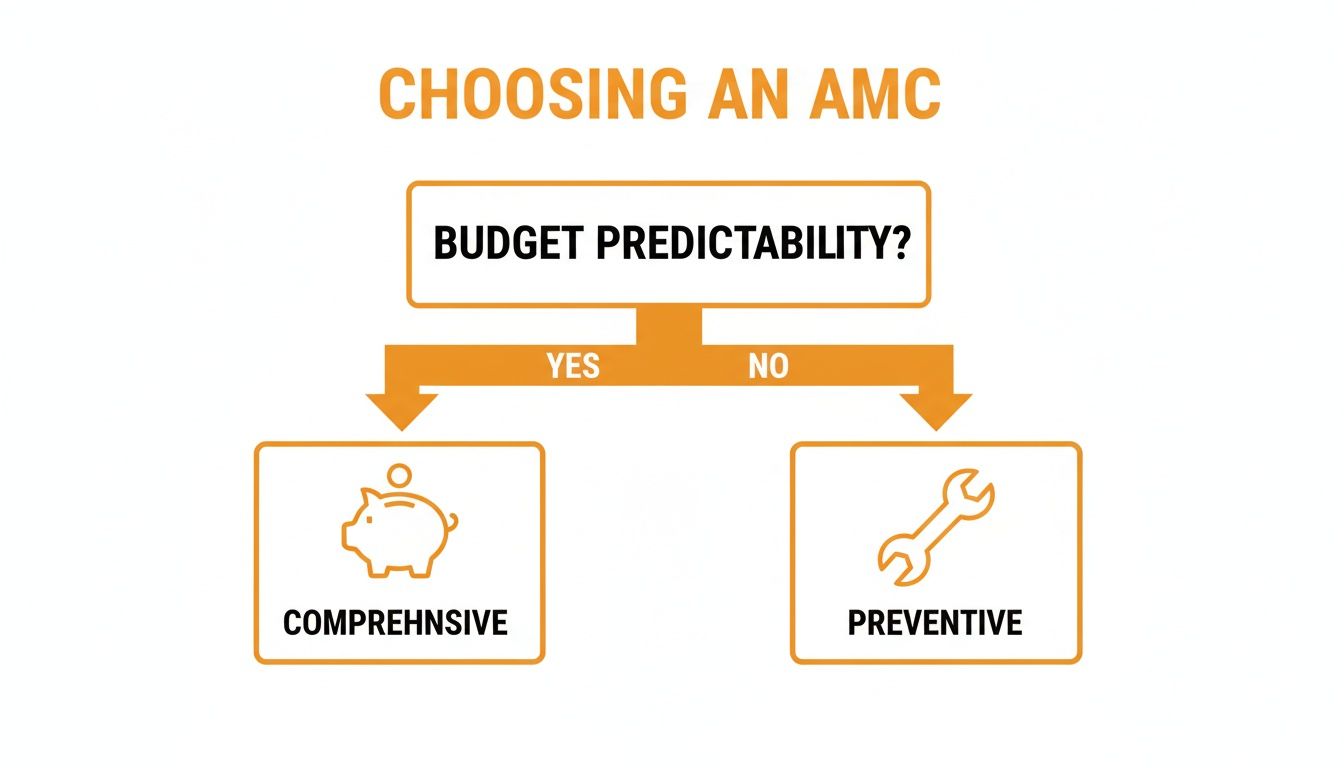
As shown, if the primary objective is a fixed operational expense, a Comprehensive model is the most suitable path. A Preventive model offers a lower entry cost but exposes the budget to the variable cost of spare parts.
Key SLA Metrics to Scrutinise
Two core metrics form the foundation of any maintenance SLA. These must be defined without ambiguity.
- Response Time: The maximum time elapsed from the logging of a service request to the physical arrival of a qualified technician on-site. This metric measures mobilisation capability, not problem resolution.
- Rectification Time: Also known as Resolution Time, this is the maximum time allowed to diagnose the fault and complete the repair, restoring the asset to operational status. This metric may include specific clauses related to the availability of spare parts.
These metrics are applied across clearly defined priority levels to prevent disputes.
For example, a major water leak impacting a critical area is an "Emergency." A single failed light fixture in a low-traffic area is a "Normal" priority. Without these definitions, a provider could downgrade an urgent request, delaying the response without technically breaching the contract.
Typical SLA Benchmarks in the Dubai Market
While negotiable, industry practice in the UAE for commercial and hospitality properties has established common benchmarks. These provide a realistic baseline for evaluating proposals.
| Priority Level | Typical Response Time | Typical Rectification Time | Example Scenario |
|---|---|---|---|
| Emergency | 1-2 hours | 2-4 hours | Total power failure, major water leak posing immediate risk, elevator entrapment (if covered). |
| Urgent | 2-4 hours | Within 24 hours | AC failure in a critical operational area, blockage of a main drainage line. |
| Normal | Within 24 hours | Within 48-72 hours | Dripping tap, noisy fan coil unit, isolated lighting failure. |
SLAs are a quantifiable commitment to performance. Leading providers in Dubai support these with 24/7 operational capabilities and tailor the terms to the specific requirements of the facility.
The Operational Backbone Enforcing SLAs
A provider's ability to meet SLA commitments is directly proportional to its operational infrastructure. A low-cost proposal may feature an aggressive SLA that the provider lacks the resources to honour.
During evaluation, scrutinise the provider's operational capacity:
- 24/7 Call Centre: Is there a dedicated, professionally staffed helpdesk for logging and escalating calls, or does it divert to a mobile phone after hours?
- Digital Reporting: Does the provider use a Computer-Aided Facility Management (CAFM) system with real-time, photo-based reporting? This is essential for transparency and provides an auditable trail of SLA compliance.
- Geographic Coverage: Does the provider have sufficient mobile teams and technical resources to service your location without compromising response times to other clients?
Integrating specific performance parameters into your SLAs can strengthen your modern quality assurance processes. Ultimately, the SLA is a direct reflection of a provider’s operational capability and commitment to service delivery.
How AMCs Turn Unpredictable Bills into a Fixed, Stable Budget
For property portfolio managers in Dubai, the primary financial benefit of an Annual Maintenance Contract is the conversion of volatile, unpredictable repair costs into a fixed, forecastable operational expense (OPEX). This represents a strategic shift from reactive spending to planned investment—a cornerstone of sound financial management for physical assets.
An AMC establishes a contracted cost for the maintenance of critical systems for a 12-month period. This allows for precise budget allocation, eliminating the financial volatility associated with sudden equipment failures. This fiscal discipline is particularly important for properties governed by RERA-regulated service charges, where budget accuracy is paramount.
From Emergency Call-Outs to Predictable OPEX
Without an AMC, each equipment failure triggers a cascade of unknown costs: emergency call-out fees, premium pricing for urgent spare parts, and the indirect cost of operational downtime. This reactive model makes accurate budgeting impossible. A comprehensive AMC absorbs these variables into a single, predictable annual fee.
In the Dubai market, this shift is a core business strategy. Properties under professional AMCs achieve significant cost predictability. Instead of managing repair bills that can fluctuate widely within the typical AED 3 to AED 30 per square foot monthly service charge range, managers can secure a fixed rate and forecast OPEX with high confidence. You can review market data by exploring Dubai's service charge index on drivenproperties.com.
Thinking Beyond the Price Tag: Calculating the Total Cost of Ownership
Evaluating an AMC proposal solely on its price is a flawed approach. A well-executed preventive maintenance program is a direct investment in reducing the Total Cost of Ownership (TCO) of your assets. TCO encompasses not just purchase and maintenance fees, but also energy consumption, major repair costs, and eventual replacement value.
A properly implemented AMC reduces TCO in several ways:
- Extends Asset Lifecycle: Proactive maintenance in Dubai's harsh climate can add years to the operational life of HVAC and MEP systems, deferring significant capital expenditure (CAPEX) for replacement.
- Improves Energy Efficiency: Routine actions like cleaning coils, calibrating controls, and lubricating motors ensure equipment operates at its designed efficiency. This leads to lower DEWA bills, a major component of a property's TCO.
- Prevents Catastrophic Failures: A routine inspection might identify a failing pump motor bearing—an AED 500 rectification. Left unattended, the bearing could seize, causing a motor burnout and a AED 5,000 replacement, plus operational downtime.
The financial rationale for an AMC centres on risk transfer and cost containment. It converts a series of unknown, potentially high financial risks into a known, manageable operating expense. This enhances financial planning and capital allocation.
Ultimately, the contract price is derived from a technical risk assessment of your specific assets—their age, condition, and operational criticality. The crucial mindset shift is to view this cost not as an expense, but as an investment in operational reliability, budget stability, and long-term asset value preservation.
Your Framework for Evaluating AMC Proposals

Selecting an Annual Maintenance Contract provider is not a search for the lowest bid, but an exercise in technical and operational due diligence. The objective is to identify a partner that can demonstrably mitigate risk. A low price often masks service delivery gaps that manifest later as increased downtime, supplementary invoices, and operational disruption.
A structured evaluation framework allows you to deconstruct each proposal to assess its true value. Understanding how to write a contract proposal from the provider’s perspective provides insight into how they structure their offer, enabling a more effective evaluation.
Technical and Operational Due Diligence
Begin by assessing the provider’s operational capability. Their ability to meet SLA commitments is a direct function of their in-house resources, technical certifications, and operational processes.
- Technical Team Structure: Scrutinise the ratio of in-house engineers to subcontractors. Heavy reliance on third parties can introduce delays, accountability issues, and inconsistent quality. Request qualifications and certifications of the team to be assigned to your property.
- Compliance and Certifications: Verify relevant credentials, such as ISO 9001 for quality management systems. More importantly, confirm their demonstrated expertise in Dubai Municipality and Civil Defence codes applicable to your assets.
- Reporting and Technology: Modern facility management is data-driven. Evaluate their reporting system. Do they provide real-time, photo-based updates via a CAFM platform? Can you track SLA performance transparently? Manual, paper-based reporting is a significant indicator of operational immaturity.
Commercial and Scope Evaluation
After validating technical capability, conduct a forensic analysis of the commercial terms. Ambiguity in the scope of work is the leading cause of future disputes.
The objective is to select a partner based on demonstrable value and risk mitigation, not on price alone. A thorough evaluation ensures the chosen provider possesses the technical depth and operational discipline to protect your assets and achieve your performance targets.
Use this checklist to guide your final decision:
- Scope Clarity: Is every asset explicitly listed as included or excluded? Are terms like "consumables" and "spare parts" defined with contractual clarity?
- SLA Realism: Are the proposed response and rectification times achievable given the provider's resources and your property’s location?
- Spare Parts Policy: For comprehensive contracts, what is the process for sourcing and stocking critical spares? Are there sub-limits or caps on the value of covered components?
- Emergency Protocols: What is the precise escalation procedure for an after-hours emergency? Verify that their 24/7 helpdesk is a professionally managed contact centre, not a call-forwarding service.
By applying this structured framework, you can elevate your decision beyond price. A deeper understanding of annual maintenance contracts in Dubai empowers you to select a provider that aligns with your operational and financial objectives.
Common Technical Questions Regarding AMCs in Dubai
Facility managers, asset owners, and procurement teams in Dubai frequently raise several key technical and contractual questions. Clear answers are essential for making an informed decision that protects both the property's assets and its operational budget.
Are Spare Parts and Consumables the Same Thing?
No, and the distinction is contractually critical. Spare parts are functional components required for a repair, such as a compressor motor, a pump, or a printed circuit board (PCB). Their inclusion is determined by the contract model (Preventive vs. Comprehensive).
Consumables are materials expended during routine preventive maintenance, such as AC filters, lubricants, oils, or cleaning agents. In most Dubai AMCs, including many comprehensive agreements, consumables are billed separately as per actual usage. The contract must explicitly define both terms to prevent disputes and delays during rectification works.
How Are Emergency Calls Handled After Hours?
A professional AMC provider in Dubai must offer 24/7 emergency support. This commitment must be contractually defined in the Service Level Agreement (SLA) with a specific response time, which typically ranges from 1 to 2 hours for genuine emergencies.
The contract must clarify whether after-hours or public holiday call-outs are fully included in the fee or if they are subject to a surcharge. For critical facilities such as hotels, data centres, or healthcare establishments, fully inclusive 24/7 coverage is a non-negotiable term.
What is the Protocol if a Major Failure is Found During a PPM Visit?
This is a standard operational scenario. If a technician identifies a major fault that falls outside the AMC scope (e.g., a chiller requiring a major overhaul), the standard procedure is to first ensure the system is safely isolated. They then provide the facility manager with a detailed technical report.
This report will diagnose the issue, provide a technical justification for its classification as capital expenditure (CAPEX), and include a separate, formal quotation for the major rectification work. The AMC covers the diagnostic labour and immediate safety measures, but not the capital replacement itself.
Does an AMC Cover System Upgrades or Modifications?
Standard AMCs are structured to maintain existing assets to their original design specifications. They do not cover system upgrades, enhancements, or modifications requested by the client.
For example, the preventive maintenance of a main electrical distribution board is covered. However, if new circuits are required due to an office expansion that increases the electrical load, this constitutes new project work. Such modifications fall outside the operational maintenance framework of an AMC and require a separate scope of work and quotation.
For professional, SLA-driven maintenance solutions designed for Dubai's demanding commercial and residential environments, trust SnapFixNow. Our photo-based reporting and certified in-house technicians provide the transparency and technical excellence you need to protect your assets. Learn more about our Annual Maintenance Contracts.