When a loss adjuster steps onto a commercial property in the UAE, their objective is singular: to build a factual, evidence-based narrative of the incident. For property managers, facility leaders, and asset owners, understanding this process is not about confrontation; it's about providing the specific, verifiable data needed to validate a claim against policy terms. The adjuster's role is to connect three critical elements: the root cause of the incident, the quantifiable scope of the damage, and the mitigation actions taken by the policyholder to control the loss.
The Adjuster's Mindset: Key Evidence Categories for Commercial Properties
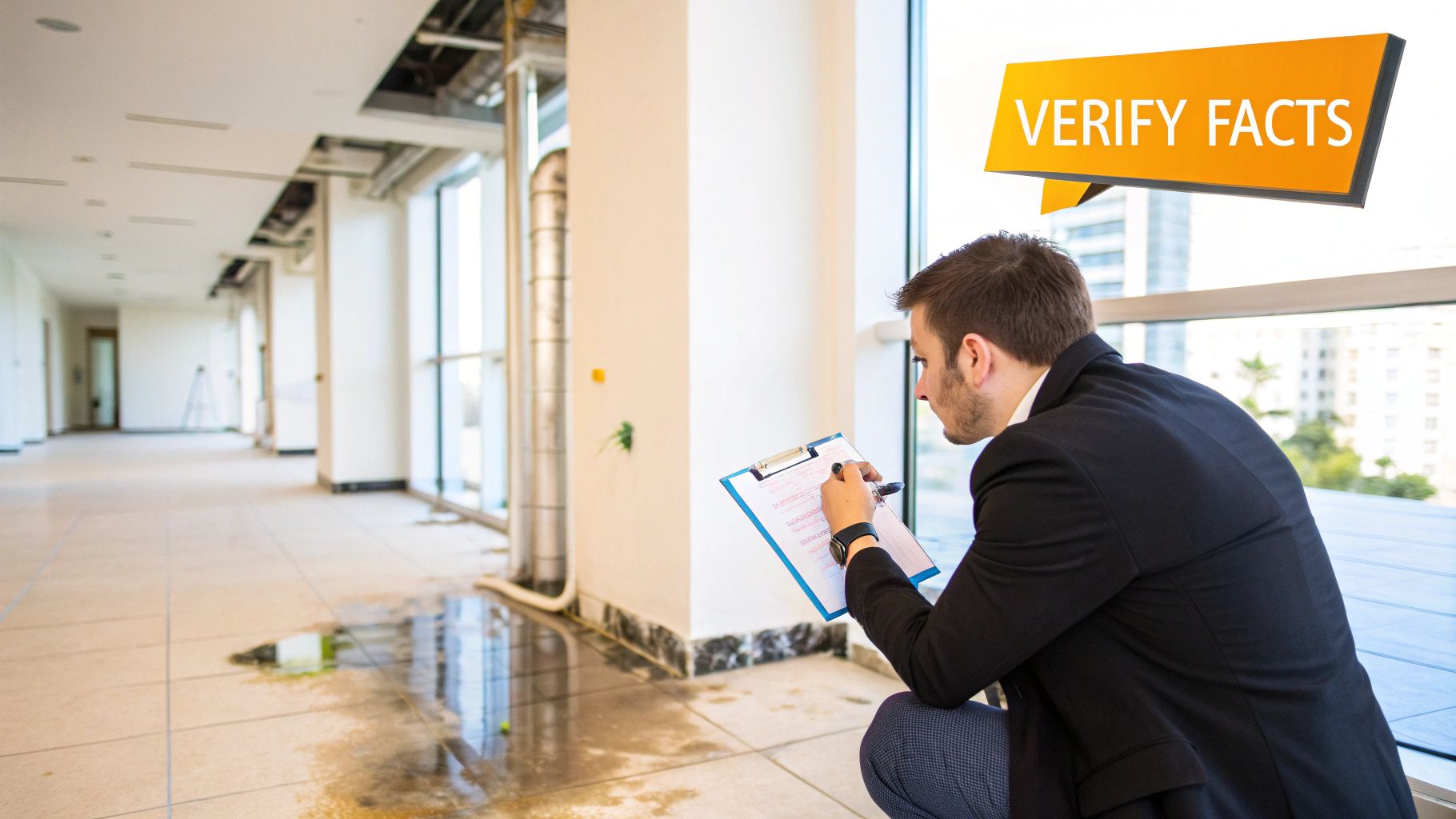
For decision-makers managing high-value assets in Dubai and the UAE, preparing for an adjuster's visit is a core risk management function. The adjuster acts as an impartial investigator, tasked with verifying the facts of the loss against the specific conditions and exclusions of the insurance policy.
In the UAE's operational environment—characterised by high-density vertical assets and climate-driven MEP stress—an incident like a pipe burst or electrical failure can escalate into a multi-million dirham loss within minutes. The quality and structure of the initial evidence presented by the facility management team are therefore paramount. A well-prepared team can transform a complex loss scenario into a straightforward validation exercise for the adjuster.
Core Areas of Evidentiary Focus
An adjuster's site inspection is a structured process designed to gather evidence across four distinct pillars:
- Cause and Origin: Pinpointing the exact source of the loss. Was it a sudden and accidental failure of a pressurised pipe, a gradual leak from an HVAC condensate line, or a fault in an electrical busbar? The evidence must clearly point to the origin to confirm coverage under the policy.
- Proof of Pre-Loss Condition: Establishing the operational state of the asset before the incident. This is the primary defence against assertions of poor maintenance, wear and tear, or pre-existing defects, which are common grounds for claim reduction or denial.
- Loss Mitigation Efforts: Demonstrating immediate, reasonable, and documented actions taken to control the damage. This fulfills a key policy condition and shows responsible management of the insurer's potential exposure.
- Scope and Quantum of Damage: A detailed, itemised quantification of all damaged property and associated financial loss, forming the basis of the claim's value.
The principles behind navigating home insurance claims share a similar logic, focusing on cause, effect, and mitigation, applicable across both residential and commercial asset classes.
The loss adjuster’s primary function during a site inspection is to reconstruct the event timeline. They use physical evidence and operational documentation to answer three core questions: What failed? Why did it fail? What immediate actions were taken to limit the consequences?
A facility manager's ability to provide clear, organised, and data-backed answers is the single most critical factor in achieving an efficient and fair claim settlement. Understanding the specific technical proof your insurer expects is a strategic advantage. The following framework outlines these evidence categories in a property management context.
Core Evidence Categories for UAE Loss Adjusters
This table outlines the essential evidence an adjuster seeks, its purpose, and its direct impact on your insurance claim's outcome.
| Evidence Category | What Adjusters Scrutinize | Impact on Claim Outcome | Property Type Application |
|---|---|---|---|
| Cause & Origin | BMS logs, alarm data, CCTV footage, photos of the precise failure point (e.g., fractured pipe, arcing switchgear). | High: Confirms the event is a covered peril under the policy terms. | All (Commercial, Hospitality, Industrial, Retail) |
| Pre-Loss Condition | Annual Maintenance Contract (AMC) records, service reports, dated photos/videos of MEP rooms. | High: Defends against policy exclusions related to negligence, wear and tear, or deferred maintenance. | Commercial & Hospitality |
| Mitigation Efforts | Dispatch logs, timestamped photos of temporary fixes (e.g., water isolation, deployment of dehumidifiers), invoices for emergency services. | Medium: Fulfills the policyholder's "duty to mitigate," preventing claim reduction on grounds of inaction. | All |
| Scope of Damage | Itemised asset registers, independent contractor repair estimates, detailed photos/videos of all affected areas and contents. | High: Forms the basis for the financial settlement ("quantum") of the loss. | All |
Presenting this evidence proactively demonstrates operational competence and significantly accelerates the validation process, leading to a more predictable claim timeline.
Proving Your Immediate and Effective First Response
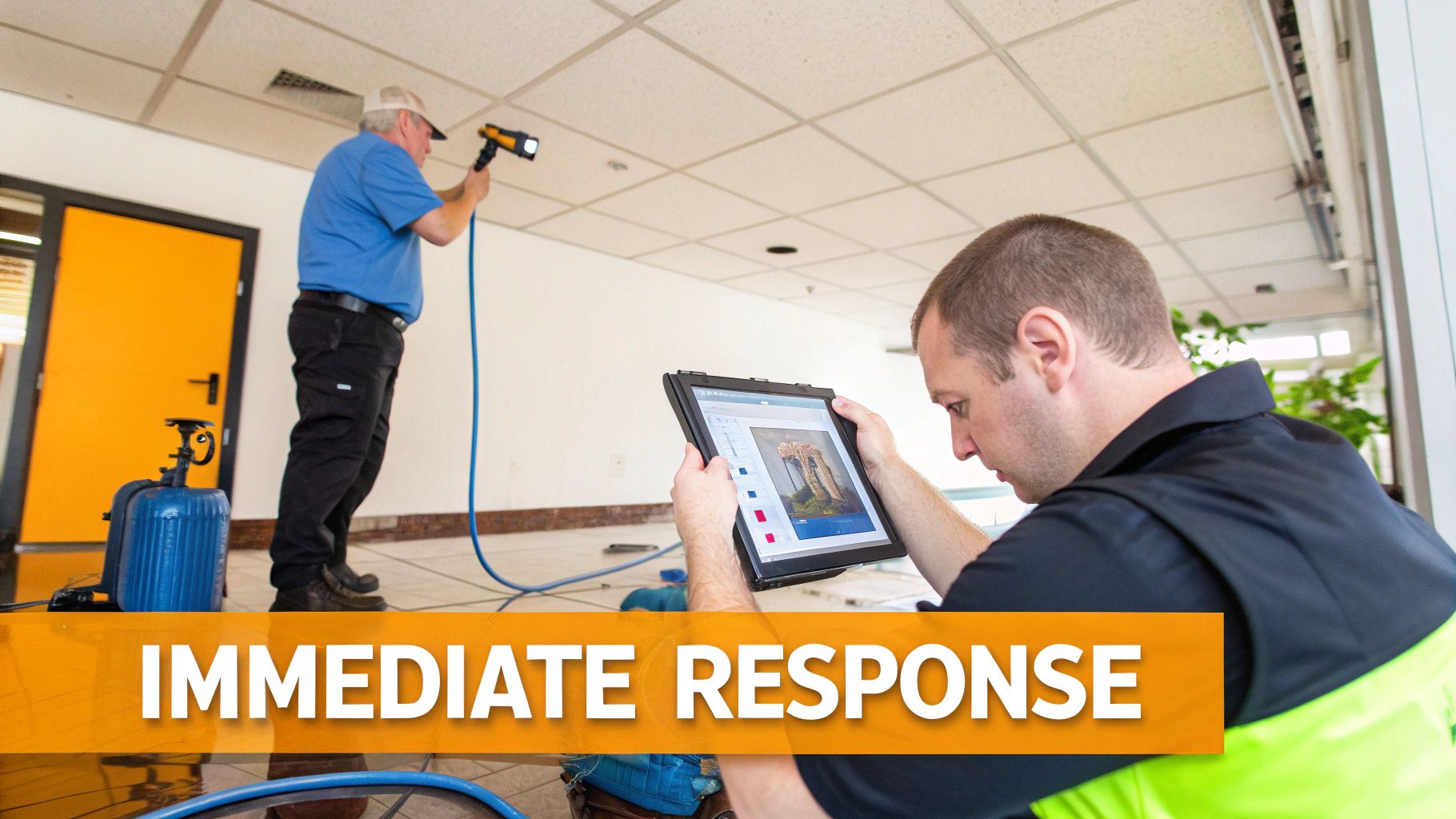
The initial 60-120 minute window following an incident is subject to the most intense scrutiny by an insurance adjuster. Your team's actions during this period provide a clear narrative: did the facility management team act responsibly and effectively to mitigate further loss? This is not a procedural formality; it is a core policy obligation that directly influences the final settlement amount.
In a high-rise commercial tower or a large-scale hotel in Dubai, a single plumbing failure can cascade into a multi-floor, multi-million dirham event in under an hour. Insurers are acutely aware of this risk. Consequently, the evidence an adjuster seeks is heavily weighted toward the quality and timeliness of the initial response. They are looking for a clear, timestamped record proving that all reasonable measures were taken to contain the damage.
Documenting Your Loss Mitigation Actions
The objective of first-response documentation is to demonstrate control, compliance with internal protocols, and fulfillment of the policy's mitigation clause. The adjuster requires a sequential, undeniable record of your team's actions.
Key evidence includes:
- Initial Discovery and Alert Logs: The precise timestamp of the initial alert (e.g., BMS alarm at 02:15, security report at 02:17), the source, and the individual who reported it.
- Emergency Call Records: A log of calls to on-call technical staff or third-party emergency contractors, including timestamps and personnel names.
- Technician Dispatch Records: System-generated proof of when a technician was assigned and, critically, their arrival time on site. This is a key performance indicator for responsiveness.
- System Isolation Confirmations: Photographic evidence of immediate safety actions, such as a closed water riser valve or an isolated electrical breaker, with the photo's metadata serving as a timestamp.
This level of meticulous record-keeping confirms that actions were swift and decisive, meeting the professional standards expected in the UAE’s commercial property sector.
The Power of Sequential Photographic Evidence
Photographs are the most compelling form of evidence, but only when they construct a chronological narrative. A single image of the final damage is insufficient. A sequence of photos illustrating the event's progression—and your team's intervention—is significantly more persuasive to an adjuster.
This visual timeline should capture key mitigation milestones. For a major water leak, the sequence should be:
- The Active Source: Photos of the active leak before isolation.
- Containment Efforts: Images of the team deploying water vacuums, sandbags, or other containment measures.
- Water Extraction in Progress: Visual proof of water being removed from affected areas.
- Drying Process Initiated: Documentation of industrial fans and dehumidifiers being installed and activated.
An adjuster's primary concern regarding first response is confirming that the policyholder fulfilled their 'duty to mitigate'. A well-documented timeline of actions, from the initial alarm to the deployment of drying equipment, provides undeniable proof and significantly reduces claim disputes.
In the UAE, this is a commercial necessity. Regional data indicates that claims related to MEP system failures—which account for over 40% of claims in hotels and residential towers—are settled significantly faster when supported by timestamped photographic evidence of mitigation efforts. Claims with such proof have been shown to settle up to 92% faster, with an average timeline of 21 days versus 45 days for claims lacking this documentation. You can discover more insights about adjuster protocols from industry sources.
Quantifying Response Times and Actions
Present first-response data in a structured format to enable rapid verification against industry benchmarks. Vague statements like "we responded quickly" carry no weight; quantitative data is essential.
A simple chronological action log provides the necessary clarity.
| Action Item | Time of Action (HH:MM) | Personnel Involved | Documentation Reference |
|---|---|---|---|
| Water Leak Alarm Received from BMS | 14:05 | Automated System | BMS Log Ref: WL-TowerA-Flr12 |
| Maintenance Team Dispatched | 14:07 | F. Ahmed | CAFM System Ticket #8812 |
| Main Water Riser Isolated | 14:19 | S. Khan (Plumber) | Photo Ref: IMG_5021 (Valve shut) |
| Emergency Water Extraction Commenced | 14:45 | In-house Team | Photo Ref: IMG_5025 (Vacuums deployed) |
| Affected Electrical Circuits Isolated | 14:50 | R. Singh (Electrician) | Photo Ref: IMG_5028 (Breaker panel) |
This factual table provides the adjuster with a clear, verifiable account of an effective and immediate loss limitation response.
Showing Your Cards: Proving Diligent Maintenance and Pre-Loss Condition
An adjuster's site inspection is as much a historical audit as it is a current damage assessment. They are tasked with determining if the loss was a sudden and fortuitous event, or the foreseeable outcome of pre-existing conditions, wear and tear, or deferred maintenance.
For property and facility managers in the UAE, this is a critical juncture where claims can be challenged. Insurers may argue that contributing factors like corrosion, known defects, or inadequate servicing fall under policy exclusions, leading to a reduced settlement. The most effective countermeasure is a well-organised body of evidence demonstrating diligent asset stewardship. This documentation establishes that the asset was in a sound operational state immediately prior to the incident.
Building Your Case for Diligent Upkeep
To substantiate the pre-loss condition of an asset, a comprehensive documentation file is required. General assertions of "good condition" are insufficient; adjusters require tangible proof.
Your evidence file should contain:
- Annual Maintenance Contracts (AMCs): Current and historical AMCs for critical systems (HVAC, fire safety, elevators, electrical). The scope of work and service frequency defined within these contracts are key.
- Detailed Maintenance Logs: Computerised Maintenance Management System (CMMS) or CAFM system logs showing all routine inspections and preventive maintenance tasks completed by in-house teams or contractors.
- Technician Service Reports: All third-party vendor reports detailing specific repairs, servicing, or inspections. These often contain professional observations on the asset's condition at the time of service.
- Asset Condition Reports: If periodic condition surveys or technical due diligence reports are conducted, these documents provide an invaluable historical baseline of the building’s overall health.
For instance, following an HVAC chiller failure that causes water damage, presenting service reports from the preceding 6-12 months showing regular maintenance, filter changes, and coil cleaning builds a strong case that the failure was sudden and accidental, not a result of predictable neglect.
An adjuster’s objective is to verify the claim narrative. A well-organised file containing dated maintenance logs, AMC records, and recent service reports tells a compelling story of responsible asset management. It allows them to confidently rule out policy exclusions related to poor upkeep.
Red Flags Adjusters Are Trained to Spot
It is equally important to understand the common indicators of deferred maintenance that adjusters are trained to identify. Awareness of these "red flags" allows you to proactively address potential questions.
Common red flags include:
- Evidence of Historical Water Ingress: Water stains on ceilings or walls, peeling paint, or efflorescence (chalky mineral deposits) on masonry near the loss area can suggest prior, unaddressed leaks.
- Visible Corrosion or Rust: Obvious corrosion on pipes, electrical panels, or structural components is a clear indicator of long-term moisture exposure or a lack of preventive care.
- Deferred Repairs: Evidence of temporary, non-professional fixes (e.g., excessive tape on pipework) or review of maintenance logs showing known defects that were reported but not rectified.
- Poor Housekeeping: Significant accumulation of dust and debris around MEP equipment suggests infrequent inspections and can contribute to overheating and premature failure.
Presenting a strong, evidence-backed case for diligent maintenance provides a robust defense against any suggestion of poor stewardship, keeping the focus on the recent, covered loss.
Assessing Damage to the Building Envelope and Structure
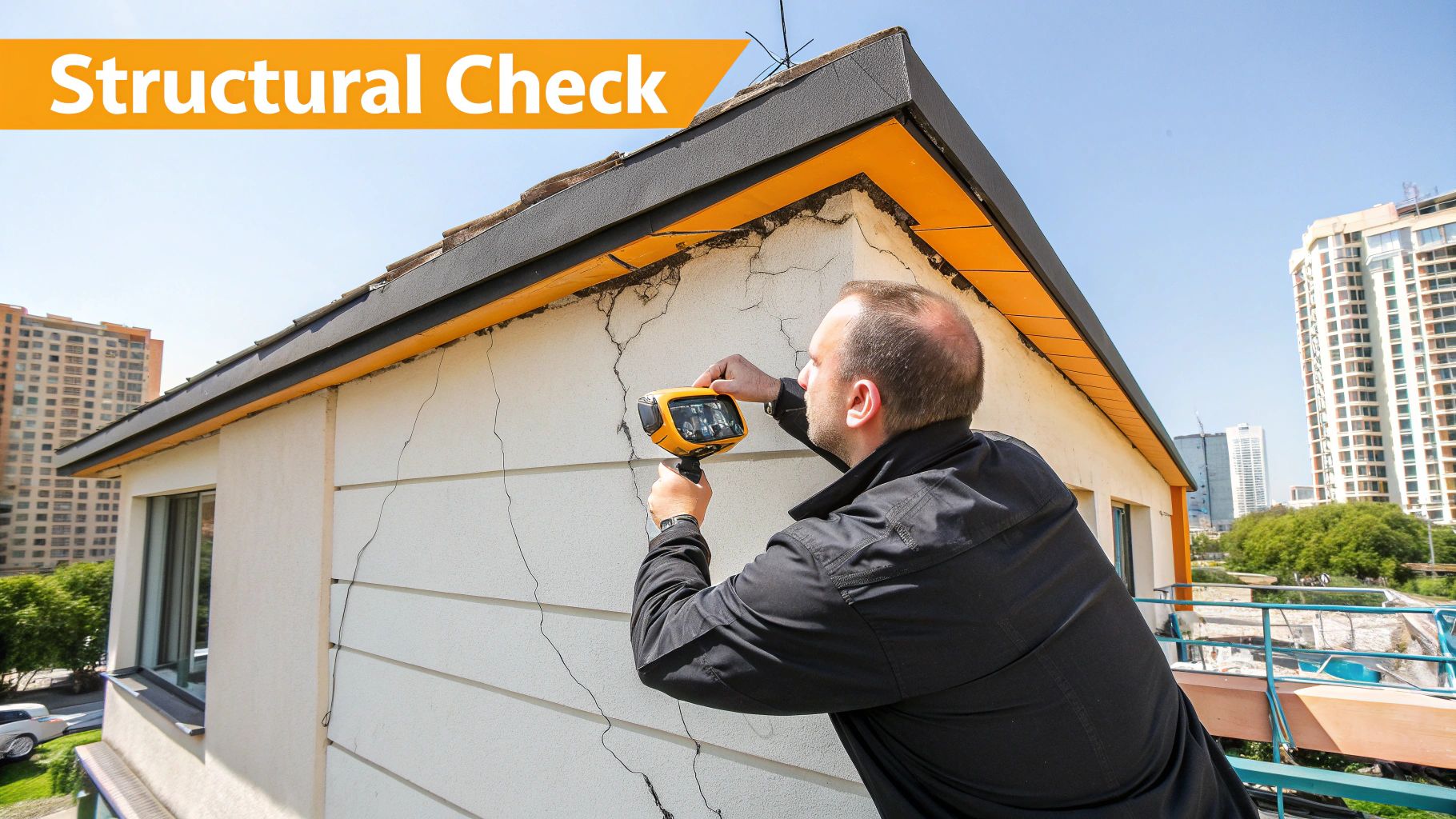
Following a significant loss event such as a major fire or flood, the adjuster's focus expands from immediate, visible damage to the fundamental integrity of the building's structure and envelope. The claim now enters a technically complex phase, guided by UAE building codes and engineering standards.
For managers of commercial towers, industrial facilities, or large residential complexes, this phase is critical. The adjuster is no longer just assessing cosmetic damage; they are evaluating the foundational health of the entire asset. Their investigation will search for any evidence of stress, compromise, or failure in the systems designed to protect the building and its occupants.
Scrutinising Structural and Envelope Integrity
The building envelope—comprising the roof, walls, windows, and foundation—is the primary barrier against external elements. An adjuster will meticulously inspect this system for any breach that either caused or resulted from the incident.
This detailed inspection focuses on:
- Roofing Systems: Evidence of tears, punctures, or failing seals in waterproofing membranes, particularly around MEP penetrations or following severe weather events.
- Foundation and Slabs: The presence of new cracks in concrete, signs of slab movement (heaving), or water ingress through the foundation, which can indicate serious underlying issues.
- Exterior Cladding and Facades: Dislodged panels, stress fractures, or failed waterproofing joints that may have allowed weather ingress.
- Structural Beams and Columns: Post-fire, steel reinforcements can be severely weakened. Adjusters will assess beams and columns for visible bowing, cracking, or spalling (flaking) of concrete.
Loss adjusters in the UAE often reference locally adapted engineering standards, such as those derived from ASTM E2018 for property condition assessments. Analysis of commercial claims in Dubai reveals that 52% of major loss inspections involve detailed scrutiny of foundation cracks and roof membrane integrity. Crucially, 22% of claim denials in this category were linked to pre-existing defects that were not addressed through maintenance.
The Critical Role of Fire-Stopping and Penetration Seals
In any multi-story commercial building, verifying the integrity of passive fire protection systems is a non-negotiable component of the inspection. Adjusters focus on firewalls, fire doors, and particularly the seals around penetrations where pipes, cables, and ducts pass through fire-rated separations.
A compromised firewall or a failed penetration seal can allow a small, containable fire to spread rapidly throughout a building. For an adjuster, verifying that these passive fire protection systems were compliant and intact before the event is fundamental to determining the insurer’s liability for the extent of the damage.
Evidence of properly maintained fire-stopping demonstrates compliance with the UAE Fire and Life Safety Code of Practice. The adjuster must confirm correct installation, absence of unauthorized modifications, and no signs of degradation. Claims for properties with documented, intact firewalls and correctly sealed penetrations have an approval rate around 95%, compared to a 60% approval rate for buildings with evidence of poor installation or corrosion. For more context on how insurers differentiate damage types, see this guide on assessing water leakage vs electrical damage.
Leveraging Technology for Deeper Insights
To detect damage not visible to the naked eye, adjusters increasingly rely on technology to provide objective, data-driven evidence that eliminates ambiguity.
- Thermal Imaging: Infrared cameras are used to identify trapped moisture within wall cavities or beneath flooring, a common issue following firefighting or major leaks.
- Drone Surveys: For large or inaccessible roofs and facades, drones capture high-resolution imagery to identify damage safely and efficiently.
- 3D Scanning and Digital Twins: Advanced scanning creates a precise digital replica of the damaged area, providing accurate measurements and a permanent record of the scene before restoration begins.
For a facility manager, having pre-incident drone footage or thermal scans as part of maintenance records provides a clear "before" state, enabling the adjuster to definitively attribute the damage to the recent event and accelerate the assessment process.
Gauging the True Impact: Validating Damage to Contents and Business Interruption
When a significant loss event occurs, the financial impact extends beyond the physical structure. The value of damaged contents—office equipment, hotel furnishings, or retail inventory—and the financial loss from operational downtime represent a substantial portion of the claim.
For a loss adjuster, quantifying these interconnected losses is a forensic accounting exercise. It involves two distinct but parallel investigations: first, a detailed inventory and valuation of all damaged physical assets (the "Contents" claim), and second, a financial analysis to calculate the revenue lost during the period of disruption (the "Business Interruption" or BI claim).
Getting Granular: Documenting Damaged Contents with Precision
An adjuster cannot process vague claims like "damaged office furniture." They require a detailed, itemized schedule of loss that can be independently verified. Ambiguity leads to requests for information (RFIs), delays, and potential disputes over valuation. The facility manager's role is to provide an undeniable record of ownership, loss, and value.
To build a robust contents claim, the following evidence is essential:
- A Detailed Asset Register: A regularly updated asset register containing serial numbers, models, and purchase dates is the foundational document for any contents claim.
- Original Purchase Invoices or Receipts: These provide direct proof of an item's original cost, which is the starting point for calculating its current value, whether on an Actual Cash Value (ACV) or Replacement Cost Value (RCV) basis, as defined by the policy.
- High-Quality Photographic Evidence: Before any items are moved or disposed of, every damaged asset must be photographed. Capture brand names, model numbers, and the extent of the damage from multiple angles.
- Independent Repair vs. Replacement Quotes: For high-value equipment, obtain independent quotes. If an item can be repaired for less than its replacement cost, the adjuster will likely favour that option. Solid evidence is required to justify why a full replacement is necessary.
The core principle is that a claim cannot be paid for an asset whose ownership and value cannot be proven. The adjuster's role is to verify the policyholder's inventory against their documentation, not to create the inventory.
Connecting the Dots: Quantifying Your Business Interruption Losses
A Business Interruption claim links the physical damage to its direct financial consequences. During the site inspection, the adjuster seeks to understand the operational impact: how did the damaged server or flooded stockroom directly prevent the business from generating revenue? This requires transparent access to financial data.
The adjuster will require specific financial records to establish a clear "before and after" revenue picture.
Key documents typically include:
- Historical Revenue Statements: A minimum of 12-24 months of profit and loss statements to establish a credible, seasonally-adjusted baseline of business earnings.
- Current Financial Records: Financials from the period immediately following the event to demonstrate the revenue drop-off.
- Payroll Records: To substantiate the cost of retaining staff during the downtime, if covered by the policy.
- Operating Expense Logs: Invoices for ongoing fixed costs like rent, utilities, and service contracts that continue despite the shutdown.
In the UAE market, adjusters place significant emphasis on accurate documentation. Regional industry reports indicate that the use of digital inventories can reduce claim processing costs for contents by up to 40%. Conversely, local insurance data shows that claims missing on-site repair logs are often subject to downward adjustments averaging AED 75,000. Meticulous, organised evidence is a financial necessity.
You can learn more about these regional claim findings and see how this data-driven approach is becoming standard practice. It transforms a subjective argument into a verifiable calculation, which is the most efficient path to BI claim approval.
Your Site Inspection Preparation Checklist
A structured, repeatable process for managing an incident and preparing for an adjuster's inspection removes ambiguity and ensures a professional, evidence-led approach. This framework is designed for facility and property managers to navigate the process from initial incident response through to the completion of the site visit.
Knowing what evidence insurance loss adjusters look for during site inspections allows you to align your preparation with their requirements.
Stage 1: The First Hour – Immediate Actions and Documentation
Actions taken within the first 60 minutes are foundational to the entire claim.
- Secure the Site: Immediately restrict access to the affected area to preserve evidence and ensure personnel safety. This prevents inadvertent disturbance of the scene and protects staff from hazards.
- Capture the Scene: Before any items are moved, use a smartphone or camera to take extensive photos and videos. Ensure the timestamp feature is enabled. Capture the source of damage, the immediate aftermath, and any contributing factors.
- Alert Key Stakeholders: Establish immediate communication with senior management, your insurance broker, and key operational staff to ensure a coordinated response.
Stage 2: Build Your Evidence Dossier
Establish a central repository—a physical binder or a dedicated digital folder—for all claim-related documentation. This dossier becomes the single source of truth.
An organised evidence dossier signals professionalism and operational control to the adjuster. It establishes the credibility of your team and demonstrates that the incident has been managed responsibly from the outset.
The dossier must contain:
- The Incident Report: A detailed, factual narrative of the event, including time of discovery and a chronological log of all immediate actions taken by the team.
- Maintenance Records: All relevant AMCs, third-party service reports, and in-house maintenance logs to prove the pre-loss condition of affected assets.
- The Financials: Purchase invoices for all damaged items and a minimum of two independent, itemised quotes for either repair or replacement.
Stage 3: Guiding the Inspection Like a Pro
During the adjuster's visit, your role is that of an informed, professional guide. An ultimate building inspection checklist can be a useful tool to ensure all compliance and safety points are covered beforehand.
- Appoint a Single Point of Contact (SPOC): Designate one knowledgeable individual, typically the Facility Manager or Chief Engineer, to lead the inspection. This ensures consistent communication and accurate responses.
- Have Technical Expertise on Standby: Ensure your chief engineer or the most relevant technical expert is available. Their direct knowledge of MEP systems or building structure is invaluable for answering detailed questions.
- Plan the Walkthrough: Pre-plan the inspection route, starting at the point of origin and following the path of damage. Have the evidence dossier on hand to provide relevant documentation at each stage of the tour.
Following this structured process significantly improves the likelihood of a successful outcome. For a more comprehensive overview, review our guide on how to prepare a successful property damage insurance claim in Dubai.
Frequently Asked Questions
This section addresses common questions from property and facility managers in the UAE regarding loss adjuster site inspections.
How Long After an Incident Should We Expect the Adjuster?
For a major loss in the UAE, you should expect the adjuster to schedule a site visit within 24 to 48 hours of the initial claim notification.
This rapid response is critical for commercial and hospitality claims, as it allows the adjuster to view the immediate aftermath and verify the initial mitigation actions before significant cleanup alters the scene. A delayed inspection can complicate the process of proving the original scope of damage.
Should We Repair Anything Before the Adjuster Arrives?
You should only perform emergency repairs necessary to prevent further damage. This is a requirement under the "duty to mitigate" clause in most policies.
Examples include isolating the main water supply after a pipe burst, de-energizing compromised electrical circuits, or moving undamaged inventory to a secure location. You must avoid permanent repairs or the disposal of any damaged materials until the adjuster has completed their initial inspection and provided authorization to proceed.
This infographic outlines the three-step process to follow in preparation for the adjuster's visit.
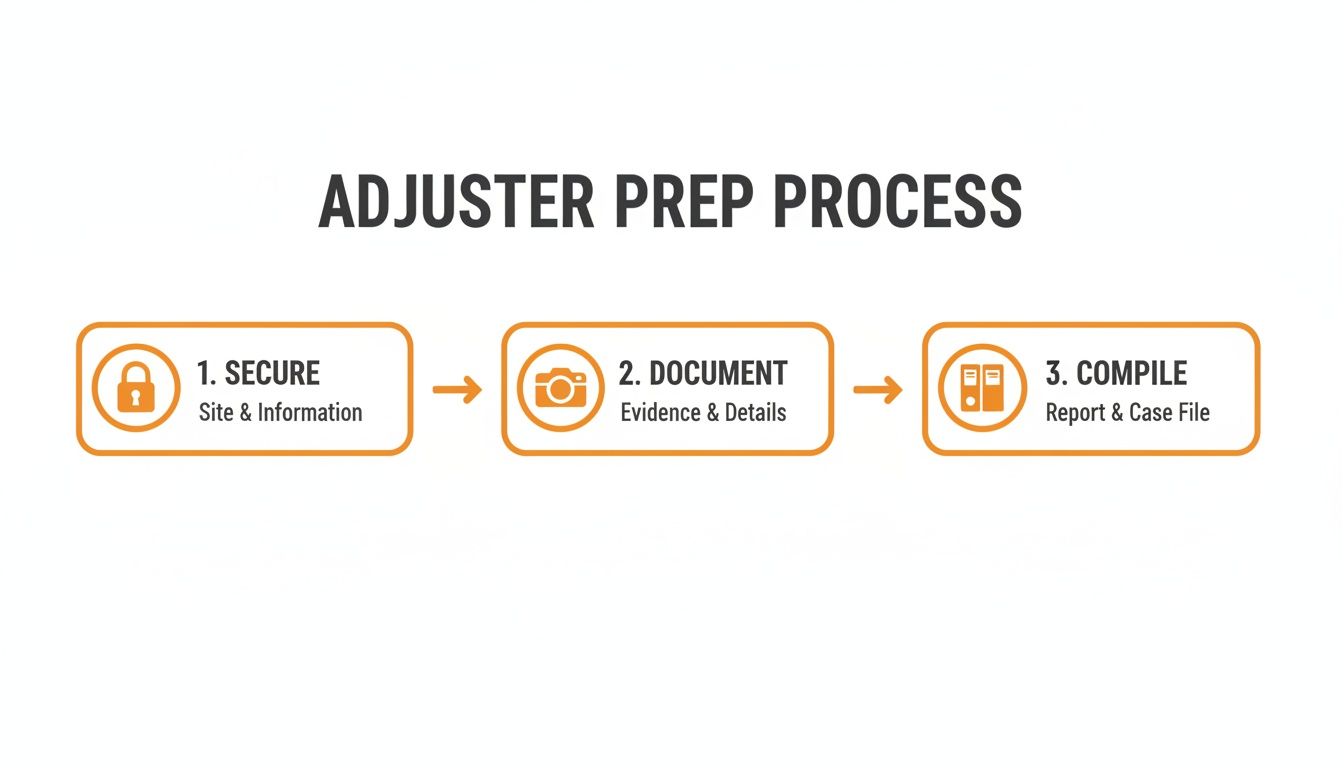
The key is to first secure the site, then meticulously document the scene before compiling all evidence into an organised dossier for the adjuster.
What If We Disagree with the Adjuster’s Assessment?
Disagreements over the scope of damage or the financial valuation of a loss can occur. If the adjuster's initial assessment differs from your position, the first step is to present your counter-evidence professionally.
Your documentation is your primary tool. Provide your independent contractor quotes, detailed asset registers, or maintenance records that support your valuation. The most effective approach is to initiate a collaborative, fact-based discussion aimed at resolving the discrepancies through evidence.
At SnapFixNow, we provide the technical documentation and expert support required to prepare for an adjuster's site inspection with confidence, ensuring your claim is presented with clarity, precision, and verifiable data. Learn more about our facility management and insurance claim support services.