For property and facility managers across the UAE, it's a familiar and costly scenario. An HVAC unit fails, a repair is authorised, and operations normalise—briefly. Weeks later, the same asset is down again, disrupting tenants, impacting guest satisfaction, and causing unforeseen operational expenditure (OPEX).
This cycle of recurring failures is a clear indicator that maintenance efforts are addressing symptoms, not root causes. The underlying technical fault, procedural gap, or contractual misalignment remains unresolved, guaranteeing a repeat breakdown. For decision-makers overseeing assets in Dubai's high-demand commercial, hospitality, and retail sectors, breaking this cycle is a strategic imperative.
Diagnosing the Cycle of Recurring HVAC Failures
In the UAE's operational context, an HVAC failure is more than a maintenance ticket; it's a critical business disruption with direct financial consequences. It impacts energy consumption—which can account for over 60% of a building's utility costs—and directly affects asset lifecycle value.
When a system fails repeatedly, it signifies a fundamental gap between a reactive, transactional repair and a strategic, diagnostic-led approach. For asset owners and procurement teams, understanding this distinction is crucial for controlling OPEX, ensuring budget predictability, and maximising asset longevity.
The diagnostic process often stalls at the symptom level, leading to ineffective, short-term solutions.
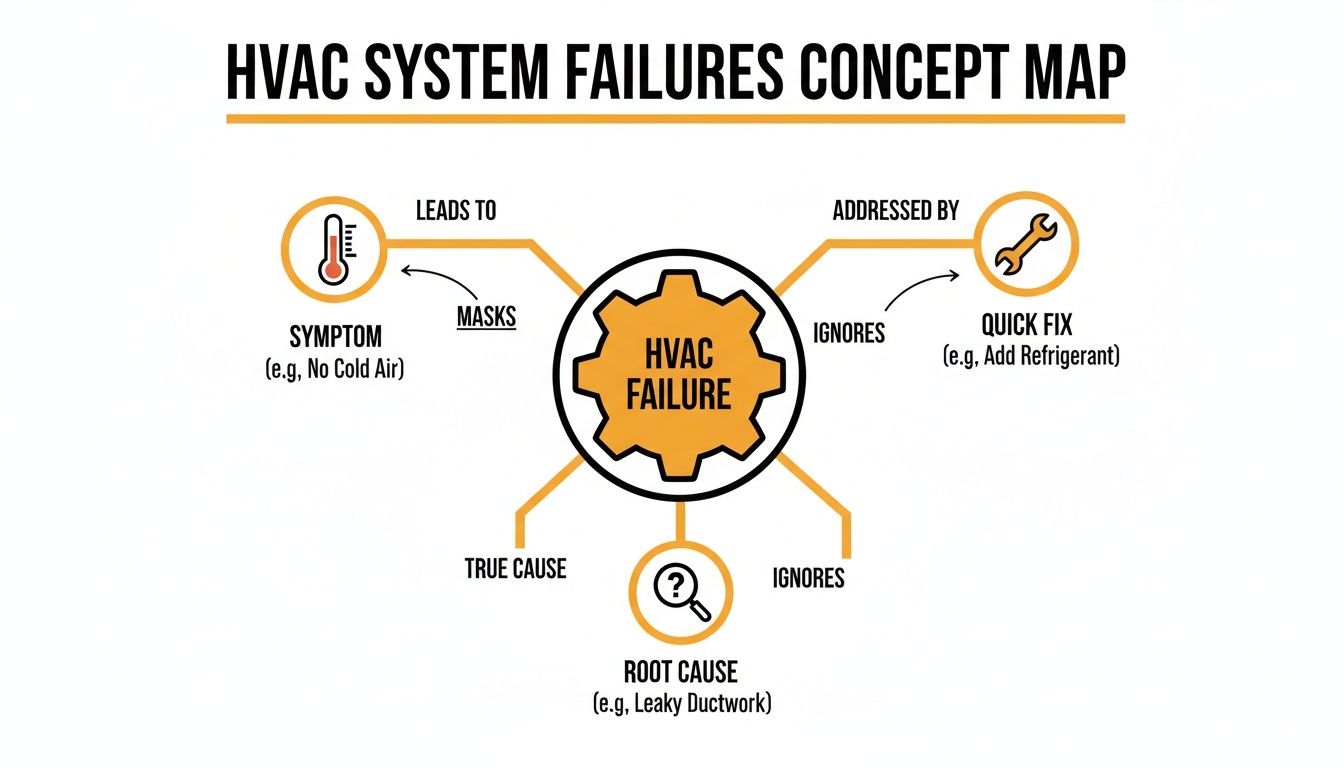
As illustrated, focusing on an obvious symptom (e.g., poor cooling) and applying a superficial fix (e.g., refrigerant top-up) without identifying the root cause (e.g., a refrigerant leak) creates a cycle of predictable failures.
The Real Reasons for Repeat Breakdowns
The drivers of recurring HVAC failures are often interconnected, but they typically fall into several distinct categories. Facility managers must evaluate these factors within their own operational frameworks and service provider contracts.
- Reactive Repairs vs. Root Cause Analysis: The immediate fault (e.g., a tripped circuit breaker) is resolved without investigating the underlying cause (e.g., an overworked compressor motor drawing excessive current). This prioritises immediate uptime over long-term reliability.
- Improper Preventive Maintenance (PM) Schedules: A generic, one-size-fits-all PM plan is insufficient for the UAE's harsh climate. The combination of extreme heat, high humidity, and airborne particulates (sand and dust) necessitates a customised, asset-specific maintenance schedule.
- Undersized or Oversized Systems: The HVAC system's capacity is mismatched with the building's thermal load. This design-stage error leads to constant overwork (undersized) or inefficient short-cycling (oversized), both of which cause premature component failure.
- Poor Drainage & Controls: Often overlooked, clogged condensate drains and malfunctioning control sensors are primary drivers of system shutdowns and catastrophic water damage. In the UAE's high-humidity environment, these are critical points of failure.
- Lack of Performance Data: Without historical data on energy consumption, temperature variance, and past repairs, each service call is treated in isolation. This prevents the identification of performance degradation trends and makes predictive maintenance impossible.
A recurring failure is not an indicator of a faulty component; it is an indicator of a faulty process. The cycle is broken by shifting focus from 'fixing' to 'diagnosing'.
Quick Diagnostic Chart for Recurring HVAC Failures
This framework helps decision-makers move beyond surface-level symptoms to question the underlying causes, enabling a more informed dialogue with service providers.
| Symptom (The Obvious Problem) | Common Reactive Fix (The Temporary Solution) | Likely Root Cause (The Real Problem) |
|---|---|---|
| Poor Cooling/Warm Air | Adding more refrigerant (gas top-up) | A slow refrigerant leak, a failing compressor, or clogged coils reducing heat exchange. |
| System Trips the Breaker | Resetting the circuit breaker | An electrical short, an overworked motor drawing too much current, or a failing capacitor. |
| Water Leaking from Unit | Clearing the visible blockage in the drain line | Improperly sloped condensate line, a cracked drain pan, or a clogged drain system deep inside. |
| Strange Noises (Grinding/Squealing) | Lubricating a noisy part | Worn-out motor bearings, a loose fan belt, or a failing component that needs replacement. |
This table serves as a decision-support tool, linking observable issues to deeper systemic problems that require a more thorough investigative approach than a standard reactive service call provides.
Moving From Reactive Fixes to Root Cause Analysis
For facility managers in Dubai, the cycle of repeat HVAC repairs directly impacts budgets, tenant satisfaction, and asset longevity. This costly loop is sustained by a fundamental difference in maintenance philosophy: the gap between a reactive fix and a proper root cause analysis.
A reactive fix addresses the immediate, visible symptom. It is transactional and focused on restoring service as quickly as possible. Root cause analysis, in contrast, is an investigative process designed to identify and rectify the underlying condition that led to the failure. This approach targets long-term system reliability.
Differentiating Surface-Level Fixes from Deep Diagnostics
Understanding why HVAC systems fail repeatedly even after repairs begins with a critical evaluation of the scope of work performed. A surface-level fix is driven by a mandate to resolve the immediate fault with minimal downtime. For example, a technician replaces a blown fuse in an air handling unit (AHU). The immediate symptom is resolved, but the critical question—why did the fuse blow?—remains unaddressed.
Without investigating whether the motor is drawing excess current due to worn bearings, a partial winding short, or restricted airflow, the replacement fuse is destined to fail again. This approach leads to higher total cost of ownership through repeat call-outs, cumulative downtime, and eventual catastrophic failure of major components.
A service report that only states "replaced faulty component" without detailing diagnostic measurements (e.g., amperage draw, static pressure, temperature differentials) is a significant red flag. It indicates a reactive approach that prioritises speed over a sustainable solution.
The Framework of a Proper Root Cause Analysis
A structured root cause analysis is an investigative methodology. It moves beyond the symptom to uncover the chain of events that precipitated the failure, which is the only way to break the cycle of repeat breakdowns in the UAE's high-stress operating environment.
A thorough analysis incorporates several key steps:
- Data Review: Analysis of historical data from the Building Management System (BMS), including past work orders, energy consumption trends, and temperature/humidity logs.
- System Interrogation: Live performance measurement, including refrigerant pressures, motor amperage, airflow volumes (CFM), and temperature differentials, benchmarked against manufacturer specifications.
- Component Inspection: Physical inspection of related components beyond the failed part, such as ductwork integrity, sensor calibration, and electrical connection torque.
- Environmental Assessment: Consideration of region-specific factors, such as sand accumulation on outdoor condenser coils or the impact of extreme ambient temperatures (often exceeding 45°C) on unit performance.
Comparing Operational Outcomes: Reactive vs. Diagnostic
The choice between these two maintenance models has significant consequences for budgets, asset lifecycle, and operational continuity. A reactive model may appear less expensive on a per-incident basis, but its total cost of ownership is consistently higher.
| Evaluation Metric | Reactive Repair Model | Root Cause Analysis Model |
|---|---|---|
| Initial Cost | Low (per incident) | Higher (per incident) |
| Total Cost of Ownership | High (due to repeat failures and energy waste) | Lower (due to increased reliability and efficiency) |
| System Downtime | Frequent, unpredictable interruptions | Reduced, with planned shutdowns for corrective work |
| Asset Lifespan | Shortened by 20-30% due to unaddressed stress | Extended, closer to manufacturer's projections |
| Budget Predictability | Poor; dominated by emergency call-out fees | High; shift from OPEX to planned CAPEX |
The key for facility managers and procurement teams is to mandate a diagnostic-led approach within their service contracts. Shifting the focus from what broke to why it broke transforms maintenance from a crisis management function to a strategic asset management activity.
How Flawed Preventive Maintenance Schedules Cause Failures
A recurring HVAC failure, despite recent repairs, often points directly to a flawed preventive maintenance (PM) schedule. In the UAE's demanding climate, a generic, calendar-based PM plan is a direct contributor to accelerated component degradation, excessive energy consumption, and costly downtime.
The unique environmental stressors in Dubai—sustained high ambient temperatures, high humidity, and airborne sand—place extreme loads on HVAC systems. A PM schedule not specifically engineered to mitigate these factors will invariably fail to prevent breakdowns.

The Consequences of Neglecting Critical PM Tasks
When critical, climate-specific PM tasks are performed inadequately or skipped, the consequences are both immediate and quantifiable. These are not minor oversights; they are direct precursors to recurring failures that reactive repairs cannot solve.
- Deep Coil Cleaning: In the UAE, sand and dust accumulate on condenser and evaporator coils, forming an insulating layer that severely impedes heat transfer. This forces the compressor to run longer and hotter, increasing energy consumption by an estimated 10-25% and leading to premature failure.
- Frequent Filter Replacement: Due to high particulate levels, filters in this region can become fully clogged within 30-45 days, far exceeding typical replacement intervals in milder climates. A clogged filter drastically reduces airflow, which can lead to evaporator coil freezing and subsequent compressor damage.
- Condensate Line Flushing: High humidity results in significant condensate production. This moisture, combined with dust, creates sludge that blocks drain lines, leading to water overflow, property damage, and safety shutdowns.
Benchmarking PM Frequency for UAE Properties
A standard "quarterly" PM schedule is an inadequate baseline for most commercial properties in the UAE. A risk-based approach that aligns maintenance frequency with asset criticality and operational intensity is required to effectively prevent repeat failures. Trends in asset management, such as those in the Top Home Service Industry Trends, reinforce this move toward customised service models. For a deeper analysis, our guide on HVAC maintenance scheduling for the Dubai climate offers further context.
| Property Type | Standard PM Frequency (Global) | Recommended UAE PM Frequency | Critical Summer Adjustments (May-Sep) |
|---|---|---|---|
| Commercial Office Tower | Quarterly | Quarterly (Comprehensive) | Monthly filter checks & coil inspection |
| High-Traffic Retail Mall | Quarterly | Bi-Monthly (6 times a year) | Monthly deep cleaning of AHUs/FCUs |
| Hospitality (Hotel) | Quarterly | Monthly | Bi-weekly checks on critical guest areas |
| Industrial Facility/Warehouse | Semi-Annually | Quarterly | Monthly inspection of ventilation systems |
| Residential Tower (Common Areas) | Semi-Annually | Quarterly | Monthly filter and drainage checks |
Skipping a single deep coil cleaning before summer can increase a commercial building's cooling energy consumption by 10-15%. For a large facility, this translates directly into tens of thousands of dirhams in avoidable operational costs.
Quantifying the Risk of a Flawed PM Strategy
A deficient PM strategy represents a significant financial and operational liability. In the UAE, where HVAC systems can account for over 60% of a building's energy consumption, poor maintenance directly inflates OPEX. Research indicates that basic faults like dirty filters can increase an asset's energy use by over 40%. This neglect creates a destructive cycle, where the operational lifespan of a commercial HVAC unit may be reduced to 8-12 years, compared to the 20-25 years achievable with a robust, climate-appropriate maintenance regime.
Uncovering the Real Culprit: Hidden Technical and Design Flaws
When an HVAC system fails repeatedly despite consistent maintenance, the root cause is often not the maintenance itself, but a fundamental flaw in the system's design, sizing, or installation. These latent issues create chronic operational stress, making frequent component failures inevitable. Standard reactive maintenance protocols are not designed to identify these deep-seated problems.
A prevalent example is improper system sizing, where the HVAC unit's capacity is mismatched to the building's calculated thermal load. This is common in commercial spaces that have undergone retrofitting or changes in occupancy density.
An undersized system operates almost continuously, leading to excessive wear on compressors and fan motors, significantly shortening their operational lifespan. Conversely, an oversized system engages in rapid, inefficient short-cycling, causing extreme stress on electrical components like capacitors and contactors and leading to premature failure.
The Overlooked Villains: Drainage and Controls
Beyond sizing, two of the most common sources of chronic failure are deficiencies in the condensate drainage and control systems. These components are rarely the focus of a standard repair but are often the true origin of recurring issues.
In the UAE's high-humidity environment, HVAC systems remove vast quantities of water from the air. A blockage in the condensate drain line—typically from an accumulation of dust and biological growth—can escalate into a critical failure. If the primary drain is blocked and the secondary drain or safety float switch fails, water overflow occurs, causing significant property damage, operational shutdowns, and potential safety hazards.
An estimated 90% of water damage from HVAC systems originates from clogged condensate drain lines. A scheduled quarterly flushing of drain lines is a low-cost preventive measure that mitigates a high-cost risk.
When Bad Data Wrecks Good Equipment
The control system—comprising sensors, thermostats, actuators, and the Building Management System (BMS)—is the "brain" of a modern HVAC installation. When these components malfunction, they provide inaccurate data, forcing the system to operate inefficiently until a major mechanical failure occurs.
Consider these common control-related failure scenarios:
- Faulty Temperature Sensors: A miscalibrated or poorly located sensor can report an incorrect room temperature, causing the system to run excessively, waste energy, and place undue stress on the compressor.
- Malfunctioning Actuators: Actuators control dampers and valves that regulate airflow and chilled water. A failed actuator stuck in a closed position can starve a zone of cooling, while one stuck open can cause overcooling and energy waste.
- BMS Integration Errors: Improper communication protocols between HVAC units and the central BMS can lead to conflicting commands (e.g., simultaneous heating and cooling signals), creating operational chaos that quickly degrades mechanical components.
Identifying these technical and design flaws requires a diagnostic approach that goes beyond standard repairs. It necessitates technical audits, load calculations, and control sequence reviews—elements of a truly comprehensive maintenance strategy essential for breaking the cycle of recurring failures.
The High Cost of Making Decisions Without Performance Data
Effective facility management is data-driven. A primary cause of recurring HVAC failures is the absence of historical performance data, which forces maintenance decisions to be made based on assumptions rather than evidence. Without clear, accessible records, it is impossible to identify trends, predict failures, or hold service providers accountable for performance.
Lacking data on energy consumption, temperature variance, and detailed repair histories, facility teams are trapped in a reactive cycle. Each breakdown is treated as an isolated incident, ignoring the sequence of events that led to the failure. The true root cause remains buried in uncollected, unanalysed data.
From a Black Box to a Transparent Process
Without documented evidence, maintenance becomes an opaque process. An invoice for a "compressor repair" provides no actionable intelligence. Was the failure caused by high head pressure from dirty coils? Was it due to short-cycling from a faulty sensor? A simple service report offers zero insight, ensuring the underlying issue will trigger another failure.
Adopting data-driven decision making moves asset management from guesswork to a proactive strategy based on empirical evidence. This shift is critical for optimising OPEX and protecting high-value assets.
In the UAE's high-stakes commercial environment, an undocumented repair history is not just poor record-keeping; it's a significant financial liability that directly contributes to shortened asset lifecycles and inflated operational costs.
Modern service delivery platforms that incorporate photo-based reporting and real-time data capture create an auditable record of all maintenance activities. This empowers asset owners and procurement teams with verifiable proof of service. For more on this trend, explore these insights on IoT monitoring and predictive maintenance solutions.
Data That Empowers Better Decisions
A robust data trail enables facility managers to transition from passively accepting service reports to actively managing asset performance. A few key metrics can form the foundation for strategic oversight and smarter budget allocation.
Essential Performance Data Points:
- Detailed Repair History: Tracks every intervention per asset, highlighting recurring fault codes and identifying chronic component-level defects.
- Energy Consumption Trends: A sudden increase in an asset's kilowatt-hour (kWh) consumption is a leading indicator of a developing mechanical or electrical fault.
- Temperature & Humidity Logs: Provides empirical evidence of system performance against setpoints, allowing for the identification of performance degradation long before a critical failure.
- Photo-Based Work Orders: Verifiable visual evidence confirms that critical PM tasks (e.g., coil cleaning, filter replacement) were completed to the required standard.
This level of detail provides procurement teams with the quantitative data needed to structure effective Annual Maintenance Contracts (AMCs) and justify capital expenditure (CAPEX) for system upgrades or replacements. The conversation shifts from "the AC broke again" to "this asset has failed three times in six months due to motor overload, indicating a systemic issue that requires a capital solution."
Structuring an Effective Annual Maintenance Contract for the UAE
Identifying the root causes of HVAC failure is the diagnostic step; preventing recurrence requires a robust contractual strategy. The Annual Maintenance Contract (AMC) is the primary tool for facility managers to codify expectations, allocate risk, and ensure long-term asset reliability.
An effective AMC is more than a service agreement; it is a strategic partnership designed to protect asset value, control OPEX, and ensure operational continuity within the demanding UAE climate. The contract's structure must align the service provider's incentives with the client's goal of maximising uptime and efficiency.
Comprehensive vs. Labour-Only Contracts
The foundational decision in structuring an AMC is the choice between a "comprehensive" and a "labour-only" model. This choice determines the allocation of financial risk for component failures and dictates the predictability of the annual maintenance budget.
Our detailed guide on residential vs commercial property AMC requirements in Dubai provides additional context for this critical decision.
AMC Model Comparison for UAE Facility Managers
Evaluating AMC models requires looking beyond the headline price to consider risk exposure, budget predictability, and alignment with asset management goals.
| Contract Model | Typical Scope | Cost Structure | Risk Allocation (Client vs. Provider) | Best Suited For |
|---|---|---|---|---|
| Labour-Only AMC | Scheduled preventive maintenance visits and technician labour for breakdown calls. All spare parts and consumables are paid for by the client. | Lower fixed annual fee, with variable costs for parts. | High Client Risk. The client bears the full financial impact of major component failures (e.g., compressor, motor). | Newer assets still under warranty or organisations with predictable, low-risk systems and a flexible OPEX budget. |
| Comprehensive AMC | All-inclusive coverage for labour, spare parts, and consumables for both preventive and corrective maintenance. | Higher fixed annual fee, with minimal to no variable costs. | High Provider Risk. The service provider absorbs the cost of component failures, incentivising them to perform high-quality preventive work. | Critical facilities (hospitals, data centres), ageing assets, or organisations requiring fixed, predictable operational budgets. |
A comprehensive contract creates a powerful incentive for the service provider to perform high-quality preventive maintenance, as they are financially liable for failures. A labour-only contract, while carrying a lower fixed cost, exposes the client to significant and unpredictable costs when major components fail.
Defining Meaningful Service Level Agreements
Service Level Agreements (SLAs) are the enforceable performance metrics within an AMC. In the UAE's climate, generic SLAs are insufficient. They must be specific, measurable, and tailored to the operational criticality of the assets.
The region's extreme ambient temperatures, which can exceed 50°C in summer, place immense strain on HVAC systems. Research conducted on buildings in Abu Dhabi highlighted that technical issues like sensor failures under Gulf heat conditions led to 87.3% dissatisfaction rates with system reliability. This context is essential when setting SLA benchmarks. Further research on factors affecting HVAC system maintenance in the region underscores these challenges.
Your SLA benchmarks must reflect this operational reality:
- Critical Response Time (e.g., server room, ICU): Target a response time of under 1 hour, with a resolution time of under 4 hours.
- Urgent Response Time (e.g., guest room, executive office): A response within 2-4 hours is a reasonable expectation.
- Standard Response Time (e.g., common areas, back-of-house): A 24-hour response time for non-critical issues is standard.
A strong AMC clause will not only define response times but also outline penalties for non-compliance, such as service credit deductions for repeated SLA breaches. This ensures your provider has a financial incentive to meet their commitments.
By structuring a detailed, climate-aware AMC with clear risk allocation and stringent SLAs, you convert a standard operational expense into a strategic tool for asset protection and financial predictability. It is the final, crucial step in breaking the costly cycle of recurring HVAC failures.
Frequently Asked Questions
How Often Should HVAC Preventive Maintenance Be Done in a Dubai Office Building?
For a typical commercial office building in Dubai, comprehensive preventive maintenance should be scheduled at a minimum frequency of quarterly. However, this baseline is insufficient to mitigate risks during the peak summer months (May-September). During this period, critical checks on air filters and condenser coils should be conducted monthly. High levels of airborne dust and sand in the region can clog filters and coils rapidly, leading to restricted airflow, increased energy consumption, and preventable breakdowns.
What Is the Main Difference Between a Comprehensive and a Labour-Only AMC?
The primary distinction is the allocation of financial risk. A labour-only contract covers the cost of technician labour for scheduled PM and breakdown responses. The client remains responsible for the cost of all spare parts and consumables. This results in a lower fixed annual fee but introduces significant budget volatility.
A comprehensive AMC includes labour, spare parts, and consumables under a single fixed annual fee. This model transfers the financial risk of major component failure (e.g., a compressor or motor) to the service provider. While the fixed fee is higher, it provides complete budget predictability.
A comprehensive AMC aligns the service provider's financial interests with the client's operational goals. Because the provider bears the cost of failures, they are incentivised to perform high-quality preventive maintenance to ensure system reliability.
Can a Brand New HVAC System Still Have Recurring Failures?
Yes, this is a common occurrence. Recurring failures in new systems are often not due to equipment defects but stem from fundamental errors during the design, installation, or commissioning phases.
Common root causes include:
- Improper Installation: Incorrect installation practices create immediate and long-term stress on components.
- Incorrect System Sizing: A unit that is oversized or undersized for the building's thermal load will short-cycle or run continuously, leading to premature failure.
- Poor Commissioning: Failure to properly test, balance, and calibrate the system to meet the actual operational demands of the space.
- BMS Integration Conflicts: Inadequate integration with the Building Management System (BMS) can result in conflicting operational commands and system instability.
A manufacturer's warranty may cover a defective part, but it will not rectify the underlying design or installation flaw that is causing the recurring failures.
At SnapFixNow, we provide engineering-led Annual Maintenance Contracts designed to go beyond simple fixes and solve the root causes of failure. Our photo-based reporting platform gives you the transparency you need to verify that every preventive task is done right, protecting both your assets and your budget. Learn more about our data-driven facility management solutions.