A Guide to Evaluating Facility Management Services in the UAE

Effective facility management in the UAE is not an operational cost but a strategic lever for asset value enhancement. It encompasses the proactive maintenance of a building's physical systems—Hard FM—and the management of occupant-facing services, or Soft FM. The primary objective is to optimise operational expenditure (OPEX) and preserve long-term asset value, a critical function within the region's demanding climate and high-performance real estate market. Why Strategic Facility Management is a Financial Imperative in the UAE In the UAE's sophisticated property market, facility management has matured from a reactive repair function to a core business discipline directly influencing an asset's profitability, safety, and market reputation. For asset owners and operators in Dubai and Abu Dhabi, a strategic approach is a commercial necessity, not an operational choice. This strategic shift is driven by the region's unique operational challenges. The extreme climate imposes significant stress on Mechanical, Electrical, and Plumbing (MEP) systems. HVAC systems, for instance, can account for up to 70% of a building's total energy consumption during peak summer months. A reactive, "break-fix" approach is not merely inefficient; it represents a direct financial and operational risk. The Core Pillars of Facility Management A resilient operational strategy requires a clear understanding of the two interdependent components of facility management. Hard FM (Hard Services): This discipline covers the physical fabric and core engineering systems of a building. It includes technical services requiring certified professionals, such as MEP maintenance (HVAC, electrical, plumbing), civil works, and critical fire and life safety systems. Soft FM (Soft Services): This component focuses on services that enhance the occupant experience and ensure a safe, functional environment. Key services include security, cleaning, pest control, landscaping, and waste management. A purely reactive maintenance model can result in lifecycle costs three to nine times higher than a proactive, preventive strategy. Integrating Hard and Soft FM creates a unified operational intelligence network. For example, a cleaning operative (Soft FM) reporting a minor water leak can trigger a swift plumbing response (Hard FM), preventing significant water damage and subsequent civil works. From Reactive Firefighting to Proactive Capital Planning The objective of strategic facility management in UAE is to transition from a cycle of reactive firefighting—addressing unexpected failures—to a model of forward planning. This involves leveraging data from scheduled maintenance to predict potential system failures, allocate resources effectively, and make informed capital expenditure (CAPEX) decisions. A well-executed FM strategy extends beyond asset protection. It ensures continuous compliance with local regulatory bodies like Dubai Municipality and Civil Defence while enhancing the tenant and visitor experience. This proactive stance is fundamental to maintaining the value and marketability of a Grade A property. Decoding FM Contracts and Service Models: A Risk-Based Analysis The selection of an appropriate contract model is the foundation of a successful facility management strategy. In the UAE, the agreement structure dictates cost allocation, risk distribution, and the operational performance of your property. Understanding the nuances between models is critical for aligning service delivery with financial objectives. The decision invariably involves a trade-off between predictable fixed costs and direct control over variable expenditures. The two most prevalent structures are Comprehensive and Labour-Only Annual Maintenance Contracts (AMCs), each designed for different risk appetites and management philosophies. Comprehensive Versus Labour-Only AMCs A Comprehensive AMC is an all-inclusive model where the service provider assumes the risk for both technician labour and the cost of most spare parts required for repairs. This structure provides a fixed, predictable annual cost, simplifying budget forecasting. It is the preferred model for critical assets and facilities with high operational uptime requirements, such as hotels, hospitals, and Grade A commercial towers. Conversely, a Labour-Only AMC covers the cost of technician labour for both planned preventive maintenance (PPM) and reactive call-outs, but the client bears the cost of all spare parts and consumables. This model offers lower fixed costs and greater control over material expenditure but introduces budget volatility. The failure of a major component, such as a chiller compressor, can result in a significant, unplanned capital expense. For a deeper dive into how these contracts are applied across different property types, refer to this guide on annual maintenance contract types for residential vs commercial properties in Dubai. This decision tree outlines the strategic choice between a proactive, planned maintenance approach and a reactive, failure-based one. The optimal path depends on your asset's condition and your organisation's tolerance for operational risk. The Financial Impact of Service Models The underlying service philosophy—preventive versus reactive—has a profound long-term financial impact. A purely reactive, call-out model may appear less expensive initially as you only pay per incident. However, this approach is laden with hidden costs. Over an asset's lifecycle, a reactive maintenance strategy can be three to nine times more expensive than a proactive one due to catastrophic failures, emergency labour rates, and extended operational downtime. A preventive maintenance schedule, the core of most AMCs, is designed to identify and rectify minor issues before they escalate. For example, regular cleaning of HVAC filters and coils—a standard PPM task—can improve energy efficiency by 5% to 15%. In the UAE climate, this translates to substantial savings on utility bills. Comparative Analysis of FM Contract Models This evaluation matrix breaks down common models against key decision-making criteria in the UAE market, helping you select the structure that best aligns with your property's risk profile and financial strategy. Decision Factor Comprehensive AMC Labour-Only AMC Reactive Call-Out Model Budget Predictability High: Fixed annual cost for predictable OPEX. Medium: Labour is fixed, but parts costs are variable. Low: Costs are entirely event-driven and unpredictable. Risk Allocation Provider: Provider assumes financial risk for most parts failures. Client: Client assumes full financial risk for parts and materials. Client: Client assumes all risk for labour, parts, and downtime. Operational Focus Proactive (Maximising asset uptime & lifecycle) Proactive (Labour planning & scheduled maintenance) Reactive (Break-fix response only) Ideal Application Critical assets, 24/7 facilities, risk-averse stakeholders (e.g., hospitality, data centres). Cost-conscious clients with in-house procurement capabilities; non-critical assets. Low-use facilities; non-essential assets; interim solutions. Cost Structure Fixed
A Guide to Preventive IT Maintenance for UAE Facilities
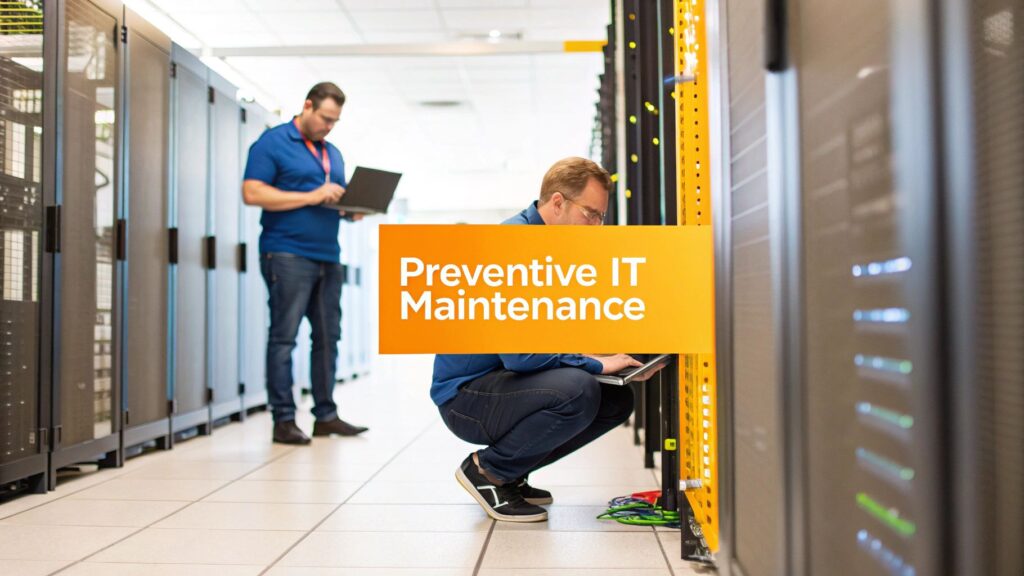
Preventive IT maintenance is not merely about scheduled checks; it is a strategic shift from reactive firefighting to proactive future-proofing. For any facility in Dubai or the UAE, this means moving away from the costly chaos of unexpected failures towards a structured program of planned services on your IT infrastructure to maintain its health and reliability. This proactive approach is essential for controlling costs, extending asset lifecycles, and ensuring business continuity. Shifting From Reactive Fixes to Proactive IT Health For many years, the "break-fix" model was the operational default: a system fails, an emergency repair is requested, and a premium is paid for the urgent fix. For modern facilities across Dubai and the UAE, this is no longer a viable strategy. It creates a cycle of unpredictable downtime and even more unpredictable costs. A structured preventive IT maintenance program reframes upkeep not as an expense, but as an investment in operational stability. For property managers, procurement teams, and engineering leaders, the logic is clear. It replaces sudden, high capital expenditures (CAPEX) for emergency equipment replacement with a steady, predictable operational expenditure (OPEX). This financial control is critical for budgeting and resource allocation in the competitive UAE market. To fully grasp the financial implications, it is useful to compare the two models side-by-side. While a reactive approach may appear less expensive on a monthly basis, the long-term total cost of ownership tells a different story. Preventive vs. Reactive IT Maintenance: A Cost-Benefit Analysis for UAE Facilities This table provides a direct comparison between the two maintenance models, focusing on key decision-making criteria for facility and asset managers in the UAE. Decision Factor Reactive Maintenance (Break-Fix Model) Preventive Maintenance (Scheduled Model) Budgeting Unpredictable. Costs are variable and spike during emergencies, creating CAPEX shocks. Predictable. Fixed monthly or annual costs (OPEX) for simplified budgeting. Downtime High and unplanned. Failures occur at peak operational times, halting business. Minimal and planned. Maintenance is scheduled during off-peak hours (e.g., 2 AM – 5 AM) to avoid disruption. Asset Lifespan Shorter. Constant stress and emergency fixes lead to premature hardware failure (typically 20-30% shorter). Longer. Regular care extends the life of servers, network gear, and UPS systems, maximizing the initial investment. Total Cost Higher over the long term due to premium emergency rates, replacement costs, and operational losses. Lower over the long term (often by 12-18%) by avoiding major failures and extending asset life. Operational Risk High. Constant risk of data loss, security breaches, and business interruption. Low. Proactive patching, backups, and monitoring mitigate risks before they escalate. Tenant/Guest Impact Negative. Unreliable WiFi, BMS failures, and system outages lead to complaints and potential contract terminations. Positive. Consistent uptime and reliable services enhance satisfaction and retention. Ultimately, the break-fix model is a gamble on asset reliability. A preventive model is a calculated strategy that delivers returns through enhanced reliability, efficiency, and financial predictability. Mitigating UAE-Specific Operational Risks The unique environmental conditions in the UAE pose specific threats to IT equipment, which a robust preventive plan must address. These are not minor inconveniences; they can cause catastrophic hardware failure. Extreme Heat: High ambient temperatures place immense stress on cooling systems in server rooms and data closets. If HVAC units, server fans, and ventilation are not performing at 100% capacity, heat-related hardware failure is imminent. Regular maintenance ensures cooling systems are calibrated for Dubai's climate. Dust and Sand: Fine airborne dust infiltrates sensitive equipment, clogging fans, coating components in an insulating layer, and leading directly to overheating. Scheduled, professional cleaning of IT environments and hardware is a non-negotiable risk mitigation task. Humidity Fluctuations: High humidity, particularly in coastal areas, can cause condensation and corrosion on delicate electronic components. Preventive checks verify that environmental controls and dehumidifiers are functioning within specified tolerances (e.g., 40-60% Relative Humidity) before corrosion occurs. A proactive maintenance strategy directly confronts these regional challenges. It transforms environmental vulnerabilities from potential crises into manageable operational tasks, safeguarding critical infrastructure against conditions that can silently degrade performance and shorten asset lifespan. The market is reflecting this shift. The UAE's predictive maintenance market, which encompasses advanced IT solutions, was valued at USD 230.3 million in 2023 and is projected to reach USD 1,435.6 million by 2030. This growth indicates a widespread move away from reactive chaos toward proactive control. To understand the specifics, you can discover more insights about these UAE market trends and their drivers. Embracing preventive IT maintenance is about ensuring operational uptime. For a hotel, it means guest WiFi, booking systems, and access controls are always functional. For a commercial tower, it ensures building management systems (BMS), security cameras, and tenant internet are stable. This proactive stance protects revenue, enhances tenant satisfaction, and solidifies a property's reputation for reliability. Building Your Preventive IT Maintenance Framework A robust preventive IT maintenance program must be built upon a detailed, comprehensive inventory of every critical IT asset within a facility. This is the foundational step; without it, any maintenance plan is based on guesswork. For a commercial tower in Dubai, this involves mapping everything from the servers running the Building Management System (BMS) to the core network switches in the main distribution frame (MDF) room. It includes uninterruptible power supply (UPS) units and the entire CCTV server and storage array. For a hotel, the inventory must include point-of-sale (POS) servers, guest Wi-Fi controllers, and digital signage players. An unlisted asset is a blind spot and a potential point of failure. This process is not merely list-making. True asset management involves creating a single source of truth for the entire IT infrastructure through systematic tagging and documentation. The Importance of Asset Tagging and Documentation Proper asset tagging enables the tracking of each piece of equipment's entire lifecycle. An effective asset tag includes a unique ID, purchase date, and a QR code linking to its digital record. The digital record should contain: Asset Details: Make, model, serial number, and specific configurations. Location: Precise physical location (e.g., "Server Rack 12U, B2 Data Centre"). Maintenance History: A full log of every check, repair,
A Decision-Maker’s Guide to Building Maintenance Companies in Dubai

Selecting a partner from the array of building maintenance companies in Dubai is a strategic decision that directly impacts asset value, operational expenditure (OpEx), and tenant satisfaction. A precise evaluation framework is critical to move beyond procurement-led cost comparisons and into a partnership focused on asset lifecycle management and risk mitigation. This guide provides a vendor-neutral methodology for property managers, facility directors, and asset owners to assess technical capabilities, contractual structures, and performance metrics. The objective is to equip decision-makers with a structured, data-driven approach to selecting a maintenance partner in the UAE's demanding real estate environment. Decoding the Dubai Building Maintenance Landscape In Dubai's high-value real estate market, a maintenance provider acts as a custodian of asset integrity and operational continuity. The selection process must therefore be rigorous, focusing on a company's documented ability to meet the unique operational, climatic, and regulatory demands of the UAE. This framework is designed for B2B decision-makers, providing quantifiable benchmarks to assess a provider's true capabilities and ensure alignment with long-term asset management strategies. Key Evaluation Pillars for Dubai Properties A systematic evaluation process should be structured around core pillars that address the specific challenges of Dubai's built environment, from the high ambient temperatures impacting HVAC systems to the stringent compliance standards set by Dubai Civil Defence and Dubai Municipality. Your assessment framework should focus on: Technical Capability and Scope: Verification of certified, in-house expertise for critical systems (MEP, HVAC, fire safety) versus reliance on subcontractors. The ratio of in-house to outsourced technicians directly impacts quality control and response times. Contractual and Financial Models: Analysis of how different contract types—comprehensive vs. labour-only Annual Maintenance Contracts (AMCs)—affect budget predictability and risk allocation. A comprehensive AMC may present a higher initial cost but typically lowers the Total Cost of Ownership (TCO). Performance Metrics and SLAs: Insistence on contractually guaranteed Service Level Agreements (SLAs) with quantifiable metrics, including response times (e.g., <60 mins for P1 emergencies), first-time fix rates (>85%), and Planned Preventive Maintenance (PPM) completion percentages (>95%). Regulatory and Compliance Adherence: Due diligence on mandatory certifications, including up-to-date trade licenses, Dubai Municipality approvals, and Dubai Civil Defence certifications for relevant technicians and services. A thorough due diligence process focuses less on a provider's marketing claims and more on their documented ability to deliver against quantifiable, asset-specific requirements. The goal is to establish a partnership based on transparent performance, not just a service transaction. By focusing on these pillars, decision-makers can create an objective scorecard to compare potential partners, ensuring the selected firm is equipped to manage the operational intensity of Dubai's commercial, residential, and hospitality assets. Evaluating Technical Capabilities and Service Scopes A provider's technical expertise is the bedrock of service delivery. The evaluation must penetrate beyond surface-level checklists to verify the depth of their capabilities, particularly concerning the specific asset types and systems prevalent in Dubai. The quality of hard Facility Management (FM) execution directly influences asset lifecycle, operational costs, and occupant safety. The UAE's facility management market is projected to grow from approximately USD 18.3 billion to USD 33.6 billion by 2030, with hard FM services like HVAC and MEP constituting a significant 61–62% of revenue. This underscores the criticality of technical proficiency. For more detail, review these UAE facility management sector growth trends on datainsightsmarket.com. Dissecting In-House Expertise vs. Subcontractor Reliance A primary evaluation metric is the provider's operational model: the balance between their in-house technical team and their reliance on third-party subcontractors. This factor has direct implications for accountability, quality consistency, and emergency response mobilisation. A provider with a robust, certified in-house team for core MEP and HVAC disciplines offers superior control and standardised service delivery. Technicians are trained to a single corporate standard and can be dispatched without third-party coordination delays. Conversely, a model heavily reliant on subcontractors can introduce operational variability and communication lags. While it may provide access to niche specialisations, it can compromise response times for critical failures—a significant risk for assets like a commercial tower's chiller plant during Dubai's peak summer months. Core Hard FM Service Evaluation Matrix To standardise the evaluation process, a matrix enables an objective, like-for-like comparison of provider capabilities against your asset's specific requirements. This framework facilitates an evidence-based assessment of building maintenance companies in Dubai. Service Area Key Evaluation Criteria for Dubai Properties Common Scope Inclusions Potential Risks of Underspecified Scope HVAC Systems Experience with high-capacity chillers, FAHU/AHU systems common in the UAE climate. Certifications for specific brands (e.g., Trane, Carrier). Scheduled filter/belt changes, coil cleaning, refrigerant level checks, duct cleaning, thermostat calibration. Increased energy consumption (up to 15-20% higher), poor indoor air quality, premature system failure, non-compliance with Dubai Municipality standards. MEP Services Electrical (DEWA compliance, load balancing), Plumbing (water pump systems, drainage), and Mechanical systems. PPM for water pumps, electrical panel testing, drainage line jetting, emergency lighting checks. Fire hazards from faulty wiring, major water damage from pump failures, business disruption from unexpected power outages. Fire & Life Safety Dubai Civil Defence (DCD) certified technicians. Experience with addressable fire alarm systems and suppression systems (FM-200, sprinklers). Monthly/quarterly testing of fire pumps, alarm panel checks, smoke detector cleaning, emergency exit light function tests. DCD penalties, voided insurance claims, catastrophic failure during a real emergency, significant legal liability. Specialised Systems Expertise in Building Management Systems (BMS), access control, CCTV, and elevator maintenance coordination. BMS alarm monitoring and calibration, software updates, integration checks with other systems. Inefficient building operations, security vulnerabilities, inability to troubleshoot integrated system failures effectively. This matrix serves as a foundational tool for a deeper technical due diligence process. Moving Beyond the Basics to Asset-Specific Needs Technical requirements vary significantly across different property types. A competent provider will demonstrate experience specific to your asset class. Hospitality: Requires immediate response times for guest-facing issues and technicians trained for discreet, 24/7 operations to minimise impact on the guest experience. Commercial Towers: Demands expertise in high-capacity vertical transport, complex HVAC and chiller plant management, and advanced BMS integration for energy efficiency. Residential Communities: Focuses on high-volume service request management, effective tenant
Top Facility Maintenance Companies in Dubai for MEP & HVAC Services
Are soaring utility bills, frequent system breakdowns, and tenant complaints dictating your budget and peace of mind? In Dubai’s challenging climate, expert MEP (Mechanical, Electrical, Plumbing) and HVAC (Heating, Ventilation, Air Conditioning) maintenance isn’t just a luxury—it’s an absolute necessity. These critical building systems are the silent workhorses that keep your property running smoothly and comfortably. For facility managers, building owners, and procurement specialists, selecting the right partner for their upkeep is paramount. A truly professional maintenance company does much more than just fix things when they break. This comprehensive guide will help you understand the crucial role of MEP and HVAC services in Dubai. We will also explore what sets the leading providers apart, and how choosing the right one can safeguard your investment, reduce operational costs, and ensure your property remains a safe and pleasant environment. The Unseen Power: Why MEP & HVAC are the Heartbeat of Your Dubai Property Dubai’s climate presents unique and intense challenges for any building’s operational systems. With scorching summers and high humidity, air conditioning units work tirelessly, often pushing their limits. This constant demand puts immense strain on HVAC components and the broader mechanical and electrical infrastructure. Beyond simply keeping occupants comfortable, MEP systems play a pivotal role in every aspect of a property’s functionality. The electrical system powers everything from lighting to security, while plumbing ensures fresh water supply and efficient waste management. A fault in any one of these can cause significant disruption, safety hazards, and costly damages. Neglecting these systems can lead to a domino effect of problems. Poor maintenance translates into inefficient energy use, leading to higher electricity bills. It also results in premature equipment failure, forcing expensive replacements that could have been avoided. Moreover, it can compromise indoor air quality and create an uncomfortable or even unsafe environment for residents or employees. What Defines a Top Facility Maintenance Company in Dubai for MEP & HVAC? (Your Checklist) When searching for the best facility maintenance companies in Dubai, especially for crucial MEP and HVAC services, it’s vital to look beyond basic offerings. A truly top-tier provider offers a blend of expertise, proactive strategies, and unwavering reliability. Here’s a practical checklist to guide your selection process: Comprehensive Service Scope A leading company should offer a full spectrum of services. This includes all aspects of mechanical electrical plumbing services Dubai. For HVAC, this means everything from routine checks of AC units, ventilation systems, and central chillers, to specialized care for VRF/VRV systems and duct cleaning. On the electrical front, they should manage power distribution, lighting, panels, generators, and UPS systems, along with Extra-Low Voltage (ELV) solutions. Plumbing services should cover water supply, drainage, sewage systems, and water heating. Proactive vs. Reactive Approach (Emphasis on PPMs) The best providers focus on preventing problems before they occur. This means offering robust Planned Preventive Maintenance Programs (PPMs) and comprehensive Annual Maintenance Contracts (AMCs). These programs include scheduled inspections, cleaning, testing, and minor adjustments to keep systems running efficiently. A proactive approach significantly extends asset lifespan and reduces the likelihood of disruptive breakdowns. 24/7 Emergency Response Critical system failures don’t adhere to business hours. A top facility maintenance company in Dubai must provide reliable 24/7 emergency response. This ensures that in the event of a sudden HVAC breakdown or an electrical fault, expert technicians are available round-the clock to minimize downtime and mitigate potential damage. Swift action is paramount in Dubai’s climate. Certified & Highly Skilled Technicians The quality of service is directly linked to the expertise of the technicians. Look for companies whose teams are certified, extensively trained, and possess deep knowledge of various MEP and HVAC systems. Continuous professional development ensures they are up-to-date with the latest technologies and best practices in HVAC system repair & installation UAE. Transparency & Reporting Transparency is key to a trusting partnership. A reputable provider will offer clear service agreements, detailed maintenance reports, and efficient asset tracking. You should have a clear understanding of what services are being performed, when, and the condition of your assets. This accountability helps you monitor performance and plan future investments. Technology Integration Modern facility maintenance leverages technology for greater efficiency. Companies utilizing Computer-Aided Facility Management (CAFM) or Computerized Maintenance Management Systems (CMMS) can streamline operations, schedule tasks, and track maintenance history effectively. The use of IoT devices for predictive maintenance and smart building solutions further enhances operational efficiency and helps in timely interventions. Adherence to Safety & Compliance Ensuring that all maintenance activities comply with Dubai Municipality regulations and international safety standards is non-negotiable. A responsible company prioritizes safety for both its staff and your property’s occupants. They will have all necessary permits and adhere to rigorous safety protocols for all tasks, from electrical work to cooling tower maintenance. Navigating the Landscape: Key Offerings from Leading Companies When assessing leading facility maintenance companies in Dubai, you’ll find that many reputable firms offer a similar core set of valuable services. These offerings are designed to provide comprehensive care for your property’s essential infrastructure, ensuring both efficiency and longevity. Understanding these key provisions can help you compare and select the ideal partner. Many top providers offer integrated hard FM solutions. This means bundling essential services like MEP, HVAC, civil maintenance, and fire & life safety into a single, cohesive package. This approach simplifies management for facility managers and ensures better coordination across different technical aspects of the building. It often leads to greater overall efficiency and accountability. Customized Annual Maintenance Contracts (AMCs) are a staple offering. These contracts are tailored to meet the specific requirements of different property types, from residential towers to commercial complexes and industrial facilities. A good AMC includes clearly defined Service Level Agreements (SLAs) for emergency response, routine checks, and detailed reporting, providing peace of mind and predictable budgeting. Another crucial service is energy audit and optimization. With the high energy demands in Dubai, optimizing HVAC and electrical systems can lead to significant cost savings. Leading companies provide detailed audits to identify areas of inefficiency and implement
A Guide to Selecting MEP Contractors in Dubai for Facility Managers
In Dubai's high-stakes real estate market, a building's Mechanical, Electrical, and Plumbing (MEP) systems are its operational core. These systems are the unseen infrastructure ensuring climate control, power, and safety. Consequently, selecting the right mep contractors in dubai is not a simple procurement task—it is a critical business decision that directly impacts operational success, regulatory compliance, and long-term asset value. Why Strategic Vetting of MEP Contractors Is Non-Negotiable For facility managers and asset owners in Dubai, the traditional "break-fix" approach to MEP maintenance is no longer viable. An MEP service provider must function as a strategic partner, not merely a reactive service. They are on the front line of managing operational expenditure (OPEX) and ensuring asset integrity in a climate where high-performance systems, particularly Heating, Ventilation, and Air Conditioning (HVAC), are essential. The city's rapid development has cultivated a crowded and competitive market. The real estate expansion between 2010 and 2020 directly fueled a significant increase in MEP services. To provide context, the broader U.A.E. MEP sector was valued at approximately USD 3.03 billion in 2020 with projections for continued growth. A substantial portion of this expenditure is concentrated in Dubai, where air conditioning can account for 40–60% of a building’s total energy consumption. This places immense pressure on contractors to deliver systems that are both reliable and highly efficient. You can review this market forecast on psmarketresearch.com. The Shift from Reactive to Proactive Maintenance A purely reactive maintenance strategy—waiting for equipment failure before initiating a service call—exposes an asset to significant risks: Unplanned Downtime: System failures can disrupt business operations, negatively impact tenant satisfaction, and lead to direct revenue loss. Higher Lifecycle Costs: Emergency repairs are invariably more expensive than planned maintenance and often accelerate equipment degradation, leading to premature capital replacement. Compliance Breaches: Neglected systems can fail to meet the stringent standards set by regulatory bodies such as the Dubai Municipality or Dubai Civil Defence. A structured vetting process is the foundation for a successful partnership. It ensures your chosen contractor has the verified technical expertise, financial stability, and quality management systems required to protect and enhance your facility's core infrastructure. This guide provides a clear framework for evaluating MEP contractors in Dubai, focusing on building resilient, compliant, and cost-effective operations through informed, evidence-based decision-making. Mastering Dubai's MEP Regulatory Framework Engaging MEP contractors in Dubai requires more than an assessment of technical skill; it necessitates partnering with a provider proficient in navigating the complex local regulatory landscape where compliance is the absolute foundation of any project. Failure to adhere to these regulations can result in significant project delays, failed inspections, financial penalties, and serious legal liabilities. A competent partner must possess an in-depth, operational understanding of this framework. The process involves managing approvals and documentation across several governing bodies. A contractor's inability to do so exposes the asset and its owner to immediate and substantial risk. Key Authorities and Their Mandates Three primary authorities regulate MEP work in Dubai, each with a distinct jurisdiction. Understanding their respective roles is the first step in ensuring your contractor is qualified for the task. Dubai Electricity and Water Authority (DEWA): DEWA governs all matters related to electricity and water infrastructure. It enforces strict standards for electrical load calculations, wiring specifications, and water connections to ensure the safety, efficiency, and stability of the city's grid. Any new electrical fit-out or significant plumbing modification requires DEWA approval. Dubai Municipality (DM): The DM is the authority for building codes, covering aspects from structural integrity to public health and safety. Its regulations directly influence MEP design, particularly for drainage, sanitation, and ventilation systems. Dubai Civil Defense (DCD): The DCD's mandate is focused on fire and life safety. It enforces codes and standards for fire alarms, smoke control systems, sprinkler installations, and emergency lighting. Compliance with DCD regulations is a non-negotiable component of any MEP project. Engaging a contractor without verified approvals from these bodies constitutes a significant liability. The choice is not merely a procurement decision but an assumption of risk. Non-compliant work may require complete removal and re-installation at the asset owner's expense. The Importance of Certified Compliance Regulatory standards are subject to continuous updates. Authorities like DEWA scrutinise electrical drawings meticulously, while the DCD enforces its fire safety codes with zero tolerance. This environment necessitates the engagement of certified, locally-approved mep contractors in dubai to avoid project stalls or the withholding of a building completion certificate. A contractor's value is demonstrated by their ability to navigate this system efficiently. Their expertise in securing permits, scheduling inspections, and delivering compliant work is as critical as the physical installation itself. For facility and property managers, securing this compliance through a structured Annual Maintenance Contract (AMC) is a fundamental risk-management strategy. An Essential MEP Contractor Vetting Checklist Selecting an MEP contractor in Dubai is a high-stakes decision that directly influences a building's performance, safety, and operational budget for years. A thorough vetting process must extend beyond proposals and presentations to an examination of verifiable evidence of capability, compliance, and commitment to quality. This structured evaluation protects an asset from the significant risks associated with underqualified or non-compliant providers and ensures the selected partner can meet Dubai's demanding operational standards. Foundational Compliance and Licensing The initial step in the vetting process involves confirming the contractor's legal and regulatory standing. These foundational requirements are non-negotiable and serve as a critical gatekeeping exercise. Before proceeding, verify the following documentation: Valid Trade Licence: The contractor must possess a current trade licence from the Dubai Department of Economy and Tourism (DET) that specifically covers MEP contracting activities. Authority Approvals: Confirm that the contractor holds necessary certifications from key regulatory bodies, including being a DEWA-approved contractor for electrical works and holding current certifications from Dubai Civil Defence (DCD) for all fire and life safety systems. Adequate Insurance Coverage: Request and review certificates of insurance, particularly for Public Liability and Workmen’s Compensation, to mitigate your organization's risk exposure. This diagram illustrates the hierarchy of regulatory bodies that compliant mep contractors in dubai